
CBD: does it help in treating depression?
Does CBD help with depression? We check what clinical and preclinical studies say, what the doses are, interactions with SSRIs, and where scientific evidence ends.
Depression affects approximately 332 million people according to the World Health Organization, and in Poland, the National Health Fund estimates the number of patients at 1.285 million. The question about cannabidiol arises in this context more frequently, as you can buy oil over the counter, while waiting for a visit to a psychiatrist takes months. The answer is shorter than most guides promise: there are simply no large randomized studies on CBD in clinical depression. There are studies on mechanisms in rodents, there are clinical trials in anxiety disorders, and there are case series without a control group. Below we show what exactly has been studied, on how many people, and with what results, where evidence ends and hope begins, and when reaching for a supplement instead of help is simply dangerous.
KEY INFORMATION
- WHO estimates the number of people with depression at around 332 million, while the NFZ estimates the number of patients in Poland at 1.285 million.
- There are no large randomized studies on CBD in clinical depression; evidence pertains to anxiety and animal models.
- Nearly half of those using CBD report side effects, dose-dependent (Brown and Winterstein, 2019).
- CBD inhibits CYP3A4 and CYP2C19, so combining it with psychotropic medications requires a doctor’s decision.
- In cases of suicidal thoughts or psychotic symptoms, no supplement replaces help: 116 123, 800 70 2222, or 112.
How big is the problem of depression in Poland and how is it treated today?
The scale is large and growing. The National Health Fund estimates the number of people with depression in Poland at around 1.285 million, and in 2024, 878.3 thousand patients received benefits with a diagnosis of depression as the main or coexisting condition (NFZ on health. Depression, report from 2025).
The same report shows how pharmacological treatment has changed. In 2024, 1.9 million people purchased reimbursed antidepressants, which is 97 percent more than in 2013, and the value of their reimbursement amounted to 290.2 million PLN. The number of medical leave due to major depression reached 418 thousand in the same year.
Depression is not a single disease, which explains part of the uneven treatment outcomes. A meta-analysis by Goldsmith et al. compared cytokine levels in the blood in schizophrenia, bipolar affective disorder, and depression. In patients in the acute phase of the disease, interleukin 6, tumor necrosis factor alpha, soluble interleukin 2 receptor, and interleukin 1 receptor antagonist were elevated, and after treatment of the episode, interleukin 6 levels decreased (Goldsmith et al., Mol Psychiatry, 2016). In some patients, the inflammatory picture co-contributes to the disease, while in others, it does not.
Do medications work? Yes, although less effectively than common perception suggests. A network meta-analysis by Cipriani et al. included 522 studies involving 116,477 people and showed that all 21 compared antidepressants are more effective than placebo, with odds ratios ranging from 1.37 for reboxetine to 2.13 for amitriptyline (Cipriani et al., Lancet, 2018).
The authors added a caveat that is often lost in summaries. Of the 522 included studies, 73 percent had a moderate risk of bias, and 9 percent had a high risk, and the certainty of evidence was rated as moderate to very low. This does not undermine the effectiveness of medications but explains why some patients do not find themselves in the statistics and seek something additional.
A separate reason for such searches is the side effects that patients are reluctant to discuss. A literature review dedicated to sexual dysfunctions with SSRIs identifies paroxetine as the drug with the highest rate of such symptoms and lists alternatives considered in this situation, including bupropion and mirtazapine (Jing and Straw-Wilson, Ment Health Clin, 2016). More about combining cannabis with pharmacotherapy is discussed in our article on whether antidepressants can be combined with CBD.
What does CBD do in the brain according to animal studies?
The strongest data concern three mechanisms: the serotonin receptor 5-HT1A, neurogenesis in the hippocampus, and the endocannabinoid system. The review by García-Gutiérrez et al. links the anxiolytic, antidepressant, and antipsychotic effects of CBD specifically to cannabinoid receptors, the 5-HT1A receptor, and neurogenesis factors (García-Gutiérrez et al., Biomolecules, 2020).
This same review sets a condition that is often overlooked in popular summaries. The effect in rodents depends on the dose, the strain of the animals, whether the administration was single or chronic, and the route of administration. Therefore, there is no single “action of CBD”; it is a collection of results obtained under very different conditions, and the authors conclude with a call for large-scale studies.
Neurogenesis is best described by the work of Campos et al. Mice were subjected to fourteen days of unpredictable chronic stress and were given CBD at a dose of 30 mg/kg. In wild-type animals, there was an increase in progenitor cell proliferation and neurogenesis in the hippocampus, and the anxiolytic effect disappeared in transgenic mice, in which neurogenesis was blocked. Administration of a CB1 receptor antagonist also abolished this effect, and the level of anandamide in the hippocampus increased (Campos et al., Int J Neuropsychopharmacol, 2013).
The third pillar is synaptogenesis. Sales et al. demonstrated in rodents that a single dose of CBD in the range of 7-30 mg/kg produces an antidepressant effect visible after 30 minutes and lasting for seven days, accompanied by an increase in synaptophysin, PSD95 protein, and BDNF in the prefrontal cortex and hippocampus. Blocking the BDNF-TrkB pathway abolished the behavioral effect (Sales et al., Mol Neurobiol, 2019).
It is worth immediately stating what these three studies do not show. All three describe rodents, and the doses were administered intraperitoneally, not orally. Translating milligrams per kilogram of body weight in mice to drops of oil in humans is not a simple multiplication, and none of these studies propose such a conversion.
Are there clinical studies of CBD in humans?
Yes, but almost exclusively in anxiety, not in depression. No direct randomized studies of cannabidiol in a depressive episode with an appropriate sample size have been published. This statement is more important than the rest of this section and cannot be circumvented with a more cautious formulation.
The most frequently cited work is by Bergamaschi et al. It involved 24 previously untreated patients with social phobia who were given a single dose of 600 mg of CBD or placebo before a simulated public speaking event. CBD significantly reduced anxiety, cognitive impairment, and discomfort during speech (Bergamaschi et al., Neuropsychopharmacology, 2011). We have described this work more broadly in our entry on CBD in social phobia.
Brain imaging comes from the work of Crippa et al., in which ten patients were examined using SPECT, not functional MRI. After a single dose of 400 mg of CBD, the subjective level of anxiety decreased, and tracer uptake decreased in the left parahippocampal gyrus, hippocampus, and inferior temporal gyrus, while it increased in the right posterior cingulate gyrus (Crippa et al., J Psychopharmacol, 2011).
| Study | Who and how many people | Dose | Result |
|---|---|---|---|
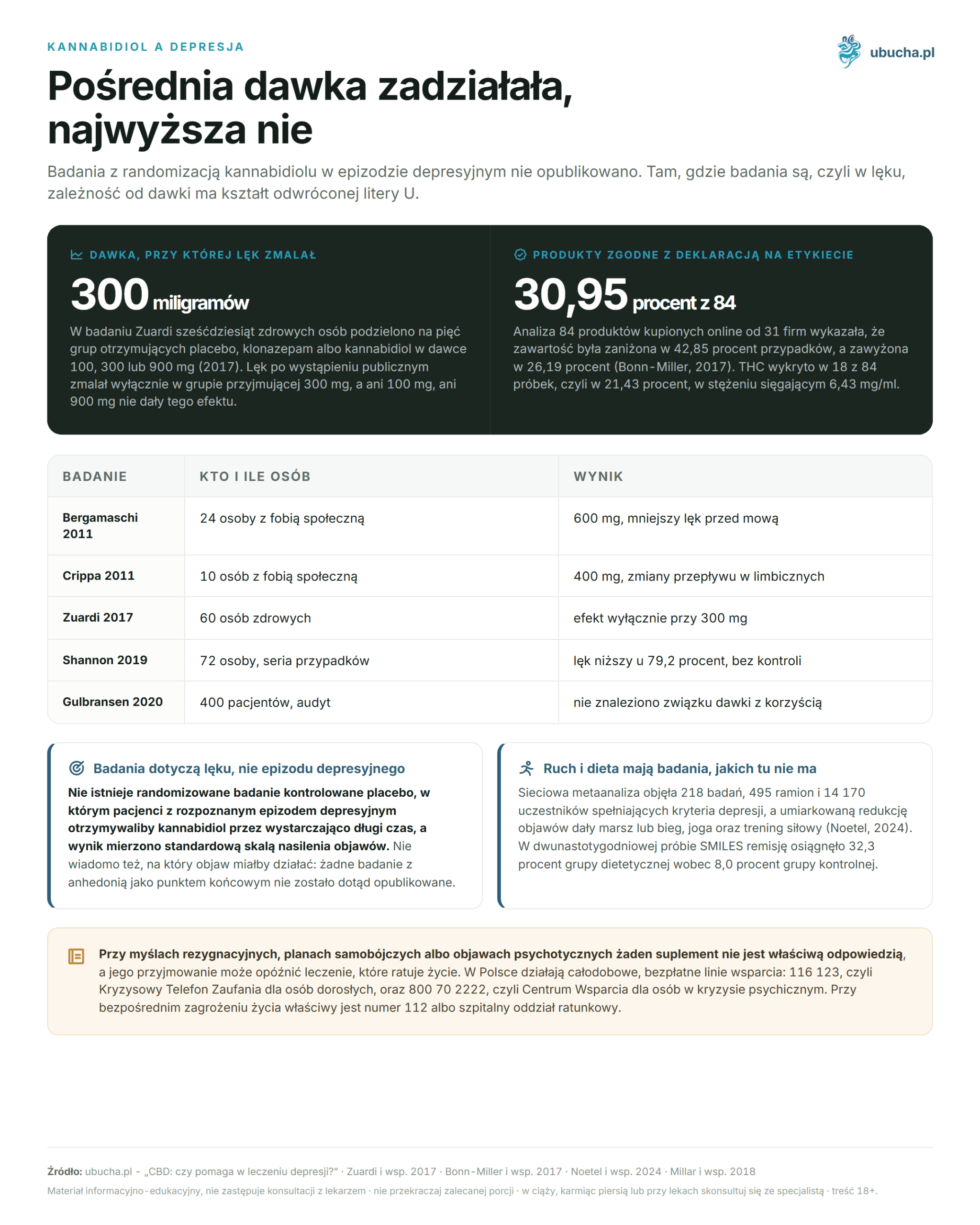
| Bergamaschi 2011 | 24 people with social phobia | 600 mg once | less anxiety before speaking |
| Crippa 2011 | 10 people with social phobia | 400 mg once | changes in flow in limbic structures |
| Zuardi 2017 | 60 healthy people | 100, 300, or 900 mg | effect only at 300 mg |
| Shannon 2019 | 72 people, case series | clinical doses | lower anxiety in 79.2 percent |
| Gulbransen 2020 | 400 patients, audit | doses chosen by the patient | quality of life increased by 13.6 points |
The last two entries require commentary, as they are most often overinterpreted. The work by Shannon et al. is a retrospective analysis of psychiatric clinic documentation, without a control group: anxiety decreased in the first month in 57 out of 72 people, or 79.2 percent, and sleep quality improved in 66.7 percent, while sleep results varied over time (Shannon et al., Perm J, 2019). The audit by Gulbransen et al. included 400 patients, of whom 253 completed the observation, and the average increase in health status on the EQ-VAS scale was 13.6 points after three weeks. The authors note that they found no relationship between the dose of CBD and the reported benefit (Gulbransen et al., BJGP Open, 2020).
What dose of CBD is described in studies?
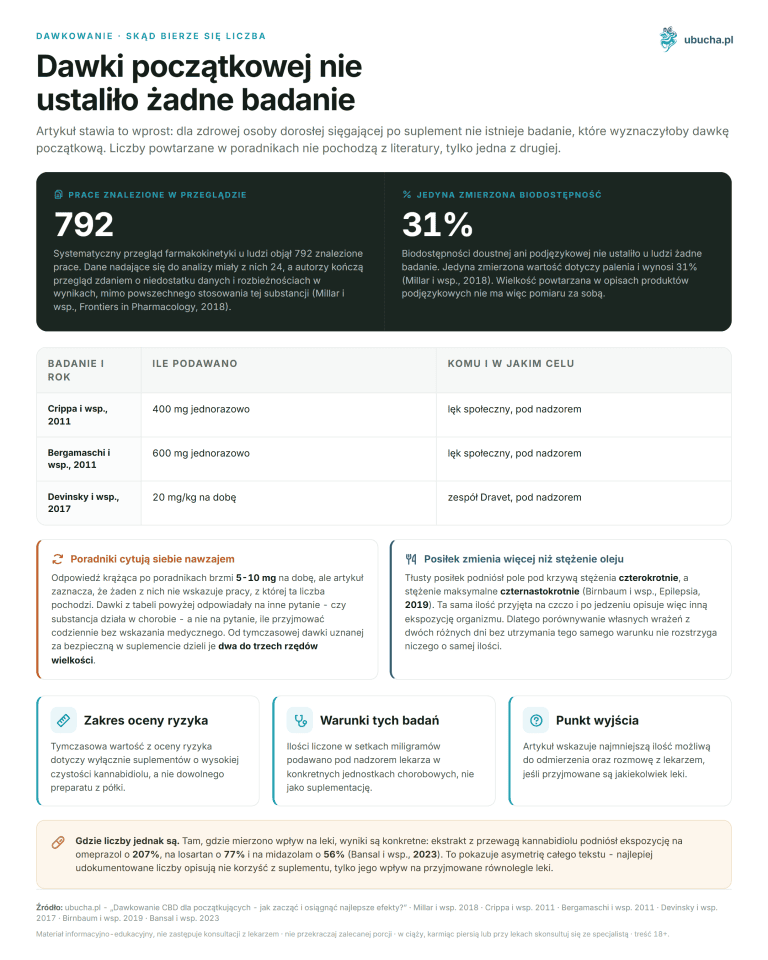
There is no established dose for depression because no studies have been conducted to determine it. In studies on anxiety, single doses ranged from 100 to 900 mg, and case series describe doses individually chosen by the patient. Any number given as a “dose for depression” is therefore an extrapolation, not a recommendation from a study.
The dose-effect relationship is not linear. In the study by Zuardi et al., sixty healthy individuals were divided into five groups receiving placebo, clonazepam, or CBD at doses of 100, 300, or 900 mg. Anxiety after public speaking decreased only in the group taking 300 mg, while neither 100 mg nor 900 mg produced this effect (Zuardi et al., Front Pharmacol, 2017). More does not mean better here.
A separate problem is how much CBD from the oil actually reaches the bloodstream. A systematic review of pharmacokinetics included 24 studies involving humans and showed that absolute bioavailability was measured only after smoking, where it was 31 percent. For oral and sublingual routes, such measurements have simply not been performed (Millar et al., Front Pharmacol, 2018).
This same review provides figures worth knowing when planning the timing of administration. Maximum concentration is reached between zero and four hours after administration, the half-life after aerosol administration in the oral mucosa ranges from 1.4 to 10.9 hours, and after chronic oral administration, it extends to two to five days. A meal and the fatty form increase the maximum concentration.
The practical conclusion is modest but honest. Since no one has measured oral bioavailability, the number of milligrams on the label does not directly indicate how much substance will act. Therefore, descriptions like “40 mg per day treats depression” have no basis in pharmacokinetics or clinical studies.
Can CBD be combined with antidepressants?
Only after discussing it with the attending physician. Cannabidiol affects the enzymes CYP3A4 and CYP2C19 and P-glycoprotein, which are the same pathways through which a significant portion of psychotropic medications are metabolized and excreted. The potential for interaction with commonly used medications is therefore high (Brown and Winterstein, J Clin Med, 2019).
This same review provides a number that CBD guides most often omit. Side effects occurred in nearly half of the people using cannabidiol and showed a dose-dependent relationship. The most common included increased aminotransferase activity, drowsiness, sleep disturbances, infections, and anemia. The authors recommend considering lowering the doses of medications that are substrates for these enzymes and monitoring the patient.
The picture from studies on safety itself is somewhat milder, but not zero. The review by Iffland and Grotenhermen confirms the favorable safety profile of CBD compared to medications used for the same indications, listing fatigue and diarrhea among the most common symptoms, as well as changes in appetite and body weight. The authors note that there is a lack of studies on the effect of CBD on hormones and on long-term chronic administration (Iffland and Grotenhermen, Cannabis Cannabinoid Res, 2017).
Practically, this means three things. First, inform your doctor and pharmacist about taking CBD just as you would inform them about a prescription medication. Second, particular caution is required with warfarin, clobazam, and immunosuppressive medications. Third, do not discontinue an antidepressant on your own, hoping that the oil will replace it.
Discontinuation is, in fact, a separate topic, in which the data can be surprising. A systematic review by Davies and Read gathered 24 studies and found that withdrawal symptoms from antidepressants occur in 27 to 86 percent of individuals, with a weighted average of 56 percent, and among them, 46 percent report the highest available severity of symptoms (Davies and Read, Addict Behav, 2019). There are no studies that have examined CBD as support in this process.
Who should not use CBD and when to seek help?
Pure cannabidiol does not exhibit potential for abuse or addiction, which the WHO Expert Committee stated, recommending that pure CBD not be subject to international drug control (WHO, 2018). However, this does not mean it is neutral for everyone.
Caution is required for four groups. Individuals with liver diseases, as increased aminotransferase activity is documented as a side effect. Individuals taking medications with a narrow therapeutic index, including warfarin and clobazam. Pregnant and breastfeeding women, for whom safety data is lacking. Finally, individuals with bipolar affective disorder, where the reaction to cannabinoids can be unpredictable.
Severe depression stands apart. If there are thoughts of resignation, suicidal plans, psychotic symptoms, or a rapid deterioration in condition, no supplement is the right answer, and its use may delay treatment that saves lives. The WHO estimates that in 2021, 727,000 people worldwide died by suicide, and among individuals aged 15 to 29, it is the third leading cause of death (WHO, 2025).
In such situations, free 24-hour support lines operate in Poland: 116 123, which is the Crisis Trust Phone for adults, and 800 70 2222, which is the Support Center for individuals in mental crisis. In cases of immediate life-threatening danger, call 112 or go to the hospital emergency department. Talking to another person is more effective here than any preparation described in this article.
If you still decide to use the oil, keep it in the same place where you keep your list of medications. The pharmacist filling the prescription has no chance of catching an interaction they are unaware of, and a product purchased over the counter rarely comes up in the pharmacy interview. The start date, dose, and form are sufficient for the doctor to link any change in well-being or test results to the appropriate cause.
Also, pay attention to signals that push the matter beyond the realm of self-help: insomnia lasting for weeks, rapid weight loss, euphoria with a lack of need for sleep, and impulsive financial decisions. The last set suggests a manic episode, not depression, and requires a different diagnosis and treatment.
How to check if CBD oil is what the label claims?
One must assume that the label may be false and request a test result. An analysis of 84 CBD products purchased online from 31 companies found that only 30.95 percent had content consistent with the declaration. It was underestimated in 42.85 percent of cases and overestimated in 26.19 percent (Bonn-Miller et al., JAMA, 2017).
The same study detected THC in 18 of 84 samples, or 21.43 percent, at concentrations reaching 6.43 mg/ml. For a person who consciously chose a THC-free product, for example, due to a driver’s test or a previous anxiety reaction, this is information about a completely different product than ordered.
| What to look for | What should be on the document |
|---|---|
| Certificate of analysis | laboratory name, date of testing, product batch number |
| Cannabinoid content | result for CBD and separately for THC, expressed numerically |
| Purity | heavy metals, pesticides, solvent residues |
| Batch consistency | batch number from the certificate matches the number on the packaging |
The variability in content has two practical consequences. The first concerns dosing itself: if one bottle contains half as much substance as on the label, and another contains a quarter more, observing your own reaction over several weeks loses meaning, as the variable is not constant. The second concerns THC. Detecting it in one in five samples means that a person driving professionally or undergoing control tests may have a problem they did not order.
A certificate without a batch number is worth little, as it cannot be linked to the bottle you are holding. Similarly, a document issued by a laboratory belonging to the manufacturer has less evidential value than an externally commissioned study. An extremely low price usually means that one of these tests was simply not performed.
For the record, we provide a range without specifying a particular product: in the oils category in the store at Bucha, 10 ml bottles cost from 65 to 240 PLN, depending on the concentration (catalog status as of August 10, 2026). Prices in stores change faster than articles, so treat this range as a reference point, not as a price list.
What has stronger evidence than CBD in depression?
Movement and diet, both of which have studies that CBD does not. A network meta-analysis by Noetel et al. included 218 studies, 495 arms, and 14,170 participants meeting the criteria for depression. Compared to control groups, moderate reductions in symptoms were achieved through walking or running, yoga, and strength training (Noetel et al., BMJ, 2024).
It is worth seeing the effect sizes side by side, as the differences between forms of activity are smaller than headlines suggest. The authors also noted that the effect increased with the recommended intensity, and yoga and strength training were the best tolerated. A caveat is important: only one study met the criteria for low risk of bias, so the certainty of evidence was rated as low for walking and very low for other forms.
| Form of activity | Effect size (g) |
|---|---|
| walking or running | -0.62 |
| yoga | -0.55 |
| strength training | -0.49 |
| mixed aerobic training | -0.43 |
| tai chi or qigong | -0.42 |
Diet has one randomized study, but with a clear result. In a twelve-week SMILES trial, sixty-seven individuals with moderate to severe depression were assigned to dietary support or social support. Remission was achieved by 32.3 percent of the dietary group compared to 8.0 percent in the control group, with a number needed to treat of 4.1 (Jacka et al., BMC Med, 2017).
Among supplements, ashwagandha is most often mentioned, but caution is warranted here as well. A systematic review by Pratte et al. found five studies involving humans, all of which performed better than placebo on anxiety and stress scales, but all had unclear or high risk of bias, and the diversity of methods prevented a meta-analysis (Pratte et al., J Altern Complement Med, 2014). A separate and better-documented path in treatment-resistant depression remains treatment conducted by a psychiatrist, which we discuss in our article on ketamine and esketamine in depression therapy.
What do we still not know about CBD in depression?
We do not know if it works. This statement sounds harsh, but it is simply a description of the state of the literature: there is no randomized controlled placebo study in which patients with a diagnosed episode of depression would receive CBD for a sufficiently long time, and the outcome was measured using a standard symptom severity scale.
We also do not know which symptom it would act on. The most frequently mentioned is anhedonia, or the loss of the ability to feel pleasure, which Pizzagalli describes as an endophenotype of depression arising from disturbed relationships between stress and the reward system (Pizzagalli, Annu Rev Clin Psychol, 2014). This is a sensible target for research, but no study of CBD with anhedonia as an endpoint has been published to date, so the repeated statement in guides about restoring reward sensitivity in humans has no basis.
We also do not know what dose should be studied. Data from anxiety indicate a dose-response relationship shaped like an inverted U, where an intermediate dose works better than a higher one, and oral pharmacokinetics remain unmeasured. These are two independent reasons why transferring milligram numbers from one indication to another is guesswork.
Finally, we do not know what happens with chronic use. Safety studies cover weeks and months, not years, and directly indicate gaps in knowledge about the effect of CBD on hormonal balance. For a supplement taken daily by someone undergoing psychiatric treatment, this is a gap of practical, not academic significance.
What does this mean for a person considering oil? It means that it makes sense to treat it as a potential addition to treatment conducted by a specialist, reported to the doctor just like any other preparation, and not as a substitute for therapy. The cannabis context is discussed more broadly in our entry on how cannabis can support depression treatment.
Frequently asked questions
Does CBD help with depression?
It is unknown. No randomized controlled placebo study has been published that tests CBD in patients with a diagnosed episode of depression. Evidence pertains to anxiety disorders and mechanisms in rodents, and the review by García-Gutiérrez et al. from 2020 concludes with a call for large-scale studies.
What dose of CBD is studied in anxiety disorders?
In studies, single doses ranged from 100 to 900 mg. In the work by Zuardi et al. from 2017, anxiety decreased only at 300 mg, while doses of 100 mg and 900 mg had no effect. There is no established dose for depression because no studies have been conducted to determine it.
Can CBD be combined with SSRI medications?
Only after consulting with the attending physician. CBD interacts with the enzymes CYP3A4 and CYP2C19 and with P-glycoprotein, so the potential for interaction with psychotropic medications is high (Brown and Winterstein, 2019). Never discontinue an antidepressant on your own, hoping to replace it with oil.
Does CBD cause side effects?
Yes, in nearly half of the people using cannabidiol, with a clear dose-dependent relationship. The most common include increased aminotransferase activity, drowsiness, sleep disturbances, infections, and anemia (Brown and Winterstein, 2019). Safety reviews also mention fatigue, diarrhea, and changes in appetite and body weight.
Is CBD addictive?
The WHO Expert Committee concluded that pure cannabidiol has no psychoactive properties and does not create a potential for abuse or addiction, therefore recommending that it not be included in international drug control. However, the lack of addiction potential does not mean there are no interactions with medications.
How much CBD from the oil reaches the bloodstream?
This has not been measured. A systematic review of pharmacokinetics included 24 studies in humans and found that absolute bioavailability was established only after smoking, where it was 31 percent (Millar et al., 2018). Maximum concentration after administration is reached between zero and four hours.
What has stronger evidence than CBD in depression?
Physical activity and dietary changes. A meta-analysis of 218 studies involving 14,170 participants showed a moderate reduction in symptoms with walking, yoga, and strength training (Noetel et al., 2024). In the SMILES trial, remission was achieved by 32.3 percent of the dietary group compared to 8.0 percent of the control group.
This article is for informational and educational purposes and does not constitute medical advice. Before starting to use cannabis or CBD for therapeutic purposes, consult your doctor, especially if you are taking other medications, are pregnant, or breastfeeding.
Author: Michał Waluk · Published: 2026-04-27 · Updated: 2026-08-10