
Hemp in Cosmetics 2026: Trends, Ingredients, Regulations (Overview)
What do studies really confirm about CBD and hemp seed oil in skincare, how to read the composition of a hemp cosmetic, and what regulations apply in Poland.
Hemp cosmetics today sit side by side on the same shelf in two completely different roles. Some are based on seed oil, which is a regular plant fat with a good fatty acid profile. Others contain cannabidiol, a substance with documented effects on skin cells. Manufacturers describe both groups with the same word “hemp,” and the difference can be worth several dozen zlotys. This overview separates what is confirmed by peer-reviewed studies from what is purely advertising language. You will check which cannabinoid corresponds to your skin type, as the data for CBD and CBG diverge in opposite directions. You will also find a practical way to read the composition and the current legal status, as cosmetics in Poland are subject to different regulations than dried flowers or edible oils.
KEY INFORMATION
• The skin has its own endocannabinoid system with CB1 and CB2 receptors in keratinocytes, sebaceous glands, and hair follicles (Bíró et al., 2009, PMC2757311).
• CBD inhibits lipogenesis in human sebocytes and has anti-inflammatory effects, which has been confirmed in cell cultures (Oláh et al., 2014, PMID 25061872).
• CBG acts oppositely to CBD: it increases lipid synthesis in sebocytes, so it is suitable for dry skin, not oily (Oláh et al., 2016, PMID 27094344).
• There are still few clinical studies on CBD on the skin, and the main obstacle remains the penetration of substances through the epidermis (Kuzumi et al., 2024, PMC11511700).
• Cosmetics in Poland are supervised by the State Sanitary Inspection and the Trade Inspection based on the Act of October 4, 2018, on cosmetic products.
Why does the skin react to cannabinoids at all?
The skin has its own endocannabinoid system: a complete set of CB1 and CB2 receptors along with locally produced ligands. A review by Bíró et al. in 2009 described that this system regulates the proliferation of keratinocytes, sebum secretion, hair growth, and the inflammatory response. This is the biological basis for the action of cannabinoids applied topically.
The receptors are not randomly distributed in the skin. Bíró and the team described their presence in epidermal keratinocytes, in sebaceous glands, in hair follicles, in skin immune cells, and in sensory nerve endings. Each of these locations is responsible for a different aspect of the epidermal barrier’s function, which is why one ingredient can influence several processes at once.
The practical conclusion is that a cannabinoid applied to the skin does not need to travel anywhere to act. The target lies directly beneath the application site. This distinguishes skincare from oral supplementation and explains why studies on topical CBD are conducted on cultures of human skin cells rather than on volunteers swallowing capsules.
A separate question concerns safety. CBD has a low affinity for the CB1 receptor, which is responsible for the psychoactive effects of THC. The WHO Expert Committee in a review from 2018 stated that pure cannabidiol does not exhibit psychoactive properties and does not create a potential for abuse or addiction, and recommended that it not be included in international control. In cosmetics, there is a second barrier: topical application does not lead to significant systemic absorption.
What hemp ingredients are found in cosmetics?
In cosmetics, you will encounter four groups of hemp ingredients with completely different profiles. They are distinguished by their INCI composition, as they come from different parts of the plant. Hemp seed oil does not contain cannabinoids at all, while flower extract contains them as the active substance.
| Ingredient in INCI | Source | What studies confirm |
|---|---|---|
| Cannabis sativa seed oil | pressed from seeds, without cannabinoids | rich in linoleic, alpha-linolenic, and gamma-linolenic acids; improved dryness and itching of atopic skin in the diet (Callaway et al., 2005, PMID 16019622) |
| Cannabidiol / Cannabis sativa flower extract | extract from flowers and leaves | inhibits lipogenesis and inflammation in human sebocytes (Oláh et al., 2014, PMID 25061872) |
| Cannabigerol (CBG) | extract from flowers, trace amounts | increases basal lipid synthesis in sebocytes, thus considered for dry skin (Oláh et al., 2016, PMID 27094344) |
| Terpenes, including beta-caryophyllene | volatile fraction of the plant | beta-caryophyllene is a selective CB2 receptor agonist and is also found in many spices (Gertsch et al., 2008, PMID 18574142) |
The biggest misunderstanding concerns the first row. Hemp seed oil is sometimes sold under the slogan “with CBD,” although it contains no cannabinoids, as they accumulate in flower clusters, not in seeds. Its value is real, just of a different kind: it is a good emollient providing essential fatty acids.
It is also worth noting what the evidence for the oil itself is based on. The work by Callaway et al. in 2005 was a randomized study in which hemp oil was consumed for twenty weeks, comparing it to olive oil. Dryness and itching of the skin improved, and water loss through the epidermis decreased. This is an argument for the fatty acid profile of this oil, not evidence of the effectiveness of a cream with its addition. You can find more about individual forms in the overview of hemp creams, serums, and balms.
What does topical CBD really do to the skin?
The best-documented effect of CBD on the skin concerns sebaceous glands. Oláh et al. demonstrated in 2014 in cultures of human sebocytes and in organ culture of skin that cannabidiol behaves as a strong sebostatic agent: it inhibits lipogenesis induced by arachidonic acid and the combination of linoleic acid with testosterone.
The mechanism described in this work is complex. Inhibition of sebocyte proliferation occurs through TRPV4 ion channels, which translates to the ERK1/2 pathway and reduces the NRIP1 protein affecting lipid metabolism. Separately, CBD acted anti-inflammatory, through the adenosine A2a receptor and inhibition of the NF-kB pathway. The authors summarized that the combination of lipostatic, antiproliferative, and anti-inflammatory actions makes CBD a promising agent for acne vulgaris. The topic is further developed in a separate entry about whether hemp oil helps with acne.
Evidence involving humans is much more modest and should be described cautiously. Palmieri et al. (2019, PMID 30993303) administered CBD ointment to twenty patients: five with psoriasis, five with atopic dermatitis, and ten with post-inflammatory scars. The ointment was applied twice daily for three months. An improvement in skin hydration, elasticity, and PASI score was noted, without irritating reactions. However, the authors themselves describe their study as spontaneous and retrospective, of a case study nature, without a control group or blinding. This is an encouraging signal, not evidence of effectiveness.
Similarly, data on antioxidant effects should be read cautiously. Hampson et al. (1998, PMC20965) demonstrated that cannabidiol protected against glutamate toxicity better than ascorbate and alpha-tocopherol. However, the study was conducted on cultures of rat cortical neurons in the context of neuroprotection. Transferring this result directly to the skin and comparing CBD with vitamin C in a cream goes beyond what the work states.
Does the cannabinoid from the cream penetrate the skin?
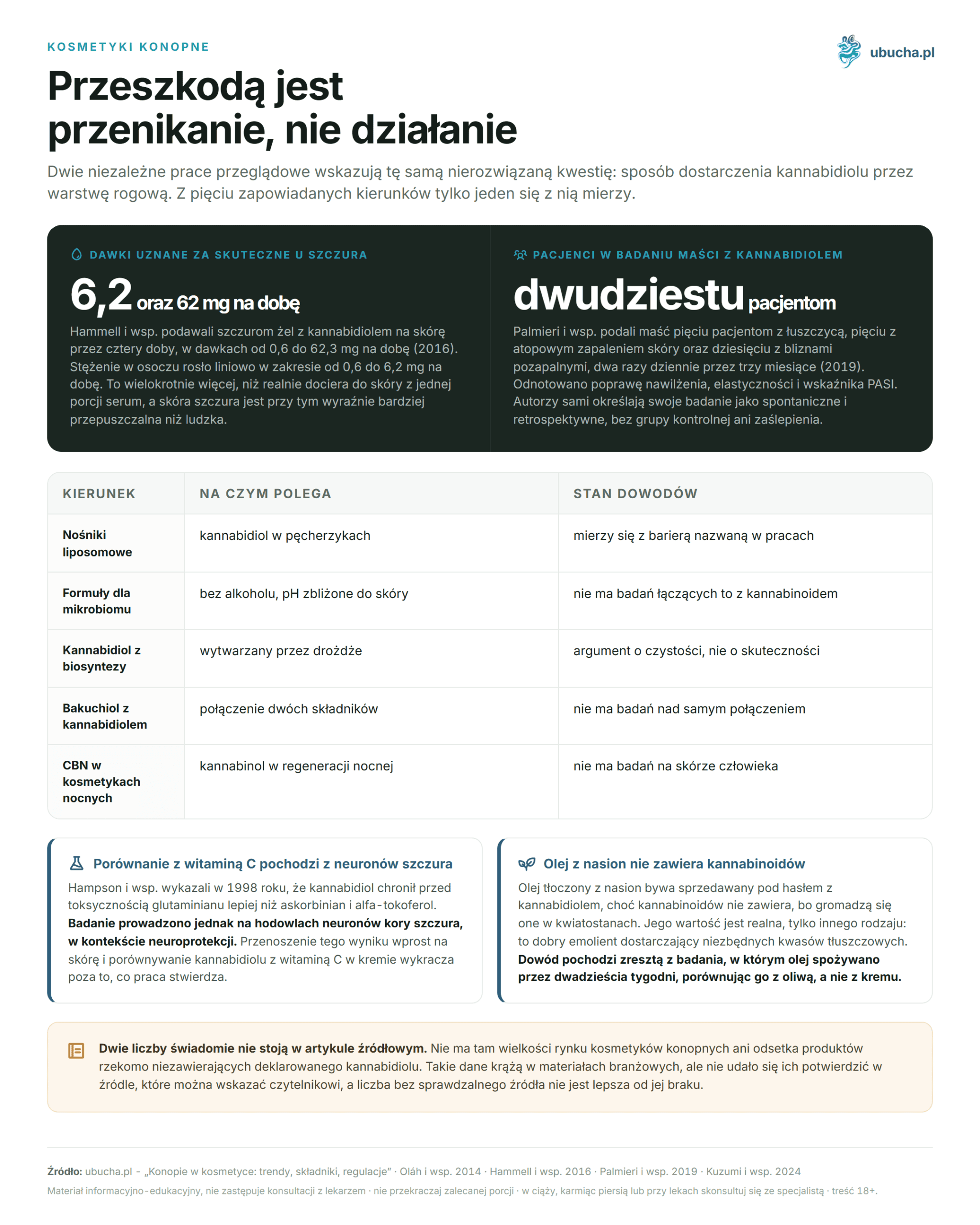
This question determines everything else, and the answer is: it depends on the formula. Cannabidiol is a lipophilic molecule and poorly soluble in water, so the stratum corneum poses a real barrier for it. Both of the latest review papers indicate the delivery method as the main unresolved issue in this category of cosmetics.
Evidence that transdermal delivery works at all comes from animal studies. Hammell et al. (2016, PMC4851925) applied a CBD gel to rats’ skin for four days, at doses ranging from 0.6 to 62.3 mg per day, in a knee joint inflammation model. The concentration of cannabidiol in plasma increased linearly from 0.6 to 6.2 mg per day, confirming absorption through the skin. Joint swelling, immune cell infiltration, and thickening of the synovial membrane decreased depending on the dose.
However, transferring this result to a shelf cream requires two caveats. Rat skin is significantly more permeable than human skin, and the tested preparation was a gel designed for transdermal delivery, not a cosmetic product. Effective doses were considered to be 6.2 and 62 mg per day, which are many times higher than what realistically reaches the skin from a single portion of serum.
This is where the sense of liposomal carriers comes from. It is not about an impressive description on the packaging, but about increasing the amount of substance that can penetrate the stratum corneum. Until the manufacturer provides the concentration of cannabidiol or the type of carrier, it is impossible to assess whether the product has a chance to work or merely moisturizes with a fatty base.
Does CBG work the same as CBD?
No, and this is one of the most commonly confused things in cosmetic descriptions. CBG is often marketed as an ingredient for oily and acne-prone skin, while the study that compared cannabinoids on the same sebocyte model showed the opposite effect to what was assumed.
Oláh et al. examined in 2016 five non-psychotropic phytocannabinoids on human SZ95 sebocytes: cannabichromene, cannabidivarin, cannabigerol, cannabigerovarin, and tetrahydrocannabivarin. The basal lipid synthesis reacted differently depending on the substance. CBC and THCV inhibited it, CBDV had minimal influence, while CBG and CBGV increased it. The authors directly indicated that CBG and CBGV may have potential in treating dry skin, while candidates for acne treatment are CBC, CBDV, and especially THCV.
For the label reader, this means a simple thing. If you are looking for an ingredient that limits sebum secretion, the indications from this work lead to CBD, not CBG. However, if you have dry or dehydrated skin, CBG is a justified choice based on the study, although still at the level of cell cultures. A common feature of all five substances was a clear anti-inflammatory effect, so in this one area, manufacturers’ claims have a basis. We write more about this cannabinoid in the guide on cannabigerol.
Which trends for 2026 are supported by research?
Some of the announced novelties address a real technological problem, while others are purely marketing names. It is determined by whether a given direction addresses the obstacle described in the literature. Two independent review papers point to the same obstacle: the penetration of cannabidiol through the stratum corneum.
| Direction | What it involves | State of evidence |
|---|---|---|
| Liposomal and niosomal carriers | encapsulation of CBD in vesicles that facilitate penetration | addresses a real barrier: review papers call the delivery system the main problem to solve (Kuzumi 2024, Rusu 2025) |
| Microbiome-friendly formulas | no alcohol, fewer preservatives, pH close to skin | formulation principle reasonable in itself, without studies linking it specifically to cannabinoids |
| Biosynthetic CBD | cannabinoid produced by yeast instead of extraction from the plant | the argument concerns the purity and repeatability of the raw material, not effectiveness on the skin |
| Bakuchiol with CBD | combination of two ingredients for skin intolerant to retinoids | lack of studies on the combination itself; data concern each ingredient separately |
| CBN in night cosmetics | cannabinol as a component of night regeneration | marketing positioning; lack of studies on topical CBN on human skin |
The conclusions from this table form one observation. Encapsulation is the only direction that directly addresses the obstacle named in the literature. Rusu et al. (2025, PMC12467061) list among the challenges the physicochemical stability of cannabidiol, its penetration through the skin, and the lack of standardized regulatory standards. Kuzumi et al. (2024, PMC11511700) write about the urgent need to develop an efficient delivery system for topical and transdermal applications.
The remaining directions are not without value, but their justification lies elsewhere than in the effectiveness of the cannabinoid. An alcohol-free formula with physiological pH is often better tolerated regardless of what else it contains. Biosynthetic raw material may be purer and less weather-dependent. These are real advantages, just not the ones suggested by the slogan on the packaging.
How to read the label of a hemp cosmetic?
Start by checking which hemp ingredient is listed in the INCI, as this determines the most. The name Cannabis sativa seed oil means seed oil and the absence of cannabinoids. Only Cannabidiol or Cannabis sativa flower extract indicates the presence of the active substance mentioned on the front of the packaging.
The second thing is the declared concentration. A reliable manufacturer provides the content of cannabidiol in milligrams or percentages, and does not stop at the words “with CBD” on the front. The lack of a number makes it impossible to compare two products and usually means that the comparison would be unfavorable.
The third is the type of extract. Full spectrum contains CBD along with other cannabinoids and terpenes, including trace amounts of THC. Broad spectrum is the same set without THC. Isolate is pure cannabidiol with a purity above 99 percent, without accompanying compounds. In cosmetics for the Polish market, broad spectrum is most often chosen, as it retains the plant profile without introducing THC.
The fourth is the certificate of analysis, which contains the cannabinoid profile, results of heavy metal testing, pesticides, microbiology, and solvent residues. Check three things: whether the batch number on the document matches the number on the packaging, how old the analysis is, and whether the laboratory is accredited. The topic of quality and access to documentation is further developed in the entry about regulations of CBD products in Poland.
How to use hemp cosmetics?
The order is the same as with any other skincare: from the lightest consistency to the heaviest. Cleansing, toner, serum with cannabinoid on slightly damp skin, moisturizing cream, and finally the most occlusive product. In the morning, the last step remains sunscreen.
With problematic skin, count time in weeks, not days. Data from cell cultures describe the impact on sebum secretion and inflammatory processes, and these change slowly, along with the skin renewal cycle. If after two weeks you see nothing, it does not mean the product is not working; if after three months there is still nothing, it probably will not work.
Test each new product first on a small area, for example on the inner side of the forearm, for two days. This is especially important with atopic dermatitis and rosacea. Cannabidiol itself is usually well tolerated, but the cosmetic also contains preservatives, fragrance compositions, and essential oils that can irritate.
What to avoid? Applying to the skin immediately after a peeling treatment or microneedling, unless the manufacturer has provided for such use. Combining in one routine with a strong retinoid, as the risk of irritation increases without a clear benefit. Treating edible oil as a cosmetic, as it does not contain dermal emulsifiers and has a different stability. Also, do not skip the filter, as antioxidant action does not replace protection against radiation.
What does the law say about hemp cosmetics?
Cosmetics are subject to the Regulation of the European Parliament and Council (EC) No 1223/2009. It imposes on the manufacturer the obligation to prepare a safety report, indicate a responsible person in the Union, register the product in the CPNP portal, and label the composition according to INCI nomenclature.
In Poland, these regulations are supplemented by the Act of October 4, 2018, on cosmetic products. The oversight of compliance with Regulation 1223/2009 is provided by the authorities of the State Sanitary Inspection and the Trade Inspection, each within the scope of their competencies. The Act also introduced a system for reporting serious adverse events. This is an important distinction, as cosmetics are not registered by the authority responsible for medicines.
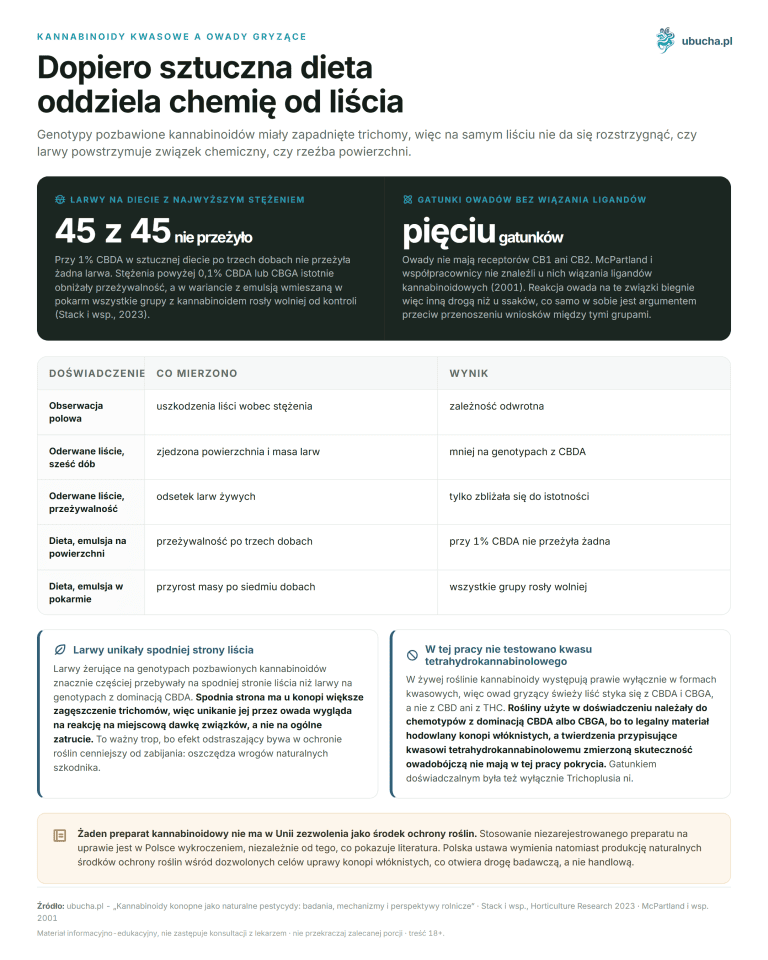
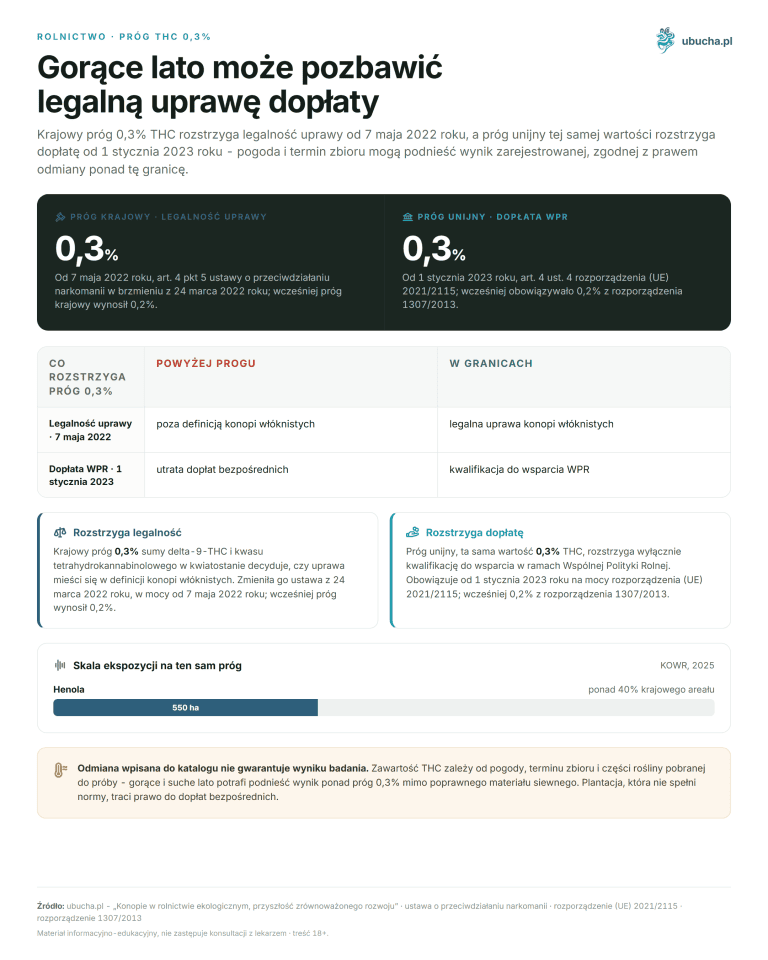
A separate issue is the THC content in the hemp raw material. According to Article 4 point 5 of the Act of July 29, 2005, on counteracting drug addiction, as amended by the Act of March 24, 2022 (Journal of Laws 2022, item 763), industrial hemp is defined as plants in which the sum of delta-9-THC and tetrahydrocannabinolic acid (THCA) does not exceed 0.3 percent calculated on a dry weight basis, rounded to one decimal place. This distinction has practical significance, as the laboratory measures the sum of both compounds, not just delta-9-THC.
The national threshold corresponds to the EU threshold, which has been in effect since January 1, 2023, based on Regulation (EU) 2021/2115, but does not derive from it. These are two separate regulations with the same numerical value. Cannabidiol itself is not listed in the register of controlled substances. Separately, it is worth knowing that products imported privately from outside the Union do not have to meet the requirements of Regulation 1223/2009 or be registered in the CPNP.
What have studies not yet confirmed?
The most honest answer is: most of what the packaging promises. Reviews from the last two years consistently indicate that there have been few studies involving humans on cannabidiol on the skin, and those that exist are small and often lack a control group.
Kuzumi et al. (2024) summarized the available data as follows: evidence from cell cultures and animal models indicates antioxidant, anti-inflammatory, moisturizing, anti-acne, healing, and anti-aging effects, but only a few clinical studies on the skin have been conducted. Further work is needed, including pharmacokinetic studies.
It is also worth knowing what is consciously absent from this text. You will not find numbers describing the size of the hemp cosmetics market or the percentage of products allegedly not containing declared CBD. Such data circulate in industry materials, but they could not be confirmed from a source that can be pointed out to the reader. A number without a verifiable source is no better than its absence.
Similarly, claims of multiple times higher potency than known antioxidants or effectiveness comparable to retinol should be treated cautiously. Hemp also contains other compounds with confirmed activity, such as cannflavins described by Barrett et al. in 1985 and 1986, but previous work on them has been conducted outside the context of skincare.
A separate example is beta-caryophyllene, a terpene present in hemp but also in pepper and cloves. Gertsch et al. demonstrated in 2008 that it acts as a selective CB2 receptor agonist, thus interacting with the same system as cannabinoids, even though it is not a cannabinoid in the chemical sense. In cosmetics, however, it most often serves as a fragrance composition ingredient, and there is a lack of studies on its local action on human skin. The mere presence of a terpene in the composition is therefore not an argument for the effectiveness of the product.
Summary
Hemp in cosmetics is two separate stories that are worth separating right at the shelf. Hemp seed oil is a good emollient with a beneficial fatty acid profile and does not contain cannabinoids. Cannabidiol is an active substance with documented effects on sebocytes and inflammatory processes, with most of this data coming from cell cultures.
Three things increase the chances of a successful purchase. Check which hemp ingredient is listed in the INCI and at what concentration. Demand a certificate of analysis with a batch number matching the packaging. Match the cannabinoid to the problem, remembering that the data for CBD and CBG diverge in opposite directions regarding sebum secretion.
The rest is a matter of patience and reasonable expectations. Cannabinoids are among the better-studied plant ingredients in cosmetics, which does not mean they are well-studied. Skincare effects build over weeks, so evaluate the product after a month of regular use, not after a few days. In cases of skin diseases, make skincare decisions together with a dermatologist, and treat innovations without research as a proposal, not a promise.
Frequently Asked Questions
Are CBD cosmetics legal in Poland?
Yes. Cannabidiol is not listed in the register of controlled substances, and the cosmetic must meet the requirements of Regulation (EC) No 1223/2009 and be registered in the CPNP portal. The hemp raw material is subject to a threshold of 0.3 percent of the sum of delta-9-THC and THCA. Oversight is provided by the State Sanitary Inspection and the Trade Inspection.
Can CBD cream cause a psychoactive effect?
No. The WHO Expert Committee stated in 2018 that pure cannabidiol does not exhibit psychoactive properties and does not create a potential for abuse or addiction. CBD has a low affinity for the CB1 receptor, and topical application does not lead to significant systemic absorption.
What is the difference between hemp seed oil and CBD?
Hemp seed oil does not contain cannabinoids, as they accumulate in the flower clusters. Its value comes from its fatty acid profile: linoleic, alpha-linolenic, and gamma-linolenic acids. CBD is the active substance from flower extracts, acting on the skin’s endocannabinoid system. In INCI, you will recognize them as two different entries.
Does CBD help with acne?
The data is promising, but mainly comes from cell cultures. Oláh et al. demonstrated in 2014 that cannabidiol inhibits lipogenesis in human sebocytes and has anti-inflammatory effects, and considered it a promising agent for acne vulgaris. So far, there have been few clinical studies involving patients.
Is CBG suitable for oily skin?
Rather not, contrary to common claims. In the study by Oláh et al. in 2016, cannabigerol and cannabigerovarin increased the basal lipid synthesis in sebocytes, which is why the authors indicated them as candidates for dry skin. On the other hand, CBC, CBDV, and tetrahydrocannabivarin reduced sebum secretion.
How long does it take to see the effects of CBD cosmetics?
The first changes in hydration and redness may be visible after two to four weeks of regular use. In the study by Palmieri et al. in 2019, the ointment was applied twice daily for three months. However, it was a small retrospective study without a control group, so treat this time as indicative.
Can CBD cosmetics be used during pregnancy?
There is a lack of research on the safety of cannabidiol during pregnancy and breastfeeding, so it is advisable to make a decision with the attending physician. Hemp seed oil does not contain cannabinoids and is often considered a safer choice. Do not treat the lack of reports on harm as evidence of safety.
If you are looking for ready-made preparations, browse the hemp cosmetics category and compare the INCI composition with the principles described above.
This article is for informational and educational purposes only and does not constitute medical advice. Before starting to use hemp or CBD for therapeutic purposes, consult your doctor, especially if you are taking other medications, are pregnant, or breastfeeding.
Author: Michał Waluk · Published: 2026-05-11 · Updated: 2026-08-10