
Insomnia - natural ways to sleep without pills (2026)
What was really measured in studies on cognitive-behavioral therapy, sleep hygiene, melatonin, magnesium, and herbs for insomnia and where the evidence ends.
Half of adult Poles report sleep complaints, but only some meet the criteria for insomnia as a disorder. This difference determines what to seek: immediate support or treatment. Scientific societies have answered this question consistently for years, but the answer rarely reaches guides because it cannot be bought in a capsule. In this guide, we go through interventions listed in guidelines and meta-analyses, specifying for each what was exactly measured: how many studies, how many participants, the effect size, and the quality of evidence. Several popular statements about sleep hygiene, melatonin, and valerian did not survive such scrutiny, and we state clearly which and why.
KEY INFORMATION
- Multicomponent cognitive-behavioral therapy for insomnia has a strong recommendation in guidelines, as the only behavioral intervention (Edinger et al., American Academy of Sleep Medicine, 2021).
- The same guidelines suggest NOT using sleep hygiene alone as a single treatment method for chronic insomnia.
- Pharmacological guidelines from 2017 suggest not using melatonin, valerian, or tryptophan in chronic insomnia (Sateia et al., 2017).
- In a meta-analysis of three studies, magnesium shortened sleep onset latency by 17.36 minutes, but the 16-minute increase in total sleep time was not statistically significant, and the quality of evidence was rated low to very low.
- Snoring with apnea, daytime sleepiness despite a full night’s sleep, and persistent evening leg discomfort are reasons to see a doctor instead of seeking supplements.
How common is insomnia in Poland?
Every second adult reports sleep complaints. In the NATPOL study, conducted on a representative sample of 2413 people aged 18 to 79, 50.5% reported sleep problems, including 58.9% of women and 41.4% of men (Nowicki et al., Psychiatria Polska, 2016). The highest percentage, 74.8%, was among women aged 60 to 79.
A complaint about sleep is not the same as a diagnosis. Insomnia as a disorder requires difficulty falling asleep, maintaining sleep, or waking too early, recurring regularly for many weeks and causing daytime impairment. Without the latter, it is shorter sleep, not a disease. A person who recovers in six hours and feels fine during the day does not need treatment.
This distinction has practical consequences. Short-term insomnia related to stress or lifestyle changes usually resolves after the cause disappears. Chronic insomnia is a separate diagnosis and is the focus of the guidelines discussed later.
It is also worth knowing the stakes. A meta-analysis of twenty-one longitudinal studies showed that people without depression complaining of insomnia had twice the risk of developing depression. The odds ratio was 2.60 with a confidence interval from 1.98 to 3.42 (Baglioni et al., Journal of Affective Disorders, 2011). The authors suggest early insomnia treatment as part of mental health prevention.
Why is cognitive-behavioral therapy the first-line treatment?
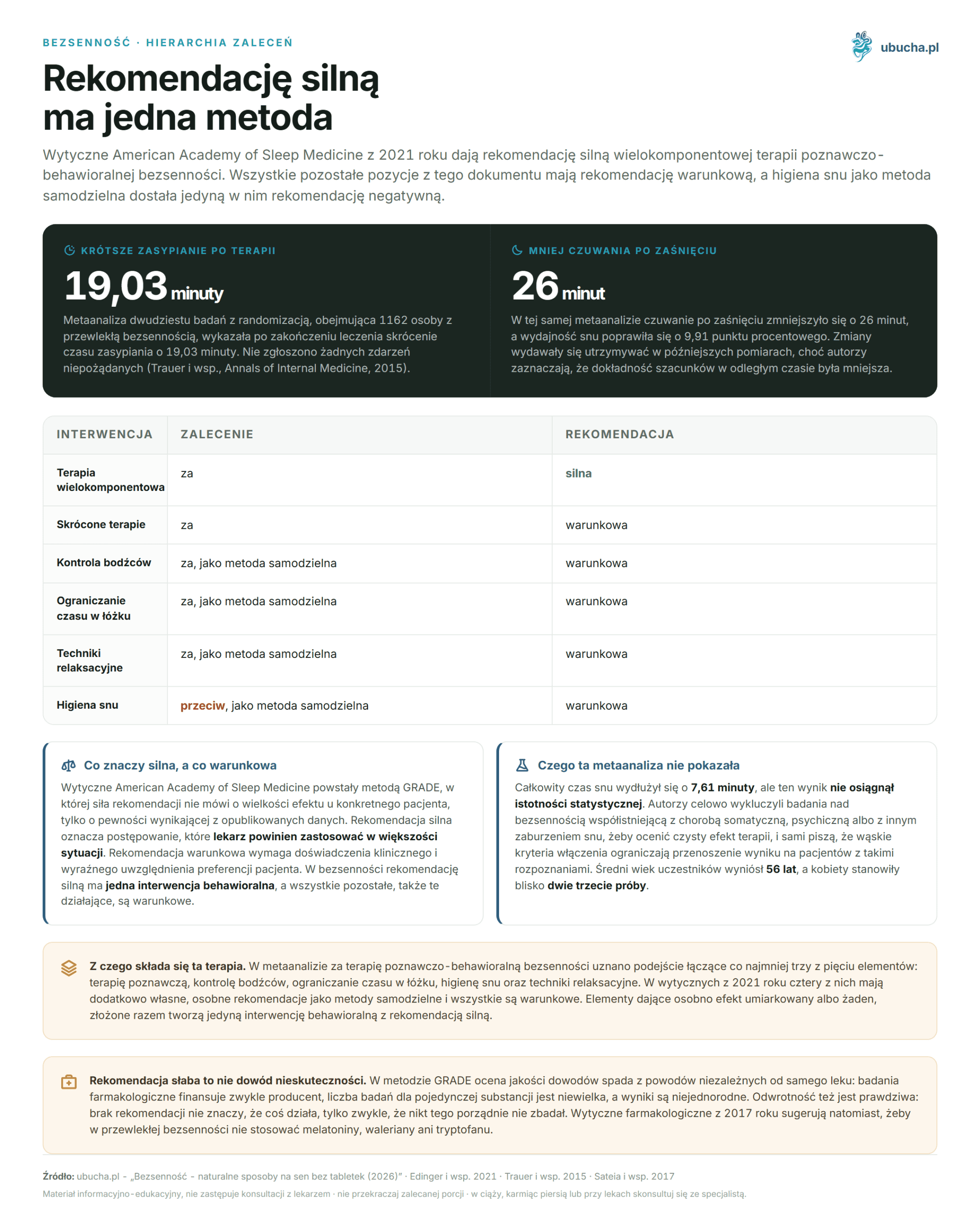
Because it is the only behavioral intervention with a strong recommendation. The American Academy of Sleep Medicine guidelines, developed using the GRADE method, recommend multicomponent cognitive-behavioral therapy for chronic insomnia in adults and mark this recommendation as strong, meaning a physician should implement it in most cases (Edinger et al., Journal of Clinical Sleep Medicine, 2021).
All other items in these guidelines have conditional recommendations, meaning weaker and requiring consideration of patient preferences. It is worth seeing the full hierarchy because guides usually show only part of it.
| Intervention | AASM 2021 Recommendation |
|---|---|
| multicomponent cognitive-behavioral therapy | for, strong |
| shortened multicomponent therapies | for, conditional |
| stimulus control as standalone method | for, conditional |
| sleep restriction as standalone method | for, conditional |
| relaxation techniques as standalone method | for, conditional |
| sleep hygiene as standalone method | against, conditional |
What does this therapy achieve numerically? A meta-analysis of twenty randomized studies including 1162 people with chronic insomnia showed after treatment a reduction in sleep onset latency by 19.03 minutes, a decrease in wake time after sleep onset by 26 minutes, and an improvement in sleep efficiency by 9.91 percentage points. Total sleep time increased by 7.61 minutes, but this was not statistically significant. Changes appeared to persist in later measurements, though the authors note less precision over time. No adverse events were reported (Trauer et al., Annals of Internal Medicine, 2015).
One limitation of this meta-analysis is worth knowing as it narrows the conclusion. The authors deliberately excluded studies on insomnia coexisting with somatic, psychiatric, or other sleep disorders to assess the pure effect of therapy. They note that narrow inclusion criteria limit generalizability to patients with such diagnoses. The average participant age was 56, and women made up nearly two-thirds of the sample.
What does cognitive-behavioral therapy for insomnia consist of?
It consists of five components, each with its own rationale. The meta-analysis of efficacy considered cognitive-behavioral therapy for insomnia as an approach combining at least three of five elements: cognitive therapy, stimulus control, sleep restriction, sleep hygiene, and relaxation techniques (Trauer et al., 2015). In the 2021 guidelines, four of these have separate recommendations as standalone methods.
Stimulus control restores the association of bed with sleep. The rules are brief: the bed is used only for sleep and sex, after about fifteen minutes of unsuccessful lying down one must get up, and wake time remains fixed regardless of when one falls asleep. Guidelines list stimulus control as an acceptable standalone method with a conditional recommendation.
Sleep restriction sounds counterintuitive as it involves shortening the sleep window to the actual sleep time recorded in a diary. The goal is to increase sleep pressure and rebuild continuity, with the window lengthening only when sleep becomes consolidated. This method also has a separate conditional recommendation and is only one element of the whole.
Cognitive therapy works with beliefs that increase pre-sleep tension: the compulsion to sleep a certain number of hours and catastrophic expectations about the next day. Relaxation techniques reduce physiological arousal and also have a separate conditional recommendation.
The fifth component has a separate status in these guidelines. Sleep hygiene is part of multicomponent therapy but received a negative recommendation as a standalone method. This illustrates how the whole works: elements with moderate or no effect alone combine to form the only behavioral intervention with a strong recommendation.
How to read recommendations in guidelines?
Two words decide everything here: strong and conditional. Both discussed American Academy of Sleep Medicine guidelines were developed using the GRADE method, where recommendation strength reflects certainty from published data, not effect size in an individual patient. This is often confused in press summaries.
A strong recommendation means a physician should apply the intervention in most cases. A conditional recommendation requires clinical knowledge and experience and clear consideration of patient preferences. In insomnia, only one behavioral intervention has a strong recommendation; all others, even effective ones, have conditional recommendations.
Pharmacological guideline authors add a caveat worth knowing before treating a weak recommendation as a verdict. The quality of evidence is lowered in GRADE for three reasons independent of the drug itself. Pharmacological studies are usually funded by manufacturers, risking publication bias. The number of qualifying studies per substance is small. Results are heterogeneous. A weak recommendation is thus not proof of ineffectiveness but reflects less certainty.
The reverse is also true and more common in natural remedy guides. Lack of recommendation does not mean something works. It usually means no proper studies or too few to assess. Negative suggestions, like those against melatonin or valerian, are assessments based on existing material and are worth remembering when reading further.
Is sleep hygiene alone enough for insomnia?
No, and guidelines say so explicitly. The American Academy of Sleep Medicine suggests not using sleep hygiene alone as a treatment for chronic insomnia in adults. This is the only negative recommendation in the entire 2021 document and the one most often omitted in guides because sleep hygiene is cheap, safe, and sounds reasonable.
A review of empirical bases for these recommendations starts with the same observation. Its authors note the ineffectiveness of sleep hygiene as treatment in sleep medicine and ask why a set of recommendations, each individually linked to sleep, stops working when given together as education. The review’s conclusion is cautious. Epidemiological and experimental studies support associations of individual recommendations with night sleep, but direct effects of single recommendations on sleep in the general population remain largely unproven (Irish et al., Sleep Medicine Reviews, 2015).
One recommendation has strong direct evidence. A home study administered fixed caffeine doses six hours, three hours, and immediately before bedtime. Each significantly disrupted sleep compared to placebo, with the six-hour-before dose shortening total sleep time enough for authors to consider it empirical support for avoiding caffeine at least six hours before sleep (Drake et al., Journal of Clinical Sleep Medicine, 2013).
How to reconcile this? Sleep hygiene remains a foundational layer and part of multicomponent therapy, which includes stimulus control, sleep restriction, and cognitive work. As standalone treatment for chronic insomnia, it fails and guidelines discourage such attempts.
Do sleeping pills solve the problem?
Pharmacological guidelines are much cooler toward them than sales figures suggest. The American Academy of Sleep Medicine evaluated individual substances, not entire classes, and gave all recommended ones a weak recommendation. This group includes suvorexant, eszopiclone, zaleplon, zolpidem, triazolam, temazepam, ramelteon, and doxepin, each with assigned use profiles: some for sleep onset difficulties, others for sleep maintenance (Sateia et al., Journal of Clinical Sleep Medicine, 2017).
A weak recommendation does not mean the drug is ineffective. It means less certainty about outcomes and the need for individualized physician decisions. Authors also explain why evidence quality drops almost automatically here: pharmacological studies are mostly manufacturer-funded, few studies qualify per substance, and results are heterogeneous.
More interesting is the second list, with recommendations against. Guidelines suggest not using trazodone, tiagabine, or diphenhydramine (an antihistamine in over-the-counter sleep aids) for chronic insomnia. On the same negative list are three commonly considered natural remedies: melatonin, valerian, and tryptophan (Winkelman et al., Journal of Clinical Sleep Medicine, 2025).
This sets the topic differently than most guides. The division is not between drug and supplement but between methods with proven efficacy and those without. Cognitive-behavioral therapy is on the effective side, sleeping pills have weak recommendations, and much of the natural sleep aid shelf has negative or no recommendations.
What is really known about melatonin?
Melatonin is not a sleeping pill but a hormone synchronizing circadian rhythm, and its effect size on sleep is modest. A meta-analysis of nineteen placebo-controlled studies including 1683 participants with primary sleep disorders showed a reduction in sleep onset latency by 7.06 minutes, an increase in total sleep time by 8.25 minutes, and an improvement in overall sleep quality by 0.22 standardized mean difference (Ferracioli-Oda et al., PLoS One, 2013).
One sentence from this work is worth noting as it contradicts the most repeated advice. Longer studies and those with higher doses showed greater effects on shortening sleep onset and lengthening sleep. The popular claim that the lowest dose works best and higher doses paradoxically worsen sleep has no support in this meta-analysis. Authors note melatonin’s effect does not diminish with continued use and its adverse effect profile is mild compared to sleeping pills.
Pharmacological guidelines go further and suggest not using melatonin for chronic insomnia, neither for sleep onset nor maintenance difficulties. This is not contradictory to the meta-analysis: seven minutes shorter sleep onset is statistically real but clinically minor for someone lying awake for an hour.
The practical conclusion differs from packaging claims. Melatonin makes sense where the problem is a shifted circadian rhythm, not persistent evening arousal. Selection of preparation and timing for any sleep disorder should be by a physician, especially in people on chronic medications. More about the hormone is in the article on melatonin for sleep.
Does magnesium shorten sleep onset?
Probably yes, but evidence is weaker than its popularity suggests. A systematic review with meta-analysis found only three randomized placebo-controlled studies comparing oral magnesium in 151 older adults with insomnia across three countries. After intervention, sleep onset latency was 17.36 minutes shorter than placebo, with a confidence interval from 7.44 to 27.27 minutes (Mah and Pitre, BMC Complementary Medicine and Therapies, 2021).
The second number from this work circulates online without the caveat that invalidates it. Total sleep time increased by 16.06 minutes, but this was not statistically significant. Statements like “magnesium increases sleep by a quarter of an hour” cite this as a finding, though the paper presents it as a difference indistinguishable from chance.
Authors judge their material strictly. All three studies had moderate to high risk of bias, and evidence quality per GRADE was low to very low. The review’s conclusion is direct: literature quality is insufficient for physicians to issue well-founded recommendations on oral magnesium use in older adults with insomnia.
What remains practically? A signal worth attention in one age group, cheap and widely available, which authors say randomized studies may support for insomnia complaints. This is much less than label promises but not nothing. In kidney disease, any magnesium supplementation requires prior physician decision.
It is also worth knowing what questions this review does not answer. It included only older adults with insomnia, so says nothing about younger people or those without diagnosis. It did not compare magnesium forms, around which most sales claims revolve. Claims that one magnesium salt works better than another do not come from this work and require separate sources.
Which herbs and adaptogens have evidence?
Ashwagandha scores best here, valerian worst, with a bigger difference than their shared shelf suggests. We gathered three plants most often described in sleep context along with what was exactly measured.
| Plant | Evidence base | Result |
|---|---|---|
| ashwagandha | 5 randomized studies, 400 participants | small but significant effect on sleep, standardized mean difference -0.59 |
| valerian | 16 studies, 1093 people | relative risk of sleep improvement 1.8, with signs of publication bias |
| passionflower | 1 crossover study, 41 healthy people | better subjective sleep quality after a week of infusion |
Ashwagandha performs best. A meta-analysis of five randomized studies including 400 participants showed a small but significant effect of extract on overall sleep, with a standardized mean difference of -0.59. The effect was clearer in the subgroup with diagnosed insomnia and with treatment lasting at least eight weeks. Alertness after awakening and anxiety levels also improved, while quality of life did not change significantly. Authors note insufficient data on serious adverse effects to assess long-term safety (Cheah et al., PLoS One, 2021).
Valerian has a larger evidence base but weaker result. A systematic review of sixteen placebo-controlled studies including 1093 people found significant benefit in six studies reporting sleep as improved or not, with a relative risk of 1.8 and confidence interval from 1.2 to 2.9. Authors note signs of publication bias and significant methodological problems in most studies, with doses and preparations varying widely (Bent et al., The American Journal of Medicine, 2006). The 2017 guidelines suggest not using valerian in chronic insomnia.
Passionflower has one decent study and must be read carefully. It involved 41 healthy people aged 18 to 35 with slight sleep quality fluctuations, not insomnia patients. A week of passionflower infusion gave significantly better subjective sleep quality than placebo. Authors call this a short-term subjective benefit in healthy people (Ngan and Conduit, Phytotherapy Research, 2011). More about this plant in a separate article on passionflower for sleep and anxiety.
What do studies say about CBD and CBN in insomnia?
The most often cited number in this topic comes from a retrospective case series, not a randomized study. In a psychiatric clinic, records of 103 adults were reviewed, with a final sample of 72: 47 reported anxiety, 25 poor sleep (Shannon et al., The Permanente Journal, 2019).
These results are worth stating precisely as distorted versions circulate. Anxiety scores decreased in the first month in 79.2% and remained lower throughout observation. Sleep scores improved in the first month in 66.7% but fluctuated in following months. Cannabidiol was well tolerated except in three patients. The statement about a lasting three-month sleep effect previously in this article has no support in that work and was removed along with the assigned dose, which the abstract does not provide.
Cannabinol, sold as a “sleep cannabinoid,” performs even worse. A narrative review searched publications for this claim, reviewed 99 human study abstracts, and discussed eight meeting criteria. It found no clinical trial assessing cannabinol’s effect on sleep by polysomnography or validated sleep questionnaire. The author concludes published evidence is insufficient to support sleep claims, and buyers should be skeptical (Corroon, Cannabis and Cannabinoid Research, 2021).
There is also a safety aspect more important than efficacy. The European Food Safety Authority panel states safety of cannabidiol cannot be established in people under 25, pregnant or breastfeeding women, or those taking medications simultaneously (EFSA, EFSA Journal, 2026). The third group includes most people with chronic insomnia. More on this in the article about CBD in treating sleep disorders.
What about L-theanine and other popular sleep additives?
There are no guideline positions on them, which differs from negative assessments. The 2017 pharmacological guidelines covered three natural substances: melatonin, valerian, and tryptophan. Each received a suggestion not to use in chronic insomnia. L-theanine, glycine, oral GABA, and lavender extract are not mentioned at all.
An earlier version of this article gave specific numbers for some: percentages of sleep quality improvement, minutes shortened to fall asleep, share of satisfied store survey respondents. None of these values could be linked to a study containing them, so they were removed along with the sentences carrying them. A vendor survey is not a study and is not included in the text.
What does this mean for someone standing before a shelf? First, presence of an ingredient in a sleep product does not mean anyone measured its effect on human sleep. Second, multicomponent mixtures make assessment even harder because any improvement cannot be attributed to a single ingredient. Third, supplements do not undergo registration procedures like drugs, so lack of adverse event reports may reflect lack of studies, not safety evidence.
This does not mean every such product is worthless. It means its effect remains a hypothesis, not a finding, and the difference between one and another should be as clearly visible on the label as the composition.
When to stop supplements and see a doctor?
There are situations where seeking natural remedies delays diagnosis of diseases requiring treatment. The first is sleep apnea. The first large screening study in Poland, using the STOP-BANG questionnaire on 613 people in the PURE project, found moderate to high risk of obstructive sleep apnea in 66.5% of men and 60.1% of women, much more often than previously thought (Postrzech-Adamczyk et al., Advances in Experimental Medicine and Biology, 2019). This is a screening result, not a diagnosis, and that is why snoring with breathing pauses requires diagnostics, not herbs.
The second situation is restless legs syndrome. The 2025 guidelines changed recommendations here, worth knowing as older guides say the opposite. Strong recommendations were given to gabapentin enacarbil, gabapentin, pregabalin, and intravenous iron carboxymaltose in patients with appropriate iron status. Guidelines advise against routine use of pramipexole and ropinirole, and strongly against cabergoline. Valerian is also on the negative list (Winkelman et al., Journal of Clinical Sleep Medicine, 2025).
The same guidelines recommend regular ferritin and transferrin saturation testing in any patient with clinically significant restless legs syndrome, as results determine choice between oral and intravenous iron. The first step is removing factors worsening symptoms, including alcohol, caffeine, and untreated apnea.
Other warning signs are simpler. Daytime sleepiness despite a full night’s sleep, symptoms persisting despite cognitive-behavioral therapy, nocturnal behaviors like sleepwalking, and sleep worsening after starting a new medication are reasons to see a doctor, not to change supplements.
How to plan the next weeks?
Order matters more than product choice. Guidelines place cognitive-behavioral therapy first, so a sensible plan starts with its elements, not purchases. The first two weeks involve a sleep diary and two behavioral changes with the best documented effects: fixed wake time and caffeine avoidance at least six hours before sleep.
A sleep diary is not a formality. Without it, one cannot assess if anything worked, as night memory is unreliable and subjective improvement appears even after placebo. Record bedtime, approximate sleep onset, awakenings, wake time, and restfulness rating on a simple scale.
The most often broken rule is the weekend. Shifting wake time by two hours on Saturday and Sunday disrupts what was set during five days, and Monday night looks like before starting the plan. Fixed wake time applies seven days a week, even after a bad night, as it anchors circadian rhythm.
The third and fourth weeks involve full stimulus control: bed used only for sleep and sex, getting out of bed after about fifteen minutes of unsuccessful lying down, and fixed wake time regardless of sleep onset. Only then does adding a product make sense, always one at a time to assess its effect. Evening combinations are discussed separately in the evening supplementation protocol.
After four weeks comes the decision point. If the diary shows shorter sleep onset and fewer awakenings, the plan works and should be maintained for weeks. If nothing changed, adding products rarely helps and more often delays talking to a doctor about secondary causes: thyroid disease, iron deficiency, depression, chronic pain, or medication effects.
Frequently Asked Questions
Which method for insomnia has the strongest evidence?
Multicomponent cognitive-behavioral therapy for insomnia. It is the only behavioral intervention with a strong recommendation in the American Academy of Sleep Medicine guidelines from 2021. A meta-analysis of twenty randomized studies with 1162 participants showed a reduction in sleep onset latency by 19 minutes and a decrease in wake time after sleep onset by 26 minutes, with no adverse events.
Is sleep hygiene enough to cure insomnia?
No. The 2021 guidelines suggest not using sleep hygiene as a standalone treatment for chronic insomnia in adults. This is the only negative recommendation in that document. Sleep hygiene remains a foundational layer and part of multicomponent therapy but alone does not treat chronic insomnia.
How effective is melatonin according to meta-analyses?
Not very. In a meta-analysis of nineteen placebo-controlled studies including 1683 people, melatonin shortened sleep onset latency by 7.06 minutes and extended total sleep time by 8.25 minutes. Longer studies and higher doses showed greater, not lesser, effects. Pharmacological guidelines from 2017 suggest not using it for chronic insomnia.
Does magnesium really help to fall asleep?
Partially. In a meta-analysis of three randomized studies including 151 older adults, magnesium reduced sleep onset latency by 17.36 minutes compared to placebo. The increase in total sleep time by 16.06 minutes was not statistically significant. All studies had moderate to high risk of bias, and the quality of evidence was rated low to very low.
Where does the 66% sleep improvement after CBD come from?
From a retrospective case series including 72 adults, of whom 25 reported poor sleep. Sleep scores improved in the first month for 66.7%, but fluctuated in subsequent months. Anxiety scores decreased in 79.2% and remained lower. This was not a randomized study.
Does cannabinol help with sleep?
Published evidence is insufficient. A 2021 review searched the literature for this claim and found no clinical trials assessing cannabinol’s effect on sleep using polysomnography or validated questionnaires. The author recommends skepticism toward manufacturers’ claims of sleep benefits.
When does insomnia require a doctor’s visit?
When snoring with breathing pauses occurs, daytime sleepiness despite a full night’s sleep, unpleasant leg sensations worsening in the evening, nocturnal behaviors like sleepwalking, or when sleep worsens after starting a new medication. In these cases, supplements delay diagnosis of conditions requiring other treatments.
Plant extracts supporting evening regeneration, including ashwagandha, can be found in the adaptogenialna section at u Bucha store.
This article is for informational and educational purposes and does not constitute medical advice. Consult a physician before starting supplementation, especially if you take chronic medications, are pregnant or breastfeeding, or have chronic illnesses.
Author: Michał Waluk · Published: 2026-05-11 · Updated: 2026-08-10