
Plantago lanceolata for cough and throat: how it works and how to use it (FAQ)
Plantago lanceolata for cough: how the mucilage from the leaf works and how to use it. Infusion 1.4 to 2 g in 150-250 ml of boiling water, 2 to 3 times a day according to the EMA monograph.
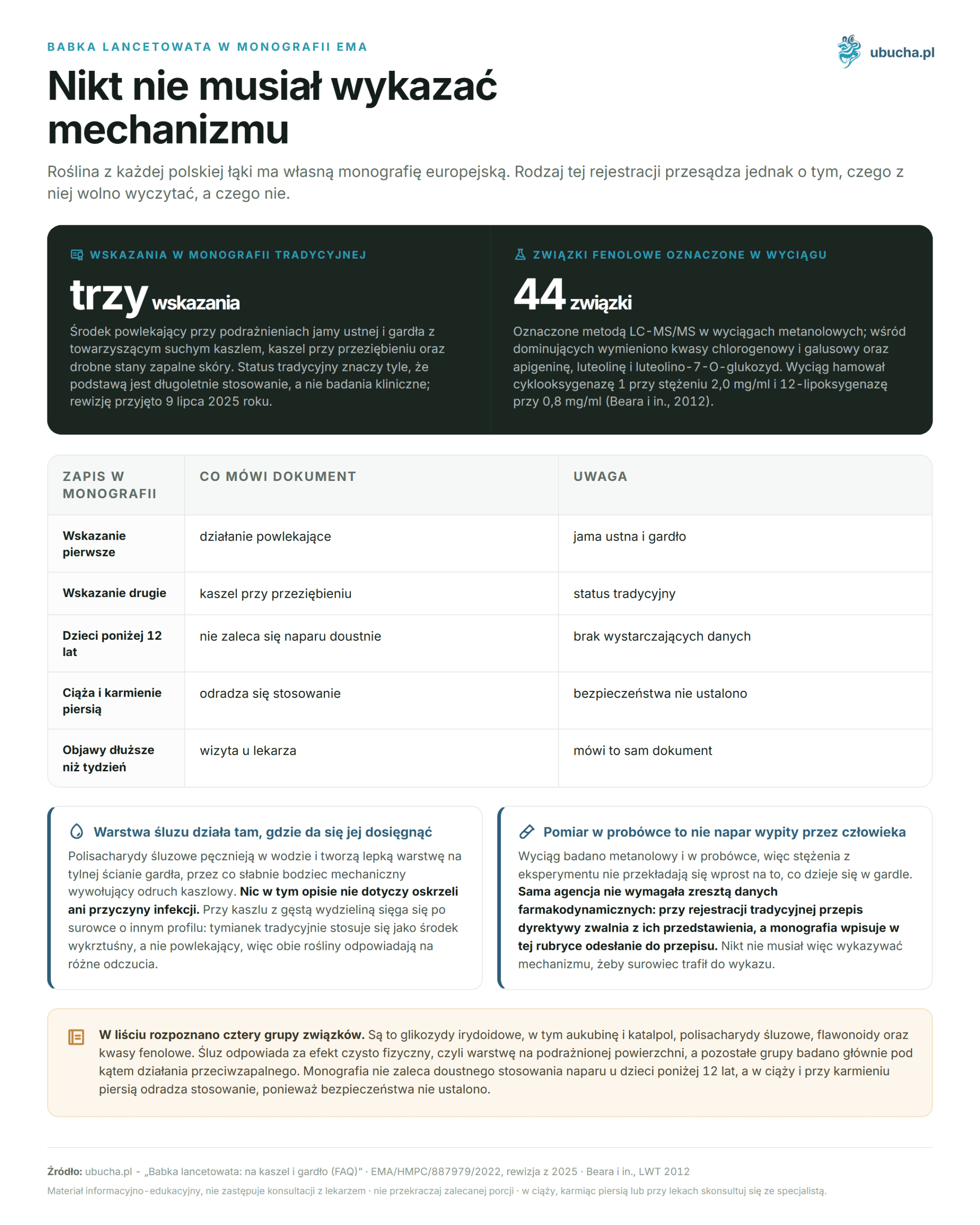
Plantago lanceolata (Plantago lanceolata L.) works on cough locally: the mucilage from the leaf coats the irritated throat and weakens the stimulus that triggers the cough reflex. It is most often used as an infusion, 1.4 to 2 g of dried leaf in 150 to 250 ml of boiling water, 2 to 3 times a day. Both answers come from the European Medicines Agency monograph for the leaf of this plant. The Committee on Herbal Medicinal Products accepted the first revision of this document on July 9, 2025, and classified the raw material as a traditional herbal medicinal product for three indications: as a coating agent for irritation of the oral cavity and throat with accompanying dry cough, for cough associated with colds, and for minor skin inflammations (EMA/HMPC/887979/2022). The traditional status means that it is based on long-term use, not clinical studies. Below we have gathered what this monograph really implies and what cannot be read from it.
KEY INFORMATION
• The leaf of Plantago lanceolata has an EMA monograph as a traditional herbal medicinal product (EMA/HMPC/887979/2022, revision 1 from July 9, 2025).
• The first indication is coating action for irritation of the oral cavity and throat with dry cough, the second is cough associated with colds.
• Infusion according to the monograph: 1.4 to 2 g of dried leaf in 150 to 250 ml of boiling water, 2 to 3 times a day, daily dose 4 to 6 g.
• The monograph does not recommend oral use of the infusion in children under 12 years of age, as there is insufficient data.
• During pregnancy and breastfeeding, the monograph advises against use, as safety has not been established.
• Symptoms lasting longer than a week are a signal to visit a doctor, and the EMA document states this itself.
What does Plantago lanceolata contain and how do these compounds work?
Four groups of compounds have been identified in the leaf of Plantago lanceolata, which are attributed with action. The first two are iridoid glycosides, primarily aucubin and catalpol, and mucilage polysaccharides. The other two are flavonoids and phenolic acids. The mucilage is responsible for the purely physical effect, that is, the layer on the irritated surface. The other groups have been mainly studied for their anti-inflammatory action.
The most specific measurement comes from a study comparing two species of plantain. The Beary team measured the presence and content of 44 phenolic compounds in methanolic extracts using LC-MS/MS, among which they listed phenolic acids, including chlorogenic and gallic acids, and from flavonoids, apigenin, luteolin, and luteolin-7-O-glucoside as dominant. In the same study, the extract from Plantago lanceolata inhibited cyclooxygenase 1 at an IC50 concentration of 2.0 mg/ml and 12-lipoxygenase at 0.8 mg/ml, which is clearly stronger than the extract from Plantago altissima (Beara et al., LWT, 2012).
This result should be read cautiously. The methanolic extract was studied in vitro, not the infusion consumed by a person, so the concentrations from the experiment do not directly translate to what happens in the throat. The EMA itself did not require pharmacodynamic data: when registering traditional products, the relevant provision of Directive 2001/83/EC exempts from their presentation, and the monograph refers to this provision in this section. In other words, no one had to demonstrate the mechanism for the raw material to be included in the list.
Does Plantago lanceolata help with dry cough?
Dry, irritating cough without secretion is exactly the situation described by the first indication of the monograph: Plantago lanceolata is listed there as a coating agent for irritation of the oral cavity and throat with accompanying dry cough. The basis for the entry is long-term use, not the result of a study with a control group.
The mechanism attributed to it is simple and exclusively local. Mucilage polysaccharides swell in water and form a sticky layer on the back wall of the throat, thereby weakening the mechanical stimulus that triggers the cough reflex. Nothing in this description pertains to the bronchi or the cause of the infection: the layer of mucilage works where it can reach.
For cough with thick secretion, raw materials with a different profile are usually sought. Thyme is traditionally used as an expectorant, not a coating agent, so both plants respond to different sensations, although they have coexisted in herbal mixtures for generations. A similar protective mechanism to Plantago works with marshmallow, while mullein has a different approach in this set.
What the monograph does not say: it does not state how long it takes for the effect to appear, does not compare Plantago with a cough medicine, and does not cover allergic or chronic cough. The statements about relief coming after the first portion of the infusion cannot be based on this document.
How to use Plantago lanceolata for cough?
The infusion from the dried leaf is described most accurately in the monograph: 1.4 to 2 g of raw material in 150 to 250 ml of boiling water, 2 to 3 times a day, with a daily dose of 4 to 6 g. This applies to adolescents, adults, and the elderly, while the document does not recommend oral administration of the infusion to those under 12 years of age.
For gargling the mouth and throat, the same leaf is prepared differently, as a maceration in cold water: 1.4 g in 150 ml, 3 to 4 times a day, with a daily dose of 4.2 to 5.6 g. This form is permitted by the monograph from the age of 3 and stipulates that it should be used immediately after preparation. The same maceration is also used for compresses on minor skin inflammations, applied with a clean dressing.
The document sets a time limit in one sentence: symptoms lasting longer than a week despite using the product are a reason to contact a doctor. All the numbers above come from the dosing section of the monograph EMA/HMPC/887979/2022, not from the label of a specific herbal tea.
What is not in the monograph: it does not state the brewing time of the infusion or how long after drinking relief comes. The popular “pour and let stand for 10 minutes” is an indication from herbal practice, not from this document, and we present it here as well.
Is the content of aucubin in the raw material constant?
No, and this is a multiple difference. Popular guides repeat that leaves collected in spring are richer in aucubin than those collected in autumn. The only measurement spread over two full growing seasons that we managed to find shows the opposite direction.
The Navarrete team measured catalpol, aucubin, and acteoside in the fodder variety of Plantago lanceolata over two consecutive seasons. The content of aucubin increased during the season: from 1.78 to 3.80 mg per gram of dry mass in the first year and from 0.44 to 6.87 mg per gram in the second (Navarrete et al., Animal Feed Science and Technology, 2016). A caveat is important: the fodder variety was studied for ruminant nutrition in New Zealand conditions, not the herbal raw material from a Polish meadow. The conclusion that can be drawn from this is narrower than the popular thesis: the variability is large, and the simple rule of “more in spring” is not confirmed by this work.
The impact of storage is much better documented. Dried leaves of Plantago lanceolata kept for 24 weeks in air with a relative humidity of 75% lost 95.7% of aucubin, 97.0% of catalpol, and 70.5% of acteoside, and the authors indicated fungi colonizing the raw material as the main cause of degradation. At 45% and 0% humidity, changes were insignificant (Gonda et al., Phytochemical Analysis, 2012). For the buyer, this means that a tight, dry package and the harvest date say more about the quality of the herb than the month in which it was cut.
Infusion or pharmacy extract: what to choose?
The EMA monograph covers several forms of raw material and treats them separately, as they differ not only in convenience but also in who is allowed to take them. The dried leaf for brewing is described the simplest, while dry and liquid extracts have their own sections in the document, each with a different age threshold. This distinction is lost on the labels of herbal teas, but it is the most practical information in this document.
| Form of raw material | What it provides | How much and how often according to the monograph | Age restriction according to the EMA monograph |
|---|---|---|---|
| Dried leaf as infusion | The cheapest form, easy to combine with other herbs | 1.4 to 2 g in 150 to 250 ml of boiling water, 2 to 3 times a day | Not recommended orally for those under 12 years |
| Dry and liquid extracts (ready-made preparations) | Repeatable content, ready-to-dose form | Each extract has its own dose, from 233 mg to 7.5 g per serving, 3 to 6 times a day | Thresholds depend on the specific extract, some allowed from 3 years |
| Maceration for gargling and skin | Local action on mucous membranes and skin | 1.4 g in 150 ml of cold water, 3 to 4 times a day | Not recommended for children under 3 years |
The monograph also stipulates that the maceration should be used immediately after preparation. Syrups with Plantago, which are most commonly purchased, are products with their own composition, and it is their leaflet, not the EMA document, that states from what age they can be given.
When is Plantago lanceolata not enough?
The monograph sets a limit directly: if symptoms persist for more than a week despite using the product, one should contact a doctor or another qualified healthcare professional. It separately lists three symptoms whose appearance during the use of the product is also an indication to contact a doctor: shortness of breath, fever, and purulent sputum.
The only contraindication in the document is hypersensitivity to the raw material or to the pollen of Plantago lanceolata. This has practical significance, as Plantago is a wind-pollinated plant and its pollen can be an inhalant allergen, so an allergy may exist long before the first cup of infusion. During pregnancy and breastfeeding, the monograph does not recommend use, as safety has not been established, and there is no data on fertility at all.
In the section on interactions with other drugs, the document records “none reported,” and in the section on adverse effects, “no known.” This is not the same as proof of safety: when registering traditional products, toxicological studies are not conducted, and the monograph openly states this, explicitly mentioning that no tests for reproductive toxicity or genotoxicity have been performed. Symptomatic herbs do not replace diagnostics either. A cough that lasts for weeks requires determining the cause, and Plantago lanceolata can accompany treatment but cannot replace it.
Frequently Asked Questions
How does Plantago lanceolata work for cough?
It works locally and exclusively symptomatically. The mucilage polysaccharides contained in the leaf swell in water and form a layer on the irritated mucous membrane of the throat, thereby weakening the stimulus that triggers the cough reflex. The EMA monograph describes the raw material as a coating agent for dry cough, without acting on the cause of the infection.
What is the difference between Plantago lanceolata and common plantain?
These are two species of the same genus Plantago, used interchangeably in herbal medicine. The EU herbal monograph, on which we base this text, concerns only the leaf of Plantago lanceolata and only mentions it in any binding way. We did not find comparisons of the content of ingredients between the two species in a source that we could cite here.
Does Plantago lanceolata help with allergic cough?
The EMA monograph does not cover allergic cough: it mentions irritation of the oral cavity and throat with dry cough and cough associated with colds. Plantago does not act like an antihistamine and does not eliminate hypersensitivity. Allergic cough requires diagnosis and causal treatment, not a coating raw material.
What are the contraindications for using Plantago lanceolata?
The monograph mentions one: hypersensitivity to the raw material or to the pollen of Plantago lanceolata. Additionally, it advises against use during pregnancy and breastfeeding, as safety has not been established, and oral administration of the infusion to children under 12 years of age. The document does not report interactions with drugs, which is not the same as having them studied.
Can Plantago lanceolata be combined with thyme?
In traditional cough mixtures, both raw materials occur alongside each other, as they respond to different sensations: Plantago coats the irritated mucosa, while thyme is used as an expectorant. However, the EMA monograph concerns Plantago administered separately and does not assess the effectiveness of such a combination. This indication comes from herbal practice, not from the document.
What is the difference between Plantago lanceolata and marshmallow?
Both raw materials contain mucilage polysaccharides and both have a protective effect, with marshmallow being considered richer in mucilage in herbal medicine. We did not find a numerical comparison of the content between them in a work that we could point to, so we present this difference as traditional, not measured.
Herbal extracts, including marshmallow and mullein, can be found in the herbs category.
This article is for informational and educational purposes and does not replace consultation with a doctor. If you are pregnant, breastfeeding, taking medications, or have chronic conditions, consult the use of supplements or herbs with a specialist.
Author: Michał Waluk · Published: 2026-08-09 · Updated: 2026-08-24