
Cannabis and Sleep: What Has Really Been Measured and What Remains Unknown
THC, CBD, and sleep: what polysomnography showed, where evidence ends, and why cognitive-behavioral therapy remains the first-line treatment for chronic insomnia.
Type “cannabis for sleep” into a search engine and you’ll find hundreds of articles promising a natural cure for insomnia. This guide is structured differently: for each claim, we specify who measured it, on how many people, and by what method. Differentiating the method is more important here than anywhere else because a sleep quality survey and a sleep lab recording can give opposite answers to the same question. We describe what polysomnography showed, what questionnaires showed, where data ends, and why systematic reviews from the last decade do not currently support recommending cannabis for any sleep disorder. It is worth immediately separating two problems: insomnia, meaning difficulty falling or staying asleep despite opportunity, and circadian rhythm disorders, where the body wants to sleep at the wrong time, such as shift work.
KEY INFORMATION
• Two systematic reviews find no basis to recommend cannabinoids for any sleep disorder (Gates et al., Sleep Medicine Reviews, 2014; Suraev et al., Sleep Medicine Reviews, 2020)
• A randomized trial with sleep recording in chronic insomnia improved survey results but changed nothing in polysomnography (Walsh et al., Sleep, 2021)
• Cognitive-behavioral therapy is the first-line treatment for chronic insomnia, with a strong recommendation (Qaseem et al., Annals of Internal Medicine, 2016)
• The American Academy of Sleep Medicine advises against medical marijuana in sleep apnea (Ramar et al., Journal of Clinical Sleep Medicine, 2018), and 2023 US veterans and defense guidelines advise against cannabis in PTSD (Schnurr et al., Annals of Internal Medicine, 2024)
• Cannabidiol safety cannot be established in people under 25, pregnant or breastfeeding women, or those taking medications (EFSA Journal, 2026)
What Has Really Been Measured About Cannabis and Sleep?
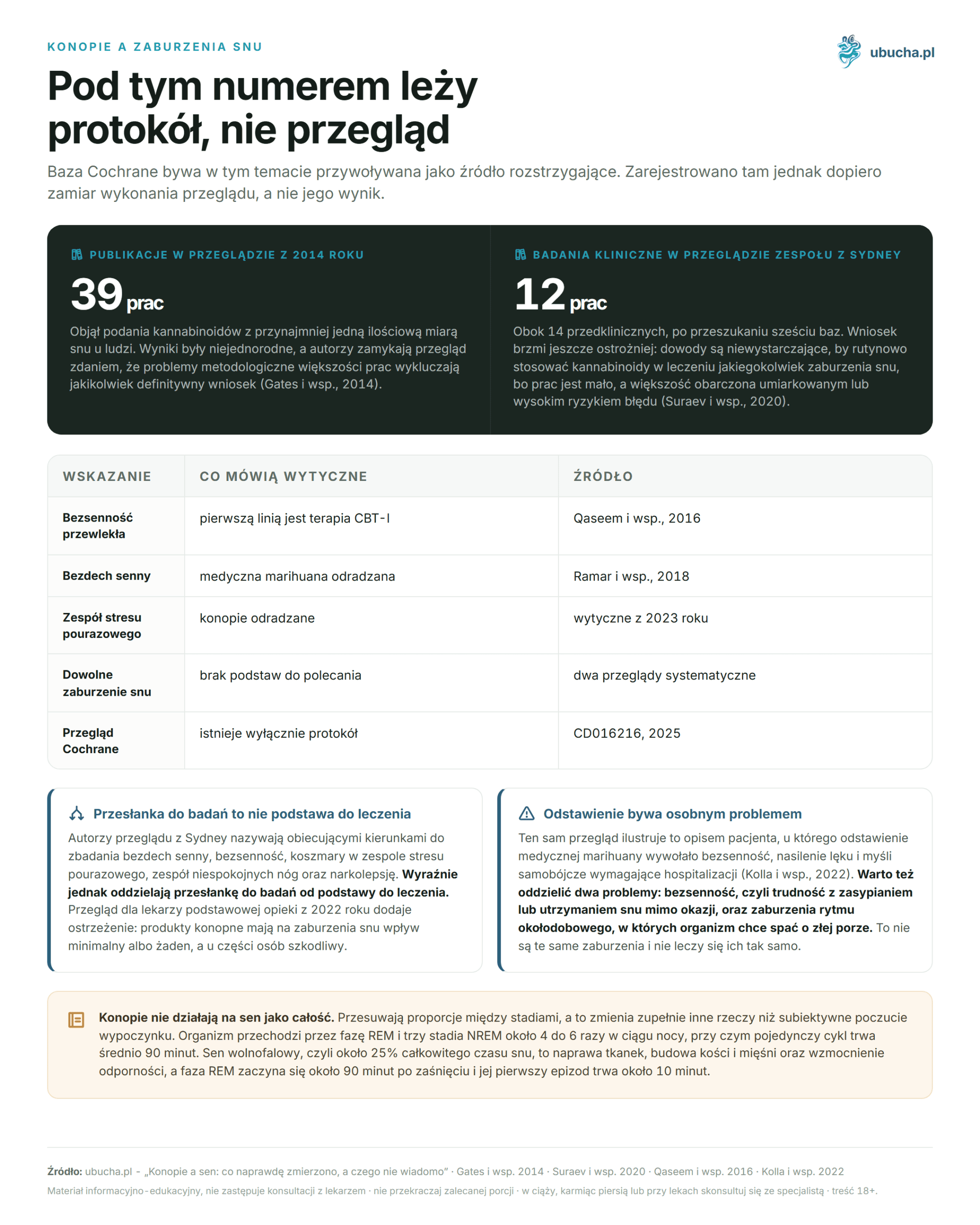
Less than the market suggests. A 2014 systematic review covered 39 publications on cannabinoid administration and at least one quantitative sleep measure in humans. Results were heterogeneous, and the authors concluded that methodological problems in most studies preclude any definitive conclusion (Gates et al., Sleep Medicine Reviews, 2014).
Six years later, a Sydney team searched six databases and included 14 preclinical and 12 clinical studies. The conclusion was even more cautious: evidence is insufficient to routinely use cannabinoids for any sleep disorder because studies are few and mostly at moderate or high risk of bias. Promising directions for research include sleep apnea, insomnia, PTSD nightmares, restless legs syndrome, and narcolepsy, but the authors clearly separate research rationale from treatment basis (Suraev et al., Sleep Medicine Reviews, 2020).
A 2022 review for primary care physicians aligns with this and adds a warning: cannabis products have minimal or no effect on sleep disorders and can be harmful in some people. It illustrates this with a patient whose cessation of medical marijuana caused insomnia, increased anxiety, and suicidal thoughts requiring hospitalization (Kolla et al., Journal of Primary Care and Community Health, 2022). Cochrane has registered a protocol for a review on medical marijuana in insomnia, but the review itself is not yet available: under number CD016216 there is only the protocol in Cochrane Database of Systematic Reviews, 2025, with no later version known.
What Does Sleep Architecture Look Like and Why Does It Matter for Cannabis?
Sleep divides into REM phase and three NREM stages, which the body cycles through about 4 to 6 times per night, with a single cycle averaging 90 minutes (range 90 to 110 minutes). Cannabis does not act on “sleep” as a whole but shifts proportions between these stages, which changes very different things than subjective restfulness.
| Stage | Proportion of Total Sleep Time | Characteristics |
|---|---|---|
| N1 | about 5% | lightest stage, lasts 1-5 minutes, theta waves |
| N2 | about 45% | sleep spindles and K-complexes, lengthens with each cycle |
| N3 (slow-wave sleep) | about 25% | delta waves, tissue repair, bone and muscle building, immune strengthening |
| REM | about 25% | starts about 90 minutes after sleep onset, first episode lasts about 10 minutes, last up to an hour |
All values in the table come from Patel et al., Physiology, Sleep Stages, StatPearls (updated January 26, 2024). The distribution is uneven: early REM episodes are short and lengthen at the expense of deep sleep as the night progresses. It is worth correcting the common simplification that REM is the “memory phase.” A review in Physiological Reviews shows that memory consolidation begins with reactivation of memory traces in slow-wave sleep, which is probably stabilized by subsequent REM (Rasch and Born, 2013). A meta-analysis of 65 polysomnographic and actigraphic studies including 3,577 people aged 5 to 102 found that in adults slow-wave and REM sleep proportions decrease with age, while sleep onset latency and wake after sleep onset increase; after age 60 only sleep efficiency continues to decline (Ohayon et al., Sleep, 2004). Polysomnography remains the standard for measuring these parameters.
How Does the Endocannabinoid System Change Over the Day?
The endocannabinoid system includes CB1 receptors mainly in the brain, CB2 receptors primarily in the peripheral immune system, and endogenous ligands anandamide and 2-arachidonoylglycerol, broken down by FAAH and MAGL enzymes. Their concentrations change over the day, but in the opposite direction to what most consumer texts repeat.
Measurements in healthy people showed plasma anandamide concentration is three times higher upon waking than immediately before sleep, and sleep deprivation disrupts this rhythm (Vaughn et al., British Journal of Pharmacology, 2010). A later circadian curve in 14 young adults was biphasic: peaks around 2 a.m. and 3 p.m., lowest around 10 a.m. Sleep restriction to 4.5 hours did not change it (Hanlon, Psychoneuroendocrinology, 2020). The other ligand behaves oppositely: 2-arachidonoylglycerol has a minimum roughly mid-night sleep and rises continuously to an early afternoon peak, with sleep shortening amplifying this amplitude (Hanlon et al., Sleep, 2016).
The statement “anandamide rises in the evening and induces sleep, while 2-arachidonoylglycerol wakes in the morning” is unsupported by human measurements: the two curves look different, and two independent studies even differ on anandamide peak timing. Phytocannabinoids enter this system via two routes. THC is a partial CB1 receptor agonist and directly stimulates it. For cannabidiol, the most common description needs correction: a study in Journal of Biological Chemistry states clearly that unlike the rodent enzyme, cannabidiol does not inhibit human FAAH, so FAAH inhibition cannot explain the anandamide increase observed in humans after CBD; the mechanism is competition for intracellular fatty acid binding proteins (FABP) (Elmes et al., 2015).
How Does THC Affect Sleep and What Is the Cost of Faster Sleep Onset?
In short: a single dose usually shortens sleep onset and shifts the night toward deep sleep at the expense of REM, but with daily use this effect disappears. A comprehensive review of sleep disorders in addiction collected polysomnographic findings and distinguished three situations that must not be confused (Angarita et al., Addiction Science and Clinical Practice, 2016).
| Use Stage | Polysomnography Findings |
|---|---|
| Single dose in inexperienced person | shorter sleep onset, more slow-wave sleep, less REM and lower REM density, though not consistently across studies |
| Chronic use | tolerance to most first-dose effects including sleep induction and slow-wave sleep increase; sleep efficiency does not improve or worsens |
| REM changes with chronic use | tolerance is weaker here, but literature is inconsistent: reports of shortening, no change, and lengthening of REM |
| First nights after cessation | longer sleep onset, more wake after sleep onset, less total and slow-wave sleep, REM rebound with shortened latency |
The practical consequence is unpleasant and the authors call it a no-exit trap: to regain the former sedative effect, a chronic cannabis user must take more, and higher amounts worsen sleep further, driving further increases. It is also important to distinguish natural THC from synthetic cannabinoids sold as designer drugs. Most detected in herbal blends have higher CB1 receptor affinity than THC, and preclinical studies show their potency can be 2 to 100 times greater; reported adverse effects in humans include respiratory depression, tachycardia, psychosis, and suicidal thoughts (Castaneto et al., Drug and Alcohol Dependence, 2014). This is a different substance class and risk profile than described in this guide.
How Does CBD Affect Sleep and What Is Unknown About Its Mechanism?
The only controlled sleep recording study in healthy people tested safety, not efficacy, and should be read literally. Twenty-seven volunteers received in a crossover, double-blind placebo-controlled design a single 300 mg dose of cannabidiol 30 minutes before an eight-hour polysomnographic recording. The substance caused no significant effect, and the authors concluded that cannabidiol at an anxiolytic dose does not disrupt normal sleep architecture (Linares et al., Frontiers in Pharmacology, 2018).
This is important information but answers a different question than “will CBD help me fall asleep?” Lack of sleep disruption in healthy volunteers is not evidence of sedative effect in insomnia; in this study cannabidiol did not sedate anyone more than placebo.
A separate issue is the widespread consumer text description that low doses act via 5-HT1A receptor and mildly stimulate, while higher doses modulate GABA-A and induce sedation. A systematic review of the molecule’s molecular pharmacology does not support this division. The authors counted over 65 distinct molecular targets described in literature, noted some effects occur only at concentrations unattainable in the body, and concluded that in neurological diseases cannabidiol most likely does not act via the endocannabinoid system alone. They identified calcium homeostasis-related targets as most plausible but noted no causal proof even for these (Ibeas Bih et al., Neurotherapeutics, 2015). The honest answer is: the mechanism is not established, and claims of dose-dependent “switching” are hypotheses dressed in certainty.
Why Do Surveys and Polysomnography Give Different Answers?
Because they measure different things, and with cannabis this difference can be the entire result. This is best seen in a randomized double-blind crossover trial where 23 of 24 participants with insomnia lasting at least three months took a sublingual cannabinoid extract containing THC, cannabinol, and CBD for two weeks, then after a one-week break took placebo for two weeks.
| Measurement Method | Result vs. Placebo |
|---|---|
| Insomnia Severity Questionnaire | Improvement by 5.07 points (95% CI 2.86 to 7.28; p = 0.0001) |
| Sleep diary: total sleep time | 64.6 minutes longer (p < 0.0001) |
| Actigraphy: wake after sleep onset | 10.2 minutes shorter (p = 0.002) |
| Polysomnography: sleep onset latency | No change (0.42 minutes; p = 0.97) |
| Polysomnography: sleep stage proportions | No change |
All values come from Walsh et al., Sleep (2021). Two points must be emphasized. Blinding did not hold: all participants who responded correctly guessed when they received active treatment, and 81% justified this by improved sleep quality. The study was funded by Zelira Therapeutics, the extract’s manufacturer, though authors state design and analyses were independent. Observational data show a similar divergence. A retrospective psychiatric clinic chart review found sleep outcomes assessed by validated tools (not sleep recordings) improved in the first month in 48 of 72 adults (66.7%) but fluctuated over time; anxiety scores decreased in 57 (79.2%) and remained stable. Sleep was the main complaint in only 25 of 72 patients (Shannon et al., The Permanente Journal, 2019). More on this, what studies say about CBD’s effect on sleep quality, is collected separately.
How Does Cannabis Compare to Benzodiazepines and Z-Drugs?
None of these options is first-line therapy for chronic insomnia. The American College of Physicians guidelines based on randomized trials from 2004-2015 recommend cognitive-behavioral therapy as initial treatment for all adults, and pharmacotherapy only if therapy fails, and only short-term after discussing benefits, harms, and costs. This latter recommendation is weak and based on low-quality evidence (Qaseem et al., Annals of Internal Medicine, 2016).
| Option | Guideline Status | Main Concern |
|---|---|---|
| Cognitive-behavioral therapy for insomnia | Initial treatment, strong recommendation | Requires time and consistency; effect not immediate |
| Z-drugs and benzodiazepines | Only after failed therapy, short-term, weak recommendation | Addiction, cognitive impairment, fall risk in elderly |
| THC and combination products | No recommendation, evidence deemed insufficient | Rapid tolerance, REM rebound after cessation |
| CBD | No recommendation, no efficacy study in insomnia | Liver enzyme inhibition and drug interactions |
This table should be read alongside the conclusions from the first section. Cannabis does not lose here because it performed worse than zolpidem in direct comparison - no such comparison was conducted. It loses because it lacks data to place it on the treatment side at all. This is an important distinction: lack of efficacy evidence is not proof of no effect, but information that no one has yet tested it in a way that allows promises.
Why Is CBT-I the First-Line Treatment for Chronic Insomnia?
Because it is the only intervention in this indication with a strong recommendation based on moderate-quality evidence and applies to all adult patients without prerequisites (Qaseem et al., Annals of Internal Medicine, 2016). Cognitive-behavioral therapy for insomnia includes sleep hygiene, sleep restriction, stimulus control, relaxation techniques, and cognitive restructuring addressing anticipatory anxiety like “I won’t fall asleep again.”
Sleep restriction, limiting time in bed to actual sleep time, can be subjectively unpleasant in the first weeks and temporarily worsen well-being before improving. It is important to know this upfront as a normal therapy phase, not a sign of failure. Therapists usually ask patients to keep a sleep diary initially to plan restriction precisely and track progress. In Poland, therapy is increasingly available remotely, shortening access for people outside large cities where sleep disorder clinics remain scarce.
If fear of sleepless nights is strong, some use cannabidiol as an adjunct, never as a substitute. A sensible sequence is several weeks of behavioral work first, then possibly adding anything, aiming to discontinue once therapy works independently. This sequence protects against attributing improvement to the substance rather than habit change and facilitates later cessation without insomnia relapse. Decide on adding anything with your doctor.
Does Cannabis Help with Sleep Apnea?
Two studies showed reduced apnea and hypopnea indices, yet scientific societies advise against such treatment. In a dose-escalation pilot, 17 adults with baseline index ≥15 events/hour received dronabinol, a synthetic THC form, for three weeks, increasing weekly from 2.5 mg to 5 mg to 10 mg daily. The index dropped by 14.1 events/hour on average (p = 0.007) without sleep architecture worsening. This was a single-arm study without placebo group (Prasad et al., Frontiers in Psychiatry, 2013).
A phase 2 trial randomized 73 adults with moderate or severe apnea to placebo, 2.5 mg, or 10 mg dronabinol one hour before sleep for up to six weeks. Compared to placebo, the index dropped by 10.7 events/hour at lower dose (p = 0.02) and 12.9 at higher (p = 0.003), with highest treatment satisfaction in the 10 mg group (p = 0.04). Sleep latency, overall architecture, and nocturnal oxygenation remained unchanged (Carley et al., Sleep, 2018).
Despite these results, the American Academy of Sleep Medicine stated medical marijuana and synthetic extracts should not be used for obstructive sleep apnea and recommended removing this diagnosis from state medical marijuana programs. Reasons include uncertain administration methods and insufficient evidence on efficacy, tolerance, and safety; most patients reported adverse effects including sleepiness (Ramar et al., Journal of Clinical Sleep Medicine, 2018). Symptoms warranting medical attention rather than self-treatment include loud snoring with breathing pauses observed by others, waking with choking or palpitations, daytime sleepiness despite sufficient sleep hours, morning headaches, and falling asleep at the wheel. Positive airway pressure therapy remains standard; cannabinoids do not replace it.
How Does Cannabis Affect Nightmares and Sleep in PTSD?
There is one small positive trial and guidelines that nevertheless advise against cannabis. A double-blind crossover study involved ten Canadian soldiers with PTSD whose trauma-related nightmares persisted despite standard treatment. Nabilone, a synthetic THC analog, was given starting at 0.5 mg in the evening, increased to an effective dose or max 3 mg over seven weeks, then after a two-week break participants crossed over. Nightmare scale scores improved by 3.6 points versus 1.0 on placebo (p = 0.03), with significant overall improvement in 5 of 10 versus 1 of 9 on placebo (Jetly et al., Psychoneuroendocrinology, 2015).
Three caveats alter this result’s meaning. The trial had only ten male military participants, so generalization is speculative. Assessments used clinical scales, not sleep recordings, so the popular explanation “it works by suppressing REM” was not measured. The authors themselves state the result requires replication in a larger group.
Updated 2023 US veterans and defense guidelines resolve this clearly and differently than many texts repeat. The document contains 34 recommendations, six with strong strength, and recommends specific manualized psychotherapies over pharmacotherapy: prolonged exposure, cognitive processing therapy, and eye movement desensitization. Medications listed include paroxetine, sertraline, and venlafaxine. Crucially for this article, the guidelines advise against benzodiazepines and cannabis and cannabis-derived products (Schnurr et al., Annals of Internal Medicine, 2024). Seek urgent care if suicidal thoughts, severe daytime trauma flashbacks, psychotic symptoms, or nightmares prevent sleep for many consecutive nights appear.
What Is the Addiction Risk in People with Chronic Insomnia?
No direct comparison with recreational use exists, but the relapse mechanism closes a loop: sleep disturbance after cessation looks like a reason to return to the substance, and return maintains the problem. The scale is measured. A meta-analysis of 47 observational studies including 23,518 participants estimated cannabis withdrawal syndrome prevalence at 47% (95% CI 41-52%), with 17% in population samples, 54% outpatient, and 87% inpatient. Daily use was associated with higher risk (Bahji et al., JAMA Network Open, 2020).
Sleep withdrawal symptoms are well described: strange dreams, insomnia, and poor sleep quality reported by 32% to 76%. Strange dreams usually start 1-3 days after stopping, peak between days 2 and 6, and last 4-14 days, but larger studies found sleep difficulties lasting 43 days and dreams 45 days (Angarita et al., Addiction Science and Clinical Practice, 2016). This explains the common relapse scenario: returning to cannabis after several sleepless nights looks like evidence of need but is a withdrawal symptom.
| Factor | What Is Known |
|---|---|
| Daily use | Associated with higher withdrawal syndrome prevalence (Bahji, 2020) |
| Concurrent tobacco or other substance use | Also linked to higher prevalence (Bahji, 2020) |
| Higher product potency at lower price | Indicated as a factor increasing cannabis use disorder frequency (Connor, 2021) |
| Coexisting psychiatric disorders | Complicate cannabis use disorder treatment (Connor, 2021) |
Cannabis use disorder affects about 10% of the 193 million cannabis users worldwide. Behavioral therapies, including motivational and contingency management, can be effective; sustained abstinence remains rare, and no pharmacotherapy is registered (Connor et al., Nature Reviews Disease Primers, 2021). Cannabidiol differs here: in a randomized double-blind study of 31 regular marijuana smokers, oral doses of 200, 400, and 800 mg behaved like placebo on all abuse potential measures, unlike smoked marijuana (Babalonis et al., Drug and Alcohol Dependence, 2017). Seek help if attempts to reduce fail due to rebound insomnia, use despite harm, or suicidal thoughts. We wrote more about this in Does cannabidiol cause addiction?.
Why Won’t You Find a Dosage Table for Sleep Here?
Because such a table would promise precision that does not exist. None of the systematic reviews above ends with a numeric recommendation, and no daily doses for insomnia have been established because no studies have determined them. Numbers mentioned here describe specific studies and always stand alongside who studied, how many people, and how long.
There is, however, a limit going the other way: a threshold not to exceed. The European Food Safety Authority in 2026 derived a provisional safe cannabidiol dose by benchmark dose method with uncertainty factor 400: 0.0275 mg per kilogram body weight per day, about 2 mg daily for a 70 kg person. This value applies only to supplements with at least 98% pure CBD, no nanoparticles, safe manufacturing, and excluded genotoxicity. The same document states cannabidiol safety cannot be established in people under 25, pregnant or breastfeeding women, or those taking medications, and animal studies showed consistent liver toxicity (EFSA Journal, 2026).
Comparing this limit with study doses says more than any table. The controlled polysomnographic study used a single 300 mg dose, the abuse potential study 200, 400, and 800 mg, and refractory epilepsy preparations use doses in hundreds of milligrams. All these are multiples of the provisional supplement ceiling because they come from supervised clinical trials, not daily over-the-counter use. The conclusion is simple and cannot be tabulated: discuss your dose with a doctor, especially if taking other medications regularly.
Which Cannabis Forms Work Best for Sleep?
Popular guides give exact onset times and effect durations for each form. A systematic review of cannabidiol pharmacokinetics in humans shows such precision does not exist, and most circulating numbers have not been measured. The table below contains only values actually measured in humans.
| Measured Parameter | Value | Source |
|---|---|---|
| Absolute bioavailability of cannabidiol after smoking | 31% | Millar et al., 2018 |
| Absolute bioavailability by other routes | Not measured in humans in any study | Millar et al., 2018 |
| Half-life after oromucosal aerosol | 1.4-10.9 hours | Millar et al., 2018 |
| Time to maximum concentration, overall | 0 to 4 hours, faster after inhalation than oral | Millar et al., 2018 |
| Time to maximum concentration after sublingual complex extract | 4-6 hours | Walsh et al., 2021 |
Three practical conclusions from this table. First, the statement “inhalation gives higher bioavailability than oral” is unjustified for cannabidiol because the latter has not been measured; only that maximum concentration is reached faster (Millar et al., Frontiers in Pharmacology, 2018). Second, food and lipid form increase maximum concentration, so the same dose taken fasting or after a fatty meal is not the same. Third, time to peak after sublingual administration was 4 to 6 hours in Walsh’s study, much longer than most guides state. The worst choice remains smoking dried herb with tobacco, described in a separate literature review.
Which Interactions Between Cannabis and Other Sleep Medications Are Dangerous?
Two mechanisms, both with the same direction: cannabis enhances drug effects, not weakens. The first is additive CNS depression when THC combines with benzodiazepines or Z-drugs. This increases next-day sedation risk, coordination impairment, and in sleep apnea patients, breathing disturbances during sleep.
The second mechanism was quantified. In an open phase 1 study in healthy volunteers, cannabidiol co-administration increased exposure to clobazam’s active metabolite N-desmethylclobazam 3.4-fold in both peak concentration and area under the curve, while clobazam exposure changed slightly (1.2-fold). Stiripentol exposure increased 1.6-fold AUC, and valproate did not change clinically significantly (Morrison et al., Clinical Pharmacology in Drug Development, 2019). The study was conducted and funded by the company marketing the cannabidiol product used, and all authors were affiliated, which is important to know for such data.
The mechanism was confirmed separately: cannabidiol strongly inhibits clobazam metabolism by human CYP3A4 and its metabolite by CYP2C19. The rest of that work, including showing joint action on GABA-A receptor, was based on mouse models and cell lines, so not directly transferable to humans (Anderson et al., Epilepsia, 2019). The practical takeaway: doses of drugs metabolized by these pathways may need downward adjustment, decided by the treating physician, never by the patient alone. Avoid combining cannabis with alcohol or opioids absolutely. People taking psychiatric medications and over-the-counter drugs, including antihistamines for sleep, should bring a full list of all products including cannabis to their doctor.
How to Recognize When Cannabis Is Not the Right Choice?
Some situations are decided before the first dose, not after. The table below collects conditions where cannabis use is contraindicated or delays diagnosis of the true insomnia cause.
| Situation | Why It Is a Problem |
|---|---|
| Schizophrenia, bipolar disorder, or family history of psychosis | THC, especially at high concentration, can trigger or worsen psychotic episodes |
| Pregnancy and breastfeeding | Cannabidiol safety cannot be established; substance crosses placenta (EFSA, 2026) |
| Under 25 years old | Cannabidiol safety cannot be established (EFSA, 2026) |
| Chronic medication use | Safety cannot be established; hepatotoxic potential described in humans (EFSA, 2026) |
| Suspected undiagnosed sleep apnea | Cannabis may mask symptoms instead of treating cause; scientific societies advise against it (Ramar, 2018) |
Driving is a separate issue. A meta-analysis of 80 publications and 1,534 results predicted that after inhaling 20 mg THC most driving-relevant skills return to normal within about 5 hours, and almost all within about 7 hours; oral administration impairment may last longer, and regular users are less impaired than occasional. Authors recommend waiting at least 5 hours after inhalation before tasks requiring full ability (McCartney et al., Neuroscience and Biobehavioral Reviews, 2021). In Polish reality, this is too short to drive safely: the basis for testing drivers for substances acting like alcohol is Article 129j of the Road Traffic Act, and driving under their influence is a crime under Article 178a paragraph 1 of the Penal Code, punishable by up to 3 years imprisonment. The practical rule is simpler than the law: do not drive if you feel any effect. Insomnia lasting over three months, daytime sleepiness, snoring, sudden onset in a previously good sleeper, or depression symptoms require medical evaluation, as this pattern may signal problems beyond sleep medicine, e.g., thyroid disorders. Before planned surgery, inform the anesthesiologist about regular cannabis use. More on cardiovascular risks is described in a separate article.
Frequently Asked Questions
Do cannabis products actually help with sleep?
Two systematic reviews respond: evidence is insufficient to recommend cannabinoids for any sleep disorder because there are few studies and most carry risk of bias (Gates, Sleep Medicine Reviews, 2014; Suraev, Sleep Medicine Reviews, 2020). Cognitive-behavioral therapy remains the first-line treatment for chronic insomnia, with a strong recommendation.
How does survey data differ from polysomnography results?
Surveys measure subjective experience, sleep recordings measure physiology, and with cannabis these two measures diverge. In a randomized crossover trial, a cannabinoid extract improved questionnaire and sleep diary results but did not change sleep onset latency or sleep stage proportions in polysomnography (Walsh, Sleep, 2021).
How does THC affect sleep architecture and REM phase?
A single dose usually shortens sleep onset, increases slow-wave sleep, and decreases REM, though not in all studies. With chronic use, tolerance develops to these effects, and after cessation polysomnography shows REM rebound, less slow-wave sleep, and more wakefulness (Angarita, Addiction Science and Clinical Practice, 2016).
Can cannabis be combined with benzodiazepines or zolpidem?
Not without a doctor, as the interaction direction is enhancement of the drug’s effect. Cannabidiol increased exposure to the active metabolite of clobazam 3.4-fold in healthy volunteers by inhibiting CYP3A4 and CYP2C19 isoenzymes (Morrison, Clinical Pharmacology in Drug Development, 2019). The drug dose may need to be reduced.
Is cannabis safe for people with sleep apnea?
The American Academy of Sleep Medicine advises against medical marijuana and its synthetic extracts in this diagnosis despite two studies showing reduced apnea events, due to uncertain administration methods and insufficient safety evidence (Ramar, Journal of Clinical Sleep Medicine, 2018). Positive airway pressure therapy remains the standard.
Does cannabis help with nightmares in PTSD?
One trial with ten soldiers showed significant improvement in 5 of 10 versus 1 of 9 on placebo (Jetly, Psychoneuroendocrinology, 2015). However, 2023 guidelines from US veterans and defense departments still advise against cannabis and derivatives, recommending trauma-focused psychotherapies instead (Schnurr, Annals of Internal Medicine, 2024).
How often does withdrawal syndrome occur after stopping cannabis?
A meta-analysis of 47 studies on 23,518 people estimated prevalence at 47%, ranging from 17% in population samples to 87% in hospital samples (Bahji, JAMA Network Open, 2020). Sleep symptoms, including strange dreams and insomnia, affect 32% to 76% of those withdrawing and can last weeks.
Does cannabidiol cause addiction?
In a randomized double-blind study of 31 regular marijuana smokers, oral doses of 200, 400, and 800 mg behaved like placebo on all measures of abuse potential (Babalonis, Drug and Alcohol Dependence, 2017). This does not mean it is inert: safety cannot be established when taken concurrently with other medications.
If after consulting your doctor you seek a specific product, a review of available cannabis oils is in the oils category.
Summary: When Does Cannabis Make Sense and When Not?
The state of knowledge can be summarized in three sentences. A single THC dose can shorten sleep onset and shift the night toward slow-wave sleep, but with chronic use the effect disappears and cessation brings REM rebound and weeks of worse sleep. Cannabidiol at an anxiolytic dose does not disrupt sleep architecture in healthy people, nor sedate them, and its mechanism remains unknown. A randomized sleep recording trial in chronic insomnia improved subjective feelings but not physiology, with blinding that did not hold.
Specific indications vary and should be separated. In sleep apnea, the scientific stance is negative and positive airway pressure therapy remains standard. For trauma nightmares, there is one small positive trial and guidelines that nevertheless advise against cannabis. In chronic insomnia, first-line is cognitive-behavioral therapy, with pharmacotherapy only after failure and short-term. In pregnancy, breastfeeding, under 25, and chronic medication use, cannabidiol safety cannot be established.
Thus, cannabis is not a natural sleep aid without side effects but a substance with a specific risk profile and surprisingly thin evidence base given the market scale. Lack of efficacy evidence is not proof of no effect but information that no one has yet tested it in a way allowing promises. The decision to try cannabis for sleep should be made after consulting a doctor and excluding other causes, not after another sleepless night.
This article is for informational and educational purposes and does not constitute medical advice. Before starting cannabis or CBD for therapeutic purposes, consult a doctor, especially if you take other medications, are pregnant, or breastfeeding.
Author: Michał Waluk · Published: 2026-05-06 · Updated: 2026-08-16