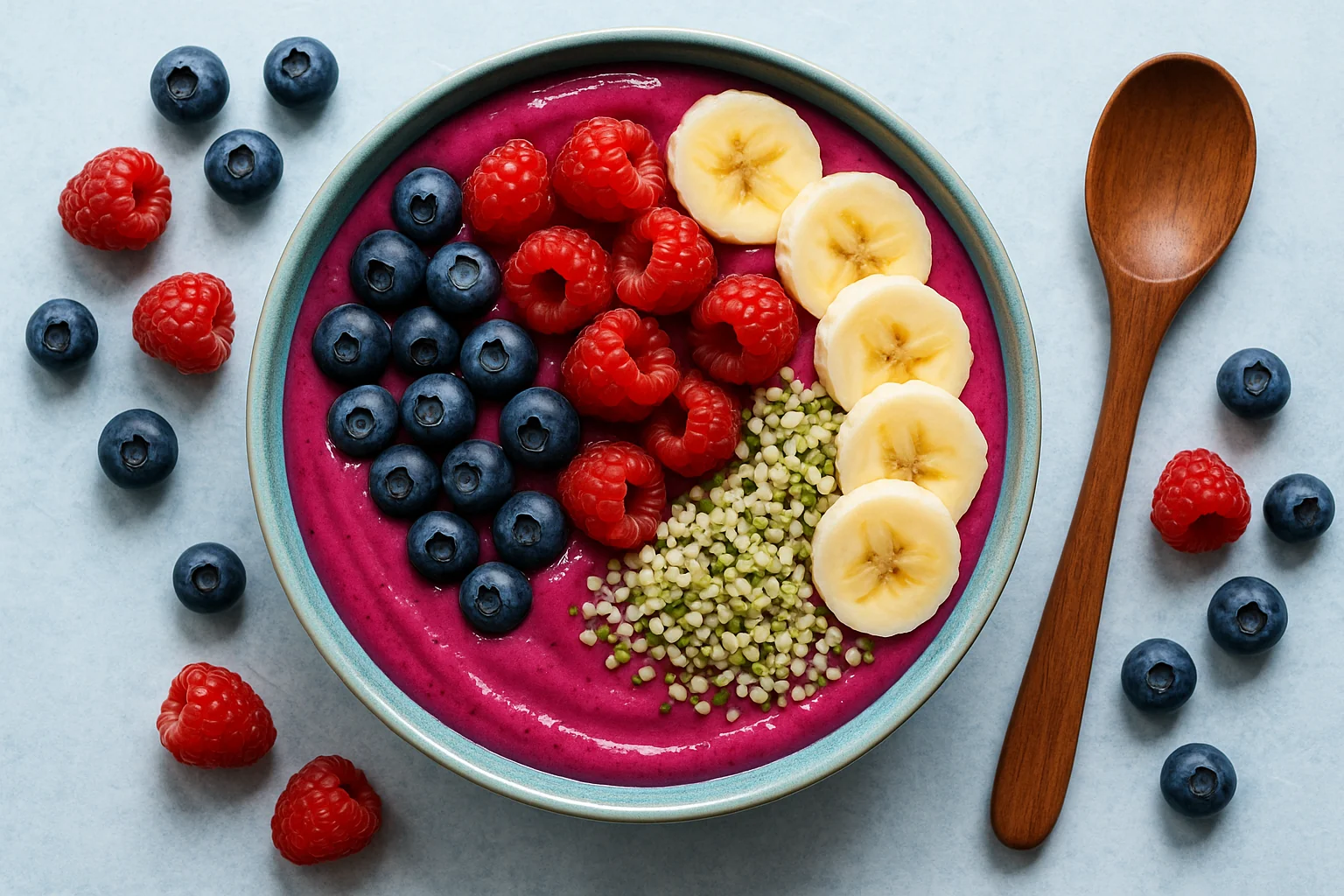

Smoothie bowl with fruits and hemp seeds: colorful breakfast
How to make a really thick smoothie bowl base and how much protein hulled hemp seeds provide. Step-by-step recipe, measurements from studies, and an honest account of the portion.
A smoothie bowl looks like a dessert but is meant to be breakfast. The biggest problem with homemade versions lies not in the ingredients but in the consistency: the base comes out liquid and turns into fruit soup after five minutes. The second problem is nutritional. The fruit base alone is mainly sugars and water, so an hour later you are hungry again. Hulled hemp seeds address this second issue: in measurements of thirty commercial batches of hemp products, they averaged 35.9% protein and 46.7% fat (House et al., Journal of Agricultural and Food Chemistry, 2010). Below you have a recipe for a base as thick as sorbet and an honest account of what the seeds bring to this bowl and what they do not.
KEY INFORMATION
• Hulled hemp seeds: 31.6 g of protein and 48.8 g of fat per 100 g (USDA FoodData Central, record 170148).
• A 30 g portion thus provides about 9.5 g of protein and nearly 15 g of fat.
• Lysine is the first limiting amino acid in hemp products, so “complete protein” is a simplification (House et al., 2010).
• The density of the base is made by frozen fruits, not fresh ones.
What do hemp seeds bring to the smoothie bowl?
Fat and protein, which the fruit base almost lacks. The USDA FoodData Central food composition database lists hulled hemp seeds as having 31.6 g of protein and 48.8 g of fat per 100 grams (record 170148), so a thirty-gram portion provides about 9.5 g of protein and nearly 15 g of fat. It contains 2.6 g of carbohydrates, of which 1.2 g is fiber.
A second, independent measurement confirms this. House and colleagues examined thirty commercial batches of hemp products and found that hulled seeds averaged 35.9% protein and 46.7% fat, with deviations of 3.6 and 5.0 points. The variation comes from the batch and variety, not the method.
This same work, however, suggests speaking about the quality of this protein more cautiously than most recipes do. The PDCAAS, or protein digestibility corrected amino acid score, was 63-66% for hulled seeds, 49-53% for whole seeds, and 46-51% for the residue after oil extraction. In all studied products, lysine was the first limiting amino acid. The statement “hemp seeds are a complete protein” is therefore an oversimplification. All essential amino acids are present in nutritionally significant amounts (Callaway, Euphytica, 2004), but lysine sets the ceiling and determines the final score.
For breakfast, this is still good news. House concludes that hemp protein has a PDCAAS equal to or higher than some grains, nuts, and legumes, and removing the hull improves both the digestibility of the protein and the score itself. The digestibility measured for hulled seeds ranged from 83.5% to 92.1%.
Fat works here on a second track. It changes the character of the meal because the fruit base is almost exclusively sugars, and 15 g of fat alongside 9.5 g of protein makes it a dish with a completely different energy density. The fat is predominantly polyunsaturated: out of 48.8 g, 38.1 g are PUFA, including 27.4 g of linoleic and 8.68 g of alpha-linolenic acid (USDA, record 170148). This results in an omega-6 to omega-3 ratio slightly above 3:1, which is at the upper limit of the range from 2:1 to 3:1 that Callaway provides for hemp seed oil.
Hulled seeds or whole: what to take to the bowl?
For the smoothie bowl, hulled seeds are the way to go. They have the highest fat content among the three hemp products measured by House, a high protein content, and the best quality index. Whole seeds crunch in the teeth and perform worse in all three measurements compared to hulled seeds.
It is worth distinguishing three things that recipes mix up. The residue on the right side of the chart is the leftover from oil extraction, and from it, hemp flour is made. It has the most protein but over four times less fat than hulled seeds, so the numbers on the flour package do not describe the seeds and vice versa. A separate measurement of whole hemp seeds, converted to dry mass, yielded 25.6 g of protein, 34.6 g of fat, and 33.8 g of fiber per 100 g (Mattila et al., Plant Foods for Human Nutrition, 2018). Most of this fiber is in the hull, which has just been removed from hulled seeds.
What do you need for one serving?
The list is short, and the only ingredient you cannot skimp on is frozen fruits. Fresh ones have too much water, and the base made from them will always be thin.
- 150 g of frozen fruits for the base: mango, strawberries, or a mixed berry blend
- half a ripe banana for creaminess
- 2-3 tablespoons of plant milk, the absolute minimum needed to get the blender going
- 25-30 g of hulled hemp seeds as a topping
- a handful of fresh seasonal fruits: berries, raspberries, or kiwi
- 2 tablespoons of granola or oats for crunch
- optional: a tablespoon of peanut butter or tahini
- optional: coconut flakes or a few mint leaves
You will need a blender with a power of at least 600 W and a spatula. A weaker device can also work, but you will need to add more liquid, and each additional tablespoon of milk takes away from the thickness of the base. Choose a wide and shallow bowl, as in a tall one, the topping slides to the center, and the whole arrangement of rows gets disrupted.
Buy hulled seeds, not whole ones. Keep the package in the fridge after opening and use it within a few weeks: with a fat content close to 49%, rancidity is a real risk, and you can recognize rancid seeds by their sharp aftertaste. Break up frozen fruits before blending, as a solid block can jam the blade.
How to make a base that is not liquid?
The secret comes down to one thing: use less liquid than instinct suggests. Most home failures come from too much milk poured in at the very beginning when the blender has nothing to grind yet. Start with two tablespoons and only add more when the blade stops.
- Place an empty bowl in the freezer for 5 minutes. A cold bowl slows down the melting of the base and gives you a few minutes to arrange the topping.
- Pour 2-3 tablespoons of plant milk into the bottom of the blender, add frozen fruits and banana. Do not add anything more.
- Blend on the highest speed, stopping every 15 seconds to push the mixture towards the blade with a spatula.
- Check the consistency: place a spoon vertically in the mixture. If it stands, the base is ready. If it falls over, add a handful of ice or a few frozen fruit cubes and blend for another 20 seconds.
- Transfer the base to the chilled bowl and smooth the surface with the back of a spoon.
- Arrange the topping in rows: hemp seeds, fresh fruits, granola. You have about three minutes before the base starts to soften.
- Serve immediately and eat with a spoon, mixing the base with the topping with each bite.
Granola and seeds go on top literally at the last moment. If placed earlier, they absorb moisture from the base, soften, and sink below the surface, causing the bowl to lose both crunch and appearance. If you prefer a warmer and more filling breakfast, the same portion of seeds works well in oatmeal with hemp seeds and berries.
What smoothie bowl variations make sense?
The formula is flexible, so it is easy to ruin it with too many additions. Three variations that work and one mistake that comes back most often.
A base made from frozen mango comes out the smoothest among popular fruits because the flesh is thick and not watery. Half a banana adds creaminess, and a few drops of lime juice balance the sweetness. Green hemp seeds stand out clearly against the yellow-orange background, which can be a stronger argument than the ingredients when it comes to breakfast for a child.
A base made from frozen berries gives a deep purple color and a strongly sour profile, so it can handle more banana. The spinach variant, on the other hand, shifts the whole towards savory and has a separate recipe: green smoothie with hemp seeds and spinach. The protein version involves mixing a tablespoon of hemp protein directly into the base before blending, at the cost of a bit of smoothness.
The mistake that comes back: fresh fruits instead of frozen ones. You cannot make a thick base from them regardless of the power of the blender because the problem is water, not power. When there is no time in the morning even for a blender, a simpler solution can be semolina with hemp seeds, ready in seven minutes.
Frequently asked questions
How to make a thick smoothie bowl that is not liquid?
The fruits must be frozen, and the liquid should be no more than three tablespoons. A blender with a power of at least 600 W, breaks to push the mixture with a spatula, and a bowl previously chilled in the freezer take care of the rest. Fresh fruits contain too much water and are not suitable for the base.
How much hemp seeds to add to the smoothie bowl?
A portion of 25-30 g, or two to three tablespoons, is enough as a topping. With 31.6 g of protein and 48.8 g of fat per 100 g, this gives about 8-9.5 g of protein and 12-15 g of fat (USDA FoodData Central, record 170148). More than three tablespoons starts to dominate in flavor.
Are hemp seeds a complete protein?
They contain all essential amino acids in nutritionally significant amounts (Callaway, 2004), but lysine is the first limiting amino acid, and the PDCAAS of hulled seeds is 63-66% (House et al., 2010). It is a good plant protein, not a reference protein.
What fruits go well with a smoothie bowl with hemp seeds?
For the base, use frozen mango, strawberries, or a mixed berry blend. Mango provides the smoothest consistency, while berries give the strongest color. On top, add fresh berries, raspberries, kiwi, or banana slices. Freezing is not a compromise here, but a condition for achieving a thick base.
Can a smoothie bowl be prepared in the evening?
The base cannot. After thawing and re-chilling, it loses thickness and becomes watery. However, in the evening, you can chop the fruits, measure the seeds, and prepare granola in a separate container. Blending the base in the morning takes about five minutes.
What is the difference between hemp flour and hemp seeds?
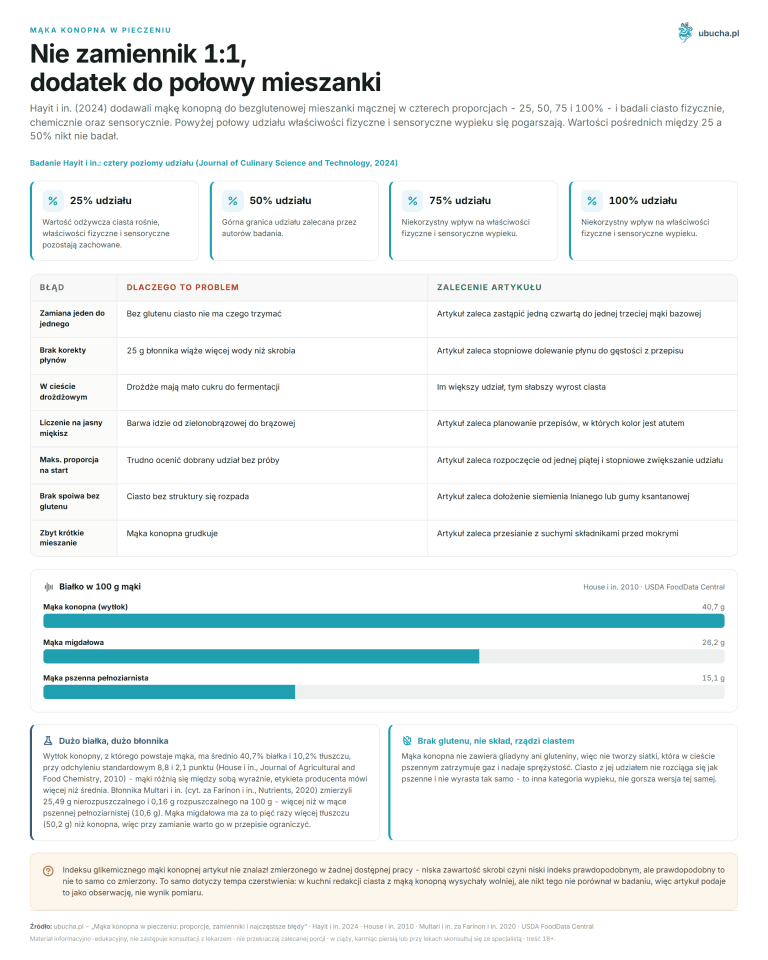
These are two different products. Flour is made from the residue left after oil extraction, so it has about 40.7% protein but only 10.2% fat, while hulled seeds have 35.9% and 46.7% (House et al., 2010). The numbers from one do not describe the other.
This article is for informational and educational purposes and does not replace consultation with a doctor. If you are pregnant, breastfeeding, taking medications, or have chronic conditions, consult the use of supplements or herbs with a specialist.
Author: Michał Waluk · Published: 2026-06-02 · Updated: 2026-08-16