
Cali weed - what is it? Facts, history and law in Poland
Cali weed is a marketing category, not a strain. Data on dried cannabis potency, California history, and legal status in Poland where possession is a crime.
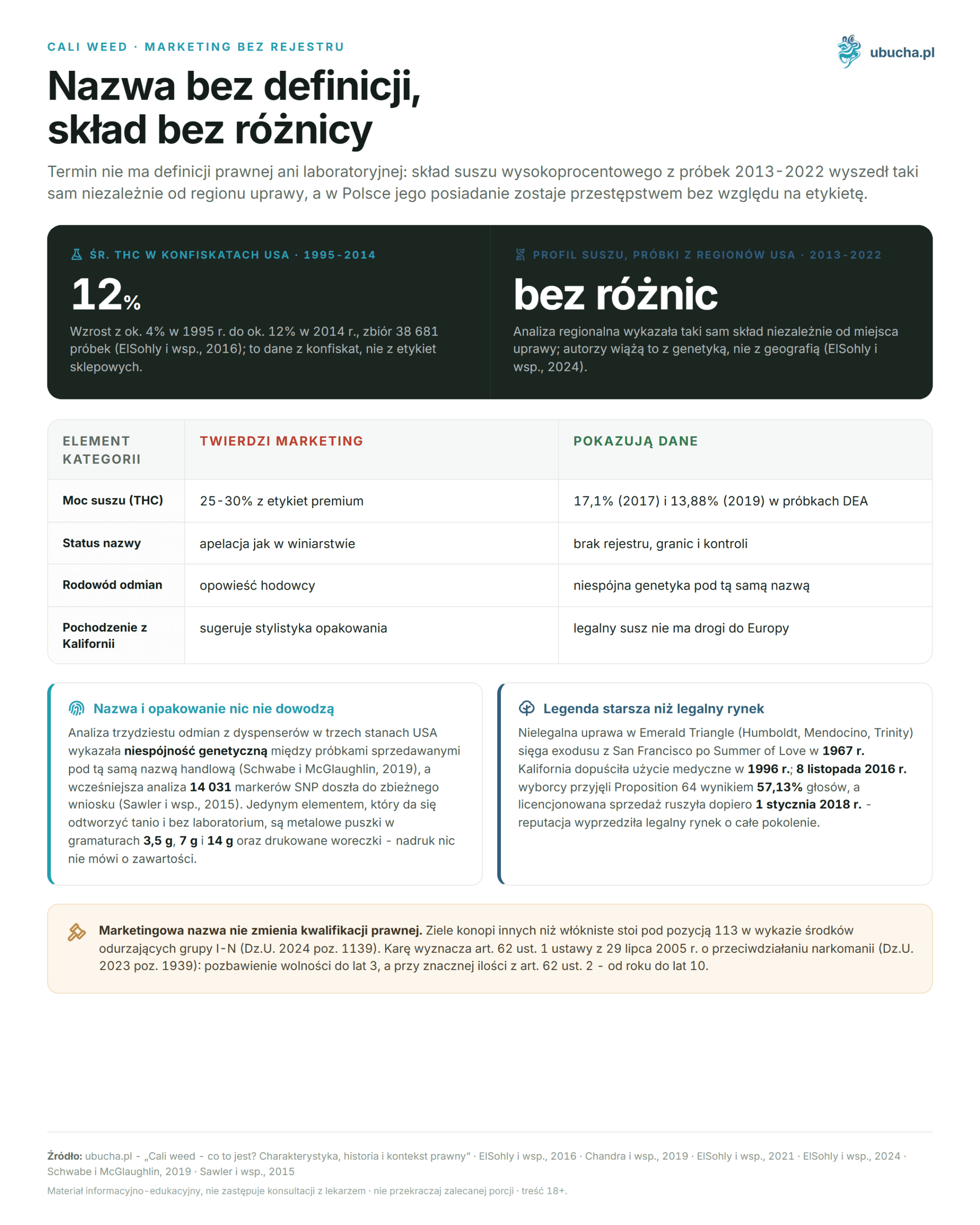
Cali is a trade name, not a strain or confirmed origin, and in Poland possession of such labeled dried cannabis is a crime under article 62. The name “cali weed” appears on packaging more often than in any strain catalog. It looks like an origin label but acts like a logo. When compared with laboratory data, the picture is less impressive. Analysis of samples from 2013-2022 grouped by US region showed that the cannabinoid profile of high-THC dried cannabis is practically the same regardless of where the plant was grown (ElSohly et al., 2024). This text describes the phenomenon, not a product to buy. It covers the history of California’s reputation, potency data, marketing mechanics of this category, and the legal status in Poland where possession is a crime.
KEY INFORMATION
• Average THC content in seized cannabis in the USA rose from about 4% in 1995 to about 12% in 2014 (ElSohly et al., 2016).
• “Cali” is a marketing category, not a botanical strain or protected designation.
• In Poland possession of such dried cannabis is a crime under article 62 of the 2005 Act.
• Products from fiber hemp below 0.3% THC are a separate category, not a substitute.
What is “cali weed” and is it even a strain?
Cali weed is a colloquial trade name for high-THC cannabis dried flower sold in California-style packaging. It is not a botanical strain, protected name, or legal category. Strains associated with this term belong to chemotype I, dominated by THC, which also prevails in medical and recreational markets (Lewis et al., 2018).
The term combines three different things. First is the genetic pool popularized by California breeders, with names like OG Kush or Girl Scout Cookies. Second is the indoor production model, repeatable and industrial. Third is the visual layer: printed bags, tins, holograms, collaborations with musicians.
None of these three is verified by any institution. The common comparison to wine breaks down here. Wine appellations have registries, geographic boundaries, and controls. “Cali” has none of these, so no one can revoke the name.
This has practical consequences for reading labels. The text on packaging describes the seller’s intention, not a verified fact about content. More on how strain names relate to actual plant biology is in the article on cannabis strains and properties.
In European circulation, the term has shifted function. It started as a geographic shorthand and ended as a price shelf label, roughly like “premium” in food categories. Sellers use it to justify higher prices, buyers read it as a promise of potency. Both sides rely solely on declaration, as no document exists in the informal market to confirm or refute it.
Where does the Emerald Triangle reputation come from?
The reputation comes from three northern California counties: Humboldt, Mendocino, and Trinity, called the Emerald Triangle. Since the late 1960s and 1970s, illegal cannabis cultivation developed there. Legalization came much later: medical in 1996, recreational only in November 2016.
The starting point was the exodus after the Summer of Love in 1967. Hundreds of young people left San Francisco and settled in northern state forests as part of the “back to the land” movement. Cannabis became a crop that sustained these settlements as the local timber industry declined.
The geography favored discretion. Dense redwood forests, scattered buildings, and poor roads hindered control, and local communities had little interest in reporting neighbors. For three decades, selection occurred without documentation, in conditions where breeding records were evidence of a crime.
The law caught up in stages. In 1996 California was the first US state to allow medical use by Proposition 215, the Compassionate Use Act. Twenty years later, on November 8, 2016, voters passed Proposition 64 with 57.13% votes, creating the Control, Regulate and Tax Adult Use of Marijuana Act. Licensed recreational sales started January 1, 2018. The legend thus predates the legal market by a generation and shaped the brand more than regulations.
However, the twenty years between votes made a breeding difference. The medical system allowed more open selection: comparing plants, describing them, selling clones, and building recognizable names instead of hiding all work. European seed banks operated legally at the same time but on material largely originating from there. California thus gained a first-mover advantage, not a climate advantage.
What do lab data say about the potency of this dried cannabis?
The best documented numbers come from the potency monitoring program at the University of Mississippi, funded by NIDA, analyzing samples seized by the DEA. They show a systematic increase in THC content: from about 4% in 1995 to about 12% in 2014 in a set of 38,681 samples (ElSohly et al., 2016).
| Period | Average THC content | Number of samples | Report |
|---|---|---|---|
| 1995-2014 | from about 4% to about 12% | 38,681 | ElSohly et al., 2016 |
| 2008-2017 | from 8.9% to 17.1% | 18,108 | Chandra et al., 2019 |
| 2009-2019 | from 9.75% to 13.88% | 14,234 | ElSohly et al., 2021 |
We compiled three reports from the same program and the numbers do not form a smooth curve. The year 2017 appears as 17.1% in one study (Chandra et al., 2019), while another sample set shows averages of 14.88% in 2018 and 13.88% in 2019 (ElSohly et al., 2021). The reason is simple: sample sets differ and seizures declined with legalization in more states.
Two practical conclusions follow. Treating any of these values as a fixed “average marijuana potency” overstates precision not present in the data. Second, these are seizures, not licensed store products, so declared 25-30% on premium labels does not come from this source.
More interesting than THC alone is its ratio to CBD, showing selection direction. In samples from 2009-2019 it rose from 24.81 to 103.48 in 2017, then reversed: 54.39 in 2018 and 24.58 in 2019. Authors link this to a return of CBD-rich strains (ElSohly et al., 2021). Concentrates also grew, with another report showing their share rose from 0.5% to 4.7% between 2008 and 2017, and average THC in concentrates from 6.7% to 55.7% (Chandra et al., 2019).
Does Californian origin change the plant composition?
Not to the extent the name suggests. Samples from 2013-2022 grouped by seizure and cultivation region showed the high-potency dried cannabis cannabinoid profile is practically the same everywhere. Authors attribute it to plant genetics, not geography (ElSohly et al., 2024).
This finding undermines the basic promise of this category. If composition depends on genetic material, and seeds and clones spread worldwide long ago, Californian latitude leaves no measurable trace in the dried cannabis.
Existing differences lie elsewhere. Terpenes shape perceived aroma and, as Russo described, may modulate cannabinoid effects via the entourage effect (Russo, 2011). Russo presents this synergy conditionally, writing “if proven” and proposing research methods, so it is a research program, not a conclusion. These compounds are volatile and depend on drying and storage, i.e., post-harvest factors.
Also, the market does not select optimal profiles but best-selling ones. Lewis, Russo, and Smith note dominance of high-THC and high-myrcene chemotypes, which may not suit those seeking specific effects. More on aromatic compounds is in the article on cannabis terpenes.
The 2013-2022 regional analysis included states with medical programs, so comparison was not limited to one market. Even with such source spread, the profile remained consistent: delta-9-THC dominant, other cannabinoids below half a percent except CBG and CBN under one percent. Geography proved a variable explaining nothing.
What does the production referenced by this name look like?
The category refers to indoor cultivation: plants grow under LED lamps, in air-conditioned rooms with humidity and CO2 control, several cycles per year. This model yields repeatable bud appearance, and the premium product impression largely comes from this repeatability.
Before continuing, one caveat. The description applies to markets where such production is legal. In Poland, cultivation of cannabis other than fiber hemp is a crime under article 63 of the Act on counteracting drug addiction, punishable by up to 3 years imprisonment.
LED panels replaced older sodium lamps because they heat less and allow spectrum control. Air conditioning, air filtration, and sanitary procedures limit molds and pests, improving microbiological test results. In large facilities, staff wear protective clothing and cultivation zones are separated by airlocks.
The biggest difference is post-harvest. Slow drying and several weeks of curing in sealed containers determine how many terpenes remain and how the product smells when opened. The same genotype grown carelessly yields dried cannabis no packaging print can save. Visual uniformity perceived as quality is thus an industrial process effect, not a Californian climate effect.
The economics of this model matter too. Outdoor cultivation yields one harvest per season, indoor several per year but at energy cost for lighting and air conditioning. Producers who bear this cost must recover it in price, selling not just grams but appearance, repeatability, and name. The category’s entire aesthetic grows from this arithmetic, not from breeding secrets.
Which strains form the canon and how certain are their lineages?
The canon includes about a dozen names, most often OG Kush, Girl Scout Cookies, Sour Diesel, and Wedding Cake. Their lineages function as breeder stories, not registry records. For a plant whose breeding was criminal for decades, documentation simply was not kept.
| Name | Reported origin | Declared aroma | Knowledge status |
|---|---|---|---|
| OG Kush | Los Angeles, 1990s | earth, pine, fuel | disputed lineage |
| Girl Scout Cookies | San Francisco area, circa 2010 | sweet, cookie-like | breeder accounts |
| Sour Diesel | US East Coast, 1990s | fuel, citrus | breeder accounts |
| Wedding Cake | circa 2015, divergent versions | vanilla, tartness | disputed lineage |
Checking these lineages, we found a pattern confirmed by genetic studies. Analysis of thirty strains bought in dispensaries in three US states, using ten microsatellite markers developed on the “Purple Kush” genome, showed genetic inconsistency between samples sold under the same name, with over two thousand trade names in circulation and no registration mechanism (Schwabe and McGlaughlin, 2019).
The same study challenges the division underlying half of sales descriptions. Samples statistically split into two genetic groups, but these did not match declared sativa, indica, or hybrid types. Authors add a usual caveat: after removing clear outliers many strains were genetically quite stable. The discrepancy concerns rather individual batches than the whole category.
Earlier work based on 14,031 SNP markers reached a convergent conclusion from another angle: trade names often do not correspond to distinct genetic identity, and the declared sativa/indica division correlates only moderately with genotype (Sawler et al., 2015). Strain name is thus a marketing label with limited informational value, even in regulated markets. Naming evolves in families: after Girl Scout Cookies came cookie variants, then a wave of dessert names. This convention is based on flavor association, not plant kinship.
Why does packaging mean as much as content here?
Packaging is the product identity carrier in this category. Multi-layer barrier foil bags protect material from light and moisture but also serve as advertising surface: print, hologram, QR code. Metal tins in 3.5 g, 7 g, and 14 g sizes do the same in another form.
Marketing grew at the intersection of hip-hop, streetwear, and social media. Collaborations with musicians, like Khalifa Kush branded by Wiz Khalifa or Cookies co-created by rapper Berner, shifted focus from composition to lifestyle. The product sells like limited edition sneakers.
This has a structural consequence rarely stated directly. Of all category elements, packaging is the only one fully reproducible cheaply and without a lab. Empty tins and bags are normal wholesale goods, and printing is a matter of ordering from a printer.
Print thus says nothing about inside content. In regulated markets this is balanced by a mandatory analysis certificate from an accredited lab, assigned to a specific batch and verifiable with the issuer. Outside that market there is no balance: only graphics remain.
Added is scarcity mechanics borrowed from fashion. Limited series, numbered batches, short sales windows, and seasonal collaborations raise price without changing content. Consumers pay for message rarity, not raw material rarity. In a category where chemical composition is basically repeatable, packaging is the only axis along which product can be differentiated.
Does dried cannabis labeled “cali” come from California?
It is worth knowing the packaging vocabulary itself, as it circulates in search engines. Weed is simply the English colloquial term for dried cannabis, with no information on strain or quality. Cali bags are characteristic foil bags with print associated with this market, and fake cali is a term for goods imitating this look. None is a quality category: they describe packaging appearance, not content, and can be bought empty on any auction portal.
Usually it cannot come from California. California regulations allow licensed cannabis sales only within the state, and US federal law still prohibits export of recreational cannabis. Material from a legal California chain has no lawful route to Europe, so packaging is not proof of origin.
Federal status changed partially and should be read carefully. The final rule effective April 28, 2026 moved FDA-approved marijuana medicinal products and state-licensed medical marijuana manufacturing, distribution, or dispensing to Schedule III (Federal Register, document 2026-08176). Recreational marijuana remains Schedule I. Proceedings for broader change are separate: hearings ran June 29 to July 15, 2026, with no decision at time of writing.
We also noticed the often repeated figure in this discussion, claiming 70-90% counterfeits in the European market, circulates without citing study, measurement, or method. We treat it as industry commentary, not data. The phenomenon’s scale simply has not been measured in a verifiable way.
What can be said from sources: monitoring programs in the Netherlands, UK, France, and Italy also noted in the last decade increased THC concentrations and THC to CBD ratios in tested material (Chandra et al., 2019). European high-potency dried cannabis exists independently of packaging claims.
Outside regulated circulation there is also risk not covered by labels. A 2025 review describes the return of synthetic cannabinoid receptor agonists as contaminants added to plant material. Authors describe them as strong full receptor agonists with unpredictable reactions (Jones et al., 2025). The nicer the packaging, the stronger the implied control behind it that does not exist.
What are the penalties for possessing cali weed in Poland?
Possession is a crime. Cannabis other than fiber hemp is listed under position 113 in the list of narcotic substances group I-N, together with extracts and pharmaceutical tinctures from such cannabis; cannabis resin has a separate position 188. The list is annex no. 2 to the Minister of Health’s regulation, consolidated text Dz.U. 2024 item 1139, not the Act itself. Penalty is set by article 62 of the Act of July 29, 2005 on counteracting drug addiction, consolidated text Dz.U. 2023 item 1939: imprisonment up to 3 years, and for significant amount from 1 to 10 years.
| Provision | Act | Penalty |
|---|---|---|
| art. 62 sec. 1 | possession | imprisonment up to 3 years |
| art. 62 sec. 2 | possession of significant amount | 1 to 10 years imprisonment |
| art. 55 sec. 1 | import, export, transport | fine and imprisonment up to 5 years |
| art. 56 sec. 1 | placing on market | fine and imprisonment 6 months to 8 years |
| art. 63 sec. 1 | cultivation | imprisonment up to 3 years |
| art. 63 sec. 3 | cultivation capable of yielding significant amount | 6 months to 8 years imprisonment |
The Act provides two mitigations with narrow scope. A minor offense under art. 62 sec. 3 allows a fine, restriction of liberty, or imprisonment up to one year. Art. 62a allows discontinuation of proceedings for a small amount for personal use when punishment would be pointless, even before investigation starts. However, it refers only to art. 62 sec. 1 and 3, so it does not apply to significant amounts under sec. 2. This is prosecutor or court discretion, not a possessor’s right.
Ordering a shipment from abroad is not a milder variant. Importing a narcotic from outside the country qualifies under art. 55, with harsher penalties than possession alone. Comparison of laws in other countries is described in the article on marijuana legality map.
The Act does not specify a threshold in grams or plant units for significant amount; for cultivation it generally means that “capable of yielding significant amount” of cannabis or resin. The boundary is set by case law. The difference between the 3-year cap and 1-10 year range is thus a matter of court qualification, not label weight.
We collected legal consequences in Q&A form in the article about penalties for marijuana possession.
How do fiber hemp products differ from cali weed?
They are two separate categories, legally and biologically, not two versions of the same product. Fiber hemp are plants of Cannabis sativa species with total delta-9-THC and tetrahydrocannabinolic acid in flower or fruiting tops, from which resin has not been removed, not exceeding 0.3% dry mass, rounded to one decimal place. The limit was raised from 0.20% by the Act of March 24, 2022, effective May 7, 2022 (Dz.U. 2022 item 763, art. 4 point 5 of the Act on counteracting drug addiction).
The difference is not just a threshold in a table. Genomic analysis of 81 intoxicating and 43 fiber samples showed both populations differ across the whole genome, not only in genes responsible for THC synthesis (Sawler et al., 2015). They are separate breeding lines with different purposes.
So let’s be clear what fiber material does not do. It does not cause intoxication or reproduce the effect of high-potency dried cannabis because it lacks THC in amounts capable of causing such effect. The shared features are terpene smell and infusion preparation method, not effect. A critical review prepared for the 40th WHO Expert Committee states cannabidiol shows no effects indicating abuse or dependence potential, is well tolerated, and is not listed in any of the three UN drug control conventions (WHO ECDD, 2018). The document does not rule on lack of psychoactivity.
Legal access to high-THC material in Poland exists only via one route: pharmaceutical raw material dispensed on Rpw prescription, approved by the Act of July 7, 2017, effective November 1, 2017 (Dz.U. 2017 item 1458). This path is described in the article on medical marijuana.
The fiber product market has its own quality problem. In control purchases from sixteen online stores, twelve oils were tested: cannabidiol concentration ranged from 19.58 to 54.09 mg/ml, and only half matched label declaration, with five overstating it. Ten of sixteen websites indirectly suggested health effects (Vida et al., 2023). Batch analysis certificates are the only reasonable reference point, even for fully legal purchases.
Frequently Asked Questions
Is cali weed legal in Poland?
No. Cannabis other than fiber hemp is listed under position 113 in the list of narcotic substances group I-N, in annex no. 2 to the regulation of the Minister of Health (Dz.U. 2024 item 1139). Article 62 of the Act of July 29, 2005 on counteracting drug addiction provides for a penalty of imprisonment up to 3 years for possession, and for a significant amount from 1 to 10 years.
Is “cali” a protected name or quality certificate?
No. The term has no legal definition, registry, or entity that grants or revokes it. It does not correspond to any single botanical strain. It is a description of packaging style and declared lineage, not a confirmation of composition or origin of the material.
Is cali weed stronger than other dried cannabis?
Declared 25-30% THC values come from producer labels, not independent monitoring. Samples seized by the DEA averaged 17.1% in 2017 (Chandra et al., 2019) and 13.88% in 2019 in another sample set (ElSohly et al., 2021).
Does dried cannabis labeled “cali” come from California?
Usually it cannot. California regulations allow licensed cannabis sales only within the state, and US federal law still prohibits export of recreational cannabis. Legal Californian product has no lawful route to Europe, so packaging does not indicate origin.
Will products from fiber hemp replace cali weed?
No, because it is a different product category. Fiber hemp contains at most 0.3% total delta-9-THC and THCA acid in dry mass of tops, rounded to one decimal place. Analysis of 14,031 SNP markers in 81 intoxicating and 43 fiber samples showed both types differ across the whole genome (Sawler et al., 2015).
Is medical marijuana from the pharmacy the same?
No. Medical marijuana is a pharmaceutical raw material dispensed on Rpw prescription, approved by the Act of July 7, 2017, effective from November 1, 2017. It is subject to manufacturing standards and cannabinoid content standardization, which the informal market does not apply.
What do genetic studies say about the lineage of popular strains?
Strain name poorly predicts genotype. A study of thirty strains from dispensaries in three US states showed genetic inconsistency between samples with the same name (Schwabe and McGlaughlin, 2019). Earlier SNP analysis gave the same picture.
If you are looking for fiber hemp products, i.e. material below 0.3% THC, you will find them in the dried cannabis and cannabis oils categories. This is a separate product category, not an equivalent of the intoxicating dried cannabis described above.
This article is informational and educational and does not constitute legal advice. The legal status described is valid on the publication date: cannabis regulations may change. Consult a lawyer or current legal acts before making decisions.
Author: Michał Waluk · Published: 2026-05-06 · Updated: 2026-08-24