
Cheap CBD vs Good CBD - How Not to Be Fooled 2026
Cheap CBD or good CBD? Calculate the cost of 100 mg cannabinoids, check batch testing, and recognize artificial promotions. Real prices from the catalog, as of August 2026.
Two oils on the same shelf: one for 65 PLN, the other for 240 PLN. Which one is more expensive? Without calculating the cost per 100 mg of cannabinoids, the answer is a guess. In an audit of 84 CBD extracts bought online, only 30.95% had a label consistent with laboratory test results (Bonn-Miller et al., JAMA, 2017). Since labels can be unreliable, discount banners even more so. This guide does not demonize cheap products nor defend expensive ones. It shows how to reduce offers to a comparable unit, how to read batch test reports, and how pricing techniques turn a regular price into a seeming bargain. At the end, you will find a table with real prices from the u Bucha catalog, converted to cost per 100 mg.
KEY INFORMATION
• Only 30.95% of 84 CBD extracts bought online had labels consistent with lab tests (Bonn-Miller et al., JAMA, 2017).
• The comparable unit is the cost of 100 mg cannabinoids, not the percentage on the bottle.
• In the u Bucha catalog, this cost ranges from 9.50 PLN to 22.50 PLN, as of 2026-08-08.
• EFSA has not yet recognized CBD as a safe novel food (EFSA, 2026).
• Batch test reports verify label declarations.
What is the difference between cheap CBD and good CBD?
The difference boils down to how much you know about the product before paying. An audit published in JAMA tested 84 CBD extracts bought online from 31 companies, and only 30.95% had labels consistent with lab results (Bonn-Miller et al., JAMA, 2017). The rest declared either too much or too little. Price alone did not resolve this.
A product with full documentation provides three things that a cheaper counterpart usually does not. Content in milligrams instead of just a percentage. Batch number along with testing of that batch. Extraction method and raw material origin. Hemp absorbs heavy metals from soil, so the cultivation site directly affects the contamination profile in the final oil.
A high price guarantees nothing either. Embossed logo on the box, social media ambassador, and the word premium on the label do not change the batch test result. Sometimes a limited edition has the same lab report as the basic line from the same producer, and the entire price difference is due to packaging.
We noticed when reviewing our own catalog that only conversion to a common unit settles this. Six CANNOVA oils in the hemp oils category range from 65 PLN to 240 PLN, nearly a fourfold difference on the tag. Converted to cost per 100 mg declared cannabinoids, the range drops below twofold, and product order changes in a way not readable from the package price. This is the same arithmetic you use in groceries when looking at price per kilogram instead of jar price.
How to calculate the real cost of 100 mg cannabinoids?
Divide the package price by the number of milligrams declared in the entire bottle, then multiply the result by one hundred. A 10% oil in a 10 ml bottle contains 1000 mg, so at a price of 110 PLN, the cost of 100 mg is 11 PLN. This single number compares bottles of different volumes and concentrations, which the percentage on the label does not do.
Percentage is a mass fraction, not an amount. A 20% oil in a 5 ml bottle contains exactly the same amount of substance as a 10% oil in a 10 ml bottle. A seller who highlights only the percentage counts on you overlooking the volume. With large volume forms, the trap grows: a 100 ml shot with a 200 mg declaration looks impressive, but its unit cost is often clearly higher than a sublingual oil from the same shelf.
The second trap is descriptive declaration instead of numerical. Phrases like rich in phytocompounds or full spectrum say nothing about mass. If the producer provides only a minimum threshold, e.g., over 200 mg per bottle, treat the calculated result as an upper cost limit, not an exact value. An honest threshold statement is better than a round number without basis, but comparison becomes approximate.
The third thing is the cannabinoid type. A milligram of CBG costs more today than a milligram of CBD because raw material is scarcer and extraction yield lower. Comparing a CBG oil with a CBD oil by price per 100 mg mixes two different markets. Sensible comparison is within one cannabinoid, and differences between cannabinoids reflect raw material availability.
How much does 100 mg cannabinoids cost in the u Bucha offer?
The following list includes all sublingual oils available in the catalog on the check date. Six items come from the oils category, two from the Green Out series. Ranking position is based solely on the cost of 100 mg declared cannabinoids, calculated from the price returned by the store API, not on quality assessment.
| Rank | Product | Highlight | Declared content | Price | Cost per 100 mg |
|---|---|---|---|---|---|
| 1 | CANNOVA Natural CBD Oil 20%, 10 ml | lowest unit cost in the entire catalog | 2000 mg | 190 PLN | 9.50 PLN |
| 2 | CANNOVA Natural CBD Oil 10%, 10 ml | mid-range, convenient dose division | 1000 mg | 110 PLN | 11.00 PLN |
| 3 | CANNOVA Natural CBD Oil 5%, 10 ml | lowest entry threshold by amount | 500 mg | 65 PLN | 13.00 PLN |
| 4 | CANNOVA Natural CBG Oil 15%, 10 ml | strongest CBG variant | 1500 mg | 240 PLN | 16.00 PLN |
| 5 | CANNOVA Natural CBG Oil 10%, 10 ml | medium concentration CBG | 1000 mg | 175 PLN | 17.50 PLN |
| 6 | CANNOVA Natural CBG Oil 5%, 10 ml | cheapest entry into CBG | 500 mg | 100 PLN | 20.00 PLN |
| 7 | Green Out Pure XL Hemp Oil 20 ml, Critical Jack | 100 servings of 0.2 ml, terpene profile of strain | at least 200 mg | 45 PLN | no more than 22.50 PLN |
| 8 | Green Out Pure XL Hemp Oil 20 ml, O.G. Kush | evening variant of the same series | at least 200 mg | 45 PLN | no more than 22.50 PLN |
Prices come from the store API and are valid as of 2026-08-08. Brands mentioned in older versions of this text have disappeared from the catalog, so the list is based only on actually available items. The full list is available in the hemp oils category and the Green Out series.
Does higher concentration always come out cheaper?
Within one product line, yes, but the difference is smaller than the tag suggests. Moving from 5% to 20% oil in the CANNOVA line lowers the cost per 100 mg from 13.00 PLN to 9.50 PLN, a 27% reduction. The receipt amount rises from 65 PLN to 190 PLN, nearly tripling.
The chart also shows a second pattern: CBG oils cost 54% to 68% more per the same mass of substance than CBD oils at the same concentration. This is not a marketing markup but reflects raw material availability. When comparing offers from different stores, compare CBD with CBD and CBG with CBG.
The calculation yields a practical conclusion for beginners. A 5% bottle costs more per milligram but at a 10 mg daily dose lasts 50 days and allows stopping without feeling money wasted. A 20% bottle pays off only when the dose is established and you know you will use the entire bottle before expiration. The lowest unit cost stops being cheap if half the bottle ends up in the trash.
How long does a bottle last and what is the monthly cost?
You calculate bottle life as simply as unit cost: divide milligram content by daily amount. A 1000 mg bottle at 20 mg daily lasts 50 days. The same bottle at 40 mg daily lasts 25 days. Daily cost is cost per 100 mg multiplied by daily amount expressed in hundreds of milligrams.
Using table numbers, at 20 mg daily dose, 5% oil costs 2.60 PLN per day, 10% oil costs 2.20 PLN, and 20% oil costs 1.90 PLN. Monthly use costs 78 PLN, 66 PLN, and 57 PLN respectively. The difference between extremes is 21 PLN per month and about 250 PLN annually, with nearly triple initial outlay.
These calculations serve to compare offers, not to set dosage. The temporary EFSA level indicated in 2026 is orders of magnitude lower than doses found in guides, as discussed in the legal section. The arithmetic answers only how much the same mass of substance costs in different packages.
Add to the calculation the shelf life after opening, usually six months. A 20% bottle with a small daily dose lasts longer than this period, so theoretical savings turn into wasted product. The highest concentration makes sense with an established higher dose; with a lower dose, smaller packages bought more often win.
Why did 69% of CBD labels not match content?
The Bonn-Miller team study covered 84 extracts from 31 online sellers. Label compliance was found in 30.95% of samples. In 42.85%, content was higher than declared, in 26.19% lower, and in 21.43% THC was detected despite no such information on the packaging (Bonn-Miller et al., JAMA, 2017).
Overstated content is sometimes mistakenly taken as good news. For someone dosing cautiously due to medications, a product with twice the real content is as problematic as a weakened product. Dose repeatability disappears, along with the possibility of meaningful effect observation.
Detected THC is a separate issue. For professional drivers, athletes under doping control, and people tested at work, a declaration without basis means real occupational risk. The authors pointed to lack of uniform oversight over the segment as the source of label-content discrepancy.
The US food regulator maintains a public list of warning letters to companies selling hemp products with unauthorized health claims or composition inconsistent with declarations (FDA). This list is interesting not for the names but for recurring allegations. Year after year, the same two return: promise of therapeutic effect and mismatch between declaration and test result. Since the pattern does not change, the product checking method need not either.
One caveat: the audit covered US online sellers and samples were bought over eight years ago, so the 69% figure does not describe today’s Polish shelf and should not be cited as such. The value lies elsewhere: it showed that a label without batch testing is a declaration, not a measurement. This conclusion is timeless and translates into one question to ask the seller before purchase.
What is a COA and how to read it?
A COA, or certificate of analysis, is a lab report issued for one specific product batch. Without it, the label declaration is only the producer’s statement. With it, you have a number to compare with the package promise and a date to assess if the report concerns what you hold.
Start with the report header. The batch number must match the number embossed on the bottle or printed on the box. A test date older than a year for a current delivery product means the report describes a different batch. The laboratory name should be given with accreditation scope, not just a logo.
Next is the numerical part. In the cannabinoid profile, look for the label-declared item and the sum of others. In the contamination section, first check heavy metals: lead, cadmium, mercury, and arsenic. Then pesticide residues, microbiological tests, and residual solvents. The last test matters if extraction was ethanol-based; with CO2 extraction, there is nothing to look for.
The most common fake report looks like this: one page, lab logo, the word compliant, and no table. A real report contains detection results with limits, because without them, ‘not detected’ means nothing. If the producer provides a report under a code on the package, check if the code leads to a document for your batch, not a marketing page with any example.
Two things distinguish a useful report from a decorative one. First, the lab’s independence from the producer, supported by ISO 17025 accreditation, verifiable in the accrediting body’s register. Second, unit consistency: if the label states milligrams per bottle and the report gives mass percentages, convert yourself instead of assuming the producer did it correctly.
What does an honest oil label look like?
An honest label answers the content question without needing the producer’s calculator. It states the cannabinoid mass in the entire package, bottle volume, and amount per drop or serving. Three numbers suffice to compare offers and measure doses without guessing.
The second layer is composition. The carrier should be named explicitly, and the extract listed separately as a distinct ingredient. The phrase hemp oil alone does not clarify if it means pressed seed oil or flower extract, which differ in cannabinoid content by several orders of magnitude. A well-described product dispels this doubt in one line.
The third layer is batch identification. Batch number, production date, and shelf life after opening allow matching the lab report to the specific bottle. Without a batch number, even the best report is a document about something else.
Check also what is missing on the label. There should be no disease name or verb suggesting treatment, as such claims are prohibited for supplements and their presence says more about the producer’s approach to regulations than the rest of the packaging. There should be no bioavailability percentage given without citing the study source.
Pay attention to fine print under the composition. Soy lecithin, natural flavor, or preservative are allergen and technology info, and their presence alone does not disqualify the product. Lack of this section in a flavored product is a worse sign than a detailed one, because flavor must come from somewhere. Also check if amount per drop is given: droppers vary in calibration and volume conversion can have a 10-15% error.
How to recognize an isolate pretending to be full spectrum?
An isolate is a purified single cannabinoid, usually over 99% pure, free of other plant compounds. Full spectrum retains the accompanying profile. You cannot distinguish the difference by taste or color, as aroma can be added and color depends on carrier and extraction method. Only the batch report table decides.
In a full spectrum product report, alongside the main cannabinoid, other cannabinoids often appear with terpene profile. In an isolate, these fields are empty or at noise level. A producer advertising a rich plant profile but publishing a report with only one filled field answers the content question themselves.
The economic motive is simple. Isolate is made from lower-grade raw material because delicate volatile compounds need not be protected, and the process is shorter and more repeatable. Extract with preserved profile requires better raw material and gentler process parameters, so costs more upfront.
Not every isolate is a scam. For someone who must have zero THC due to work controls, isolate is a reasonable choice, and its lower price reflects real production cost. Fraud begins when an isolate is sold at the price and under the name of a full spectrum product. The question is not whether isolate, but whether the seller calls it by its name.
Between isolate and full spectrum is a middle variant called broad spectrum. It retains other cannabinoids and terpenes but THC is removed in a separate purification step. This extra step costs, so such products can be more expensive than full spectrum counterparts, which may look illogical at first glance. You can check this in the report: in broad spectrum, the THC field is empty and others filled.
Is MCT oil in the composition a scam?
No, if proportions are given. Every sublingual oil mostly consists of a fat carrier because cannabinoids are lipophilic and absorb poorly without fat. A standard 10% oil is one part extract to nine parts carrier. This ratio is not a product flaw but its design.
The fat’s effect on absorption is documented. A systematic review of CBD pharmacokinetics in humans noted that after a meal, the area under the concentration curve was on average five times, and maximum concentration three times higher than fasting (Millar et al., Frontiers in Pharmacology, 2018). Practical advice: take with food, as timing affects results more than choice between carriers.
The same review contains an observation marketing ignores. The authors found no study measuring absolute oral bioavailability of CBD in humans. The only value given was for inhalation at 31%. So when packaging promises triple absorption or a specific bioavailability percentage, that number does not come from comparative human measurement.
Terminology remains to be recognized. Hemp seed oil is a food product pressed from seeds, practically cannabinoid-free. Flower extract is a completely different ingredient. A label showing only the first but the trade name promises the second describes a product different from the advertised one.
How do price anchoring and eternal promotions work?
Anchoring means the first number seen becomes a reference point for evaluating every next one. The mechanism was described by Tversky and Kahneman in 1974 and has long been used in trade: a crossed-out price of 299 PLN makes 89 PLN read as a bargain, even if the product was never sold at 299 PLN.
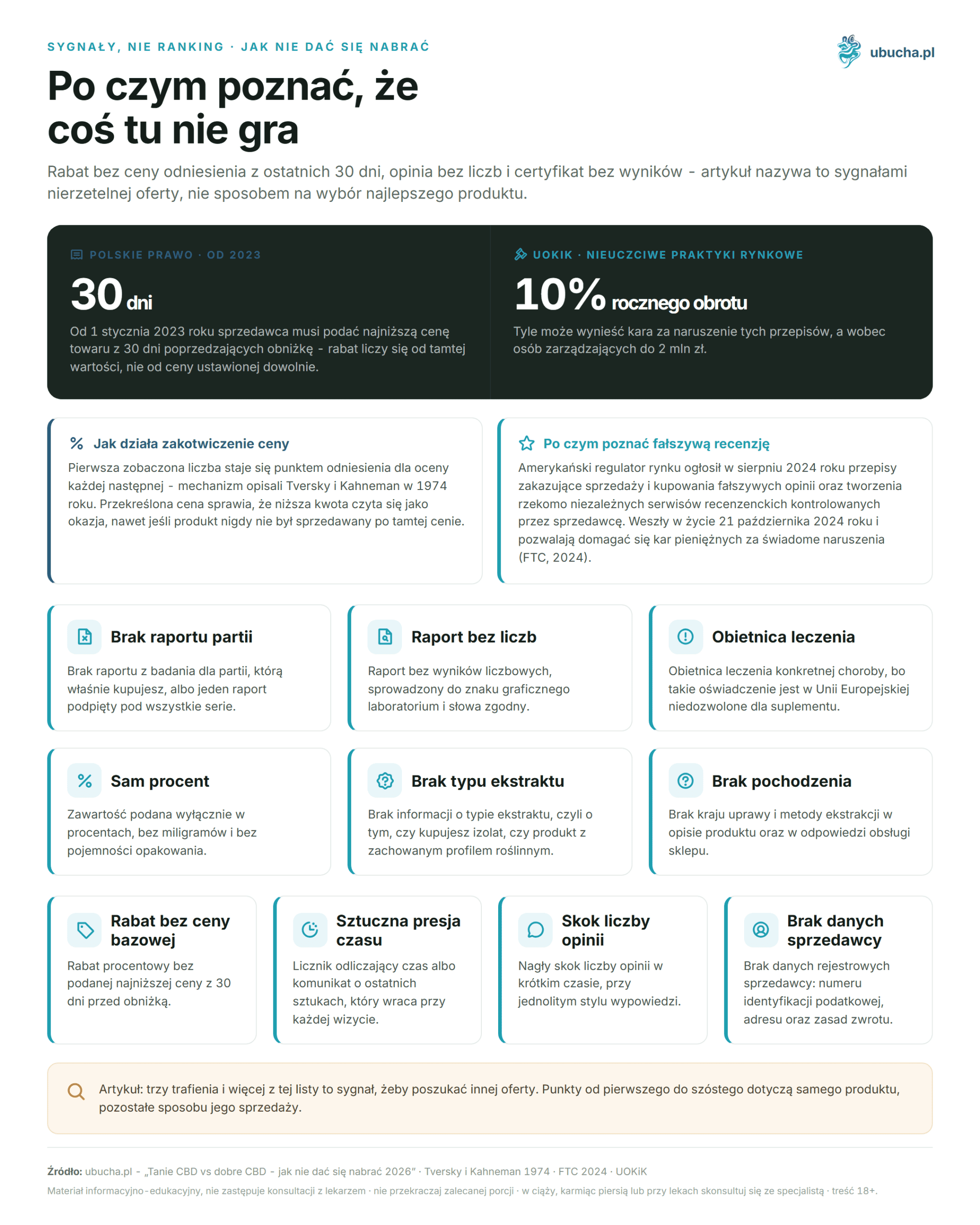
Polish law partially closes this loophole. Since January 1, 2023, alongside discount info, the seller must provide the lowest price of the product from the 30 days before the discount. The discount is calculated from that value, not from any arbitrarily set catalog price. For violating unfair market practices, UOKiK can impose a penalty up to 10% of annual turnover, and up to 2 million PLN on managers.
Checking takes a second. If next to the crossed-out price there is no sentence about the lowest price in the last 30 days, the percentage discount carries no information. If such a sentence exists, compare it with the promotional price, as the difference can be several times smaller than the banner number.
Our observations from our own catalog are unexpected here. On the check day, none of the six CANNOVA oils had a promotional price, as regular and sale prices were identical. Only two Pure XL oils had a discount from 55 PLN to 45 PLN, i.e., 18%. This is not an impressive number and therefore credible. A 70% discount maintained for weeks says more about the starting price than product value.
How to spot a fake review?
The US market regulator announced in August 2024 rules banning selling and buying fake reviews and creating supposedly independent review sites controlled by sellers. They came into force on October 21, 2024, allowing fines for deliberate violations (FTC, 2024).
Recognition signals are quite consistent. A review without numbers, i.e., no dose, no usage time, no comparison, carries no verifiable content. Repeated phrases in reviews of different products indicate a common source. A sudden jump in review count in one day after weeks of silence usually means a purchased package.
An authentic review looks different because it contains a detail no one invents on demand. Someone writes they started with four drops in the evening and after two weeks reduced to three. Someone else complains about taste while praising the effect. Mixed ratings signal truthfulness, as no one buys threes.
A practical method: instead of reading the best ratings, read average ratings and the author’s profile. A reviewer with fifty fives given to different stores in one week is not a source. A reviewer with three reviews spread over a year, including one critical, is worth more than a hundred anonymous praises.
Helpful are also verified purchase marks, if the platform uses them, and the questions section to the seller. Answers to questions are harder to fake than ratings, as they require specifics and remain visible next to the product. A store replying within a day to questions about batch number or raw material origin provides stronger proof of credibility than any average rating from anonymous stars.
Which signals disqualify a product before purchase?
No single signal decides. Only accumulation of several changes the picture. Treat the list below pointwise: three or more hits is the moment to look for another offer rather than explain missing info.
- No batch test report for the batch you are buying, or one report linked to all series.
- Report without numerical results, reduced to lab logo and the word compliant.
- Promise of treating a specific disease, as such claims are prohibited for supplements in the EU.
- Content given only in percentages, without milligrams or package volume.
- No info on extract type, i.e., whether you buy an isolate or a product with preserved plant profile.
- No country of cultivation and extraction method in product description or store support response.
- Percentage discount without the lowest price from 30 days before the discount.
- Countdown timer or last pieces message that returns on every visit.
- Sudden jump in review count in a short time with uniform style.
- No seller registration data: tax ID, address, and return policy.
Points one to six concern the product itself, the rest the sales method. Separating these groups helps avoid the opposite error: rejecting a good product due to aggressive store or buying a weak product from a store with exemplary service.
What does the law say about CBD and THC limit in 2026?
The threshold for industrial hemp in Poland is 0.3% total delta-9-THC and tetrahydrocannabinolic acid in dry matter of flowering or fruiting tops. It was raised from 0.2% by the amendment to the Act on Counteracting Drug Addiction of March 24, 2022, effective May 7, 2022 (Dz.U. 2022 poz. 763). Imported raw material is subject to the same threshold.
The food status is much less settled. The EFSA panel stated in 2022 that CBD safety as a novel food cannot be established on current data and pointed to gaps in data on liver, hormonal, and reproductive effects (EFSA, 2022). It separately noted lack of genotoxicity study resolution. Applications for approval were then suspended.
In 2026, the panel published an update. After reviewing newer literature, it indicated a temporary safe intake level of 0.0275 mg per kilogram body weight daily, which for a 70 kg person is about 2 mg daily, assuming raw material purity of at least 98% (EFSA, 2026). Safety for people under 25 and pregnant or breastfeeding women remains unassessed.
This number is two orders of magnitude lower than doses found in dosing guides and is worth knowing before purchase. It is not a ban or sales limit but a temporary value adopted in novel food assessment under incomplete data. However, it shows the large gap between category marketing and scientific assessment, and why advertising suggesting therapeutic effect is prohibited in this category.
How to start safely and when to ask a doctor?
Start with the smallest measurable dose and keep it unchanged for several days. Record intake time, number of drops, and observations. Without records, after two weeks you cannot distinguish product effect from normal weekly variability. Change one thing at a time, as simultaneous dose and timing changes resolve nothing.
Cannabinoids pass through the same liver enzymes metabolizing most prescription drugs. A 2024 systematic review collected 31 documented interactions involving over 600 users, mainly via CYP3A4, CYP2C19, and CYP2C9 enzymes (Nachnani et al., Frontiers in Pharmacology, 2024). The best-documented cases concerned anticoagulants, post-transplant drugs, and antiepileptics.
Talk to a doctor or pharmacist before starting, not after symptoms appear. This especially applies to ongoing pharmacotherapy with a narrow therapeutic window, where small blood drug concentration changes matter. Bring the package and batch test report to the visit, as dose questions without content knowledge remain unanswered.
If you seek a gentler introduction than sublingual oil, the same calculation logic applies to other forms. In the hemp gummies category, content is given per piece, so cost per 100 mg is calculated from package price and piece count. Evaluation criteria remain identical regardless of form: milligram amount, batch test report, clear raw material description.
Summary: three numbers and one document
The cheap vs good CBD dispute is resolved by four pieces of information. The first number is the cost of 100 mg declared cannabinoids, the only comparable size between bottles of different volumes. The second number is milligram content per package, without which you cannot calculate the first. The third number is THC content, within the 0.3% threshold. The document is the batch test report for the batch you buy.
The rest follows from these four items. A producer who provides milligrams usually also provides raw material origin and extraction method, as they can support them. A producer hiding one of these usually hides the others. The JAMA audit, FDA warning letter list, and cautious EFSA stance form the same conclusion: neither low nor high price replaces documentation.
If you start, choose the smallest package with a clear milligram declaration and a report for the current batch, calculate cost per 100 mg for order, not savings, and observe effects for a full two weeks. Only after establishing dose does switching to higher concentration become real savings. The reverse order usually means spending on a product you won’t use up.
One question remains worth asking before every next purchase in this category. Can you state how many milligrams you take daily and how much it costs? If yes, comparing offers takes a minute and no banner changes the result. If not, the problem is not price but lack of a number to relate price to. Every sensible purchase decision in this category starts from that number.
Frequently Asked Questions
How to calculate the cost of 100 mg cannabinoids?
Divide the package price by the number of milligrams declared in the entire bottle and multiply by one hundred. A 10% oil in a 10 ml bottle contains 1000 mg, so at a price of 110 PLN, the cost of 100 mg is 11 PLN. This single number compares bottles of different volumes and concentrations.
Does a low price always mean a worse product?
No. A low price can result from a cheaper form of raw material, a shorter supply chain, or a lower margin. The problem arises when a low price is accompanied by no batch testing and no milligram declaration. Then there is no way to verify exactly what you are paying for, and the label remains the only source of information.
What is a COA and what should it contain?
A COA is a laboratory report for a specific product batch. It should provide the batch number, test date, and the laboratory name. Then come numerical results: cannabinoid profile including THC content, followed by contamination tests such as heavy metals, pesticides, and microorganisms. A laboratory logo alone without a results table is not a test report.
How much THC can a legal hemp product contain in Poland?
The amendment to the Act on Counteracting Drug Addiction of March 24, 2022, raised the threshold for industrial hemp from 0.2% to 0.3% total delta-9-THC and tetrahydrocannabinolic acid in dry matter. The regulation has been in effect since May 7, 2022, and also applies to raw materials imported from other countries.
Does MCT oil in the composition reduce the product’s value?
Not by itself. The fat carrier constitutes the majority of the volume of every oil and affects absorption. A systematic review noted that after a meal, the area under the CBD concentration curve was about five times higher than on an empty stomach. The problem arises only when the proportion of extract to carrier is hidden.
Why does a discount banner hang for weeks?
Because the reference price is often set high to make the discount look attractive. Since January 1, 2023, sellers in Poland must provide the lowest price from the 30 days before the discount next to the promotional price. If this information is missing, the percentage discount alone proves nothing.
Does CBD interact with medications?
Yes. A 2024 systematic review described 31 documented interactions involving over 600 cannabinoid users, mainly via enzymes CYP3A4, CYP2C19, and CYP2C9. The best-documented cases concern anticoagulants, immunosuppressants, and antiepileptics. For ongoing pharmacotherapy, make the decision with your doctor.
Current prices and full descriptions are available in the hemp oils category, and if you seek a trusted seller, read the guide how to find a good CBD store and the material CBD and chronic pain: what science says and what marketing says - a comprehensive guide.
This article is informational and educational. It contains internal links to product categories available in the u Bucha store. Prices and specifications may change: check current data on the product page before purchase.
Author: Michał Waluk · Published: 2026-05-11 · Updated: 2026-08-08