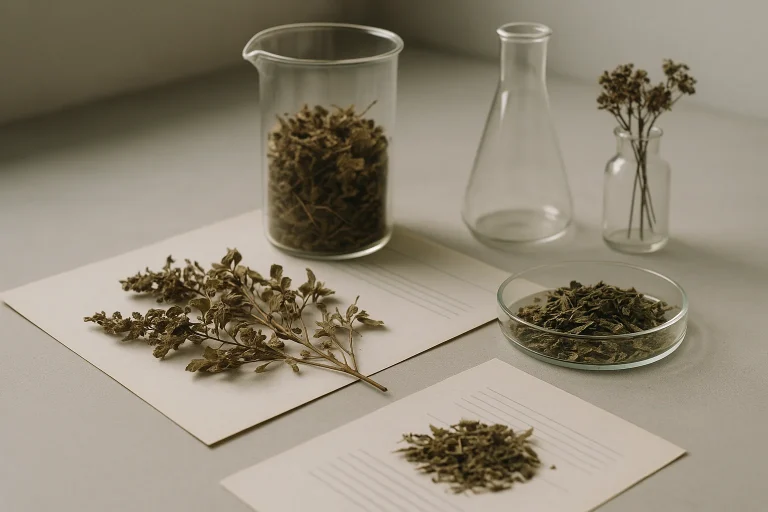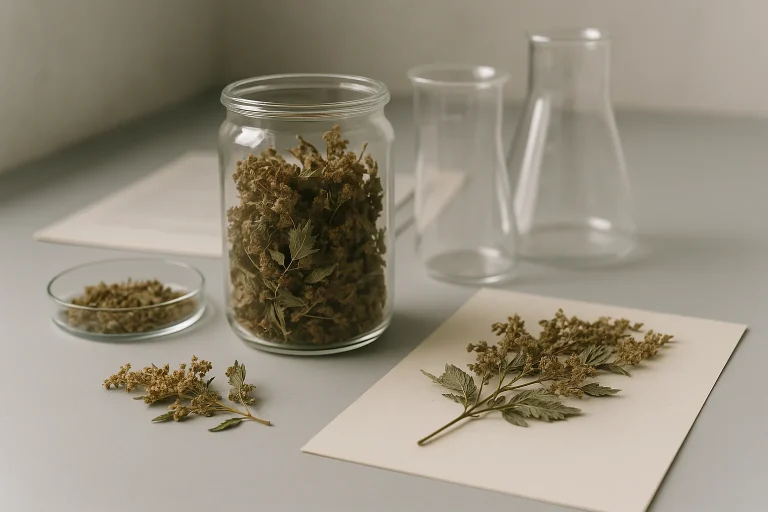

Sativa vs Indica: What Are the Differences? Botany, Chemistry, and Critique 2026
Sativa and indica today are trade labels, not species. Botany, chemovars, terpenes, Polish law, and a table of legal flowers with prices from August 8, 2026.
Sativa is supposed to stimulate, indica to sedate. This division has hung on packaging, apps, and store descriptions for decades, but botany has stopped confirming it. John McPartland wrote in a review for Cannabis and Cannabinoid Research that widespread crossbreeding of both forms has made the difference between them almost useless. In this text, we separate two layers of the topic: the classic one found in most guides, and the contemporary one based on plant chemistry. You will find the history of the names from Linnaeus and Lamarck, morphological differences, genetic critique, Polish regulations, and a comparison of legal flowers with prices read on August 8, 2026. After reading, you will know what to look at instead of the word “sativa” on the label.
KEY INFORMATION
• Genetics of 81 strains showed only moderate agreement with declared sativa or indica origin (Sawler et al., PLOS ONE, 2015).
• Both forms are one species Cannabis sativa L., and trade names are not taxonomy.
• Chemovars types I, II, and III describe the plant by numbers instead of morphology (Lewis et al., Planta Medica, 2018).
• In Poland, the limit is 0.3% total THC in dry mass, regardless of strain name.
• A gram of legal flower cost from 7.50 PLN to 35 PLN on August 8, 2026.
Where do the names sativa and indica come from?
Both names date back to the 18th century and were created to describe industrial plants, not their effects. Carl Linnaeus in 1753 placed the species Cannabis sativa in Species Plantarum, meaning cultivated hemp: a European fibrous plant used for ship ropes and coarse fabrics. Seeds were used for oil and feed.
Thirty-two years later, Jean-Baptiste Lamarck described material brought from India in Encyclopédie méthodique and considered it a separate species, Cannabis indica. The basis was visible and tangible differences: shorter stature, denser branching, darker leaves, and clearly more resin. Ethan Russo collected the history of this division in a work on cannabis and its products (Russo, Chem Biodivers, 2007).
It is worth seeing what really happened here. The 18th-century division was a utilitarian one: fiber versus resin, Europe versus India. It was not a division into “energy” and “sleep” because such a category did not exist then. Only two hundred years later did breeders attach new meanings to old names, and stores solidified them. Hence today’s confusion: the same word means different things in a herbarium and in a price list.
The taxonomic status remains disputed to this day. Some botanists defend three separate species, but most treat sativa, indica, and ruderalis as subspecies of one species Cannabis sativa L. However, the dispute has little impact on what you buy because the material on sale has long not corresponded to any of these pure categories.
What did Lamarck see that Linnaeus did not?
Lamarck observed different plant material, not a different logical category. Linnaeus described hemp from European fields, selected over centuries for long, strong fiber and high seed yield. Resin was a byproduct, even a nuisance during stalk processing.
Samples Lamarck received came from a region where hemp was cultivated for resin for millennia. Charas, bhang, and ganja are three different preparations of the same plant, known in India long before European botany. A plant selected for resin looks different than one selected for fiber: it is shorter, more branched, has thicker leaves, and denser trichome-covered buds.
Thus, Lamarck described a real difference but assigned it the wrong rank. What he saw was the result of thousands of years of different selection and climate, not a species boundary. A biological test settles the matter clearly: crossing sativa with indica produces fertile offspring, and this has been done for generations on an industrial scale.
While organizing this topic, we noticed that most misunderstandings come from one mental shortcut. People read “Lamarck distinguished indica” as “science confirmed two types of effects.” Lamarck did not study effects. He described leaf shape, stem height, and resin amount, using herbarium material and travelers’ reports.
What is Cannabis ruderalis and why do breeders use a third form?
Cannabis ruderalis is a wild form described in 1924 by Russian botanist Dmitrij Janiszewski, growing spontaneously in Eastern Europe, Siberia, and Central Asia. It grows low, usually 50-80 cm, has small leaves, completes its life cycle in 10-12 weeks, and contains negligible THC.
One feature decided its breeding career. Ruderalis flowers autonomously: it enters flowering a few weeks after germination regardless of day length. Classic sativas and indicas are photoperiodic, waiting for day length to shorten to about twelve hours. In short, capricious Siberian summers, waiting for a light signal would kill the plant before seed production.
Crossing ruderalis with useful strains produced autoflowering varieties. Harvest occurs after a set time, not after photoperiod change, simplifying cultivation and allowing several cycles per year indoors. The price is known to every breeder: autoflowering plants tend to be smaller and less productive because the vegetative growth phase is by definition short.
Ruderalis also shows how arbitrary the whole sativa versus indica axis is. The third form does not fit on this axis at all, yet its genes are present today in thousands of strains sold as “indica” or “sativa.” The trade name is completely silent about this.
What are the morphological differences between sativa and indica?
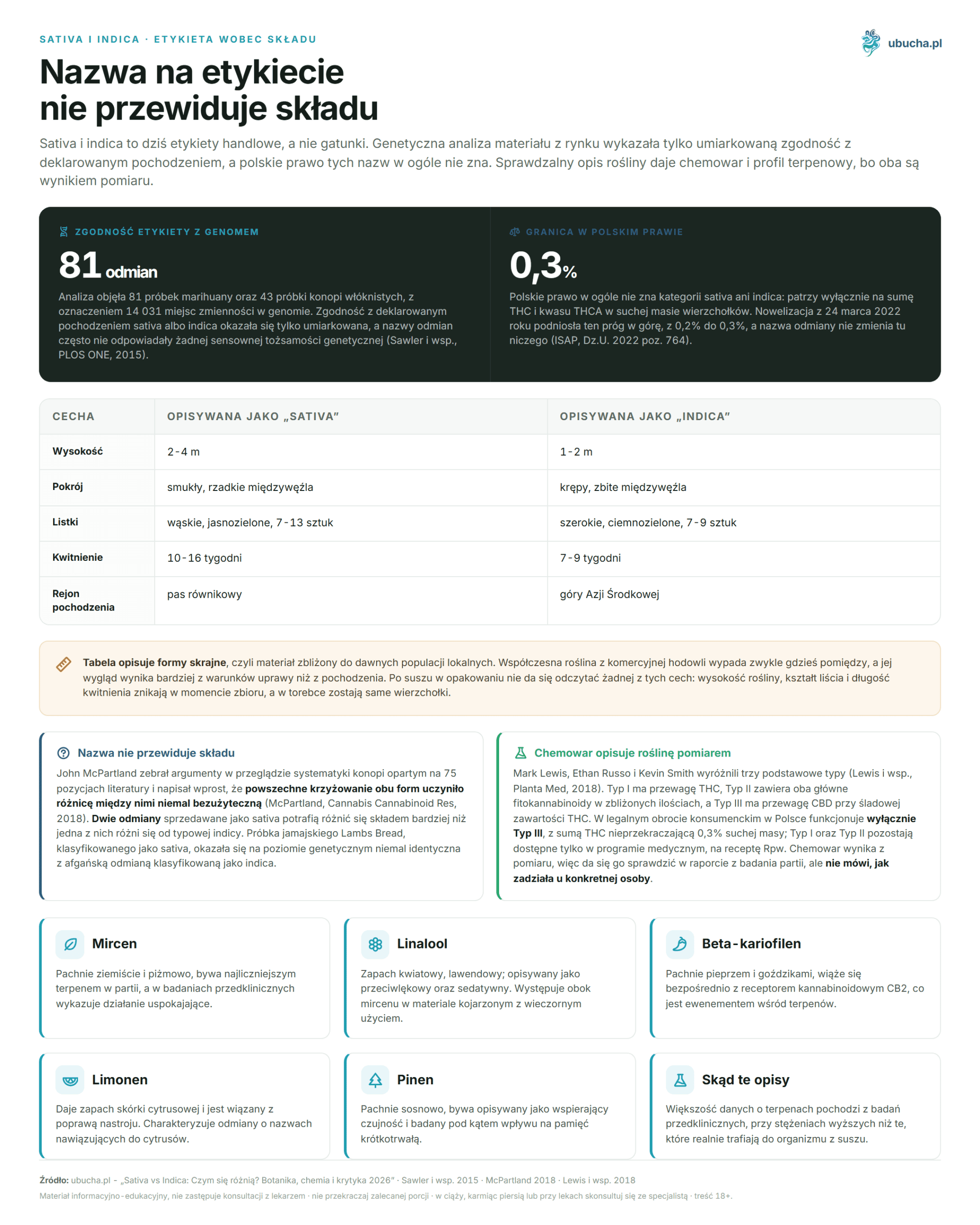
The classic morphological description is concise and easy to remember. The form called sativa grows tall and slim, has narrow light green leaves, and flowers long. The form called indica is short and stocky, has broad dark green leaves, and flowers shortly. The table below collects these traits in one place.
| Trait | Described as “sativa” | Described as “indica” |
|---|---|---|
| Height | 2-4 m | 1-2 m |
| Structure | slim, sparse internodes | stocky, dense internodes |
| Leaves | narrow, light green, 7-13 pieces | broad, dark green, 7-9 pieces |
| Flowering | 10-16 weeks | 7-9 weeks |
| Buds | longer, looser | shorter, denser |
| Origin region | equatorial belt | Central Asian mountains |
The table describes extreme forms, i.e., material close to old local populations. The modern plant from commercial breeding usually falls somewhere in between, and its appearance depends more on growing conditions than origin. The same genetics grown under strong lamps and pruned produces a low, sprawling bush, though in soil it would grow tall.
For the buyer, this has one consequence rarely written about. You cannot read any of these traits from the flower in the package. Plant height, leaf shape, and flowering length disappear at harvest, leaving only buds in the bag. Morphological traits help breeders plan cultivation and botanists identify herbarium specimens. The consumer gets a product on which this layer of information is unreadable, so must rely on something else: smell, bud appearance, and analysis results.
How did climate shape both forms?
The differences described in the table respond to two different sets of conditions. In the equatorial belt, i.e., Thailand, Colombia, Jamaica, or Sub-Saharan Africa, day length changes minimally throughout the year. The plant has no reason to hurry: it grows tall, flowers slowly, and benefits from a long warm season.
In the Hindu Kush mountains, Afghanistan, and northern India, the growing season is short, nights cold, and UV radiation strong. Selection favored fast-flowering plants producing abundant resin, which acts as a protective layer. A stocky structure better withstands cold and wind, and broad leaves capture more light in a short time window.
The same logic explains why amateur outdoor cultivation in Poland has long relied on mountain genetics. Short-flowering plants can be harvested before autumn rains, which easily cause mold in loose, long buds. In conversations with breeders, we hear the same sentence for years: it’s not about effect, it’s about the calendar.
Indoor cultivation reversed some of these dependencies because the grower sets day length and temperature. However, room height limits and electricity costs favor short and fast plants. That is why pure equatorial forms have almost disappeared from the market, while their names survive in strains genetically little related to them.
What effects are traditionally attributed to sativa?
Tradition describes sativa’s effect as stimulating, brightening, and conducive to associations. The jargon term “head high” means an effect located in the head, opposed to body heaviness. Typical use contexts are daytime, creative work, conversation, and walking.
However, a boundary must be set here immediately. This description comes from user reports and sales narratives, not controlled studies comparing strains by name. We know no study assigning the “sativa” label a reproducible effect profile independent of plant chemical composition. So when you read that sativa adds energy, you read a generalization from surveys and forums.
Classic names associated with this profile are Durban Poison from South Africa, Thai Stick, Acapulco Gold, or Jamaican Lambs Bread. All come from near the equator. Today, almost none appear in pure form in commerce because sixteen-week flowering is unprofitable under lamps.
What the store sells as sativa is usually a hybrid with mountain genetics added precisely to shorten flowering. Sour Diesel, Jack Herer, or Green Crack are examples of such crosses. The label thus rather announces an expected mood than plant origin, and these are two completely different promises.
What effects are traditionally attributed to indica?
Indica is attributed the opposite effect: muscle relaxation, body heaviness, slowed thinking, and sleepiness. The jargon “body high” and the joke “in-da-couch” express the same sensation of couch-lock. Typical use contexts are evening, end of day, and rest after effort.
Here too, the source of knowledge is qualified. The description comes from user reports, not from controlled comparisons of strains by name. Moreover, part of the effect may come from expectation: if you buy a product described as evening and take it in the evening, it is hard to separate pharmacology from context and time of day.
Names associated with this profile are Hindu Kush, Afghan, Northern Lights, or Bubba Kush, mostly deriving from Afghan and Pakistani genetics. Pure mountain forms have survived better in commerce than equatorial ones because short flowering was always profitable. Still, they too have undergone decades of Western selection.
There is one area where the traditional description looks more reasonable than usual. Plants described as indica more often have a high share of myrcene and linalool, both terpenes showing sedative effects in preclinical studies. However, here we no longer talk about the label but about a specific chemical composition measurable and reportable in a lab report.
Why does modern science question this division?
The main objection is simple: the name does not predict composition. John McPartland collected arguments in a cannabis systematics review for Cannabis and Cannabinoid Research based on 75 literature sources (McPartland, Cannabis Cannabinoid Res, 2018). He proposed two theses undermining the commercial division at its roots.
The first concerns language. Names in quotation marks, i.e., “Sativa” and “Indica” from breeder catalogs, mean something different than species names in italics in botanical work. These are two parallel vocabularies using the same words with different meanings. A discussion where one side talks about taxonomy and the other about store shelves cannot be resolved.
The second thesis concerns plant material. Widespread crossbreeding of both forms has made the difference between them almost useless, McPartland writes directly. Fifty years of intensive hybridization dissolved pure lines into a gene mosaic. Botanically pure Cannabis indica from Hindu Kush slopes is today a collector’s item, not a commodity.
There is also variability within categories. Two strains sold as sativa can differ in composition more than one differs from a typical indica. Since within-group variation exceeds between-group difference, the label ceases to carry information. Geneticists verified exactly this, as shown in the next section.
What did genetic analysis of commercial strains show?
The most cited study was published by Jason Sawler’s team in PLOS ONE in 2015. The authors examined 81 marijuana samples and 43 hemp samples, marking 14,031 variable genome sites (Sawler et al., PLOS ONE, 2015). This was the first analysis of this scale on commercial material.
The result was moderately bad for labels. The correlation between genetic structure and declared sativa or indica origin was only moderate. The authors stated plainly that strain names often do not correspond to any sensible genetic identity. In other words, the same name from two suppliers can be two different plants.
The most telling example from this work is a Jamaican Lambs Bread sample, classified as sativa, which was genetically almost identical to an Afghan strain classified as indica. It is hard to find clearer proof that label and genome live separate lives.
The study also brought an unexpected result. Hemp was genetically closer to indica-type material than to sativa-type strains, although the species name of hemp contains the word sativa. Thus, nomenclature is misleading not only in stores but also in textbooks. Marijuana and hemp differ at the whole genome scale, not only in genes responsible for THC production.
Why can the same strain be different in two stores?
Because the strain name is not protected and does not mean a fixed genetic line. Any breeder can name their material after a known strain, and no one verifies it. Sawler’s data show this: samples with the same trade name were genetically distant, and samples with different names could almost overlap.
The second layer of differences arises after harvest. The same plant grown in two cycles produces two batches because composition depends on harvest time, sunlight, fertilization, and drying temperature. Terpenes are volatile and degrade fastest. A batch dried at too high a temperature loses some aroma before packaging.
The third layer is storage. Light, heat, and oxygen degrade both terpenes and phytocannabinoids, so a bag lying for months on a sunny store shelf has a different composition than the same batch in a sealed container in coolness. That is why packaging date can be more important information than strain name.
The practical conclusion is simple and unromantic. Look for repeatability at the producer and batch level, not at the name level. If a batch worked for you, note its number and date, as that is the only identifier that really matters for the next purchase.
What are chemovars and why do they describe the plant better?
A chemovar, i.e., chemical variety, describes the plant by laboratory analysis results instead of appearance or name. Mark Lewis, Ethan Russo, and Kevin Smith described this system in Planta Medica in 2018, distinguishing three basic types (Lewis et al., Planta Med, 2018). Type I has THC dominance and dominates both medical and recreational offers. Type II contains both main phytocannabinoids in similar amounts. Type III has CBD dominance with trace THC.
The advantage of such a description over a label is practical, not theoretical. A chemovar results from measurement, so it can be checked in a batch test report. It does not depend on country of origin, name history, or plant appearance after drying. A certified producer can assign each batch to a type without negotiation.
The system is further expanded. Plants with CBG dominance, a precursor of other phytocannabinoids, are described, as well as practically cannabinoid-free material grown only for fiber. Another natural extension is adding the terpene profile, which Russo has advocated for years.
A chemovar does not solve everything. It tells how much of what is in the plant but not how it will act in a specific person, as tolerance, dose, and administration method come into play. However, it is a starting point that can be verified, unlike a trade name.
Which chemovar type is legal in Poland?
Only type III, i.e., material with CBD dominance and total THC not exceeding 0.3% dry mass, is allowed in legal consumer trade. The entire offer of flowers, oils, and hemp cosmetics in Polish stores fits this type. Strains like Charlotte’s Web or Harle-Tsu were developed by selection in this direction.
Type I, with THC dominance, is available in Poland only in the medical program, on prescription Rpw issued by an authorized doctor. Type II, mixed, functions under the same regime. Outside pharmacies, both types remain illegal regardless of plant appearance or strain name.
The safety of pure CBD was assessed by the WHO Expert Committee on Drug Dependence at its 40th meeting in 2018. The report recommended that preparations considered pure cannabidiol not be internationally controlled, finding no abuse or dependence potential (WHO ECDD, CBD critical review, 2018). This assessment underlies market liberalization in most EU countries.
The conclusion for buyers is narrow but concrete. Since only one chemovar type is legal, the whole game about “sativa” or “indica” takes place within it and boils down to terpene profile and minority phytocannabinoid content. The rest is packaging description.
What role do terpenes play in cannabis effects?
Terpenes are volatile aromatic compounds giving the plant its smell and modifying phytocannabinoid effects. Ethan Russo described this mechanism in the British Journal of Pharmacology in 2011 as the entourage effect, arguing that cannabis components act together, not as a sum of separate substances (Russo, Br J Pharmacol, 2011).
Over two hundred terpenes have been described in cannabis, but realistic concentrations reach about a dozen. They decide whether the flower smells citrusy, earthy, or resinous, and differentiate two batches with similar cannabinoid content. For many users, the difference in perception between such batches is greater than the difference from the cannabinoid percentage alone.
Mechanisms of action vary and are not reduced to smell. Beta-caryophyllene binds directly to the CB2 cannabinoid receptor, a terpene rarity. Others modulate enzymes responsible for cannabinoid metabolism, and some have independent pharmacological effects described in animal model studies.
Proportions must be kept in these claims. Most terpene data come from preclinical studies at concentrations higher than those realistically delivered from flower. The entourage effect is a well-founded hypothesis, not a closed case. More about these compounds is described in our post on terpenes in hemp products.
Which terpenes calm and which increase alertness?
Assigning terpenes to two poles is a simplification but more useful than the sativa/indica division because it is based on measurable composition. The list below orders five compounds most often topping analysis reports.
- Myrcene smells earthy and musky, often the most abundant terpene in a batch, and shows sedative effects in preclinical studies. The same compound dominates in hops.
- Linalool has a floral, lavender scent and is described as anxiolytic and sedative. It occurs alongside myrcene in material associated with evening use.
- Beta-caryophyllene smells of pepper and cloves, binds to CB2 receptor, and is linked to anti-inflammatory effects.
- Limonene gives a citrus peel scent and is associated with mood improvement. It characterizes strains with citrus-related names.
- Pinene smells piney, is described as supporting alertness, and is studied for effects on short-term memory.
Treat this as a shopping hint, not a recipe. Terpene profiles vary between harvests of the same strain, depending on harvest time, drying temperature, and storage method. A batch stored in warmth and light loses the most volatile compounds fastest, so two packages with the same name may smell different.
Note also what is missing from this list. None of these compounds is exclusive to cannabis: myrcene dominates in hops, linalool in lavender, pinene in pine needles. This is good news for verifying claims because these substances’ effects have been studied outside cannabis context on separate models. The bad news is that concentrations in those studies were often many times higher than what flower or oil realistically delivers.
Does flower smell tell anything about its profile?
It tells more than the label name but less than analysis results. Smell is a direct consequence of terpene presence, so a distinct citrus, pine, or earthy note is a real signal about composition, not a suggestion. The nose detects concentrations no marketing claim can convey.
However, this method has serious limitations. First, humans recognize scent mixtures poorly and suggestively: just reading “citrus” on the package can make you smell citrus. Second, scent strength depends on batch freshness and temperature, not only content. Third, some prominent terpenes occur in small amounts, while the most abundant ones may be olfactorily unremarkable.
Sensible use of smell looks like this: check consistency, not composition. If the analysis report shows high limonene but the flower smells only earthy and sweet, something is off and you should ask the seller about the batch date. Smell confirms or questions the document but does not replace it.
We noticed a recurring mistake. Intensity of smell is confused with potency, though these are independent. A very aromatic batch may have average phytocannabinoid content, and a nearly odorless, poorly stored batch may still have high content. Aroma indicates terpenes, not cannabinoids.
Which legal flowers correspond to classic strain profiles?
In the flower category at the uBucha store on August 8, 2026, there were 34 items, all type III. We selected eight below that best show how strain name translates to the real shelf. The order is by gram cost, from lowest to highest, as it is the only comparable number between different package sizes.
| Rank | Product | What stands out | Price (as of 2026-08-08) | Cost per 1 g |
|---|---|---|---|---|
| 1 | SZAŁ MIAŁ CBD 10 g Babcia Marysia MIX Trim | cheapest gram in the category, fine sifted material | 75 PLN | 7.50 PLN |
| 2 | SZAŁ MIAŁ CBG 10 g Babcia Marysia MIX Trim | same form with CBG dominance, outside sativa and indica axis | 75 PLN | 7.50 PLN |
| 3 | Specjały Babci Marysi Susz Konopny Autopower 10 g | name refers to autoflowering strains, i.e., ruderalis heritage | 140 PLN | 14.00 PLN |
| 4 | Specjały Babci Marysi Susz Konopny Santhica CBG 10 g | Santhica is an EU strain with CBG dominance instead of CBD | 140 PLN | 14.00 PLN |
| 5 | Specjały Babci Marysi Susz Konopny Northwest 10 g | largest package at this price, whole buds material | 140 PLN | 14.00 PLN |
| 6 | Cannabis Spot Susz CBD Jack Herer 5 g | name from a line associated with a sativa-like profile | 100 PLN | 20.00 PLN |
| 7 | Cannabis Spot Susz CBD Lemon Haze 5 g | Haze family, name suggests citrus profile | 100 PLN | 20.00 PLN |
| 8 | Cannabis Spot Susz CBD Amnesia Haze 5 g | second Haze family item, good for batch comparison | 100 PLN | 20.00 PLN |
Prices are given as a reference point, not an offer. We read them on August 8, 2026, from the public store interface, and all eight items were available that day. The assortment rotates faster than the article, so check the current status in the Flower category. If product card data differ from the table, the card is binding.
How much does a gram of legal flower really cost?
The range is larger than prices on packaging suggest. A gram of the same type of material cost from 7.50 PLN to 35 PLN on August 8, 2026, nearly five times more at the high end. This depends on package size and product form, not strain name.
The chart shows one rule and one exception. The rule: gram price decreases with package size, from 35 PLN for one gram to 14 PLN for ten grams. The exception: trim, i.e., fine sifted material, is half the price of whole buds in the same package because it is a different product form.
The practical conclusion is that one-gram packages make sense only as a trial before a bigger purchase. If you return to the same material, a ten-gram package cuts the gram cost by more than half. How to assess batch quality is described in our post on assessing hemp flower quality.
How to choose a product when seeking calming or stimulation?
Start with a batch test report, not the name. A document issued by an external lab provides phytocannabinoid content, total THC confirming compliance with the limit, and, in better versions, the terpene profile. Without these numbers, you buy marketing description and nothing more.
If you seek evening calming, look for batches with a clear share of myrcene and linalool. In practice, you recognize them by an earthy, slightly musky scent with floral notes. An alternative to flower is sublingual oil, which acts slower but more predictably dose-wise, as you measure drops, not volume. The full offer is in the Oils category.
If you seek clarity during the day, head for batches with limonene and pinene, recognizable by citrus and resinous-pine scents. Another path is material with CBG dominance, available in flower and oil forms. This is a different phytocannabinoid, much less studied than CBD, so approach it as an experiment, not a ready answer.
The last rule concerns method, not product. Change one thing at a time: first establish dose on one batch, then try another terpene profile. With two variables at once, you won’t know what worked, the most common reason for disappointment on first purchases.
Which myths about sativa and indica should be set aside?
A layer of beliefs has grown around this division, sounding reasonable but falling apart on first check. Below are six most common, ordered from most widespread.
- Sativa and indica are separate species. They are not. Botany treats them as subspecies of Cannabis sativa L., and crosses produce fertile offspring.
- Sativa always stimulates, indica always sedates. This is a generalization from typical terpene profiles, not a rule. Hybridization blurred these profiles so material with one label can resemble that with the other.
- Indica is stronger. Potency depends on THC content, not plant structure. Highest concentrations were recorded in classic equatorial strains.
- A strain is 100% sativa or indica. Practically every market item is a hybrid, and pure local populations are now collector’s material.
- The label suffices to choose a product. It does not, as it does not predict composition. It is replaced by chemovar, terpene profile, and lab report.
- Store sativa is botanical Cannabis sativa. In botany, this name means cultivated hemp, including fiber hemp. In commerce, it means expected mood. These two meanings diverged long ago.
The common denominator of these six points is one: all assume the name carries chemical information. It does not. It is a mental shortcut useful when strains really came from separate populations, and ceased to be useful roughly when breeders began mass crossbreeding.
How have hybrids changed the cannabis market?
Hybridization began in earnest in the 1970s when breeders from the Netherlands and the United States brought material from Hindu Kush, Thailand, Mexico, and Colombia. The goal was practical: combine short flowering of mountain genetics with traits of equatorial strains. Skunk No. 1 from 1978 was one of the first widely available crosses and became the basis of thousands of later lines.
Subsequent decades added layers. Northern Lights from the mid-1980s dominated indoor cultivation due to short flowering. The Haze line went the opposite way, maintaining flowering up to sixteen weeks, so it was crossed with mountain material to make commercial cultivation feasible. Modern strains with “Haze” in the name descend from this operation.
The 2000s were the era of sweet aroma strains from Cookies and Gelato lines. They share one trait unmentioned in names: they are consistently chemovar type I, with high THC and negligible CBD. Selection went for potency at the cost of composition diversity.
Recent years reverse this trend. Interest grows in chemovars type II and III, i.e., material where CBD balances or replaces THC. This is the same direction legally available in Poland, but there it results from consumer choice, not regulation.
What is the legal status of sativa and indica in Poland?
Polish law does not recognize sativa or indica categories. The Act of July 29, 2005, on counteracting drug addiction distinguishes fiber hemp and other hemp, with the boundary set solely by THC content (ISAP, Dz.U. 2005 no. 179 item 1485). The strain name changes nothing here.
The threshold was raised by the amendment of March 24, 2022, effective May 7, replacing 0.2% with 0.3% (ISAP, Dz.U. 2022 item 764). The definition is more precise than the common shortcut suggests: it concerns the sum of delta-9-tetrahydrocannabinol and its acidic form THCA in flower or fruiting tops with resin not removed, measured in dry mass and rounded to one decimal place.
Including the acidic form matters practically for producers. Non-decarboxylated flower contains mainly THCA, which converts to active THC only after heating, so analysis must cover both forms simultaneously. A result given only for delta-9-THC is insufficient to prove compliance.
Material above the threshold is available only in the medical program, on prescription Rpw. Consequences of possession outside this regime are described separately in our post on responsibility for marijuana possession. The EU has no single standard: member states set limits independently, usually between 0.2% and 0.3%, with Poland at the upper end.
Summary: what remains of the sativa vs indica division
A convenient linguistic shortcut remains, as does the history that created it. The 1753 and 1785 names described industrial plants from two world regions, not two effect types. Modern genetics and systematics show that after fifty years of crossbreeding, these names ceased to correspond to anything measurable in commercial material.
They are replaced by a description that can be checked. Chemovar tells how much of the main phytocannabinoids is in the plant, and the terpene profile explains why two batches with the same content are perceived differently. Both result from measurement and can be verified in a batch test report. The trade name does not pass such verification.
For Polish readers, the matter is even simpler because legal consumer trade covers only chemovar type III. The choice boils down to product form, package size, and terpene profile, with a nearly fivefold price difference per gram between the cheapest and most expensive item. These are numbers worth checking before purchase, unlike the word on the label.
This does not mean old names should be discarded. They serve as conversation shortcuts and are a good starting point if treated as a question, not an answer. Someone says “I’m looking for something indica-like” and communicates an expectation of evening calming. A sensible response is: let’s check which batches have a high myrcene share. Then the conversation moves from label to composition, the only transition that actually improves choice quality.
Frequently Asked Questions
What is the botanical difference between sativa and indica?
The plant described as sativa grows tall, up to 2-4 meters, has narrow light green leaves, and flowers for 10-16 weeks. The form called indica is shorter, stockier, has broad dark green leaves, and flowers for 7-9 weeks. Botanically, both belong to one species Cannabis sativa L. and are treated as subspecies, not separate species.
Does the division into sativa and indica have scientific justification today?
Only residual. John McPartland wrote in a 2018 review for Cannabis and Cannabinoid Research that widespread crossbreeding of both forms has made the difference between them almost useless. Names in quotation marks mean something different than species names in italics, and commerce uses only the former.
Does indica always relax and sativa always stimulate?
No. The effect depends on the proportions of phytocannabinoids and the terpene profile of the specific plant, not on the name on the package. Russo described in the British Journal of Pharmacology in 2011 how terpenes modify cannabinoid effects. Two strains with the same label can have vastly different chemical compositions.
What is Cannabis ruderalis?
It is the third form of cannabis, described by Dmitrij Janiszewski in 1924, growing wild in Eastern Europe and Siberia. It grows low, has a short life cycle, and negligible THC content. It is distinguished by autoflowering, i.e., entering the flowering phase regardless of day length, which breeders use in autoflowering strains.
What are chemovars and how do they differ from the sativa or indica label?
A chemovar describes a plant by chemical analysis results, not by appearance or trade name. Lewis, Russo, and Smith described three types in Planta Medica in 2018: type I with THC dominance, type II containing both main phytocannabinoids, and type III with CBD dominance. Such a description can be verified in a lab report.
Which terpenes are responsible for calming and which for stimulation?
Calming effects are usually due to myrcene, linalool, and beta-caryophyllene, while limonene, pinene, and terpinolene contribute to clarity sensations. Russo compiled these observations in a 2011 review describing the entourage effect. However, these are preclinical findings, so treat the terpene profile as a guideline, not a promise.
Are sativa or indica legal in Poland?
The strain name does not matter here. Polish law looks only at the sum of THC and THCA acid in the dry mass of the buds. The amendment to the anti-narcotics act on March 24, 2022, raised the limit from 0.2% to 0.3%. Material above this threshold is available only by prescription Rpw.
How to choose legal hemp flower in Poland?
Start with a batch test report issued by an external laboratory: it should provide phytocannabinoid content, total THC, and terpene profile. Only then look at the strain name. Also, calculate the price per gram, as in the flower category on August 8, 2026, a gram cost from 7.50 PLN to 35 PLN.
The full and current list of available flowers with prices is in the Flower category. Check it before purchase, as the assortment changes more often than this text.
This article is informational and educational and does not constitute medical advice. Before starting cannabis or CBD for therapeutic purposes, consult a doctor, especially if you take other medications, are pregnant, or breastfeeding.
Author: Michał Waluk · Published: 2026-05-10 · Updated: 2026-08-08