
Hemp and Their History - From Prehistory to Legalization 2026
The history of hemp from domestication in the Neolithic to legalization in Germany: what research confirms, what is tradition, and what is today’s Polish THC threshold.
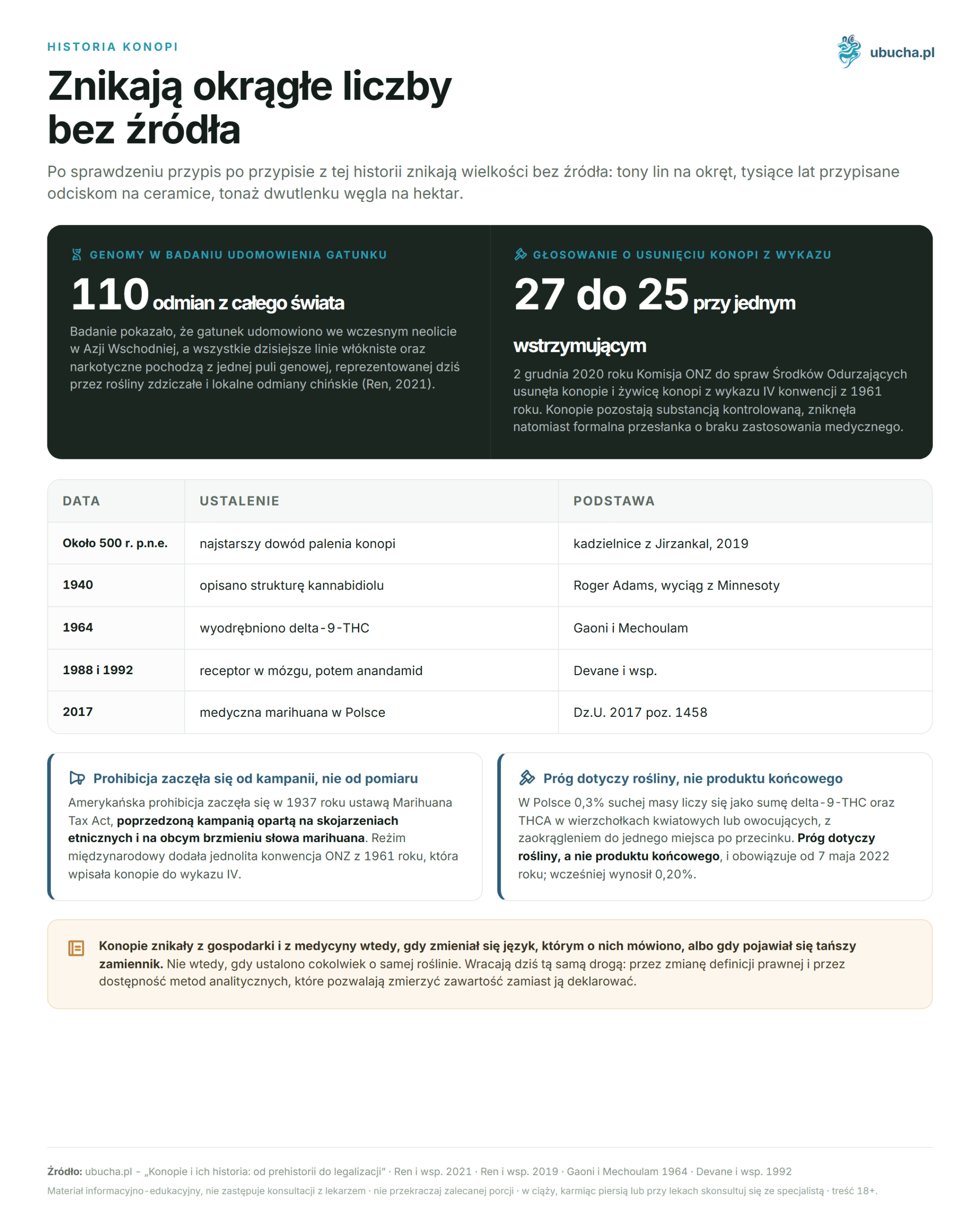
Hemp (Cannabis sativa L.) is among the oldest cultivated plants by humans. A genomic study of 110 varieties worldwide indicates the species was domesticated in the early Neolithic in East Asia, and all current fiber and narcotic lines derive from a single gene pool (Ren et al., Science Advances, 2021). The same plant provided fiber for ship ropes, paper for early prints, oil for lamps, and material for rituals. For several decades in the 20th century, it was a public enemy of drug policy, and since the 1990s it has returned as a subject of research and regulation. This guide organizes the chronology and separates three things: what scientific work confirms, what comes from tradition, and what later narratives added.
KEY INFORMATION
- Cannabis sativa was domesticated in the early Neolithic in East Asia; this was established from 110 sequenced genomes (Ren et al., Science Advances, 2021).
- The oldest chemically confirmed evidence of hemp smoking comes from the Jirzankal cemetery in Pamir, around 500 BCE.
- The structure of cannabidiol was described by Roger Adams in 1940, and delta-9-THC was isolated by Gaoni and Mechoulam in 1964.
- In December 2020, the UN Commission on Narcotic Drugs removed hemp from Schedule IV of the 1961 Convention by a vote of 27 to 25.
- In Poland, the 0.3% threshold is calculated as the sum of delta-9-THC and THCA in the plant, not in the final product.
When and where did hemp cultivation begin?
Hemp was domesticated in the early Neolithic in East Asia. A genomic study of 110 varieties worldwide showed that all current fiber and narcotic lines come from a single gene pool, currently represented by wild plants and local Chinese varieties (Ren et al., Science Advances, 2021).
This study reveals more than just the date. The authors identified genes responsible for traits that diverged between fiber and narcotic varieties: plant branching and biosynthesis of cellulose and lignin. Fiber varieties grow straight and tall, as no one wants side shoots in a bundle; resin varieties do the opposite. This divergence began thousands of years before the first botanical description.
The second finding is even more interesting. Genomes of both groups show traces of loss of function in genes responsible for synthesizing two competing cannabinoids. The plant has a limited pool of a common precursor, so enhancing one pathway occurs at the expense of the other. Selection by farmers over millennia left a mark in the genome that can now be read directly from sequences.
The spread of hemp across Eurasia is a separate issue, studied by archaeobotanists based on seed, pollen, and fiber impressions (Long et al., Vegetation History and Archaeobotany, vol. 26, 2017). The work links hemp’s appearance in Europe to Bronze Age contact networks, not a single migration of one people.
The often repeated internet figure of “10,000 years” for hemp cord impressions on Taiwanese pottery lacks a source that can be opened and verified. The address cited led to a press note about a language barrier in Indian science. We removed this number instead of supporting it with another figure. What remains after verification is strong: hemp domestication coincides with the beginning of agriculture in East Asia.
What do we really know about ritual hemp smoking in the Iron Age?
The oldest chemically confirmed evidence of hemp smoking comes from the Jirzankal cemetery in eastern Pamir, dated to about 500 BCE. Phytochemical analysis of residues from wooden censers showed plants were burned during funeral ceremonies, with high levels of psychoactive compounds (Ren et al., Science Advances, 2019).
This work is valuable for two reasons. First, it provides direct dating and chemical measurement, not iconographic or literary interpretation. Second, it tells us about the plant itself. Wild hemp has low psychoactive compound levels, so the Jirzankal material indicates either conscious plant selection or use of mountain populations with naturally higher chemotypes. The authors state that archaeological evidence for ritual hemp use is scarce and disputed, and their find is among the earliest scientifically verified.
It is worth pausing on why such evidence is so rare. Fiber and seeds leave material traces; smoke leaves only microscopic residues on vessels. Detecting these requires preserved censers, intact burial contexts, and analytical methods capable of identifying decomposition products from 2,500 years ago. Such conditions are rare, so each new result shifts the map more than hundreds of textual mentions.
Alongside this is a layer of transmission that cannot be measured. Herodotus in Book Four of “Histories” describes a Scythian funeral rite involving inhaling smoke from hemp seeds in a closed tent. Soviet excavations in Pazyryk kurgans in Altai revealed incense sets with hemp, confirming Herodotus’s account. Hemp in ritual is a topic for a separate article, which we covered in the guide on hemp in religion. Dates and details from that layer are presented as transmission, not measurement.
How did hemp enter ancient Eastern cultures?
Hemp entered Asian cultures by three routes simultaneously: as fiber, food, and medicinal raw material. In China, it provided material for clothing and ropes, seeds were eaten and pressed for oil, and flower clusters entered pharmacopeias. In India, the plant became embedded in religious practice and survives there to this day.
Chinese tradition attributes the oldest medicinal description to the Pen Ts’ao Ching treatise, linked to Shen Nung. This is a traditional attribution, not a dating: the text is known from later editions, so the date “2737 BCE” is part of the founding legend of Chinese medicine, not a research result. Similarly, mentions of hemp in the Atharvaveda and Mesopotamian cuneiform tablets are treated cautiously. The plant appears, but term identification and dating remain subjects of philological dispute, with different translators assigning different species to the same words.
The colonial period in India is much better documented. A study based on archives from Assam and Calcutta shows that before British rule, hemp had economic, ritual, and medicinal significance, and colonial bioprospecting shifted it from a medicinal plant to an industrial commodity. The ban on private cultivation and sale led to the disappearance of hemp in native therapeutics (Bania, Journal of Cannabis Research, 2022).
The author describes a dual reaction, which is the most interesting aspect. Native doctors quietly resisted, trying to restore hemp to local therapeutics, while local elites adopted the colonial definition of the plant as a dangerous drug. Displacement of the raw material from medicine was thus not an administrative ban but a takeover of the language used to speak about it. The same mechanism appears in the United States a century later.
The Egyptian thread of this story was entirely removed from the article. The sentence about THC detection in Ramesses II’s mummy was supported by a reference leading to a text on mercury contamination. The thesis itself is disputed in literature and linked to sample contamination allegations, so we did not keep it with another source.
Did Greece and Rome know about hemp’s psychoactive effects?
The Mediterranean world knew hemp primarily as fiber. Herodotus describes it as a wild and cultivated plant with fiber only slightly inferior to flax. The Roman fleet used hemp ropes and sailcloth, and the English word “canvas” derives from the Latin name of the plant.
Medicinal use appears in late antiquity medical texts. Dioscorides in “De materia medica” describes cannabis, distinguishing effects of seeds and flower clusters. Galen mentions the custom of serving hemp seeds as dessert. These accounts prove familiarity with the plant but do not allow us to conclude to what extent Greeks and Romans consciously used its psychoactive effects.
The reason for this caution is botanical, not philological. Ancient terminology rarely distinguished varieties, and plants cultivated in Europe then were grown for fiber, selected exactly opposite to resin content. Genomics shows the split between lines is old but does not tell us which grew in Roman provinces. Without chemical analysis of archaeological material, claims about Roman hemp intoxication remain speculation, repeated in popular works as fact.
Eastern Europe adds an economic layer. Palynological studies show hemp pollen in early medieval layers, and Polish toponymy preserves traces of this cultivation in place names with the root “konop-“: Konopiska, Konopnica, Konopat. Place names are hard evidence of economy, though they cannot be translated into hectares or tons. Until the 19th century, hemp was a basic fiber in Polish villages before being replaced by imported cotton. The trace remains on the map, not in the field.
What role did hemp play in the Islamic world?
In the Islamic world, hemp functioned under the name hashish and occupied part of the space elsewhere taken by alcohol. It entered the Arabic pharmacopeia, and doctors described it systematically several hundred years earlier than European medicine. This knowledge later returned to the West through Latin translations of Arabic treatises.
Avicenna in the “Canon of Medicine” describes hemp among remedies for head and digestive ailments. Andalusian pharmacologist Ibn al-Baytar cataloged it in a work on simple drugs, distinguishing effects of seeds, leaves, and flower clusters. It is important to mark the boundary: these are treatise descriptions, not research results, so we reconstruct the history of medical thought, not efficacy. The value of these texts lies elsewhere than in the content of recommendations. They show that before the modern era, there was a knowledge circulation about the plant based on clinical observation and classification, not solely religious transmission.
A separate thread is paper. Paper production technology reached the Arab world in the 8th century, and the first paper mills in Samarkand and Baghdad processed hemp and flax fiber. Cheaper writing material accelerated the circulation of medical and mathematical texts, as the codex ceased to be a luxury item. Paper reached Europe several centuries later and remained largely hemp-flax for five hundred years until the switch to wood cellulose in the 19th century. The plant these texts wrote about was simultaneously the material on which they were recorded.
The legend of assassins intoxicated with hashish has no confirmation in Arabic sources. It originates from Marco Polo’s accounts and was popularized by 19th-century orientalists. Modern Arabic studies reject this etymology, and we mention it only to indicate the origin of the motif linking hemp with violence. This motif returned in the 1930s, without reference to the Middle East.
Why was hemp a strategic raw material for Europe?
From the late Middle Ages to the 19th century, hemp was a raw material of military importance in Europe. Its fiber was used for ship ropes, sailcloth, and fishing nets, and no fleet could sail without steady supplies. Whoever controlled hemp controlled the fleet’s reach.
States reacted as they do to critical raw materials: with cultivation mandates. English and continental decrees obliged farms to sow part of their land with hemp, and the Polish-Lithuanian Commonwealth exported it through Gdańsk to Dutch, British, and Danish fleets. Russia became the main supplier to Great Britain in the 18th century, and Napoleon’s continental blockade hit this supply chain, accelerating the search for colonial fiber substitutes.
Numbers circulating in this context were removed from the article. Claims of one hundred thousand tons of rope annually and eighty tons per first-class ship were supported by a source that led to a blocked code, so they could not be verified. The trend is well documented in economic history and remains; specific figures disappear with unverifiable references. This distinction matters practically: a historical text without round numbers still carries the thesis; one with fabricated numbers carries it falsely.
The decline came from the supply side of substitutes. Sisal from Yucatan and jute from India took over the rope market in the second half of the 19th century, cotton earlier took the fabric market, and synthetic fibers joined in the 20th century. Hemp was displaced not by one technology but several simultaneously, long before any legal ban. This order is often reversed in popular works, as if prohibition killed the hemp industry. Prohibition finished off a sector already losing market for two generations.
What was hemp’s history in colonial America?
In British North American colonies, hemp cultivation was often a legal obligation, not an economic choice. Colonies mandated sowing part of the land because fiber was needed for the navy and merchant marine. In some, hemp could be used to settle tax obligations.
This last detail is simpler than it looks. Colonies lacked specie, so goods with steady demand and measurable quality served as money: tobacco, grain, hemp. Warehouse receipts for such goods circulated like payment instruments. Thus, hemp’s position was not exceptional but a normal feature of a currency-less economy, which faded with banking development.
However, this thread acquired a thick layer of myth that needs debunking. Founding Fathers did grow hemp, as all larger farm owners did, but this does not make them pioneers of the hemp movement. The popular claim that the Declaration of Independence was “printed on hemp paper” is inaccurate: the original document was written on parchment. Similarly, George Washington’s diary notes on separating male from female plants, sometimes cited as evidence of conscious chemotype selection, are a later interpretation; sex separation has obvious seed and fiber reasons.
What remains is a less spectacular but source-consistent picture. Hemp was a common strategic raw material in the colonies: legally mandated, profitable while substitutes were lacking, and abandoned when cheap imported fibers entered the market. The plant disappeared from the economy not because it ceased to work but because it ceased to be cheaper than competitors.
When did science break hemp down to its components?
Systematic pharmacology of individual cannabinoids began only in the 1940s, decades after the first cannabinoid was detected in hemp (Pertwee, British Journal of Pharmacology, 2006). Earlier medicine worked with extracts of unknown composition, so reproducibility was out of reach.
It is worth appreciating how severe this limitation was. A 19th-century doctor had a tincture whose strength depended on variety, harvest time, and storage method, and two bottles from the same pharmacy could act completely differently. Without knowledge of the active substance, dosage cannot be established, and without dosage, comparative studies cannot be conducted. Western medicine adopted hemp from India in the 19th century but in a form that blocked research for another hundred years.
The breakthrough came from two laboratories a quarter-century apart. Roger Adams from the University of Illinois described cannabidiol’s structure working on extracts from wild hemp in Minnesota. Yechiel Gaoni and Raphael Mechoulam from Hebrew University isolated delta-9-tetrahydrocannabinol from hashish, determined its structure, and performed partial synthesis. Only from then on was it possible to study a single compound instead of a mixture.
| Year | Finding | Publication |
|---|---|---|
| 1940 | cannabidiol structure | Adams et al., J. Am. Chem. Soc. 62:196 |
| 1964 | isolation and structure of delta-9-THC | Gaoni and Mechoulam, J. Am. Chem. Soc. 86:1646 |
| 1988 | cannabinoid receptor in rat brain | Devane et al., Molecular Pharmacology |
| 1992 | anandamide, first endocannabinoid | Devane et al., Science |
| 1993 | CB2 receptor outside brain | Munro et al., Nature 365:61 |
Mechoulam’s name appears twice in this table, as his team is behind both the first THC description and the anandamide identification. The researcher passed away in 2023.
How was the endocannabinoid system discovered?
The endocannabinoid system was discovered from the receptor side, not the plant side. In 1988, Devane and Howlett’s team demonstrated in rat brain a binding site with high affinity and stereoselectivity, meeting criteria for a distinct cannabinoid receptor (Devane et al., Molecular Pharmacology, 1988).
A detail from this work is worth highlighting as it corrects a popular simplification. Researchers compared displacement strength of labeled probe by successive cannabinoids and ranked them: strongest were synthetic analogs, then 11-hydroxy-THC and delta-9-THC, then cannabinol. Cannabidiol and cannabigerol at one micromolar displaced the probe less than half. In other words, CBD from the first receptor description did not appear to bind it, and this observation from 1988 holds to this day.
The receptor discovery immediately raised the question of the body’s own ligand. The answer came in 1992: in pig brain, a derivative of arachidonic acid named anandamide (from Sanskrit for bliss) was identified. Its structure was determined by mass spectrometry and nuclear magnetic resonance and confirmed by synthesis, and the compound behaved as a typical competitive ligand (Devane et al., Science, 1992).
A year later, a second receptor was described. Munro and colleagues characterized a peripheral cannabinoid receptor, now called CB2, mainly outside the central nervous system (Munro et al., Nature, 1993). This publication started pharmacology of selective agonists and antagonists of both receptors.
This sequence reversed the logic of the hemp dispute. The mammalian body produces its own ligands for these receptors, and plant phytocannabinoids interact with a ready regulatory system. The implications for body systems are detailed in a separate article on cannabinoids and their health effects.
Why did the 20th century introduce hemp prohibition?
American hemp prohibition began in 1937 with the Marihuana Tax Act, which formally imposed a tax but practically ended legal trade. Its architect was Harry Anslinger, the first head of the Federal Bureau of Narcotics, seeking a new mission after alcohol prohibition repeal.
The campaign preceding the act was based on otherness. Anslinger consistently used the Spanish word “marihuana” instead of the pharmacopeial “cannabis” to separate the plant from the medicine known to doctors and associate it with Mexican and African American users. We traced this naming mechanism in the article on where the word marihuana came from. The 1936 film “Reefer Madness” provided imagery, and the American Medical Association, which opposed the act, was ignored in congressional proceedings.
Note what this name change did to knowledge continuity. Doctors had cannabis in pharmacopeia, pharmacists had tinctures, and the act covered “marihuana,” socially perceived as something else. Separating the name from the substance allowed banning the plant without open dispute with medicine, as formally no medicine was banned. The same trick, only in colonial form, was described earlier in India.
We present the economic thread more cautiously than popular versions. The thesis about DuPont nylon and Hearst forests as direct causes of prohibition mainly appears in journalism, while historians point to a convergence of interests rather than a planned conspiracy. The effect is undisputed: for decades, hemp research required permits rarely issued, and this delay is visible today in the number of clinical studies from the 1950s and 1960s.
What did UN conventions and the 2020 decision change?
The 1961 Single Convention on Narcotic Drugs listed hemp and hemp resin in Schedule IV, reserved for substances under the strictest control. The convention obliged parties to limit cultivation, production, and possession, and its ratification transferred this regime to Polish law.
Conventions from the 1960s and 1970s made local bans a global system. A state wanting to allow cultivation or trade had to consider not only its parliament but also treaty obligations and UN control bodies’ assessments. This explains why liberalization in Europe proceeded through intermediate constructs, like the Dutch tolerance policy, rather than simple law changes.
This classification lasted fifty-nine years. On December 2, 2020, the UN Commission on Narcotic Drugs voted on WHO recommendations and by 27 to 25, with one abstention, removed hemp and hemp resin from Schedule IV (UN News, 2020). The margin of this decision cannot be overstated: two votes.
It must be said clearly what this vote did not do. Hemp did not cease to be a controlled substance under the convention and remains subject to its regime. What changed is the removal of the formal criterion that the plant has no medical use, removing an administrative barrier for clinical research and medical programs in member states. The 2020 decision was a regulatory signal, not legalization, and governments read it as such.
How did the thaw and legalization movement unfold?
The change started from below, not from international organizations. In 1996, California allowed medical marijuana use by referendum, and over the next two decades, the conflict between state and federal law in the US created a unique regulatory situation.
National level openings began with Uruguay in 2013, and Canada joined in 2018 as the first G7 country. In the EU, a breakthrough was the Court of Justice ruling in case C-663/18 on November 19, 2020: a member state cannot ban trade in cannabidiol legally produced in another member state if obtained from the whole plant, not just fiber and seeds (EU Court of Justice, press release, 2020). This ruling removed the biggest legal barrier for CBD in the EU market.
The biggest practical change came from Germany. The Cannabisgesetz entered into force on April 1, 2024, and regulations on cultivation associations began July 1, 2024. Adults may possess 25 grams of dried flower, store 50 grams at home for personal use, and grow up to three plants simultaneously; cultivation associations may have up to 500 members (German Ministry of Health). The German model does not allow commercial sales, only community cultivation without profit.
Portugal has taken a different path since 2001, treating drug possession as an administrative, not criminal, matter. The Drug Policy Alliance summarizes its qualitative results: increased voluntary treatment entry and clear decreases in overdose deaths and HIV infections (Drug Policy Alliance). This site does not provide specific percentages, so none are included here.
What is the history of hemp in Poland?
Poland has a centuries-old tradition of hemp cultivation and a several-decade break in it. From the Middle Ages to the 19th century, hemp stood alongside flax and oats on farms, providing fiber and cloth, and oil was pressed from seeds. Gdańsk was the main port through which goods went to the Baltic.
In peasant households, the plant’s role was broader than the word “fiber” suggests. Hemp cloth was used for underwear and bedding, ropes made harnesses and nets, and seeds were boiled with milk as a fasting dish. Hemp oil was a primary vegetable fat in some regions before rapeseed became widespread. The disappearance of hemp from Polish villages over two generations meant replacing a whole set of everyday materials, not just giving up one crop.
The 20th century reversed this direction. Interwar factories processed hemp into ropes, sacks, and cloth, and the Institute of Natural Fibers in Poznań bred Polish fiber hemp varieties with low THC content. After the war, central planning favored imported cotton and synthetic fibers, and the 1990s completed the process with the collapse of the textile industry. Administrative barriers around legal cultivation effectively discouraged farmers.
The return began from the medical side. The Act of July 7, 2017, published as Dz.U. 2017 item 1458, came into force November 1, 2017, allowing use of hemp herb other than fiber hemp as raw material for magistral preparations under Article 33a of the Act on Counteracting Drug Addiction. Pharmacy dried flower requires a prescription and is subject to separate regulations.
One clarification is due separately. Domestic cultivation of hemp other than fiber hemp has not been opened to private companies in Poland. Articles 45(4) and 49a of the Act allow such cultivation only to a research institute, so lists of private producers circulating in texts about the Polish market have no legal basis.
What is hemp’s status in Polish law today?
Fiber hemp are Cannabis sativa L. plants in which the sum of delta-9-THC and tetrahydrocannabinolic acid in flowering or fruiting tops, from which resin has not been removed, does not exceed 0.3% dry weight. The sum is rounded to one decimal place. The basis is Article 4 point 5 of the Act on Counteracting Drug Addiction (consolidated text Dz.U. 2023 item 1939), as amended by the Act of March 24, 2022.
This one sentence contains three distinctions often lost in consumer texts. The threshold applies to the plant, not the final product. It is calculated as the sum of delta-9-THC and THCA, not delta-9-THC alone, which changes laboratory results. It has been in effect since May 7, 2022; previously it was 0.20%, so older texts citing 0.2% as current are simply outdated.
The national and EU thresholds have the same value but are separate regulations. EU law set 0.3% for varieties qualifying for support under the Common Agricultural Policy, effective January 1, 2023. The Polish threshold results from the Act, not an EU regulation, so the correct formula is: the national threshold corresponds to the EU threshold.
Separately stand limits for food from hemp seeds, expressed not in percentages but milligrams per kilogram. For seeds and processed products, the highest allowed level is 3.0 mg/kg; for hemp seed oil, 7.5 mg/kg. The level refers to the sum of delta-9-THC and its acidic form, recalculated to delta-9-THC. Confusing these limits with the 0.3% threshold is one of the most common errors in texts about hemp food.
Also worth remembering are two facts about substance status. Cannabidiol is not listed in any controlled substance schedules. Hexahydrocannabinol, known as HHC, is a controlled substance in Poland, and its transfer between schedule groups in July 2026 changed nothing.
Why is CBD still not approved as food in the EU?
Cannabidiol is subject to the EU novel food procedure and has no authorization as a food ingredient yet. This is separate from drug status: the Kanavape ruling decided on free movement of goods but did not replace the safety assessment conducted by the European Food Safety Authority.
The latest EFSA position is from 2026 and derives a temporary safe dose by the benchmark dose method: 0.0275 mg per kilogram body weight per day, about 2 mg daily for a 70 kg person, with an uncertainty factor of 400 (EFSA, EFSA Journal, 2026). This value applies only to supplements with at least 98% pure cannabidiol, without nanoparticles, and produced safely.
This is a safety ceiling, not a recommendation or therapeutic dose, and must be read as such. The discrepancy with the “1500 mg daily” figure circulating online as a supposed WHO position is five hundredfold, and the source address for that number no longer responds.
The panel also lists unknowns. CBD safety cannot be determined for people under 25, pregnant or breastfeeding women, or those taking medications. Animal studies show consistent liver toxicity, and in humans, hepatotoxic potential appears especially when combined with drugs. Placental transfer and neurodevelopmental effects after prenatal exposure were noted. No studies addressed immunotoxicity.
For the reader, this means one thing: the knowledge gap is real, not formal. Hemp history is full of moments when regulation preceded data or data preceded regulation; the current CBD food status belongs to the first category.
What is hemp used for today?
Modern hemp is a multi-industry raw material. From one plant, fiber for textiles, hurds for building material, seeds for food and oil, flower clusters for extracts and cosmetics, and roots as green manure can be obtained. This multifunctionality is the main economic argument for returning to cultivation.
| Plant part | Use |
|---|---|
| bast fiber | fabrics, ropes, geotextiles, composites |
| hurds | hempcrete, insulation, bedding |
| seeds | food, cold-pressed oil, plant protein |
| fiber hemp flower clusters | extracts, cosmetics, vaporization dried flower |
| biomass | cellulose, paper, bioplastics |
Hempcrete, a mixture of hemp hurds with lime and water, is the most technologically developed example. The material has good thermal insulation properties and binds carbon dioxide during lime carbonation. The first commercial projects appeared in France; several pilot buildings exist in Poland. It does not replace concrete, as hempcrete does not bear structural loads, but it has a niche in low-emission construction as filler and insulation.
Numbers on carbon dioxide absorption per hectare of hemp were removed from this article. They stood under a reference that could not be resolved to a specific study, and values in industry materials vary severalfold. The agronomic advantage remains: hemp grows fast, competes well with weeds, and is sometimes used for soil phytoremediation.
Frequently Asked Questions
When and where was hemp domesticated?
A genomic study of 110 varieties worldwide indicates domestication of Cannabis sativa in the early Neolithic in East Asia. All current fiber and narcotic varieties derive from a single gene pool, currently represented by wild plants and local Chinese varieties (Ren et al., Science Advances, 2021).
What is the oldest confirmed evidence of hemp smoking?
Residues from wooden censers at the Jirzankal cemetery in eastern Pamir, dated to around 500 BCE. Phytochemical analysis showed plants were burned during funeral ceremonies and contained high concentrations of psychoactive compounds (Ren et al., Science Advances, 2019).
Who described CBD and who THC?
The structure of cannabidiol was described in 1940 by Roger Adams from the University of Illinois, working on extracts from wild hemp in Minnesota. Delta-9-tetrahydrocannabinol was isolated, structurally described, and partially synthesized by Yechiel Gaoni and Raphael Mechoulam in 1964, published in the Journal of the American Chemical Society.
When was the endocannabinoid system discovered?
The cannabinoid receptor in the rat brain was described in 1988 (Devane et al., Molecular Pharmacology). Anandamide, the first endocannabinoid, was identified in 1992 (Devane et al., Science), and the CB2 receptor was described a year later (Munro et al., Nature, 1993).
Why was hemp made illegal?
American prohibition began in 1937 with the Marihuana Tax Act, preceded by Harry Anslinger’s campaign based on ethnic associations and the foreign-sounding word “marihuana”. The international regime was added by the 1961 UN Single Convention, which listed hemp in Schedule IV.
What did the 2020 UN vote change?
On December 2, 2020, the UN Commission on Narcotic Drugs removed hemp and hemp resin from Schedule IV of the 1961 Convention by a vote of 27 to 25, with one abstention. Hemp remains a controlled substance, but the formal criterion of no medical use was removed.
Since when is medical marijuana legal in Poland?
Since November 1, 2017, under the Act of July 7, 2017 (Dz.U. 2017 item 1458). Hemp herb other than fiber hemp is a raw material for magistral preparations under Article 33a of the Act on Counteracting Drug Addiction, dispensed only on prescription.
What is the THC threshold for fiber hemp in Poland?
0.3% dry weight, calculated as the sum of delta-9-THC and THCA in flowering or fruiting tops, rounded to one decimal place. The threshold applies to the plant, not the final product, and has been in effect since May 7, 2022; previously it was 0.20%.
Summary: what remains after verification of this history
After checking reference by reference, it turns out hemp history is shorter in numbers but stronger in facts. Round figures without sources disappear: tons of rope per ship, thousands of years assigned to pottery impressions, tons of carbon dioxide per hectare. What remains is what can be opened and read: genome, dated chemistry from a censer, molecule structure, voting protocol, and official journal number.
This leaner version tells essentially the same story. The plant has accompanied humans since the start of agriculture, mostly without legal dispute, and 20th-century prohibition is an episode in this scale. Science reclaimed the topic only when it learned to separate individual compounds, and it is science, not changing customs, that shifted the regulatory debate from the 1930s to today.
A recurring pattern is visible. Hemp disappeared from economy and medicine when the language about it changed or when a cheaper substitute appeared, not when anything about the plant itself was established. It returns today the same way: through legal definition changes and availability of analytical methods that measure content instead of declaring it.
For readers seeking products today, the practical conclusion is one: verifiability. The same principle that requires removing numbers without sources from the article requires looking at batch analysis certificates, declared composition, and whether the seller provides raw material origin. Hemp history teaches that the most harm was done by claims no one checked, in both directions.
Products in this category can be found in the hemp dried flower section of the u Bucha store.
This article is informational and educational and does not constitute legal advice. The legal status described applies as of publication date: hemp regulations may change. Consult a lawyer or current legal acts before making decisions.
Author: Michał Waluk · Published: 2026-05-04 · Updated: 2026-08-10