
Hemp Butter: How Long to Cook and at What Temperature
How long to cook hemp butter and at what temperature? We show what was measured in dried herb decarboxylation and pharmacy oil. We also discuss whether to strain butter.
How long to cook hemp butter and at what temperature? No one has measured this for butter itself: we found no study in PubMed or Europe PMC checking temperature, time, or rendering efficiency. However, the first stage, decarboxylation of dried herb, has been measured. In ground hemp fiber flowers, the amount of CBDA acid dropped by half after 44.4 minutes at 105 degrees and after 32.6 minutes at 120 degrees (Ryu et al., Molecules, 2021). The closest measured equivalent of rendering is pharmacy medical cannabis oil, macerated for 30 minutes at 100 degrees (Ramella et al., Molecules, 2020). This text explains what these measurements imply for the kitchen and what remains unknown. We also discuss whether to strain butter, legal boundaries, and why potency cannot be calculated.
KEY INFORMATION
• At 90 degrees, hemp fiber dried herb did not lose even half of CBDA acid in 60 minutes (Ryu et al., 2021).
• No study measured temperature and time of butter rendering.
• Pressing dried herb recovers fat; without pressure more remains in the material.
• The recipe does not allow processing pharmacy dried herb at home.
What was measured in making hemp butter, and what was not?
Stages similar to butter making were measured, but always on different material. Decarboxylation was studied on ground hemp fiber dried herb at 90-135 degrees (Ryu et al., 2021) and on dried extract at 80-145 degrees (Wang et al., Cannabis and Cannabinoid Research, 2016). Heating in fat was studied on pharmacy olive oil and MCT oil and on hemp seed oil. Rendering in butter was not measured in any found study.
Below we compare these measurements side by side, stage by stage. We found no such compilation in any source. Each row comes from different material, and the last is empty.
| Stage | What was measured | On what material | Source |
|---|---|---|---|
| Dried herb decarboxylation | Time after which half of CBDA and THCA is lost | Ground hemp fiber flowers, closed laboratory dryer | Ryu et al., 2021 |
| Extract decarboxylation | Reaction rate and loss of acid plus neutral form sum | Dried extract in vials, vacuum oven | Wang et al., 2016 |
| Maceration in oil | Full pharmacy procedure: temperature, time, ratio, oil recovery after press | Medical cannabis in olive oil or MCT oil | Ramella et al., 2020 |
| Heating CBD oil | Decrease of CBD and CBDA sum after 15 minutes at various temperatures | Hemp seed oil, open and closed vials | Citti et al., 2018, cited in Kanabus et al., 2021 |
| Rendering in butter | None | None | No study found |
What does this mean? Both heat stages have only direction measured. At lower temperature decarboxylation is slower, at higher temperature losses in fat increase. Each stage is described below, with source caveats.
Why does fat extract cannabinoids better than water?
Because cannabinoids are very lipophilic, meaning they dissolve well in fats and poorly in water. A review in Molecules gives them log P 6-7 and water solubility 2-10 µg/ml (Bruni et al., Molecules, 2018). In Italian standardized cannabis preparations, oil extracted cannabinoids clearly more efficiently than water (Pacifici et al., Clinical Chemistry and Laboratory Medicine, 2017).
However, poorly does not mean not at all. In the same study, 15 minutes of boiling was enough for the infusion to reach highest cannabinoid concentrations. Tea from dried herb is thus not free of these compounds, just poorer than fat.
The same mechanism is described in EU food law. Commission Regulation (EU) 2026/1828 states that delta-9-THC and THCA are lipophilic, and their transfer from cannabis leaves to infusion “significantly increases” after adding a fat-containing ingredient such as cream or milk (Commission Regulation (EU) 2026/1828). From 2027, labels on leaves for brewing must warn against adding fat.
Fat also changes absorption after ingestion. In a study on healthy volunteers, CBD taken with a high-fat meal had bioavailability about 4-5 times higher than fasting (Taylor et al., CNS Drugs, 2018). In rats, pure CBD given in sesame oil gave almost 3 times greater exposure than fat-free preparation, and THC over 2.5 times (Zgair et al., American Journal of Translational Research, 2016). These data are for pure compounds, not butter from dried herb.
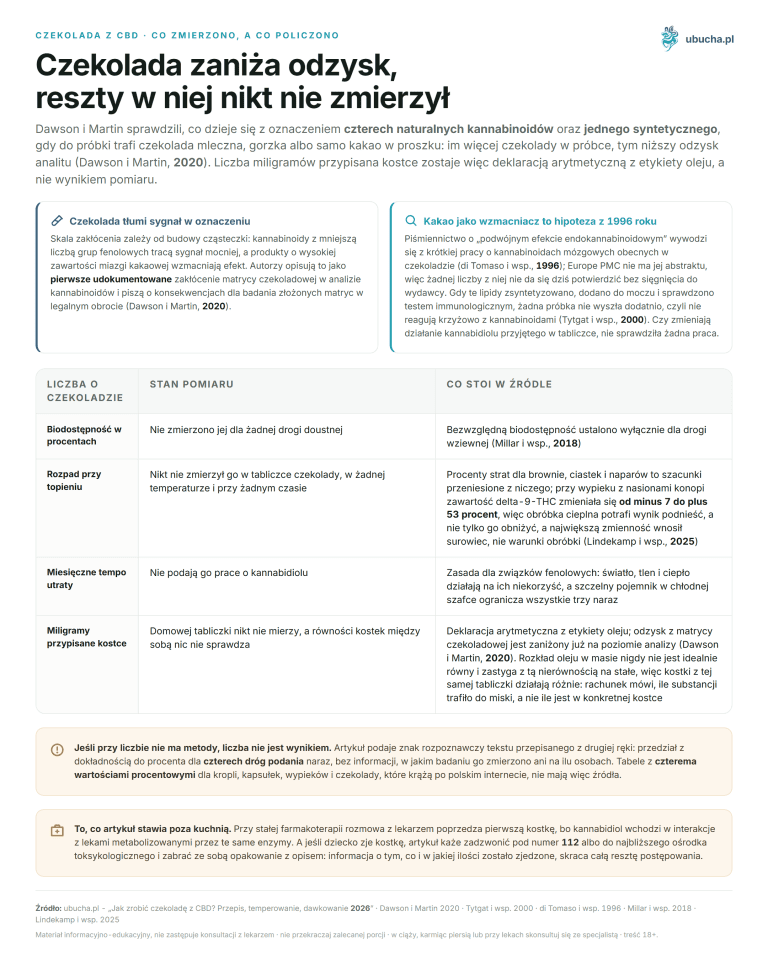
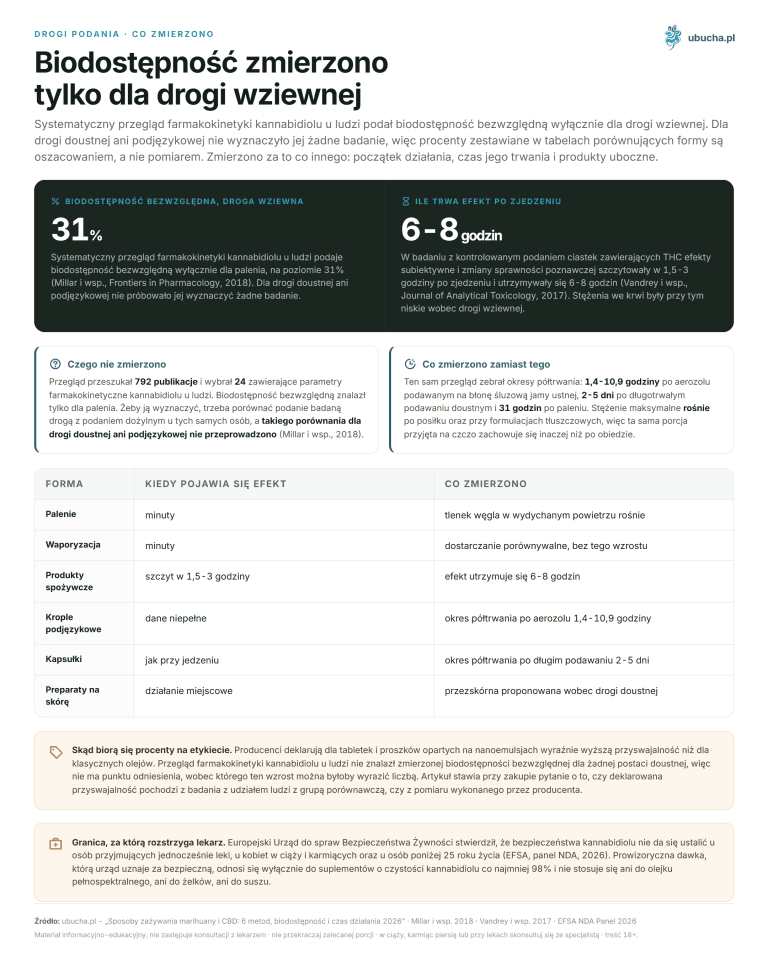
Exactly how much reaches blood is unknown. Only that it is little: a review by Lucas et al. estimates oral bioavailability of THC and CBD as low as 6% (Lucas et al., British Journal of Clinical Pharmacology, 2018). Grifoni et al. link this to lipophilicity and first-pass liver metabolism (Grifoni et al., 2022). No measured human value exists for oral route. A review of 24 CBD studies in humans found absolute bioavailability only for smoking, 31%, and none for oral administration (Millar et al., Frontiers in Pharmacology, 2018).
Is it allowed to make butter from hemp fiber dried herb?
The law does not explicitly resolve this. Hemp fiber plants have a sum of delta-9-THC and THCA in flower or fruiting tops not exceeding 0.3% dry mass (art. 4 pt 5 of the Act on Counteracting Drug Addiction, consolidated text Dz.U. 2023 pos. 1939). Their dried herb is thus not cannabis other than fiber (art. 4 pt 37). The question concerns finished butter, not the dried herb itself.
The 0.3% threshold applies from May 7, 2022, as amended by the act published in Dz.U. 2022 pos. 763. Previously it was 0.20%. The sum of both forms is rounded to one decimal place, so testing only delta-9-THC answers a different question than the law. The same 0.3% applies from 2023 to EU subsidies for hemp cultivation (Regulation (EU) 2021/2115), but the Polish threshold does not derive from it.
Uncertainty arises from art. 4 pt 38. Cannabis resin is defined as “resin and other cannabis products containing delta-9-tetrahydrocannabinol or delta-9-tetrahydrocannabinolic acid”, without any threshold. The list of narcotics group I-N includes cannabis resin at item 188, without a note on fiber cannabis (consolidated text Dz.U. 2024 pos. 1139). Whether homemade butter from hemp fiber is such an “other cannabis product” is not stated by the law, and we did not check case law. Therefore, we do not say it is legal or illegal. A lawyer will decide.
Separate questions arise from food law. In the EU novel food catalog, extracts from Cannabis sativa L. and products with non-psychoactive cannabinoids are novel foods without authorization (EU novel food catalog). The Commission calls the catalog a non-binding tool giving orientation on whether a product requires authorization. Binding is Regulation (EU) 2015/2283, concerning placing novel food on the market. Whether it covers butter made for personal use also requires legal assessment. It differs for hemp seed paste, sometimes called hemp butter: hemp seeds and products with seeds with documented consumption history, e.g. oil, are not novel food.
Is it allowed to process pharmacy dried herb on prescription into butter?
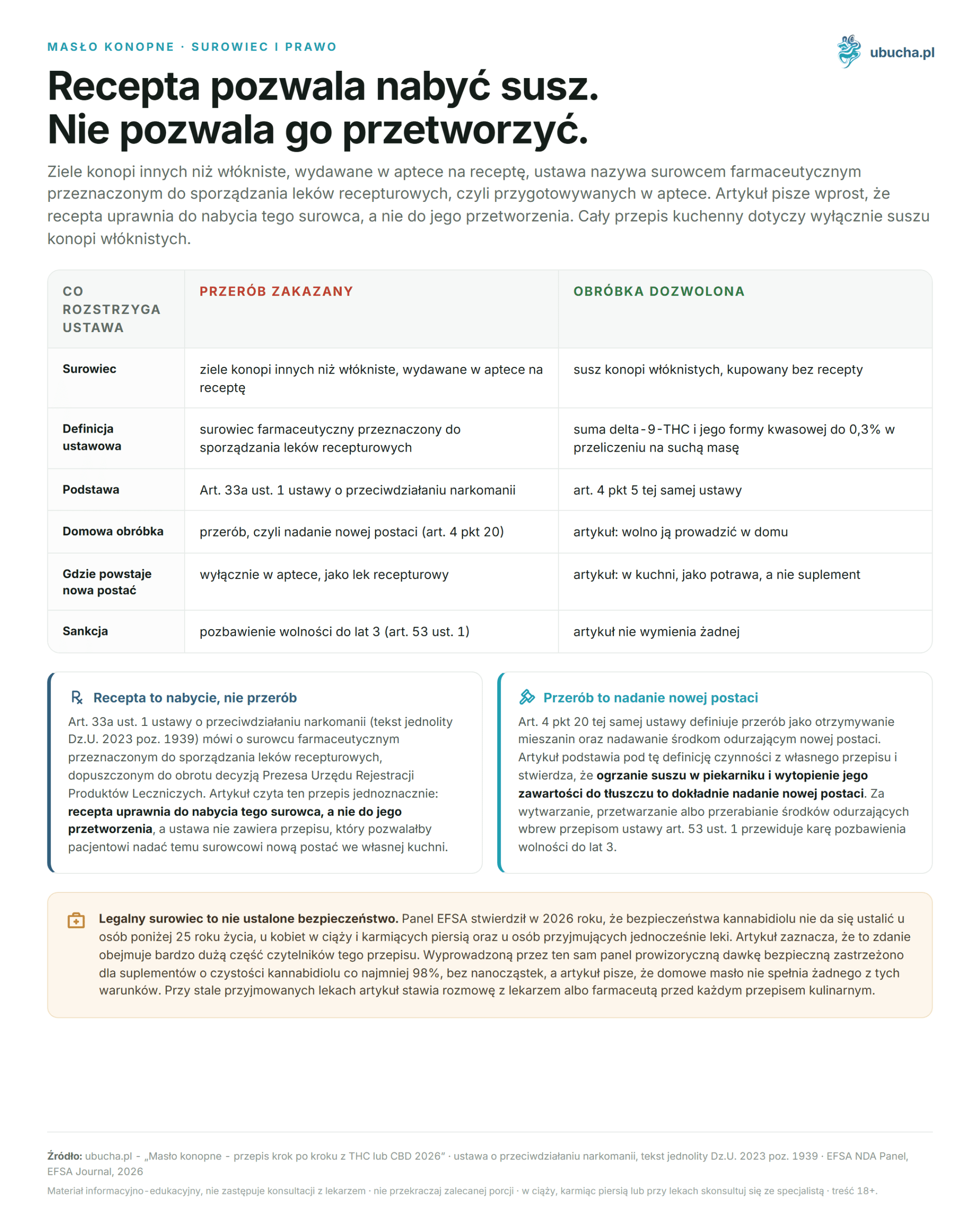
No. Cannabis other than fiber may be a pharmaceutical raw material for magistral preparations with permission from the President of URPL, issued for 5 years (art. 33a para 1 and 3 of the Act on Counteracting Drug Addiction, consolidated text Dz.U. 2023 pos. 1939). The patient receives it in pharmacy on prescription. The law contains no provision allowing home processing of this raw material.
Processing also means “giving these substances a new form” (art. 4 pt 20). Activities involving processing narcotics require permission from the Chief Pharmaceutical Inspector, and without permission they may be processed only in pharmacy under Pharmaceutical Law (art. 35 para 1 pt 1 and para 3). Processing narcotics contrary to law is punishable by up to 3 years imprisonment (art. 53 para 1). These provisions imply that homemade butter from pharmacy dried herb is unauthorized processing. We did not check case law.
The same law prohibits advertising and promotion of narcotics and advertising food by suggesting it acts like them (art. 20 para 1 and 3). Therefore, this text contains no methods for stronger effect or tips on where to get dried herb. It contains evidence and risk description.
What dried herb is suitable for hemp butter?
One for which you know the test result with sum of THC and THCA, as the law counts the threshold that way. The second number in the test is CBDA and CBD, which in hemp fiber flowers vary extremely: from 0.1 to 46.8 mg CBDA and from 0.1 to 23.9 mg CBD per gram dry mass (Brighenti et al., cited in Kanabus et al., 2021).
Composition also changes in storage. Hemp undergoes decarboxylation even without heating, e.g. under light (Ryu et al., 2021). After one year in darkness, the biggest cannabinoid changes in flowers and extracts occurred at 25 degrees (Milay et al., Frontiers in Plant Science, 2020). The test from the label thus describes the state on the test day. How to limit these changes is explained in the guide on storing dried herb.
What about leaves and stalks? Cannabinoids concentrate in flowers. In analysis of three medical cannabis strains, flowers had 15.77-20.37% cannabinoids, leaves 1.10-2.10%, and bark of stalks 0.005-0.008% (Jin et al., Scientific Reports, 2020). These are proportions between plant parts, not values for fiber dried herb. We found no measurement of how much from leaves and stalks passes into fat in butter.
Vaporized dried herb is a separate case. Lanz et al. vaporized 50 mg dried herb with THC or CBD dominance, both with over 0.3% THC, in five devices. Residue contained 1.1 to 16.2% of total THC and CBD, depending on device (Lanz et al., PLoS One, 2016). They also measured acid forms by HPLC and calculated decarboxylation efficiency: in four electric devices set to 210 degrees it was 94.6 to 99.9%, and in a gas burner device without temperature control 87.7 to 93.3%. This is a lab test result, not any home session at different temperature. More on this material is in the text about vaporized dried herb (ABV).
What is decarboxylation and can it be skipped?
Decarboxylation is a reaction where a carboxylic acid loses carbon dioxide (OpenStax, Organic Chemistry). In cannabis, cannabinoid acids predominate, and CBD and THC form from them in this reaction (Wang et al., 2016). It can be skipped, but then conversion depends on rendering. At 90 degrees, hemp fiber dried herb lost less than half of CBDA in 60 minutes (Ryu et al., 2021).
Are acid forms different? The abstract of Lewis-Bakker et al. describes them as inactive at cannabinoid receptors, with CBD and THC as strong ligands. The table in the same work is more cautious: THCA acts as a weak agonist at CB1 receptor, and CBD as antagonist, with EC50 above 10 µM (Lewis-Bakker et al., Cannabis and Cannabinoid Research, 2019). The division into “inactive” and “strong” is thus a simplification. We compare acid and active forms in the table of acid and active forms.
Acid forms remain in homemade products in practice. In Argentina, 436 samples of oils, resins, and flowers were tested. Homemade preparations contained cannabinoid acids not listed in commercial product leaflets, and variability was large (Sedan et al., Cannabis and Cannabinoid Research, 2023).
Does rendering alone replace oven? No one checked this for butter in reviewed studies. If fat below 90 degrees behaves like dried herb in dryer, conversion will be slow.
How long to decarboxylate dried herb before rendering?
No exact time for home oven was measured, but direction is known. In ground hemp fiber flowers, half of CBDA disappeared after 44.4 minutes at 105 degrees, 32.6 minutes at 120 degrees, and 25.8 minutes at 135 degrees (Ryu et al., 2021). THCA converted faster by about 5 minutes under same conditions.
The popular setting of 110 degrees for 40 minutes, also given in earlier versions of this text, should be read cautiously. 110 degrees is between 105 and 120 degrees in the study. Forty minutes is roughly the time after which half of CBDA is lost. This is not full decarboxylation of CBDA-dominant dried herb.
Why does CBDA react slower? In dried extract, reaction followed first-order kinetics, and THCA rate constants were about twice those of CBDA and CBGA (Wang et al., 2016). A review of cannabis oil preparation methods recommends lower temperature for longer time rather than high temperature for short time to convert all acids (Gouvêa-Silva et al., Cannabis and Cannabinoid Research, 2023).
The oven is not a laboratory dryer. Authors of the flower study note that in a closed chamber, reaction rate may depend on volume. Actual home oven temperature and dried herb layer thickness were not measured. Decarboxylation in oven is described in the text on step-by-step cannabis decarboxylation.
How many cannabinoids and terpenes are lost during decarboxylation?
Losses were measured on extract, not dried herb. In vacuum oven, loss of acid plus neutral form sum was 18.05% for CBDA at 110 degrees and 25.2% at 130 degrees (Wang et al., 2016). THCA lost least, 7.94% at 110 degrees, and CBGA most, 52.67% at same temperature.
Pure CBDA standard lost 13.75% at 110 degrees. Authors allow that some loss is evaporation in vacuum or unidentified products. Higher temperature shortens decarboxylation but increases loss.
These numbers should not be directly transferred to dried herb. Ryu et al. compared flowers and extracts at 135 degrees from same strains. Thermal degradation of neutral forms was greater in extracts than plant material. Losses measured on extract may overestimate what happens to dried herb on tray. By how much, none of these studies calculated.
Odor also decreases. According to review: in water bath method, monoterpenes, the most volatile terpenes, dropped to about half after 5 minutes in boiling water. Another study found cannabis oil without decarboxylation had most volatile compounds (Boffa et al., Molecules, 2024). What this loss changes besides butter aroma was not studied.
How long to render hemp butter and at what temperature?
No measurement for butter was found in PubMed or Europe PMC. The closest is pharmacy medical cannabis oil: 30 minutes maceration at 100 degrees, counted from when oil reaches that temperature (Ramella et al., 2020). Flowers were decarboxylated 30 minutes at 125 degrees in an oven without ventilation before maceration, and oil was filtered with a press afterwards.
Safety: Do not leave hot fat unattended and keep cloths away from flame. When using water bath, watch water level. Press material only when cooled enough not to burn. Keep pot and finished butter out of reach of children and animals.
We searched PubMed and Europe PMC in September 2026. Query for terms like cannabutter gave 21 results in PubMed, and a broader query combining cannabis with butter and extraction gave 9. In Europe PMC we reviewed 4 and 11 results. None measured temperature, time, efficiency, or stability of hemp butter. Among them were dog poisonings and surveys.
Another lead is hemp seed oil heated for 15 minutes. In open vials, sum of CBD and CBDA below 100 degrees dropped only 1-2%. At 100 degrees it dropped 20%, and at 120 degrees 60%. In closed vials at 120 degrees loss was about 11% (Citti et al., 2018, cited in Kanabus et al., 2021). Losses increased with temperature and air access. This is commercial hemp seed oil, not butter from dried herb.
Ranges like 70-90 degrees for 2-3 hours or 80-85 degrees in water bath, given in our earlier butter texts, have no measurement. We do not replace them with other numbers because none exist. Data only show direction: losses in oil rose from 100 degrees up, and no one studied rendering time in butter.
Does water bath protect butter from overheating?
It limits temperature, but its effect on butter was not measured. Water at normal pressure boils at 373.17 K, about 100 degrees (NIST Chemistry WebBook). As long as water remains in lower pot, the vessel above will not heat beyond that point. When water evaporates, this ceiling disappears.
Similarly, water added to pot with butter: boiling mixture will not exceed about 100 degrees. However, we found no study on water added to fat during cannabis rendering. PubMed query for water bath with oil or butter from cannabis gave one result analyzing CBD oils. The claim that water protects from burning is thus physics of boiling, not a study result.
What about air fryer or Thermomix? PubMed query combining air fryer with cannabis or cannabinoids gave 0 results, and Europe PMC 3 unrelated to cannabinoids. For Thermomix both databases returned 0 results. Therefore, we do not provide temperatures or times for these devices.
Fast butter also lacks data. Only known is that shorter heating at same temperature leaves more unconverted CBDA, as seen in times given above.
How much dried herb per 250 g butter?
No proportions for butter are given in any reviewed study. The only proportion found is 1:10 in pharmacy oil: 5 g flower per 50 ml olive oil or MCT (Ramella et al., 2020). This is medical cannabis and liquid oil, not hemp fiber dried herb in butter.
The same 5 g per 50 ml is given in a study of 201 pharmacy oils (Carcieri et al., Journal of Pharmacy and Pharmacology, 2018).
Two of our earlier butter texts, replaced by this one, gave different proportions: one 7-10 g, the other 14-20 g dried herb per 250 g butter. Neither had a source, and the upper limit of the first is below the lower limit of the second. This is a good example of how numbers without measurement propagate from recipe to recipe. We do not choose either or convert pharmacy 1:10 to butter.
What about butter from 2 g dried herb? How many cannabinoids such amount brings depends on dried herb composition, which varies extremely as shown above. Losses during decarboxylation and fat retained in material add up. No one measured how much of 2 g passes into butter, so we do not give milligram results.
Write the proportion on the jar with date and dried herb name. It will not help calculate potency but will describe the batch to a doctor if someone accidentally consumes it.
Is it necessary to strain and press hemp butter?
Yes, and pressing recovers fat. In the pharmacy method, oil was filtered 5 minutes with a mechanical press with filter, and plant material still retained 0.52 to 1.27 g oil from about 5 g flower. From 45.8-47.5 g oil recovered 43.91-46.23 g (Ramella et al., 2020).
Authors state clearly that most published methods do not apply any pressure when separating oil, leaving oil in plant waste. The advice “do not squeeze cheesecloth because chlorophyll and bitterness will pass” has no basis in measurements. Chlorophyll or bitterness in butter were not measured in any reviewed study.
The table in that study also gives “extraction efficiency” 95.87-97.46%. This is oil mass recovery after filtration, not percentage of cannabinoids passing into fat. This number cannot be used to assess potency.
Press material through cheesecloth or cloth only after cooling. Dispose of leftovers so dogs cannot access them. A survey among veterinarians in Canada and USA listed butter and hemp oil, as well as compost, among causes of cannabis poisoning in animals (Amissah et al., PLoS One, 2022).
Can coconut oil, olive oil, or ghee be used instead of butter?
Yes, but only olive oil and MCT were compared. In pharmacy oils both gave similar cannabinoid concentrations and were stable for first 60 days at 4 degrees. MCT extracted more terpenes and retained them better: after 90 days it lost 23.07-40.70%, olive oil 44.70-61.27% (Ramella et al., 2020).
No such data exist for coconut oil and ghee. PubMed query combining coconut oil with cannabinoid extraction gave 9 results, none measuring transfer from flower to oil. For ghee and clarified butter with cannabis, results were 0. The claim that clarification raises smoke point has no scientific source in searched databases.
Regular butter is regulated for composition. Butter in the EU has at least 80% and less than 90% milk fat, max 16% water, and max 2% dry non-fat milk solids (Regulation (EU) No 1308/2013). Popular 82% is a threshold for butter collected in public intervention, not a butter definition. Water is thus at most about one-sixth of mass.
Fat type matters for long heating. CBD and THC oils were kept at 50 degrees for 2 days or 70 degrees for 14 days. Unsaturated oils like olive or sunflower formed free radicals, MCT almost none. CBD or THC dropped most in sunflower oil (Tonoyan et al., Free Radical Biology and Medicine, 2022). Butter was not in this study. More on carriers is in the comparison MCT vs olive oil as CBD carrier.
Why can’t you calculate how much CBD is in a butter portion?
Because even in pharmacies concentrations vary greatly. In 201 olive oils prepared from medical cannabis, relative standard deviation of THC and CBD concentrations exceeded 50%, with median extraction efficiency over 75% (Carcieri et al., 2018). Authors studied variability between batches and labs, with no standard preparation method.
At home, unknowns are greater. We compiled them with existing measurements. Dried herb composition varies between flowers by hundreds of times. Decarboxylation was measured in laboratory dryer, not oven. Transfer to fat was measured in pharmacy olive oil, and fat retained in material with press, not with cheesecloth. Degradation in homemade cake was not measured, and THC content in edibles varies even within one product (Barrus et al., RTI Press, 2016). Homemade potency cannot be predicted, only measured in lab on finished batch.
Comparison of extraction methods does not help. Lewis-Bakker et al. compared four methods on three medical cannabis strains: ultrasonic, supercritical, Soxhlet, and microwave. Microwave gave fully decarboxylated extracts, but authors note conditions may differ for each strain and repeatability requires higher rigor (Lewis-Bakker et al., 2019). This is solvent extraction, not fat.
Therefore, we do not give milligrams per teaspoon. How to make an approximate calculation for baking and why it remains an estimate is shown in the text with CBD dose calculator for homemade baking.
How much hemp butter to add to a dish?
This number cannot be given because homemade butter content is unknown. EFSA set a provisional safe CBD dose of 0.0275 mg per kg body weight per day, about 2 mg for a 70 kg person. It applies only to supplements with at least 98% pure CBD, without nanoparticles (EFSA NDA Panel, 2026). It is not converted to teaspoons of butter.
Time also matters. After eating, peak THC concentration comes after about 120 minutes, after inhalation in 3-10 minutes (Lucas et al., British Journal of Clinical Pharmacology, 2018). For CBD, review gives 1 to 4 hours (Grifoni et al., Molecules, 2022). For eating with THC, onset was 30-90 minutes, peak 2-4 hours. Delay encourages eating more than intended (Barrus et al., 2016).
Pharmacology gives the rule “start low and go slow”: start with small amounts and increase slowly. Lucas et al. write this for doctors prescribing cannabis medicines. For food with delayed effect, it has the same sense in the kitchen. Why edibles act later than dried herb is explained in the text on 11-hydroxy metabolism.
What about dish temperature? Pure CBD in a closed vial at 220 degrees after 2 minutes hardly changed, but after 60 minutes decomposed over 80%, producing THC and CBN (García-Valverde et al., Frontiers in Chemistry, 2022). This is a fat-free and food-free model. No conclusion on sauce or cake temperature can be drawn except direction: long and strong heating promotes breakdown.
How to store hemp butter to slow composition loss?
Best in fridge, in airtight container protected from light. After one year in darkness, whole flowers and olive oil extracts stored at 4 degrees fared best (Milay et al., 2020). Pharmacy cannabis oils are stored at 4 degrees in amber glass because active ingredient loss was greater at room temperature (Ramella et al., 2020).
Fat protects cannabinoids better than water. In Pacifici et al. study, in worst case 72% of initial concentration remained in oil, and other cannabinoids had 80-85% after 14 days, regardless of room or fridge temperature. In infusion, THC and CBD dropped to half or less after 3 and 7 days (Pacifici et al., 2017).
Cold also slows acid form breakdown. In hemp seed oil, CBDA half-life was about 20 months at 5 degrees, 49 days at 20 degrees, and 20 days at 25 degrees (Citti et al., cited in Kanabus et al., 2021). On the other hand, pure CBD products were stable even at room temperature in long storage (Majumdar et al., Cannabis and Cannabinoid Research, 2026).
Grifoni et al. list poor stability among CBD limitations as medicinal substance, but conditions matter. In acidic solution pH 2, CBD degradation rate rose from 0.0266 per day at 40 degrees to 1.6222 per day at 70 degrees, about 60 times (Jaidee et al., Cannabis and Cannabinoid Research, 2022). Butter is not acidic solution, so transfer direction, not numbers.
How long can hemp butter stay in fridge?
No measurement for hemp butter. PubMed query combining butter with CBD or THC and stability or storage gave 4 results, none studying butter as food. Guidelines for homemade herbal oils are contradictory. University of Georgia advises keeping oil heated with herbs in fridge and discarding after 4 days or freezing (University of Georgia Cooperative Extension, C1334).
University of Maine considers oils with dried herbs safest and allows keeping them in cool dark place up to three months (University of Maine Cooperative Extension, 4385). Caution is justified. Clostridium botulinum spores surrounded by oil have anaerobic environment favoring growth at room temperature (Penn State Extension). In 1989, garlic in oil, a low-acidity product requiring constant refrigeration, caused botulism poisoning in three people (Morse et al., American Journal of Public Health, 1990).
None of these guidelines apply to butter, which is water-in-fat emulsion. We do not average them. If choosing the more cautious, keep butter in fridge briefly and freeze portions.
Can hemp fiber butter cause intoxication?
It cannot be excluded because fat also extracts THC. EFSA set acute reference dose 1 µg delta-9-THC per kg body weight. German BfR found that common hemp food may exceed it and impair driving ability (EFSA, Arcella et al., EFSA Journal, 2020). The 0.3% threshold for dried herb does not say how much THC reaches butter.
Infusions show the scale. EFSA assessment found adults drinking many cannabis infusions at 95th percentile content could ingest up to 208 µg THC per kg body weight, though estimates are likely overestimated. In same data, one commercial clarified butter sample with at least 5% cannabis had 6.85 mg delta-9-THC per kg (EFSA, EFSA Journal, 2020). According to review, in Germany at least one in four of 67 tested cannabis food samples exceeded acute reference dose for THC (Kanabus et al., 2021).
EU THC limits in food do not cover flowers. Regulation (EU) 2023/915 sets 3.0 mg/kg for seeds and seed products and 7.5 mg/kg for seed oil, calculated as sum of delta-9-THC and THCA multiplied by 0.877 (Commission Regulation (EU) 2023/915). From January 1, 2027, limits apply to leaves for brewing and ready infusions from leaves. No item covers flowers or butter.
CBD itself is described as non-psychoactive in pharmacological reviews (Lucas et al., 2018), but butter from dried herb is not pure CBD. Do not drive after eating hemp butter.
Who should not eat hemp butter?
According to EFSA, CBD safety cannot be established for people under 25, pregnant and breastfeeding women, and people taking medications (EFSA NDA Panel, 2026). Panel also notes CBD crosses placenta and human studies indicate potential liver damage, especially with drug combinations.
Interactions arise from liver metabolism. Rifampicin, which induces CYP3A4 enzyme, clearly lowered CBD peak concentration, and ketoconazole, which inhibits it, nearly doubled it. In vitro studies showed CBD strongly inhibits CYP2C19. Review describes CBD inhibition of clobazam metabolism raising its concentration up to eightfold (Lucas et al., 2018).
Drugs using these pathways are common. A review based on CBD drug information lists examples including hypertension and migraine drugs. Adverse effects occurred in nearly half of CBD users, more often at higher doses (Brown and Winterstein, Journal of Clinical Medicine, 2019). These data come from epilepsy drug studies at high doses.
If you take medications regularly, ask your doctor or pharmacist before consuming anything with cannabis. During pregnancy and breastfeeding, reviewed studies do not support considering hemp butter safe, and lack of data is not proof of safety.
How to protect children and animals from hemp butter?
Keep butter and baked goods out of their reach, in labeled and closed container. In the USA from 2017-2021, 7043 cases of edible cannabis ingestion by children under 6 were reported, from 207 in 2017 to 3054 in 2021. 97.7% occurred at home, and 22.7% of children were hospitalized (Tweet et al., Pediatrics, 2023).
Small children more often eat something that looks like food without reading labels. The most common form of edible cannabis products are baked goods, which require a fat carrier like butter (Conerney et al., Frontiers in Psychiatry, 2024). A 2026 review adds that oral THC features, including delayed onset, increase risk of accidental ingestion by children (Jurowski et al., Food and Chemical Toxicology, 2026).
Dogs are the second risk group. In Colorado from 2005-2010, 125 dogs with cannabis poisoning were described, two died after eating baked goods with medical cannabis butter (Meola et al., Journal of Veterinary Emergency and Critical Care, 2012). That was THC butter, but baked goods with any hemp butter must be kept away from animals as from children.
How to make hemp butter step by step?
Hemp butter is made in two heat stages, only the first measured and in lab. In hemp fiber dried herb, half of CBDA disappeared after 32.6 minutes at 120 degrees (Ryu et al., 2021), so short decarboxylation leaves much acid. No study measured rendering time and temperature in butter.
If making butter, follow what can be justified:
- Check dried herb test with sum of THC and THCA, as law counts threshold that way.
- Decarboxylate dried herb before rendering. In hemp fiber flowers at 105 degrees after 44.4 minutes only half of CBDA disappeared, so this is not full conversion (Ryu et al., 2021).
- Render without overheating. No measurement for butter was found, and in hemp seed oil losses rose from 100 degrees up (Citti et al., 2018, cited in Kanabus et al.).
- Press material because without pressure more fat remains in plant waste (Ramella et al., 2020).
- Keep butter in fridge, out of reach of children and animals.
Example of CBD baked goods is in the text about CBD cookies, and a broader picture in the guide to cannabis in the kitchen.
If you want declared CBD content, homemade butter will not provide it. A simpler way is ready oil with content on the package, e.g. from the oils category. For medicines, pregnancy, or breastfeeding, consult a doctor first.
Frequently Asked Questions
Is it necessary to strain hemp butter?
Yes. Separating plant material is part of every described method, and pressing recovers fat. In pharmacy oil filtered with a press, the material still retained 0.52-1.27 g oil from about 5 g flower (Ramella et al., 2020). Authors state that methods without pressing leave oil in plant waste.
How much dried herb is needed for hemp butter?
No proportions for butter are given in any reviewed study. Common proportions of 7-10 g and 14-20 g per 250 g butter lack measurement and contradict each other. The only proportion from research is 1:10 in pharmacy oil, 5 g flower per 50 ml olive oil or MCT (Ramella et al., 2020), which is a different raw material and fat.
At what temperature should hemp butter be rendered?
No measurement for butter was found. The closest is pharmacy medical cannabis oil, macerated for 30 minutes at 100 degrees (Ramella et al., 2020). In hemp seed oil heated for 15 minutes, the sum of CBD and CBDA hardly changed below 100 degrees, but dropped by 60% at 120 degrees (Citti et al., 2018, cited in Kanabus et al.).
Can decarboxylation be skipped?
It can, but then conversion of CBDA to CBD depends only on rendering, for which no measurement in butter was found. In hemp fiber dried herb at 90 degrees after 60 minutes, not even half of CBDA was lost (Ryu et al., 2021). CBDA reacts more slowly than THCA, as shown also by measurements on extract (Wang et al., 2016).
Is hemp butter from CBD dried herb legal?
The law does not explicitly resolve this. Dried herb with sum of delta-9-THC and THCA up to 0.3% is not cannabis other than fiber (art. 4 pt 5 u.p.n.), but the definition of cannabis resin in art. 4 pt 38 has no threshold. Processing dried herb from pharmacy outside pharmacy and without permission is punishable (art. 53). The EU catalog recognizes cannabinoid extracts as novel food.
Can you fry with hemp butter?
Better not. Pure CBD in a closed vial at 220 degrees after 2 minutes hardly changed, but after 60 minutes decomposed over 80%, producing THC and CBN (García-Valverde et al., 2022). This is a fat-free model, but the direction is clear: long and strong heating promotes CBD breakdown.
How long can hemp butter be stored?
No studies on hemp butter stability were found. Guidelines for homemade herbal oils are contradictory: University of Georgia advises discarding oil heated with herbs after 4 days in fridge or freezing it, while University of Maine allows up to three months for dried herbs. None apply to butter, so better to keep it short or freeze it.
Can hemp butter be made in an air fryer?
No studies on this. PubMed queries combining air fryer with cannabis or cannabinoids yielded 0 results, and 3 results from Europe PMC were unrelated to cannabinoids (as of September 2026). For Thermomix both databases returned 0 results. Temperatures and times for these devices are not provided as no measurements exist.
This article is informational and educational and does not replace consultation with a doctor. If you are pregnant, breastfeeding, taking medications, or have chronic conditions, consult a specialist before using supplements or herbs.
Author: Michał Waluk · Published: 2026-05-11 · Updated: 2026-09-20