
CBD and Chronic Pain - What Does Science Say and What Does Marketing Say? Guide 2026
How much does CBD realistically provide for chronic pain? Numbers from Cochrane, BMJ, and Annals of Internal Medicine juxtaposed with promises from oil sellers.
Chronic pain of moderate to severe intensity affects 19% of adult Europeans, and for 40% of them, treatment proves insufficient. This is a market where empty promises find a buyer in seconds. Oils with cannabidiol are sold today with claims of effectiveness that are not found in any of the systematic reviews to which these advertisements refer. This text juxtaposes one with the other: what the Cochrane reviews, BMJ, and Annals of Internal Medicine have really shown, how these results compare to standard pain medications, and which popular claims about dosing, bioavailability, and full spectrum have no support in the cited works. We checked every number in the source, and where the source did not contain it, we state this directly instead of softening it.
KEY INFORMATION
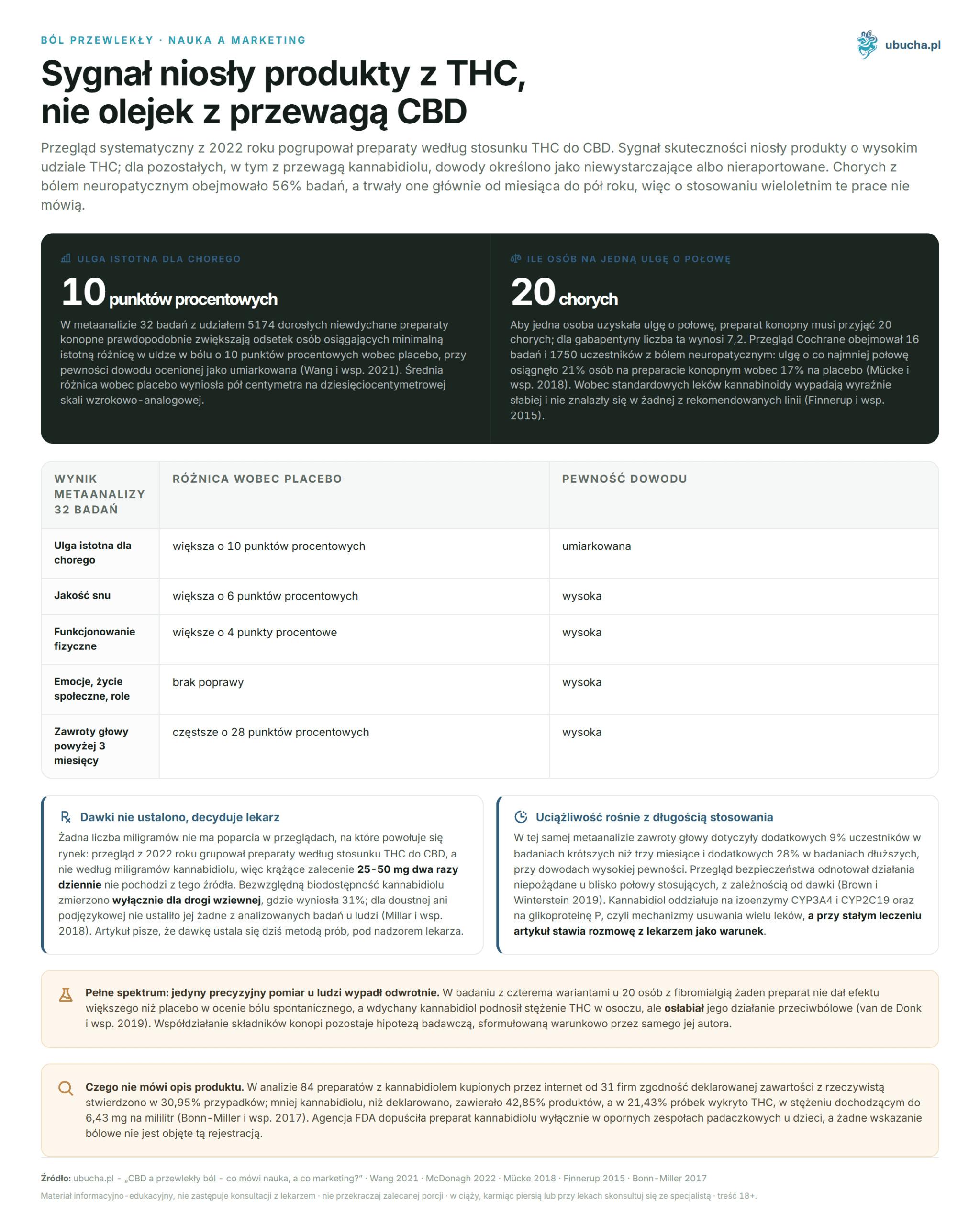
• A review of 32 studies involving 5174 people showed a small improvement in pain: 10 percentage points more patients achieved a minimal significant difference than on placebo (Wang et al. 2021).
• A signal of effectiveness was carried by products with a high THC to CBD ratio, not products with a predominance of cannabidiol (McDonagh et al. 2022).
• For one person to achieve relief by half, 20 patients must take a cannabis product; for gabapentin, this number is 7.
• Compliance with the label was found in 31% of the tested cannabidiol oils purchased online.
• The effective dose of CBD for chronic pain has not been established in any of these reviews.
Who is affected by chronic pain and what is lacking in its treatment?
It affects nearly one in five adult Europeans, and the treatment system is lagging behind. In a survey involving 46,394 people from 15 European countries and Israel, 19% of respondents reported chronic pain of moderate to severe intensity (Breivik et al. 2006).
The picture from in-depth interviews is even sharper. Severe pain, rated 8-10 points on an eleven-point scale, was reported by 34% of patients. Depression due to pain was diagnosed in 21% of respondents. 61% of people could not work outside the home or could do so to a lesser extent, and 19% lost their jobs. 59% of respondents had lived with pain for two to fifteen years, so we are talking about a permanent condition, not an episode.
It is also worth noting what these people were reaching for. Two-thirds used non-pharmacological methods, most often massage, indicated by 30% of respondents, and physiotherapy indicated by 21%. The willingness to seek help outside of prescriptions existed long before the trend for cannabidiol.
However, the most important aspect of this topic is the gap in care. At that time, one-third of patients did not receive treatment, 40% had inadequate treatment, and only 2% of respondents were under the care of a pain medicine specialist. Such a gap does not disappear on its own. It is filled by what is available without a referral and without a queue.
This background explains the popularity of cannabis products better than any pharmacological argument. A person who waits months for a pain treatment clinic reaches for a product from a pharmacy or an online store because they have it today. The question is not whether people will reach for CBD, but whether they will receive honest information about what they can expect.
How would CBD work on pain?
Through many molecular targets at once, and none of them are classical cannabinoid receptors. Cannabidiol does not work like THC, which stimulates CB1 and CB2 receptors. Instead, it affects ion channels and enzymes of the endocannabinoid system, as described in laboratory studies.
A review of cannabinoid receptor pharmacology noted that cannabinoid ligands also interact with targets outside the CB1 and CB2 systems: the GPR55 receptor, TRP family channels, ligand-gated ion channels, and nuclear PPAR receptors. The authors note that none of these targets currently meet the criteria that would allow them to be called a third cannabinoid receptor (Pertwee et al. 2010).
A study comparing eleven pure cannabinoids and plant extracts showed what cannabidiol itself does. It stimulated and inhibited the human TRPV1 channel, the same one activated by capsaicin from chili peppers. It was also the only one among the studied compounds that inhibited FAAH, the enzyme that breaks down anandamide, and inhibited cellular uptake of anandamide (De Petrocellis et al. 2011).
These results come from cell cultures and enzymatic assays, not from patients. They have explanatory value but do not predict. The multitude of molecular targets is often presented in advertisements as an advantage, as “multidirectional action.” In pharmacology, it rather means the opposite: the more targets with uncertain involvement, the harder it is to predict the outcome for a specific person, and the less the mechanism itself means as an argument.
What does the latest systematic review show?
It shows something that reverses the typical sales message. A signal of effectiveness in chronic pain was carried by products with a high THC content relative to CBD, not products with a predominance of cannabidiol. The review included 18 randomized studies with a placebo group involving 1740 people and 7 cohort studies with 13,095 participants (McDonagh et al. 2022).
The authors grouped products by THC to CBD ratio and by origin. Synthetic products with a high THC content, above 98%, could moderately improve pain intensity and response rates, with an increased risk of sedation and a significant increase in the risk of dizziness. A sublingual spray with a similar ratio of both compounds, about 1.1 to 1, probably provided a slight improvement in pain intensity and overall functioning.
Two limitations of this review change the way its conclusions are read. The studies lasted mainly from one month to six months, so they say nothing about the effects of long-term use. Patients with neuropathic pain comprised 56% of them, meaning that other types of chronic pain are less represented in this material.
| Product Category | What was noted |
|---|---|
| Synthetic, high THC content (above 98%) | Possible moderate improvement in pain, greater risk of sedation and dizziness |
| Extract with a high THC to CBD ratio (from 3:1 to 47:1) | Significant increase in the risk of dropout and dizziness |
| Sublingual spray with a similar ratio (1.1:1) | Probably slight improvement in pain and functioning |
| Other products, including those with a predominance of CBD | Insufficient or unreported evidence |
The last row of this table is the crux of the matter. For products outside the listed categories, i.e., for a typical oil with a predominance of cannabidiol, the evidence was deemed insufficient or completely unreported. The review does not say that such oil does not work. It says that it is unknown, and this is a different statement than what is found in product descriptions.
How much does cannabis realistically provide for chronic pain?
It provides a small and measurable improvement, not a breakthrough. A meta-analysis of 32 randomized studies involving 5174 adults showed that non-inhaled cannabis products likely increase the percentage of people achieving a minimal significant difference in pain relief by 10 percentage points compared to placebo, with the certainty of evidence rated as moderate (Wang et al. 2021).
The effects beyond pain itself are even smaller. Improvement in physical functioning included an additional 4% of patients, and improvement in sleep quality included an additional 6%. Cannabis products had no effect on emotional, social functioning, or role fulfillment, and this conclusion was based on high-certainty evidence.
| Outcome | Difference from placebo | Certainty of evidence |
|---|---|---|
| Pain relief at a level significant to the patient | 10 percentage points | moderate |
| Sleep quality | 6 percentage points | high |
| Physical functioning | 4 percentage points | high |
| Emotional and social functioning | no improvement | high |
| Dizziness with use for at least 3 months | 28 percentage points | high |
The last row deserves special attention because it shows how the balance changes over time. In studies shorter than three months, dizziness affected an additional 9% of participants, while in studies lasting longer, it affected an additional 28%. Thus, the longer the use, the less favorable the benefit-to-burden ratio becomes.
The scale of pain improvement is worth expressing in units that mean something at the patient’s bedside. The average difference from placebo was half a centimeter on a ten-centimeter visual analog scale. This is less than the difference considered minimally significant for the patient, and the percentage of 10% describes precisely those patients who exceeded this threshold.
How do cannabinoids compare to standard neuropathic pain medications?
They clearly perform worse, and this is the most honest answer that can be formulated today. A Cochrane review involving 16 studies and 1750 participants showed that relief from pain reaching at least half intensity was achieved by 21% of people on cannabis products compared to 17% on placebo, which gives a number needed to treat equal to 20 (Mücke et al. 2018).
In comparison, let’s take a meta-analysis of 229 studies on neuropathic pain pharmacotherapy, which used the same endpoint, i.e., relief of at least half (Finnerup et al. 2015). Comparing both works shows the scale of the difference better than any adjective.
| Treatment | Number of people to treat for relief of half |
|---|---|
| Serotonin and norepinephrine reuptake inhibitors | 6.4 |
| Gabapentin | 7.2 |
| Pregabalin | 7.7 |
| High-concentration capsaicin patches | 10.6 |
| Cannabis products | 20 |
Strong recommendations and first-line positions were given in this meta-analysis to tricyclic antidepressants, serotonin and norepinephrine reuptake inhibitors, and pregabalin with gabapentin. Cannabinoids were not included in any of the recommended lines. The authors noted that the analysis of publication bias indicates an overestimation of treatment effects by about 10%, which applies to all positions in this table.
On the side of adverse effects, the proportions reverse against cannabis. Participation in the study due to adverse effects was discontinued by 10% of people on cannabis products compared to 5% on placebo, and neurological symptoms occurred in 61% compared to 29%. Mental disorders were reported in 17% of people on cannabis products compared to 5% on placebo. With a milder efficacy threshold, i.e., relief of at least 30%, the result was slightly better: 39% versus 33%, which gives a number needed to treat equal to 11. Differences between types of pain are discussed more broadly in the post about why cannabinoids work differently for each type of pain, and the comparison with opioids in the text about cannabis and opioids in pain treatment.
Does CBD help with fibromyalgia?
In the only study that separated cannabinoids into individual variants, cannabidiol alone did not outperform placebo. In an experimental study with randomization and four consecutive variants, 20 people with fibromyalgia inhaled four cannabis strains with known compositions: high in THC, mixed, high in CBD, and a strain without either compound (van de Donk et al. 2019).
None of the variants produced an effect greater than placebo in assessing spontaneous pain or in response to an electrical stimulus. The mixed strain did result in a 30% reduction in pain intensity being reported by a greater percentage of participants than on placebo, but the intensity of relief correlated with the intensity of intoxication, making it difficult to separate the analgesic effect from the psychoactive one.
The composition of the strains was known to the milligram, making this study unique. The high-THC strain contained 22.4 mg of this compound, the mixed strain contained 13.4 mg of THC and 17.8 mg of cannabidiol, and the high-CBD strain contained 18.4 mg of CBD with THC content below 1 mg. Only the strains containing THC significantly raised the pain threshold under pressure.
However, the most interesting result concerns cannabidiol itself and contradicts popular messaging. Inhaling CBD raised THC levels in plasma but simultaneously weakened the analgesic effect induced by THC. The authors describe this as a pharmacokinetic synergy with pharmacodynamic antagonism. Cannabidiol did not enhance the effect here but suppressed it.
It is worth comparing this with recommendations for the disease itself. In the revised European recommendations for fibromyalgia, the only recommendation with a strength of “strongly for” remains physical exercise; all other therapies were rated as “weakly for,” and initial management should be based on patient education and non-pharmacological methods (Macfarlane et al. 2017).
Does CBD help with cancer pain?
The latest randomized study states that adding cannabis oil to palliative care did not reduce overall symptom burden. The double-blind study included 144 people with advanced cancer who received oil with a THC to CBD ratio of 1 to 1 or placebo, with the dose increased over 14 days according to tolerance (Hardy et al. 2025).
The overall symptom severity score improved in both groups to a similar extent, and the difference between them was not significant. The improvement in overall well-being was even greater in the placebo group. A statistically significant advantage was noted only in the assessment of pain itself, and this, as the authors noted, came at the cost of greater psychomimetic toxicity.
The authors’ conclusion is stated directly and is worth quoting in conversation with a patient: patients can be informed that cannabis oil with a 1 to 1 ratio has not proven to be better than palliative care alone in alleviating symptoms, and the slight benefit in pain control was associated with greater toxicity.
Two things arise from this for a person buying oil. First, the study concerned a product containing THC in equal proportion to cannabidiol, thus a product unavailable without a prescription. Second, even this product did not improve overall condition more than placebo. We write more broadly about cannabinoids in oncology in the text about whether cannabis can support cancer treatment.
What dose of CBD for pain is supported by research?
No specific number of milligrams is supported in the reviews cited by the market. This is an uncomfortable answer, but the only one that can be defended after checking these works one by one. A review from 2022 grouped products by THC to CBD ratio and method of production, not by the dose of cannabidiol in milligrams.
The circulating recommendation of “25-50 mg twice daily” is often attributed to this review. We checked: it is not there. This does not mean that such a dose is bad. It means that the source cited to support it does not contain it, so the argument from the authority of the study is empty in this case.
The second obstacle is even more fundamental and concerns absorption. A systematic review of the pharmacokinetics of cannabidiol in humans states that absolute bioavailability was measured only for the inhalation route, where it was 31%. For the oral or sublingual route, no study has established it (Millar et al. 2018). The values provided in sales materials of “13-19% for sublingual drops” do not come from this work.
The practical consequence is simple. Since it is unknown what portion of cannabidiol from drops reaches the bloodstream, converting drops to milligrams gives an illusion of precision, not precision. The dose is currently determined by trial and error, under the supervision of a doctor, and this should be described instead of relying on numbers borrowed from studies that do not contain them.
Does formulation matter: isolate or full spectrum?
In the laboratory, extracts can be stronger than pure compounds, but in humans, the best-documented interaction goes the other way. This is one of the few situations where preclinical and clinical data diverge so clearly that it can be shown in two works.
The hypothesis of the interaction of cannabis components was described in a review dedicated to terpenes and minor cannabinoids. Its author conditionally formulates it: the synergy of phytocannabinoids and terpenoids, if proven, increases the chance of developing new products, and the paper only proposed methods for studying it (Russo 2011). This is a research hypothesis, not a finding.
On the laboratory side, differences are indeed visible: in assays on TRP channels and enzymes of the endocannabinoid system, some plant extracts were stronger than their corresponding pure cannabinoids (De Petrocellis et al. 2011). However, these are assays on cells, without the involvement of the organism.
In humans, the only precise observation of this interaction in pain showed antagonism: cannabidiol weakened the analgesic effect of THC, even though it raised its concentration in the blood. The conclusion for the buyer does not sound like “full spectrum is better,” but rather “it is unknown, and the only direct measurement in patients turned out the opposite of what the advertisement says.” We dissect the differences between the forms of the raw material in the text about how hemp distillate differs from isolate.
What does CBD marketing not say?
It does not mention three things: that the product may be non-compliant with the label, that cannabidiol has no registration for any pain indication, and that not every oil without THC is free of THC. All three can be verified in sources, and none appear in product descriptions.
An analysis of 84 cannabidiol products purchased online from 31 companies showed compliance of declared content with actual content in only 30.95% of cases. 42.85% of products contained less cannabidiol than declared, while 26.19% contained more. THC was detected in 21.43% of samples, at concentrations up to 6.43 mg per milliliter (Bonn-Miller et al. 2017). For a driver or athlete subjected to doping control, this is not a technical detail but a real risk of a positive result from a product described as THC-free.
The second issue concerns registration. The FDA has approved a cannabidiol product only for resistant epilepsy syndromes in children (NCI, PDQ). The basis was a double-blind study involving 120 participants, in which the median number of seizures per month fell from 12.4 to 5.9 compared to a drop from 14.9 to 14.1 on placebo (Devinsky et al. 2017). No pain indication is covered by this registration.
Below are phrases that should raise a warning light when reading a product description.
- “FDA approved for pain,” while registration covers only childhood epilepsy.
- “Clinically proven” without citing a specific study that could be verified.
- “Natural alternative to opioids” or “works like morphine but without side effects.”
- “One hundred percent safe,” despite documented drug interactions and adverse effects.
- Thousands of satisfied customers as the only cited evidence of effectiveness.
Why are opinions on effectiveness misleading?
Because in chronic pain, it is difficult to separate the effect of the product from expectation, natural fluctuations of the disease, and the way the question was asked. This applies to both online reviews and clinical studies, and in the latter case, the scale of the phenomenon has been measured.
In a meta-analysis of 229 studies on neuropathic pain pharmacotherapy, the analysis of publication bias indicated an overestimation of treatment effects by about 10%. Studies published in peer-reviewed journals reported greater effects than unpublished studies found in registries and on pharmaceutical company websites (Finnerup et al. 2015). If the overestimation applies to works on drugs with an established position, one must read reports on products sold as supplements even more cautiously.
The second problem concerns blinding and was clearly shown in the study on fibromyalgia. The intensity of reported relief correlated with the intensity of intoxication, and the significance level of this relationship was lower than 0.001. A participant who feels a psychoactive effect knows that they did not receive a placebo, and this alone changes the reported outcome. In products containing THC, maintaining a blind trial is therefore difficult by design.
The third observation comes from a meta-analysis of 32 studies and is a convenient test for any life-changing report. Cannabis products had no effect on emotional, social functioning, or role fulfillment, with high-certainty evidence. A report describing the recovery of social life due to oil therefore describes something that studies with a control group do not confirm, and it cannot be resolved based on a single experience.
What has stronger evidence than CBD for chronic pain?
Things that no one advertises because no one profits from them. In a meta-analysis of neuropathic pain pharmacotherapy, strong recommendations and first-line positions were given to tricyclic antidepressants, serotonin and norepinephrine reuptake inhibitors, and pregabalin with gabapentin (Finnerup et al. 2015).
The second line, with a weak recommendation, includes lidocaine patches, high-concentration capsaicin patches, and tramadol. The third line, also weak, includes strong opioids and botulinum toxin type A. Topical products and botulinum toxin are recommended only for peripheral neuropathic pain. Cannabinoids do not appear in any of these lines.
In fibromyalgia, the recommendation system looks even more instructive. In the revised European recommendations, the only therapy rated “strongly for” remains physical exercise. Initial management should be based on patient education and non-pharmacological methods, and all further therapies were rated as “weakly for” and tailored to the needs of the individual (Macfarlane et al. 2017).
Comparing these two documents gives an honest hierarchy. The strongest evidence lies with movement, education, and established medications, with even they providing moderate effects. Cannabidiol does not compete with them for first place; at best, it is an addition considered when the others have failed or are poorly tolerated. The order has practical significance because money and time spent on oil are money and time not spent on physiotherapy.
How to safely approach CBD for chronic pain?
Starting with a conversation with your doctor about the medications you are already taking, because that is where the real risk lies. A review of the safety of cannabidiol noted adverse effects in nearly half of users, with a clear dose-dependent relationship (Brown and Winterstein 2019).
The most commonly reported were increased aminotransferase activity, sedation, sleep disturbances, infections, and anemia. Cannabidiol interacts with isoenzymes CYP3A4 and CYP2C19 and with P-glycoprotein, which are mechanisms for eliminating many drugs. It can be both sides in these interactions: its concentration is changed by other drugs, and it changes their concentrations. With drugs that have a narrow therapeutic window, a small shift is enough to change efficacy or increase toxicity.
Separately, it is worth remembering about time. In a meta-analysis of studies on cannabis products, dizziness affected an additional 9% of participants with use shorter than three months and an additional 28% with longer use. Thus, the burden increases with the length of use, which is exactly when the product would be taken continuously in chronic pain.
From the above, several principles arise that are worth applying if, despite moderate evidence, you want to try.
- Tell your doctor about all regular medications, especially anticoagulants, anticonvulsants, and antidepressants.
- Do not discontinue effective treatment in favor of a product with moderate efficacy.
- Set in advance how long and what signs will indicate that it is not working, instead of extending the trial indefinitely.
- Request a certificate of analysis for a specific batch, with a date and number matching the packaging.
- Treat drowsiness, dizziness, and sleep disturbances as possible signals of interaction, not just ordinary nuisances.
Frequently Asked Questions
Does CBD really work for chronic pain?
Cannabis products provide a small improvement. In a meta-analysis of 32 studies involving 5174 people, a minimal significant relief was achieved by 10 percentage points more patients than on placebo. For products with a predominance of cannabidiol, a 2022 review assessed the evidence as insufficient or unreported.
What dose of CBD for pain is supported by research?
No specific one. A systematic review from 2022 grouped products by THC to CBD ratio, not by milligrams of cannabidiol, so the popular recommendation of 25-50 mg twice daily does not come from this source. No study has yet established the absolute bioavailability of orally administered cannabidiol in humans.
Does CBD help with fibromyalgia?
In a study with four variants involving 20 people with fibromyalgia, no product produced an effect greater than placebo in assessing spontaneous pain. Inhaled cannabidiol weakened the analgesic effect of THC. In European recommendations, the only recommendation with a strength of “strongly for” remains physical exercise.
Is CBD a registered drug for pain?
No, it is not. The FDA has approved a cannabidiol product only for resistant epilepsy syndromes in children, and no pain indication is covered by this registration. The claim that cannabidiol is an approved pain medication has no support in registration documents.
Does CBD interact with pain medications?
Yes. Cannabidiol interacts with isoenzymes CYP3A4 and CYP2C19 and with P-glycoprotein, which are mechanisms for eliminating many drugs. Adverse effects have been reported in nearly half of users, depending on the dose. Before combining with regular medications, a conversation with a doctor or pharmacist is necessary.
Does full spectrum work better than isolate?
This has not been demonstrated in humans. The interaction of cannabis components remains a research hypothesis, conditionally formulated by its author. The only precise measurement in patients with pain showed that cannabidiol weakened the analgesic effect of THC, despite raising its concentration in the blood.
If after talking to your doctor you decide to try, choose products with a certificate of analysis for a specific batch; the cannabis oils available from us are dietary supplements, not pain medications.
This article is for informational and educational purposes and does not constitute medical advice. Before starting to use cannabis or CBD for therapeutic purposes, consult your doctor, especially if you are taking other medications, are pregnant, or breastfeeding.
Author: Michał Waluk · Published: 2026-05-11 · Updated: 2026-08-10