
CBD in Alzheimer’s Disease Therapy - Evidence, Dosages, Safety 2026
What cannabinoid studies really showed in Alzheimer’s disease, where the CBD safety limit lies for seniors, and why CBD cannot replace a neurologist.
Alzheimer’s disease currently has no cure that stops its progression, and any text promising otherwise is false. In 2021, 57 million people worldwide lived with dementia, with Alzheimer’s accounting for 60-70% of cases (“Dementia fact sheet”, WHO, 2026). Families seek support beyond standard pharmacotherapy and encounter cannabinoids: CBD, THC, nabilone. Some of these leads have real research behind them, others originated online. This article separates fact from fiction. We show what mouse models revealed, what the Cochrane review collected, where EFSA set safety limits, and how to discuss supplementation with a doctor when the patient already takes donepezil or anticoagulants. The order in this disease is always the same: first a neurologist, then anything else.
KEY INFORMATION
• Alzheimer’s accounts for 60-70% of dementia cases, with 57 million people living with dementia in 2021 (WHO, 2026).
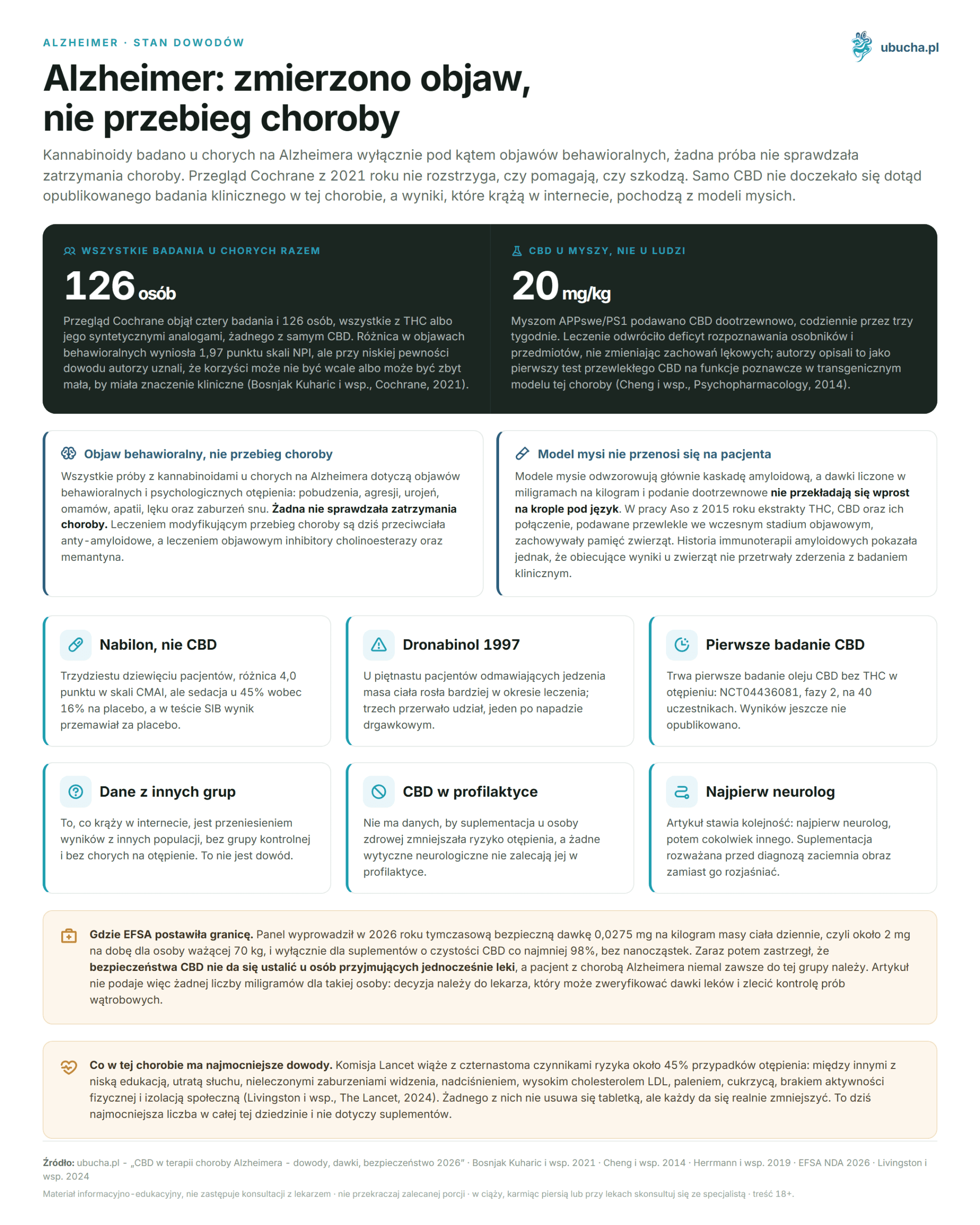
• The 2021 Cochrane review included 4 cannabinoid studies in dementia, totaling 126 people, and does not resolve benefit or harm.
• No published clinical trial has tested CBD alone in Alzheimer’s patients.
• EFSA has not established a safe CBD dose for people taking medications (EFSA NDA, 2026).
Important medical information. Alzheimer’s requires neurological diagnosis and standard pharmacotherapy. CBD is not a cure for Alzheimer’s. If you notice worsening memory, disorientation in familiar surroundings, or difficulty with daily tasks in a loved one, see a primary care doctor for referral to a neurology or geriatric clinic. Do not stop pro-cognitive medications or start supplementation without consultation, especially if the patient takes donepezil, memantine, or anticoagulants. Family information is provided by the Polish Alzheimer’s Association (alzheimer-polska.pl).
What is Alzheimer’s disease and how common is it?
Alzheimer’s disease is a progressive neurodegenerative disorder characterized by beta-amyloid plaques and neurofibrillary tangles of tau protein accumulating in the brain, leading to neuron death. It is the most common cause of dementia, accounting for 60-70% of cases. In 2021, 57 million people lived with dementia worldwide, with nearly 10 million new diagnoses annually (“Dementia fact sheet”, WHO, 2026).
Dementia and Alzheimer’s are not synonyms. Dementia is a syndrome: memory, executive functions, and personality decline enough that a person cannot manage independently. Alzheimer’s is one cause, though the most common. The distinction matters practically because treatment depends on diagnosis: vascular dementia is managed differently than Lewy body dementia, which poorly tolerates some antipsychotics.
| Dementia Type | Characteristics |
|---|---|
| Alzheimer’s disease | 60-70% of all dementia cases (WHO); predominant fresh memory impairment |
| vascular dementia | stepwise course linked to vascular brain changes |
| Lewy body dementia | fluctuating alertness, visual hallucinations, parkinsonian symptoms |
| frontotemporal dementia | behavioral changes predominate over memory loss |
National data are cautious. Poland does not maintain a dementia registry, so media estimates vary widely and cannot be confirmed at source. This article sticks to numbers from cited documents and does not supplement with secondhand values.
How does Alzheimer’s disease destroy hippocampal memory and neurons?
Changes begin in the entorhinal cortex and hippocampus, where fresh impressions become lasting memories. Thus, the first to disappear is memory of recent hours and days: names, recent conversations, scheduled appointments. Skills practiced over years last much longer.
The duration of the hidden disease is described by the Jack biomarker model. The authors ordered the sequence in which markers become abnormal and linked it to symptom onset and progression. The 2013 version allowed that two protein pathologies, beta-amyloid and tau, may start independently, with amyloid influx accelerating earlier tauopathy (Jack et al., The Lancet Neurology, 2013). The practical conclusion is that at diagnosis, the process has been ongoing for a long time.
This explains why a patient can play piano or peel potatoes without remembering what they ate for breakfast. Procedural memory and world knowledge rely on different networks than new event encoding. Reminiscence therapy and music therapy tap into these preserved pathways, which remain longest and give the patient a sense of agency when discussing yesterday’s day no longer works.
It is important to honestly note the knowledge boundary. The biomarker model describes event order, not when symptoms appear in a given person. Variation among individuals is large, and the authors added this as a separate correction in the model’s second version.
What causes Alzheimer’s and why is beta-amyloid tested?
The strongest hypothesis remains the amyloid cascade: abnormal cleavage of APP precursor protein produces beta-amyloid 42 peptide, which aggregates into oligomers and plaques, followed by inflammation, tau hyperphosphorylation, and neuron death. The hypothesis is not a full explanation, just the best-studied part.
Genetics provide a second pillar. APOE gene variants are the main genetic risk factor: epsilon 4 allele increases risk compared to the more common epsilon 3, while epsilon 2 lowers it. Apolipoprotein E isoforms differ in regulating beta-amyloid aggregation and clearance, and also affect lipid transport, glucose metabolism, and inflammation (Liu et al., Nature Reviews Neurology, 2013). Carrying epsilon 4 is not a verdict and does not justify genetic testing on one’s own.
The third thread is microglia, the brain’s immune cells. Activated by plaques, they enter chronic inflammation and instead of clearing deposits, contribute to damage of neighboring neurons. This is where cannabinoids come in, as CB2 receptors are mainly on immune cells. We explore microglia’s role in plaque clearance in the post Alzheimer’s and microglia: how CBD supports amyloid plaque clearance via TRPV2.
Additional modifiable factors exist. The Lancet Commission counted them separately and we return to them in the prevention section, also showing what proportion of dementia cases they explain.
What are early and late symptoms of Alzheimer’s?
The first sign is usually progressive fresh memory impairment, accompanied by personality changes and planning difficulties. The difference from normal forgetting is not that something slipped the mind, but that the whole situation disappears: not just the doctor’s visit, but the awareness that it even happened.
The US Alzheimer’s Association collected ten early warning signs, from trouble performing familiar tasks, through disorientation in time and place, to social withdrawal (“10 Early Signs and Symptoms of Alzheimer’s”, Alzheimer’s Association). If several appear simultaneously in someone over sixty, it is sufficient reason to see a doctor rather than wait.
Behavioral and psychological symptoms of dementia (BPSD) form a separate group: agitation, aggression, delusions, hallucinations, apathy, anxiety, and sleep disturbances. They affect most patients during the disease, burden families more than memory loss, and accelerate institutionalization (Rogowska et al., Drugs and Aging, 2023). All cannabinoid studies below relate to this area.
| Stage | Symptoms | Caregiver Needs |
|---|---|---|
| early | losing track, repeated questions, planning difficulties | diagnosis and legal arrangements |
| moderate | disorientation, wandering, evening symptom worsening | stable daily routine and safe housing |
| advanced | speech loss, swallowing difficulties, immobility | 24-hour care and nursing support |
How is Alzheimer’s diagnosed?
Diagnosis is not based on a single test. The doctor collects history from the patient and separately from a close person, as the patient often does not perceive what family sees, performs a neurological exam, and conducts a cognitive screening test. The MMSE short form or MoCA test is most common. The test result alone is not a diagnosis; it sets a baseline and allows comparison after months.
The second step is excluding reversible causes. Dementia-like symptoms can be caused by hypothyroidism, vitamin B12 deficiency, depression, electrolyte disturbances, and anticholinergic drugs. This part of diagnosis cannot be replaced by any home test, and missing it can be costly, as some conditions are treatable.
The third step is biomarkers. MRI shows structural atrophy, and amyloid imaging by PET or cerebrospinal fluid confirms pathology. Jack’s biomarker model orders the sequence in which markers become abnormal (Jack et al., The Lancet Neurology, 2013). This is not academic theory: registration trials of new drugs required amyloid confirmation by PET or CSF, and donanemab trials also tau pathology imaging.
This directly affects family decisions. Without confirmed diagnosis, disease-modifying treatment cannot be accessed, nor can changes in well-being be reliably attributed to therapy or natural course. Supplementation before diagnosis clouds rather than clarifies the picture.
What are standard Alzheimer’s treatments in 2026?
Treatment divides into two tiers. Symptomatic drugs include acetylcholinesterase inhibitors - donepezil, rivastigmine, galantamine - and memantine acting on NMDA receptors. They improve function but do not stop disease. The second tier is anti-amyloid antibodies, which have changed recent years.
Lecanemab was tested in an 18-month phase 3 trial on 1795 early Alzheimer’s patients. CDR-SB decline was 1.21 points versus 1.66 in placebo, a 0.45 point difference, roughly a 25% slowing. Amyloid burden dropped by 59.1 centiloids. Infusion reactions occurred in 26.4%, and ARIA-E (edema/effusion) in 12.6% (van Dyck et al., New England Journal of Medicine, 2023).
Donanemab followed a similar path. In TRAILBLAZER-ALZ 2 with 1736 participants, iADRS difference was 3.25 points favoring drug in low/medium tau burden population. Safety burden was higher than lecanemab: ARIA-E in 24.0% vs 2.1% placebo, and three deaths considered treatment-related (Sims et al., JAMA, 2023).
It is worth seeing therapy from the patient’s perspective. Lecanemab was given IV at 10 mg/kg every two weeks for 1.5 years; donanemab every four weeks for 72 weeks, switching to placebo after dosing criteria met. 1320 of 1736 donanemab participants completed the trial, indicating regimen burden.
Both numbers should be read together. Anti-amyloid antibodies slow decline but effects are measured in tenths of points on clinical scales, require infusions and repeated MRIs, and serious event risk is real. This is the background against which every supplement claim must be judged.
How does the endocannabinoid system work in the Alzheimer’s brain?
The endocannabinoid system includes CB1 and CB2 receptors, endogenous ligands like anandamide and 2-AG, and enzymes that produce and degrade them. CB1 receptors are densely located in several brain areas and mediate cannabinoids’ psychoactive effects. CB2 receptors have a much narrower distribution: mainly on immune cells and few neurons (Mackie, Journal of Neuroendocrinology, 2008).
This division directly relates to Alzheimer’s. Since CB2 is on immune cells, the target is microglia sustaining inflammation around plaques. Aso and Ferrer’s review collected studies where CB1 or CB2 stimulation at non-psychoactive doses reduced beta-amyloid toxicity and tau phosphorylation in experimental models, also affecting neuroinflammation, excitotoxicity, and oxidative stress (Aso and Ferrer, Frontiers in Pharmacology, 2014).
The third element is system sensitivity to stress. Chronic stress lowers anandamide, raises 2-AG, and reduces CB1 receptor numbers in almost every brain region studied. Anandamide decrease contributes to stress response, including hypothalamic-pituitary-adrenal axis activation (Morena et al., Neuropsychopharmacology, 2016). For a dementia patient living under constant tension, this is not a side issue.
However, all these findings come from models and tissues, not patient treatment. The path from receptor to pharmacy is long, and most molecules that started it never finished.
What did CBD studies in animal Alzheimer’s models show?
The most cited work is Aso’s 2015 study on transgenic AbetaPP/PS1 mice. THC extracts, CBD extracts, and their combination given chronically at early symptomatic stage preserved memory, with THC+CBD additionally reducing learning impairment. Treated mice had lower soluble beta-amyloid 42, altered plaque composition, reduced astroglial and microglial activation, and genome analysis pointed to thioredoxin 2 and Wnt16 protein as effect basis (Aso et al., Journal of Alzheimer’s Disease, 2015).
The second is Cheng et al. Mice APPswe/PS1 received 20 mg/kg CBD intraperitoneally daily for three weeks. Treatment reversed recognition deficits without affecting anxiety behaviors. Authors described it as the first chronic CBD test on cognitive functions in this transgenic model (Cheng et al., Psychopharmacology, 2014).
| Study | Substance and Administration | Animal Results |
|---|---|---|
| Aso 2015 | THC, CBD extracts and THC+CBD, chronic | memory preserved, less soluble beta-amyloid 42, weaker gliosis |
| Cheng 2014 | CBD 20 mg/kg intraperitoneal, 3 weeks | reversed recognition deficit, no anxiety effect |
These data have sharp limits. Mouse models mainly reflect the amyloid cascade, doses in mg/kg and intraperitoneal administration do not directly translate to sublingual drops, and the path from model to patient is often blind. Amyloid immunotherapy history in the 2000s painfully showed this: promising animal results did not survive clinical trials.
What clinical cannabinoid studies have been done in Alzheimer’s patients?
All concern behavioral symptoms; none tested disease arrest. The oldest is from 1997: fifteen patients refusing food received alternating dronabinol and placebo for six weeks each. Weight increased more during treatment, and behavioral disturbances were milder. Three participants dropped out: one due to generalized seizure, two due to serious infections; euphoria, drowsiness, and fatigue were more frequent than placebo (Volicer et al., International Journal of Geriatric Psychiatry, 1997).
The best-designed trial is Herrmann’s. Thirty-nine Alzheimer’s patients with moderate to severe agitation received alternating nabilone and placebo for six weeks each, mean dose 1.6 mg. CMAI scale difference was 4.0 points favoring nabilone, NPI-NH 4.6 points. Sedation occurred in 45% during nabilone vs 16% placebo; SIB test favored placebo (Herrmann et al., American Journal of Geriatric Psychiatry, 2019).
The Cochrane review collected four studies with 126 people, all THC or synthetic analogs, none with CBD alone. Behavioral symptom difference was 1.97 points on NPI, but with low certainty evidence authors concluded benefits may be absent or too small to be clinically meaningful. Sedation was more frequent with nabilone. The conclusion is clear: it is not possible to determine if cannabinoids help or harm in dementia (Bosnjak Kuharic et al., Cochrane Database of Systematic Reviews, 2021).
The material is limited. The four included studies lasted 3 to 14 weeks, three had crossover design, and only one reported adverse events over 70 weeks. Cognitive function difference was 1.1 points on sMMSE, with very low certainty and based on one trial with 28 participants, so not clinically significant.
Currently, three clinical trials directly address agitation in Alzheimer’s: NCT04516057 with nabilone phase 3 on 112 people, completed NCT02792257 with dronabinol on 84 people, and NCT04436081, the first CBD oil without THC phase 2 on 40 participants. Results of the last are not yet published.
Does CBD alleviate behavioral symptoms of dementia?
The honest answer is: unknown, as no one has measured this in Alzheimer’s patients. The Cochrane review found no CBD-alone studies in dementia; all online claims are extrapolations from other populations. Such extrapolation may be justified but is not evidence.
Most often data are extrapolated from Shannon’s case series. In a psychiatric clinic, records of 72 adults receiving CBD as adjunct for anxiety or insomnia were analyzed. Anxiety severity dropped in the first month in 79.2% and remained lower; sleep improved in 66.7% but fluctuated over time (Shannon et al., The Permanente Journal, 2019). This was a retrospective chart review without control group and no dementia patients. The final sample was 47 for anxiety and 25 for sleep, and the preparation was well tolerated except in three patients.
Another source is Solowij’s open study: twenty regular cannabis users took 200 mg CBD daily for ten weeks, reporting fewer depressive symptoms and psychosis-like experiences (Solowij et al., Cannabis and Cannabinoid Research, 2018). Again: no placebo, small sample, very different age group. CBD’s anxiety mechanisms are discussed in the post CBD and THC in anxiety disorders, and mood effects in cannabis in depression.
The reference point is not placebo but antipsychotics, most used for agitation. A 2023 review reminds that non-pharmacological methods are first choice for neuropsychiatric dementia symptoms, and antipsychotics may increase mortality and associate with pneumonia, vascular events, and parkinsonism (Rogowska et al., Drugs and Aging, 2023).
What CBD form is considered in dementia care?
If the attending doctor deems supplementation reasonable, form choice depends on practical matters, not potency. Repeatable dosing, ease of administration to cognitively impaired persons, and availability of a certificate of analysis from an independent lab covering heavy metals, pesticides, and mycotoxins matter.
Sublingual oil in a dark bottle with a dropper wins for seniors: it allows measuring a small, consistent dose and administering under the tongue without swallowing solids. Broad spectrum products, i.e., without detectable THC, reduce psychoactive risk in a person with impaired orientation. Gummies can be convenient but contain sugars and require chewing, problematic with dysphagia or diabetes.
| Form | Advantage for Seniors | Limitation |
|---|---|---|
| sublingual oil | repeatable, small dose; no swallowing solids | taste can be off-putting |
| gummies | easy for cooperative person | sugars, choking risk with dysphagia |
| dry herb vaporization | fast onset | device handling beyond patient ability |
The certificate of analysis deserves a separate mention as the only document verifiable before purchase. It should come from a lab unrelated to the producer, refer to the specific batch on the packaging, and cover cannabinoid content as well as heavy metals and pesticide residues. Concentration declarations without such a document are just seller promises. For patients with kidney or liver failure, this matters more than for healthy adults, as contaminants clear more slowly.
We deliberately do not provide product names or prices. The assortment changes faster than the article, and a price from a year ago is misleading. To see current compositions and concentrations, browse the hemp oils category and compare certificates, and consult your doctor about use.
How safe is CBD for an elderly person taking medications?
This is the most important boundary in the entire text. The European Food Safety Authority updated its position on CBD in 2026 and derived a temporary safe dose of 0.0275 mg per kilogram body weight daily, about 2 mg per day for a 70 kg person. This applies only to supplements with at least 98% pure CBD, without nanoparticles (EFSA NDA, EFSA Journal, 2026).
For this article, the decisive point is the caveat that follows. EFSA explicitly states that CBD safety cannot be established for three groups: under 25 years old, pregnant and breastfeeding women, and people taking medications simultaneously. Alzheimer’s patients almost always belong to the third group. Therefore, no dose can be responsibly recommended here in an article, and any text giving specific milligrams for such a person goes beyond known facts.
The reason for caution is pharmacological. A review of adverse events and interactions showed side effects in nearly half of CBD users, increasing with dose; most common were elevated aminotransferases, sedation, sleep disturbances, infections, and anemia. CBD affects CYP3A4 and CYP2C19 and P-glycoprotein, making it both victim and perpetrator of interactions. Authors recommend dose reduction of substrate drugs and considering alternative therapy in patients with multiple comorbidities (Brown and Winterstein, Journal of Clinical Medicine, 2019).
In practice, this means one thing. The CBD discussion starts with a full list of medications, not oil concentration choice. With warfarin, antiepileptics, and CYP3A4-metabolized drugs, the decision belongs to the doctor, who can verify doses and order liver tests.
How to realistically reduce Alzheimer’s risk?
This is where evidence is strongest in the entire text, but it does not concern supplements. The Lancet Commission’s 2020 report identified twelve risk factors linked to about 40% of dementia cases (Livingston et al., The Lancet, 2020). The 2024 report added two more: untreated vision disorders and high LDL cholesterol, raising the estimate to about 45% (Livingston et al., The Lancet, 2024).
The full list includes low education, hearing loss, hypertension, smoking, obesity, depression, physical inactivity, diabetes, alcohol abuse, head injuries, air pollution, social isolation, plus the two new 2024 items. None are removed by a pill, but each can be realistically reduced.
Diet has its own data. A prospective study of 923 people followed for 4.5 years found the highest MIND diet adherence tertile had over 50% lower Alzheimer’s risk than the lowest, and moderate adherence also gave benefit, with the middle tertile risk over one-third lower (Morris et al., Alzheimer’s and Dementia, 2015). This is a practical observation: benefit does not require perfect diet adherence. Another study by the same team on 960 participants over 4.7 years found cognitive decline rate difference between extreme tertiles corresponded to 7.5 years of age (Morris et al., Alzheimer’s and Dementia, 2015).
And CBD in prevention? There is no data that supplementation in healthy people reduces dementia risk. All studies above concern animals with developed pathology or symptomatic patients. No neurological guidelines recommend CBD for prevention, and EFSA has not set a safe dose for people on medications.
Where to find support in Poland for caring for a patient?
The care burden for Alzheimer’s patients in Poland mainly falls on families, and support is scattered among several institutions. It is worth knowing their map before the situation becomes urgent, as some formal matters are easier while the patient still signs documents.
The Polish Alzheimer’s Association runs support groups, caregiver training, and educational materials, and regional associations belong to the National Alzheimer’s Organizations Alliance. Resources in several European languages are available from Alzheimer Europe. Social matters are handled by county disability adjudication teams and social welfare centers.
| Need | Where to Seek |
|---|---|
| diagnosis and treatment | neurology or geriatrics clinic, referral from family doctor |
| disability certification and benefits | county disability adjudication team, social welfare center |
| caregiver support | Polish Alzheimer’s Association, local support groups, respite care in municipality |
A separate problem is caregiver exhaustion. Dementia care lasts years, with no free weekends, usually falling on one family member. Respite care, i.e., temporary patient care by a facility or assistant, is provided by municipalities and is often the easiest formal help to arrange. It is worth asking before reaching the limit, not after.
Daily communication follows its own rules. Speak slowly and in short sentences, maintain eye contact, give one instruction at a time. Do not correct memories or ask “do you remember?” as this confronts the patient with a deficit they cannot compensate. A stable daily routine and predictable environment do more for evening agitation than any supplementation.
Summary: what we know about CBD and Alzheimer’s in 2026
The knowledge state can be summarized in three sentences. Cannabinoids have been studied in Alzheimer’s only for behavioral symptoms; studies are small and involve THC or analogs; the 2021 Cochrane review does not resolve if they help. CBD alone has not yet had a published clinical trial in this disease; the first, NCT04436081, is ongoing.
The second point concerns safety. EFSA has not established a safe CBD dose for people on medications, and Alzheimer’s patients usually take several. This is not a formality: CBD affects the same liver pathways metabolizing some pro-cognitive and anticoagulant drugs. Therefore, talking to a doctor is not a polite disclaimer at the article’s end but a prerequisite.
Third, it is worth saying what is not in this text and why. We do not provide a CBD dosing protocol for seniors because no study supports it, and numbers circulating online come from other populations or nowhere. We also do not give prices or product names, as the assortment rotates faster than the article. Absence of numbers is often more honest than secondhand figures.
The third point is optimistic and least trendy. The best-documented actions have nothing to do with supplements: hearing and vision control, blood pressure, exercise, social contact, diet, and sleep. The Lancet Commission links fourteen such factors to nearly half of dementia cases, the strongest figure in the field today. Supplements may add to well-managed treatment; never replace it.
Frequently Asked Questions
Can CBD cure Alzheimer’s disease?
No. No human study has shown that CBD reverses beta-amyloid deposition or stops dementia. Data come from mouse models and do not directly translate to patients. Disease-modifying treatment today consists of anti-amyloid antibodies, and symptomatic treatment includes cholinesterase inhibitors and memantine.
Are there clinical trials of CBD in Alzheimer’s patients?
A 2021 Cochrane review covered four studies and 126 people, all involving THC or its synthetic analogs. A study of CBD alone in dementia is currently underway under number NCT04436081, phase 2, with 40 participants. Results have not yet been published, so there is simply no answer to this question.
What daily CBD dose is considered safe for seniors?
In 2026, EFSA derived a temporary dose of 0.0275 mg per kilogram of body weight, about 2 mg per day for a 70 kg person. However, it noted that safety cannot be established for people taking medications simultaneously. Alzheimer’s patients usually take medications, so the dose is determined by a doctor, not an article.
Can CBD be combined with donepezil and memantine?
Only after neurological consultation. CBD affects CYP3A4 and CYP2C19 as well as P-glycoprotein, and donepezil is metabolized partly by CYP3A4. Memantine is excreted unchanged by the kidneys, so the risk of pharmacokinetic interaction is lower there. The doctor may reduce the drug dose or order liver function tests.
Can CBD replace antipsychotic drugs for agitation?
There is no data to support this, as CBD has not been studied for agitation in dementia. Guidelines recommend starting with non-pharmacological methods because antipsychotics may increase mortality in elderly dementia patients. The choice between them and anything else is up to the attending physician.
Can medical marijuana be prescribed for Alzheimer’s?
In Poland, cannabis other than fiber hemp is dispensed only on a prescription marked Rpw, and the decision is made by a doctor. Alzheimer’s is not a standard indication, so it is sometimes used off-label for severe agitation. Practical details are described in the guide on becoming a medical marijuana patient.
If after talking to your doctor you want to compare available products, their concentrations, and certificates, browse the hemp oils category.
This article is informational and educational and does not constitute medical advice. Before starting cannabis or CBD for therapeutic purposes, consult a doctor, especially if you take other medications, are pregnant, or breastfeeding.
Michał Waluk is a cannabis education specialist collaborating with u Bucha. His articles are based on peer-reviewed publications from Europe PMC and Cochrane databases and ClinicalTrials.gov registry, emphasizing evidence quality and realities of Polish patients.
Author: Michał Waluk · Published: 2026-05-04 · Updated: 2026-08-10