
CBD and Cancer: Can Cannabis Support Cancer Treatment?
Cannabis does not cure cancer. We examine what the ASCO 2024 guidelines and Cochrane reviews say about CBD for chemotherapy nausea, pain, and palliative care.
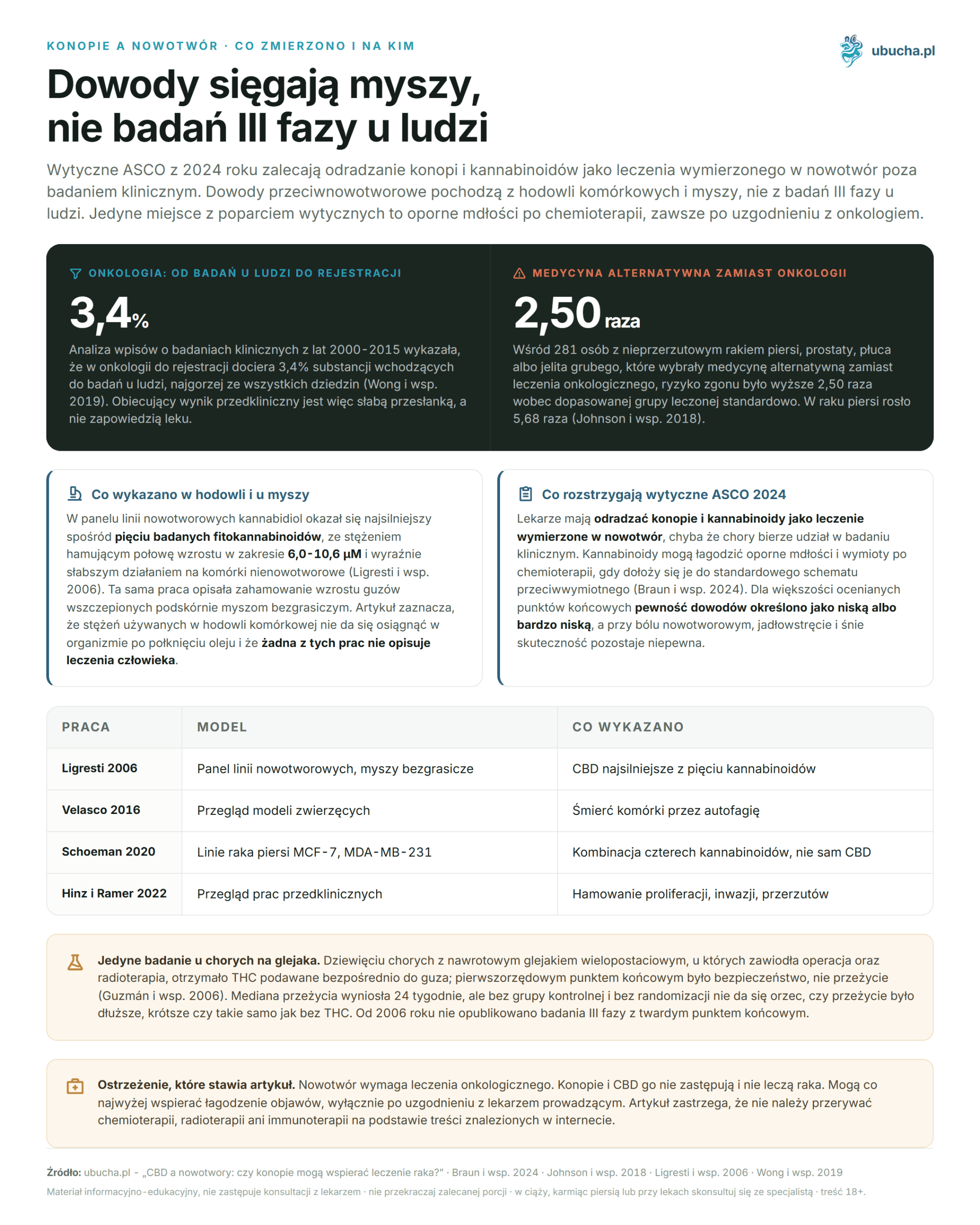
The American Society of Clinical Oncology included in its 2024 guidelines a statement that settles a long-standing online debate: doctors should advise against cannabis and cannabinoids as cancer-targeted treatments outside clinical trials. This is not a skeptic’s opinion but a conclusion of a panel that reviewed thirteen systematic reviews and five additional primary studies. However, the same guidelines allow cannabinoids in one narrow indication: refractory nausea after chemotherapy, as an adjunct to standard antiemetic regimens. This article shows exactly where the line lies between one and the other. You will find numbers from studies that actually provide them and a list of claims circulating online without data support.
KEY INFORMATION
• ASCO 2024 guidelines advise against cannabis as cancer-targeted treatment outside clinical trials (Braun et al. 2024).
• Patients who replaced oncological treatment with alternative medicine died more often: 2.50 times higher risk of death (Johnson et al. 2018).
• Anticancer evidence comes from cell cultures and mice, not from phase III human trials.
• The only guideline-supported indication is refractory nausea after chemotherapy, always after oncologist consultation.
WARNING
Cancer requires oncological treatment. Cannabis and CBD do not replace it and do not cure cancer. They may at most support symptom relief, only after consulting the treating physician. Do not stop chemotherapy, radiotherapy, or immunotherapy based on information found online.
Why is the claim “cannabis cures cancer” dangerous?
It is dangerous because it leads some patients to discontinue effective therapy. An analysis of 281 people with non-metastatic breast, prostate, lung, or colorectal cancer who chose alternative medicine instead of oncological treatment showed a 2.50 times higher risk of death compared to a matched group treated conventionally (Johnson et al. 2018).
The gap between cancers was large. In breast cancer, the risk of death increased 5.68 times; in colorectal cancer 4.57 times; in lung cancer 2.17 times. The authors note that complete treatment abandonment is rare but when it occurs, it costs lives.
The US National Cancer Institute states unequivocally: the FDA has not approved cannabis as a treatment for cancer or any other disease (NCI, PDQ). Only single purified cannabinoids are approved in narrow symptomatic indications.
The scale of cannabis use in oncology is real. In a survey at a US oncology center in a state with legal marijuana, 926 of 2737 patients responded. Cannabis had ever been used by 66%, in the past year by 24%, and in the past month by 21% (Pergam et al. 2017). It was mainly used for physical symptoms (75% of users) and neuropsychiatric symptoms (63%).
The same survey explains the origin of myths. 74% wanted to discuss cannabis with their oncology team but did not receive such conversations. Forums and social media fill this gap. A separate discussion of the official oncologists’ position is available in the post on the American Society of Clinical Oncology guidelines.
What exactly do the ASCO 2024 guidelines say?
They say two things at once. First, doctors should advise against cannabis and cannabinoids as cancer-targeted treatments unless the patient is in a clinical trial. Second, cannabinoids may alleviate refractory nausea and vomiting after chemotherapy when added to standard antiemetic regimens (Braun et al. 2024).
The evidence base for these recommendations is slimmer than press headlines suggest. The panel relied on thirteen systematic reviews and five additional primary studies (four randomized and one cohort). For most assessed endpoints, the certainty of evidence was low or very low.
The third sentence of the guidelines is often omitted but is decisive: whether cannabis improves other elements of supportive care remains uncertain. The guidelines do not confirm that cannabinoids treat cancer pain, anorexia, or insomnia. They say it is unknown. This is not the same as endorsement.
| Use | ASCO 2024 Position |
|---|---|
| Cancer-targeted treatment | Advised against outside clinical trials |
| Refractory nausea and vomiting after chemotherapy | May be considered as adjunct to standard antiemetics |
| Cancer pain, anorexia, sleep, anxiety | Efficacy remains uncertain |
| Doctor-patient conversation about cannabis | Recommended, open and nonjudgmental |
| Certainty of evidence for most endpoints | Low or very low |
The difference between approval for refractory nausea and support for cancer treatment is the difference between one symptomatic indication and all oncology. This difference is regularly blurred in sales materials.
What do in vitro and animal studies show?
They show reproducible inhibition of cancer cell growth in culture and in mice. In a panel of cancer cell lines, cannabidiol was the strongest of five tested phytocannabinoids, with half-maximal inhibitory concentration between 6.0-10.6 µM and clearly weaker effects on non-cancer cells (Ligresti et al. 2006).
The same study described tumor growth inhibition in subcutaneously implanted tumors in athymic mice and fewer lung metastases after administration of MDA-MB-231 breast cancer cells. A 2022 preclinical review adds inhibition of invasion, metastasis, angiogenesis, and chemoresistance (Hinz and Ramer 2022).
Two details from this review are often omitted but speak volumes about the difference between isolate and extract. A cannabidiol-rich extract was as potent as pure cannabidiol, with cannabigerol and cannabichromene next in potency. The authors note that cannabidiol had no single distinguished mechanism in tested lines, complicating drug development.
| Study | Model | Findings |
|---|---|---|
| Ligresti 2006 | Cancer cell line panel, athymic mice | CBD strongest of five cannabinoids, growth inhibition at 6.0-10.6 µM |
| Velasco 2016 | Review of animal models | ER stress, autophagic cell death, angiogenesis inhibition |
| Schoeman 2020 | MCF-7, MDA-MB-231 breast cancer lines | Combination of THC, CBG, CBN, CBD arrests cell cycle at G2, then apoptosis |
| Hinz and Ramer 2022 | Preclinical review | Inhibition of proliferation, invasion, metastasis, chemoresistance |
Two clarifications lost in reprints. The 2020 study concerned a combination of four cannabinoids, not CBD alone, and studied breast cancer lines, not glioma (Schoeman et al. 2020). The Spanish team’s review describes mechanisms in animal models and notes these justify first clinical trials (Velasco et al. 2016). None of these studies describe human treatment.
Why don’t in vitro results translate to patients?
Because concentrations used in cell culture cannot be achieved in the body after oral oil ingestion, and the path from animal model to registered oncological drug is exceptionally unreliable. Both obstacles are measured and act independently.
Starting with absorption, a commonly cited number lacks confirmed source. A systematic review of cannabidiol pharmacokinetics in humans states absolute bioavailability was measured only for inhalation at 31%. No oral bioavailability was measured in analyzed studies despite availability of intravenous forms (Millar et al. 2018). The often repeated “6-19% for oral oil” value does not come from this work and is unsupported.
The practical conclusion is more important than the number. Since it is unknown what fraction of cannabidiol from drops reaches the blood, it is even less known what concentration reaches tumor tissue. Comparing label dose with concentrations that killed cells in vitro is therefore baseless.
The second obstacle concerns all oncology, not just cannabis. An analysis of 406,038 clinical trial entries covering over 21,000 compounds from 2000-2015 showed that only 3.4% of substances entering human trials reach registration (Wong et al. 2019). Oncology ranks worst among all fields. Promising preclinical results are thus weak grounds, not drug promises.
What did the only THC study in glioma patients show?
It showed that direct THC administration into the tumor is feasible and safe, and nothing more. Nine patients with recurrent glioblastoma multiforme, who failed surgery and radiotherapy and had documented progression, received THC directly into the tumor. The primary endpoint was safety, not survival (Guzmán et al. 2006).
Median survival from cannabinoid administration was 24 weeks (95% CI 15-33 weeks). This number alone says nothing about efficacy. The study had no control group or randomization, and all participants were in progression phase after exhausting standard treatment. Without a comparator arm, it is impossible to say if survival was longer, shorter, or the same as without THC.
This distinction is practical because promotional materials cite “24 weeks survival after THC” as therapeutic success. The authors described their work differently: as a safety study to justify further trials. They also noted proliferation inhibition in lab conditions and decreased Ki67 in two patients, i.e., biological signals, not clinical benefit.
Since 2006, no phase III trial with hard endpoints has been published testing cannabinoids’ effect on glioma survival. Any statement about “life extension due to cannabis” thus exceeds available data, regardless of how suggestive it sounds.
Do cannabinoids help with chemotherapy-induced nausea?
This is the only area where guidelines allow their use, but evidence is older and weaker than advertising suggests. A Cochrane review covered 23 randomized studies on cannabinoids for chemotherapy-induced nausea and vomiting in adults (Smith et al. 2015).
Compared to placebo, results were clear. Patients receiving cannabinoids more often reported complete absence of vomiting and nausea plus vomiting. Comparison with prochlorperazine, an older antiemetic, showed no efficacy difference but cannabinoids caused more dizziness, drowsiness, dysphoric symptoms, and more treatment discontinuations due to adverse effects.
| Comparison | Efficacy | Tolerance |
|---|---|---|
| Cannabinoid vs placebo | More complete absence of vomiting and nausea plus vomiting | More discontinuations due to adverse effects |
| Cannabinoid vs prochlorperazine | No evidence of difference | More dizziness, dysphoria, euphoria, drowsiness |
| Cannabinoid vs newer antiemetics | Not studied in any of the 23 trials | Not studied |
This is the most common distortion in texts about cannabis in oncology. The review authors note all studies were conducted between 1975-1991 and none compared cannabinoids with newer antiemetics like ondansetron. The statement “cannabinoids work in nausea refractory to ondansetron and aprepitant” has no support in this review, though it is repeated in hundreds of product descriptions.
Separate are prescription drugs with known dosing. Dronabinol, synthetic THC, was approved in the US in 1986 for chemotherapy-induced nausea and later for anorexia in HIV-infected patients; nabilone is a synthetic THC analogue with antiemetic action (NCI, PDQ). These are not equivalents of store-bought oil. More on the mechanism is in the post about whether CBD helps with nausea.
Does cannabis help with cancer pain?
Phase III trials of THC-CBD extract in cancer pain did not meet their primary endpoint. Pain affects 55.0% of patients during cancer treatment and 66.4% in advanced, metastatic, or terminal disease, so the problem is huge (van den Beuken-van Everdingen et al. 2016).
The same meta-analysis provides two more numbers worth remembering. After radical treatment, pain persists in 39.3% of patients, and moderate to severe pain is reported by 38.0% of all patients. At this scale, every additional option is tempting, which is why study results must be read carefully.
Two phase III trials of Sativex added to optimized opioid therapy showed no superiority over placebo in primary pain intensity assessment (Fallon et al. 2017). A separately published study with 199 patients on active and 198 on placebo showed median improvement of 10.7% vs 4.5%, with p=0.0854, also not reaching significance (Lichtman et al. 2018). Both studies showed quality of life questionnaire benefits.
Separately, an opioid interaction study: 21 chronic pain patients on morphine or extended-release oxycodone inhaled vaporized cannabis for five days. Pain intensity decreased by 27% on average, opioid plasma levels unchanged (Abrams et al. 2011). This was a small pharmacokinetic safety study, not evidence of efficacy in cancer pain. We discuss separating data from promises in the post on what science and marketing say about chronic pain.
What is known about neuropathic pain after chemotherapy?
The best available data concern chronic neuropathic pain in general, not chemotherapy-induced polyneuropathy. A Cochrane review covered 16 studies with 1750 participants comparing cannabis preparations with placebo or active drug in this indication (Mücke et al. 2018).
Benefit was real but small and accompanied by adverse effects. Pain relief of at least 50% intensity was achieved by 21% on cannabis preparation vs 17% on placebo. Relief of at least 30% was 39% vs 33%. Authors conclude potential benefits may be outweighed by potential harms.
| Outcome | Cannabis preparation | Placebo |
|---|---|---|
| Pain relief ≥50% | 21% | 17% |
| Pain relief ≥30% | 39% | 33% |
| Discontinuation due to adverse effects | 10% | 5% |
| Neurological adverse effects | 61% | 29% |
| Psychiatric disorders | 17% | 5% |
Numbers translated to practice look more sober. To achieve pain relief ≥50% in one additional person, twenty patients must be treated. To cause neurological adverse effects in one, only three treated are needed. This ratio, not just effect direction, explains guideline caution.
It is worth noting what we did not find in literature. The circulating recommendation “CBD 150 mg twice daily for chemotherapy neuropathy” has no support in any verified study and was misattributed to a review on non-cancer pain. Such dosing advice should not be treated as established. More data are in the post on cannabis treatment of neuropathic pain.
What does sufficient evidence for drug registration look like?
It looks like a randomized controlled trial with a control group and a result achieved on a pre-specified endpoint. Cannabidiol has such evidence in epilepsy, not oncology. This is the best reference point for evaluating cancer claims because it shows how high the bar is set.
In a double-blind trial, 120 children and young adults with Dravet syndrome and refractory epilepsy received cannabidiol 20 mg/kg/day or placebo, both as add-ons to existing antiepileptic treatment. Median monthly seizure count dropped from 12.4 to 5.9 in the cannabidiol group and from 14.9 to 14.1 on placebo. A ≥50% seizure reduction was achieved by 43% on cannabidiol vs 27% on placebo (Devinsky et al. 2017).
On this basis, the FDA approved cannabidiol for refractory pediatric epilepsy (NCI, PDQ). Registration covers a specific pharmaceutical form, dose, and diagnosis. It does not extend to other diseases or oils sold as supplements, though advertising often cites it as proof that “CBD is a drug.”
The opposite mechanism applies to failed studies. In THC-CBD extract trials for cancer pain, the primary endpoint was not met, but post hoc analyses showed benefit in a US subgroup under 65 years old, absent in other countries. Authors describe these as exploratory analyses. Such results serve to design further studies, not to promote a product, as a subgroup chosen after seeing data can almost always be found.
Do cannabis products improve appetite, sleep, and mood in cancer?
The best evidence concerns taste, not body weight. In a double-blind randomized trial, 46 adults with advanced cancer and taste disturbances received THC 2.5 mg twice daily or placebo for 18 days (Brisbois et al. 2011).
The THC group reported better taste and smell perception, more frequent sensation that food “tastes better,” greater pre-meal appetite, and higher protein proportion in consumed calories. Sleep quality and relaxation improved. Total calorie intake and quality of life scores increased in both groups, including placebo, so these are not cannabinoid-attributed benefits.
Sleep problems in oncology are widespread. Among 823 chemotherapy patients, 36.6% reported insomnia symptoms, and 43% met insomnia syndrome criteria in the first treatment cycle, about three times higher than the general population (Palesh et al. 2010).
Mood-related numbers circulating online are inflated and need correction. A meta-analysis based on psychiatric interviews found depression by DSM or ICD criteria in 16.3% of oncology and hematology patients and anxiety disorders in 10.3%. Any mood disorder was diagnosed in 38.2% (Mitchell et al. 2011). Authors conclude depression and anxiety are less common than previously thought. The popular “anxiety in 40% of patients” confuses the rate for all mood disorders with that for anxiety alone.
What are real CBD interactions with oncological drugs?
Real and poorly controlled, because cannabidiol affects the same metabolic pathways that eliminate drugs. A CBD safety review noted adverse effects in nearly half of users, dose-dependent (Brown and Winterstein 2019).
Most commonly reported were elevated aminotransferases, sedation, sleep disturbances, infections, and anemia. In a post-chemotherapy patient, each affects an already burdened organism, and aminotransferase elevation may be mistaken for chemotherapy toxicity, leading to unnecessary treatment changes.
The mechanism involves CYP3A4 and CYP2C19 isoenzymes and P-glycoprotein responsible for drug efflux. Cannabidiol can be both affected by other drugs and affect their levels. For drugs with narrow therapeutic windows, like most cytostatics, small concentration shifts translate to toxicity or loss of efficacy.
Four practical rules arise for patients considering CBD during oncological treatment:
- Inform your oncologist before starting, not after, and ask directly about your treatment regimen.
- Do not start CBD on your own during a chemotherapy cycle when it is hard to distinguish drug effects from supplement effects.
- Treat elevated aminotransferases, drowsiness, and sleep disturbances as possible interaction signals, not just nuisances.
- Do not increase the dose on your own, as adverse effects increase with dose.
What is the legal status of CBD and medical cannabis in Poland?
Medical marijuana has been available on prescription in Poland since November 1, 2017, under the July 7, 2017 amendment to the anti-narcotics law (Dz.U. 2017 poz. 1458). Pharmacy dried flower is a medicinal product with standardized composition. Store-bought CBD oil is not.
Cannabidiol itself is not listed in the controlled substances list maintained by the Ministry of Health regulation on psychotropic substances, narcotics, and new psychoactive substances (consolidated text Dz.U. 2024 poz. 1139). A separate matter is HHC, which is controlled in Poland.
The threshold distinguishing hemp is 0.3%, calculated as the sum of delta-9-THC and tetrahydrocannabinolic acid, on a dry mass basis rounded to one decimal place. This is based on Article 4 point 5 of the July 29, 2005 anti-narcotics law (consolidated text Dz.U. 2023 poz. 1939), as amended by the March 24, 2022 law (Dz.U. 2022 poz. 763). The national threshold matches the EU threshold but does not derive from it: these are two separate regulations with the same value. Calculating delta-9-THC alone yields different lab results than summing both.
For oncology patients, the most important is product quality, which is often poor. An analysis of 84 cannabidiol products bought online from 31 companies found only 30.95% matched label content; 42.85% contained more than declared, 26.19% less. THC was detected in 21.43% of samples (Bonn-Miller et al. 2017). A certificate of analysis for the specific batch ceases to be a formality and becomes a prerequisite for any oncologist discussion.
What can no cannabis oil replace?
Curative treatment and prevention. Cancers caused nearly 10 million deaths in 2024, almost one in six deaths worldwide, and about 38% of cases today can be prevented by reducing risk factors and applying proven preventive measures (WHO 2024).
Nearly one quarter of cancer deaths are linked to five behaviors: tobacco smoking, alcohol consumption, high body mass index, low fruit and vegetable intake, and physical inactivity. No oncology society includes CBD among preventive measures because no study justifies it.
The question remains what cannabis really offers in oncology. The answer supported by data is: possible support in refractory chemotherapy nausea, probable improvement in taste perception, uncertain benefit in other symptoms, and real risk of interactions. This is little compared to advertising promises and quite a lot compared to zero.
The second thing oil cannot replace is time. Delayed diagnosis or treatment interruption change prognosis in ways no supportive product can reverse, as the analysis of patients abandoning oncological therapy showed at the start of this text. The question is not “cannabis instead of treatment” but “cannabis alongside treatment and with doctor’s knowledge.”
For a patient undergoing treatment, the practical rule is simple. Talking with the oncologist before using any cannabis product changes the situation from risky to controlled and is what patients most often expect from their doctors but least often receive.
Frequently Asked Questions
Does CBD cure cancer?
No. The ASCO 2024 guidelines recommend against cannabis and cannabinoids as cancer-targeted treatments outside clinical trials, and the FDA has not approved cannabis for any oncological indication. Anticancer evidence comes from cell cultures and animal models, not from phase III human trials.
Can I use CBD oil during chemotherapy?
Only after consulting with an oncologist. Cannabidiol affects CYP3A4 and CYP2C19 isoenzymes and P-glycoprotein, pathways responsible for eliminating many cytostatics. Adverse effects were reported in nearly half of users, dose-dependent, most commonly elevated aminotransferases, sedation, and sleep disturbances.
Do cannabinoids help with nausea after chemotherapy?
They may help with refractory nausea as an adjunct to standard antiemetic regimens. A Cochrane review covering 23 studies from 1975-1991 showed superiority over placebo and no difference compared to prochlorperazine. None of these studies compared cannabinoids with ondansetron or newer drugs.
Can cannabis replace morphine for cancer pain?
No. Phase III trials of THC-CBD extracts added to optimized opioid therapy did not meet primary endpoints. Pain affects 55.0% of patients during treatment and 66.4% in advanced disease, with management based on the analgesic ladder.
Is medical marijuana available on prescription in Poland?
Yes, since November 1, 2017, under the July 7, 2017 amendment to the anti-narcotics law. Pharmacy dried flower is a medicinal product with standardized composition, dispensed on prescription. Cannabidiol oils sold in stores have a different legal status and are not medicinal products.
How do I know if CBD oil contains what the label declares?
This is determined by a certificate of analysis for the specific batch. An analysis of 84 products bought online from 31 companies found label compliance in only 30.95% of cases; 42.85% contained less cannabidiol than declared, and 21.43% of samples contained THC. This has practical significance for oncology patients.
Cannabis products available without prescription, including cannabis oils in our store, are dietary supplements, not anticancer drugs; their use during oncological treatment requires prior approval from the treating physician.
This article is for informational and educational purposes and does not constitute medical advice. Before starting cannabis or CBD for therapeutic purposes, consult a doctor, especially if you take other medications, are pregnant, or breastfeeding.
Author: Michał Waluk · Published: 2026-05-04 · Updated: 2026-08-10