
CBD in Olympic Athletes - What the 2026 Study on Pain, Sleep, and Recovery Revealed
CBD in athletes without myths: no study involving Olympians exists, and the survey of 517 athletes and clinical trials tell a different story than the internet repeats.
There is no clinical study that has tested cannabidiol in Olympic athletes. The most frequently cited review in Sports Medicine Open states this clearly: direct studies on CBD and sports performance are lacking, and available evidence comes from preclinical studies and a few clinical trials conducted outside athlete populations. The largest survey in this field covered 517 professional rugby players and asked about perceptions, not measurements. This text shows what has actually been measured: where signals are visible, where they disappeared after statistical correction, and which numbers circulating online have no basis in any study. Instead of dosing schemes, we provide protocols of specific studies, knowledge about absorption, and the current position of the European food regulator.
KEY INFORMATION
- The 2020 narrative review by McCartney et al. is not a meta-analysis of athletes. The authors state that direct studies on CBD and sports performance are unavailable (Sports Medicine Open, 2020).
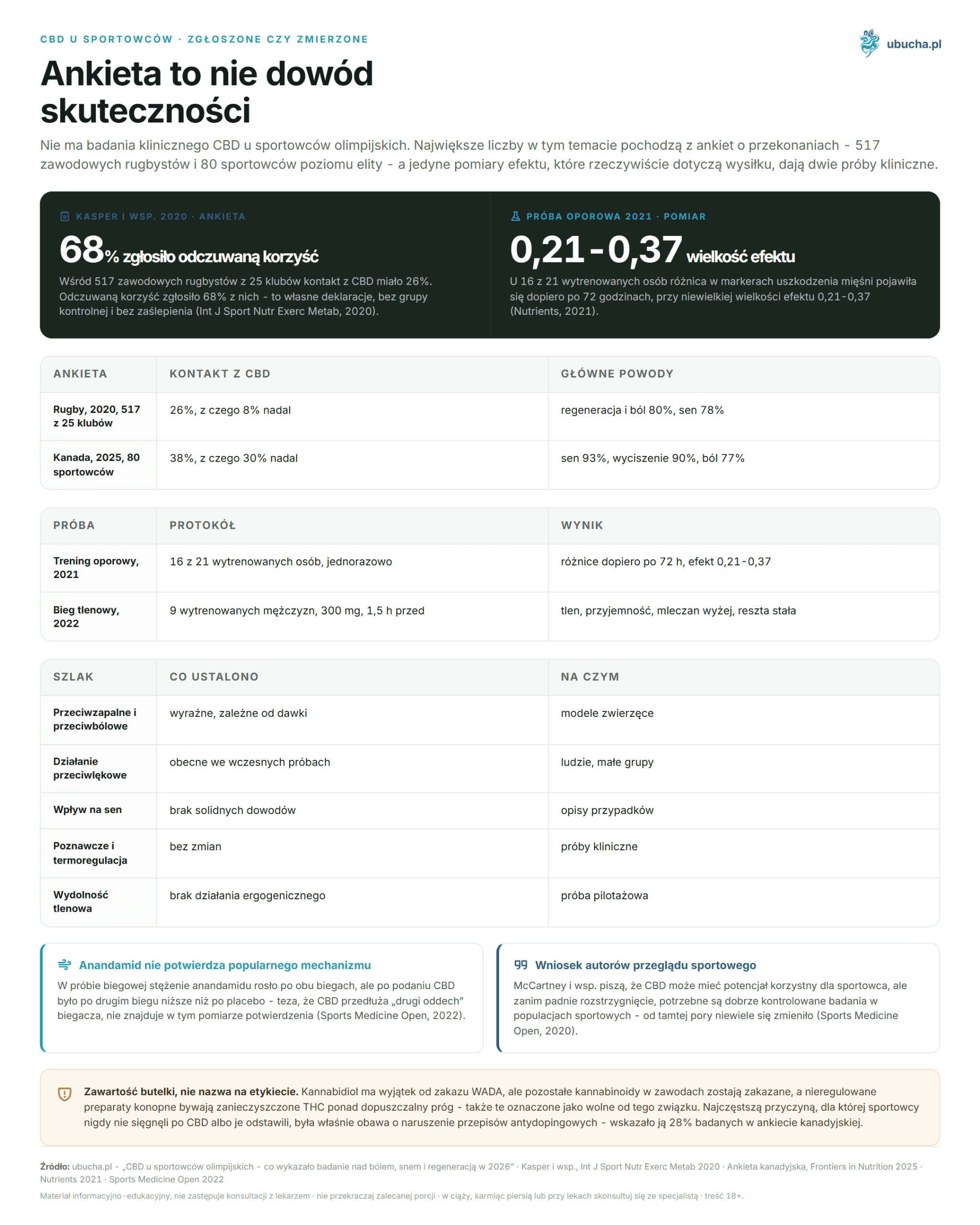
- Survey of 517 professional rugby players: 26% had contact with CBD, of which 18% no longer use it and 8% still do. Reasons were recovery and pain (80%) and sleep (78%), with 68% reporting perceived benefit (Int J Sport Nutr Exerc Metab, 2020).
- After resistance training, small but significant differences in muscle damage markers appeared only after 72 hours, with effect sizes 0.21-0.37 (Nutrients, 2021).
- Since 2018, CBD is excluded from the cannabinoid class on the WADA list, but other cannabinoids remain banned; a study of 80 products detected THC in 52 samples, including five labeled THC-free (Drug Testing and Analysis, 2021; Drug and Alcohol Dependence, 2022).
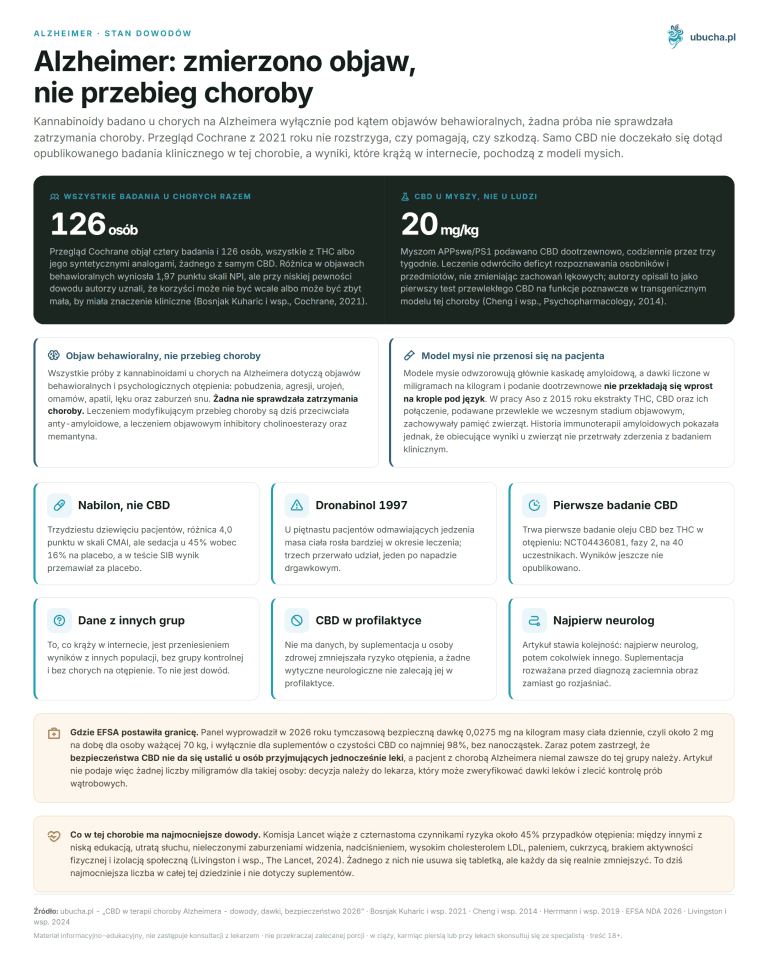
- EFSA in 2026 derived a provisional safe dose of 0.0275 mg per kilogram body weight per day, about 2 mg for a 70 kg person (EFSA Journal, 2026).
Is there a CBD study involving Olympic athletes?
No. No published work to date has tested cannabidiol in the Olympic population, and the review most often cited online in Poland explicitly denies this. McCartney and colleagues published a narrative review in Sports Medicine Open stating directly that direct studies on CBD and sports performance are lacking, so the evidence was gathered from preclinical studies and a small number of clinical trials conducted outside athlete populations (Sports Medicine Open, 2020).
This distinction is practically important. A narrative review does not count participants, weigh results, or derive a combined effect. The repeated online claim that the paper summarized 26 studies on over six hundred athletes does not come from this publication. It also lacks a dosing summary for athletes because no such studies exist.
What did the authors actually write? In animal models, CBD showed clear anti-inflammatory, neuroprotective, and analgesic effects. Preliminary preclinical data suggest gastrointestinal protection in inflammation and support for bone injury healing. Early clinical studies indicate anxiolytic effects in stress-inducing situations and in people with anxiety disorders. For sleep, the authors noted only case reports and a lack of solid evidence. Cognitive functions and thermoregulation remained unchanged.
The authors’ conclusion is more cautious than any headline: cannabidiol may exert physiological and psychological effects potentially beneficial for athletes, but well-controlled studies in athlete populations are needed before conclusions. Six years after this statement, the situation has changed little, as discussed further.
What did the survey of 517 professional rugby players show?
The survey by Kasper et al. collected 517 responses from players in 25 clubs and is the largest such dataset in professional sport. However, it did not cover sixteen disciplines or Olympic participants, only men playing professional rugby union and rugby league (International Journal of Sport Nutrition and Exercise Metabolism, 2020). The starting point was that rugby involves frequent high-intensity collisions, and players seek ways to reduce post-exercise soreness.
The response distribution differs from repeated summaries. Most respondents never used cannabidiol. 26% had contact with it, with 18% having stopped and 8% currently using it. The percentage increased with age, reaching 41% in those 28 and older. Rugby union players used CBD more often than rugby league players.
The reasons for using CBD were twofold and related to perceptions, not outcomes. Recovery and pain were cited by 80% of users, sleep by 78%, and 68% reported perceived benefit. None of these percentages relate to pre-competition anxiety or biochemical recovery measures. These are survey declarations without control groups or blinding.
The most interesting number concerns knowledge sources. Players sought CBD information mainly online (73%) and from teammates (61%), with only 16% consulting a dietitian. The authors close the article with a call for urgent education on risks, especially anti-doping, rather than encouragement to use.
What do elite-level athletes say about CBD?
The closest population referenced in this article’s title is a survey among Canadian elite athletes collected from October 2021 to June 2023. Eighty athletes completed it. 38% had ever used cannabidiol, i.e., 30 people, and among them, 30%, i.e., nine people, reported current use (Frontiers in Nutrition, 2025).
Users’ assessments were high and consistently related to perceptions. 96% considered cannabidiol safe, 93% reported improved sleep, 90% calmness, and 77% reduced post-training pain. The most common form was oral oil or tincture, cited by 31% of users. The primary knowledge sources were friends (26%) and the internet (24%), repeating the rugby survey pattern.
| Survey | Who and how many | Contact with CBD | Main reasons |
|---|---|---|---|
| Rugby, 2020 | 517 professionals from 25 clubs | 26%, of which 8% still use | recovery and pain 80%, sleep 78% |
| Canada, 2025 | 80 elite athletes | 38%, of which 30% still use | sleep 93%, calmness 90%, pain 77% |
However, the most important result concerns reasons for quitting. The most frequently cited reason for never using or stopping cannabidiol was fear of violating anti-doping rules, cited by 28% of respondents. The authors recommend that medical staff working with this group provide evidence-based guidance rather than leaving athletes to search online. Both surveys are cross-sectional and based on declarations, so they speak about prevalence and beliefs, not efficacy.
How might CBD reduce pain and inflammation?
The mechanism is best described in animal models and remains largely a hypothesis transferred from the lab in humans. The most cited study in this area is a rat knee inflammation model where cannabidiol gel was applied topically for four consecutive days after inducing inflammation. Transdermal application reduced joint circumference, immune cell infiltration, and synovial membrane thickening dose-dependently, and the thermal stimulus response threshold returned close to baseline (European Journal of Pain, 2016).
Three details of this study are often misrepresented. The model involved rats, not mice. Doses were given in milligrams per day, not per kilogram body weight, and were 0.6, 3.1, 6.2, and 62.3 mg per day. The two highest doses, 6.2 and 62 mg per day, were effective. The authors did not provide any single percentage reduction value, so the commonly cited 43% figure does not come from this source.
| Pathway | Findings | Model |
|---|---|---|
| Anti-inflammatory and analgesic effects | clear, dose-dependent | animal models |
| Anxiolytic effects | present in early trials | humans, small groups |
| Effect on sleep | no solid evidence | case reports |
| Cognitive functions and thermoregulation | no change | clinical trials |
| Aerobic capacity | no ergogenic effect | pilot trial |
A separate matter is anandamide, an endogenous compound linked to the runner’s high. A PNAS study showed that cannabinoid receptors mediate anxiolytic and analgesic effects of running, with anxiolytic effects depending on CB1 receptors on GABAergic forebrain neurons and analgesic effects on peripheral CB1 and CB2 receptors. The study was on mice, and the authors noted that euphoria cannot be assessed in the mouse model (PNAS, 2015).
Does CBD improve athlete sleep?
Evidence is weaker than headlines suggest and comes from outside sport. The most cited work is a retrospective review of psychiatric clinic records, not a randomized trial. Records of 103 adults were reviewed, with 72 analyzed: 47 presented mainly for anxiety, 25 for poor sleep. Anxiety scores decreased in the first month in 57 patients (79.2%) and remained lower throughout observation (The Permanente Journal, 2019).
Sleep results differ and are often lost in summaries. Improvement was noted in the first month in 48 patients (66.7%), but sleep metrics fluctuated in subsequent months. The authors did not describe a stable effect but a variable one. Cannabidiol was well tolerated except in three patients. The study design - chart review without control or blinding - does not separate treatment effect from natural course.
There is no source for numbers often associated with this topic online. Shortening sleep onset by 11-15 minutes, increasing slow-wave N3 phase, extending total sleep by 25-43 minutes, and improving sleep efficiency by 4-8% do not come from any identifiable study. The 2020 sports review closes this topic with one sentence: for CBD’s effect on sleep, only case reports exist, and solid evidence is lacking.
For athletes, the simple conclusion is that sleep remains the best-documented recovery tool, but cannabidiol does not provide it. If insomnia persists for weeks, diagnosis - not supplementation - is the first choice. A broader discussion is in the post on CBD for insomnia and sleep disorders.
What was measured after strength training and running?
Two clinical trials actually concern exercise, both small. The first tested a single cannabidiol dose after resistance training in a crossover design with placebo. Of 21 enrolled, 16 completed analysis. One-rep max squat dropped significantly after 24 hours but not after 48 or 72 hours. Differences between groups appeared only after 72 hours (Nutrients, 2021).
Muscle damage markers behaved similarly. Creatine kinase and myoglobin rose significantly at 24, 48, and 72 hours in both groups, with group differences only at 72 hours, with small effect sizes: 0.24 for creatine kinase and 0.21 for myoglobin. No significant changes were found in reach jump. Authors summarized effects as small but significant, noting more data are needed for stronger conclusions.
| Trial | Who | Protocol | Result |
|---|---|---|---|
| Resistance training, 2021 | 16 of 21 trained individuals | single dose, crossover design | differences only after 72 h, effect 0.21-0.37 |
| Aerobic running, 2022 | 9 trained men | 300 mg orally 1.5 h before | no changes in heart rate, perceived exertion, or time to exhaustion |
The second trial involved running. Nine endurance-trained men ran for one hour at 70% VO2 max, then performed a time-to-exhaustion test. Cannabidiol 300 mg was given orally 1.5 hours before exercise in a double-blind design. Oxygen uptake, pleasure rating, and lactate concentration were higher than placebo, but heart rate, perceived exertion, glucose, and respiratory quotient did not differ, nor did time to exhaustion or maximum heart rate (Sports Medicine Open, 2022).
One result contradicts a popular mechanism explanation. Anandamide concentration rose after both runs, but after cannabidiol administration it was lower than placebo after the second run. The hypothesis that CBD prolongs anandamide action and thus sustains the runner’s high is not supported by this measurement. We discuss exercise and cannabis more in the post on smoking hemp flower before training and its effect on performance and satisfaction.
Does WADA allow athletes to use CBD?
Yes, but only cannabidiol itself. Since 2018, CBD has been explicitly excluded from the cannabinoid class on the World Anti-Doping Agency’s prohibited substances list, while other cannabinoids remain banned in competition (Drug Testing and Analysis, 2021). A positive result is based on the inactive THC metabolite in urine above 180 ng/mL, and any other cannabinoid is reported upon detection. The current list is maintained by WADA, and the Polish Anti-Doping Agency uses the same.
The core problem is not the molecule’s legal status but the product’s content. Analysis of 80 unregulated hemp products bought online and in stores detected delta-9-THC above the limit of quantification in 52 samples, ranging from 0.008 to 2.071 mg/mL. Twenty-one products were labeled THC-free, yet five contained this compound at 0.015 to 0.656 mg/mL (Drug and Alcohol Dependence, 2022).
The authors list eligibility to compete as one of the risks, alongside professional and legal consequences. For an athlete under anti-doping control, this means the label is not a guarantee. The guarantee is a certificate of analysis issued for a specific batch by an independent lab, and in professional sport, an additional program verifying each production batch for banned substances.
The mechanism of accidental violation has been experimentally described. Since plant-isolated cannabidiol may contain other cannabinoid contaminants, its permitted use can lead to a positive test. A study administering 15 commercially available products and samples from habitual users detected variable cannabinoid sets and metabolites, especially after full-spectrum products. The presence of such compounds in a competition sample is a significant risk of rule violation. Anti-doping regulations are discussed separately in the post on CBD in sport, WADA and POLADA regulations.
What doses were given in studies and what does EFSA say?
There is no established cannabidiol dose for athletes, and no study defines one. It makes sense only to reproduce protocols, i.e., how much was given, to whom, and for how long. In a 2022 running trial, it was 300 mg orally once 1.5 hours before exercise. In a social phobia anxiety study, a single 600 mg dose was given. In an animal model, a transdermal gel was used at 0.6 to 62.3 mg per day for four days.
These numbers describe experiments, not recommendations. The European Food Safety Authority updated its position on cannabidiol as novel food in 2026 and derived a provisional safe dose of 0.0275 mg per kilogram body weight per day with an uncertainty factor of 400. For a 70 kg person, this is about 2 mg per day (EFSA Journal, 2026).
| Source | Value | What it is |
|---|---|---|
| EFSA, 2026 | 0.0275 mg/kg/day | provisional safe dose for supplements |
| Running trial, 2022 | 300 mg single dose | study protocol on nine subjects |
| Anxiety study, 2011 | 600 mg single dose | study protocol on 24 patients |
This position’s scope is narrow and must be read literally. The dose applies only to food products with cannabidiol purity of at least 98%, without nanoparticles, produced by a process recognized as safe and excluding genotoxicity. The panel closes the assessment with a statement relevant to many readers: cannabidiol safety cannot be established for people under 25 years old, pregnant and breastfeeding women, and those taking medications simultaneously. The often-repeated claim of safety up to 1500 mg per day is not supported by the document to which it is sometimes attributed.
What were EFSA’s reservations about cannabidiol?
The panel began by recalling that data gaps identified in 2022 remain open. Literature searches covering animal and human studies from the previous opinion to June 2024 confirmed their persistence due to many new studies’ methodological limitations: non-standardized protocols, short duration, and concurrent pharmacological treatment of participants. The last limitation recurs and is why the panel could not resolve safety in medicated individuals.
The liver proved the most sensitive organ. Animal studies showed consistent liver toxicity, with organ mass and histopathological changes as early endpoints. Human studies indicated hepatotoxic potential, especially with concomitant drug use. Gastrointestinal effects were reported at higher doses, and neurological and psychiatric safety data were insufficient.
Three areas go beyond typical recovery supplement discussion. Reproductive toxicity studies reinforced earlier concerns. Prenatal exposure caused neurodevelopmental effects indicating long-term and sex-dependent consequences. Hormonal disturbances, including altered thyroid hormone levels and adrenal histopathology, were noted. The panel also noted that immunotoxicity has not been studied, though cannabidiol’s effects on immune pathways warrant caution.
For athletes, two pharmacokinetic findings from the same assessment are important. Cannabidiol bioavailability is variable, depending on the carrier and whether taken with food. The compound crosses the placenta and accumulates in the body, raising further concerns. The provisional safe dose described earlier was derived with an uncertainty factor of 400 against this background.
How does administration form affect what reaches the blood?
Less is known than comparative tables suggest. A systematic review of cannabidiol pharmacokinetics in humans searched PubMed and EMBASE, screening 792 articles, with 24 containing human pharmacokinetic parameters. This is the entire available material on cannabidiol’s fate in the human body (Frontiers in Pharmacology, 2018).
The key finding concerns absolute bioavailability, the percentage of dose reaching circulation. It was measured only for inhalation and was 31%. No other administration route has been measured in humans, despite intravenous preparations being available for such comparison. This means popular tables listing sublingual drops or capsules’ bioavailability percentages rely on unmeasured values.
Half-life varies by administration route and differs greatly. After oral mucosa administration, it ranged from 1.4 to 10.9 hours. After chronic oral dosing, it reached 2 to 5 days. Intravenous administration half-life was about 24 hours, and smoking about 31 hours. Area under the curve and maximum concentration increase with dose, and smoking and inhalation reach peak faster than oral and sublingual routes.
Two points from this review have direct practical implications. Maximum concentration is higher when taken with food and when the carrier is fat, so the same milligram amount behaves differently fasting and fed. Time to maximum concentration ranges widely from zero to four hours. The authors conclude with a statement about data scarcity and pharmacokinetic discrepancies despite widespread cannabidiol use.
Does CBD reduce pre-competition anxiety?
This is the area with the strongest human evidence, though still outside sport. A 2011 study included 24 patients with generalized social phobia, never treated before. Twelve received a single 600 mg cannabidiol dose, twelve placebo, 1.5 hours before a simulated public speaking test. A separate comparison group of twelve healthy volunteers received no treatment (Neuropsychopharmacology, 2011).
The result was clear across several dimensions. Cannabidiol significantly reduced anxiety, cognitive impairment, and discomfort during the speech, and lowered vigilance in the pre-speech phase. The placebo group performed worse than healthy controls in all these aspects. Negative self-assessment scale increases seen in placebo were nearly abolished in the cannabidiol group, and differences between this group and healthy controls became non-significant.
What does this study not say? It does not provide any single percentage anxiety reduction, so the often-cited 53% figure has no source here. It does not concern athletes pre-competition but patients with diagnosed social phobia. It does not test repeated dosing, as each volunteer participated in one session only. Finally, the dose used is two orders of magnitude higher than the provisional safe dose EFSA recognizes today for supplements.
The cautious conclusion is that an anxiolytic signal exists and is reproducible experimentally, and the sports review considers it one of the better-documented cannabidiol effects. Translating it to the crowd and warm-up remains extrapolation, not established fact.
What drug interactions must be considered?
A summary of cannabinoid-drug interactions, prepared based on medicinal product characteristics, identified 57 prescription drugs with narrow therapeutic indices potentially affected by cannabinoids. This applies to both medicinal cannabinoid products and over-the-counter extracts (Medical Cannabis and Cannabinoids, 2020).
A narrow therapeutic index means the gap between effective and toxic concentrations is small, so slight metabolism changes affect drug action. The authors describe mechanisms in three roles: cannabinoid as inhibitor or inducer of metabolism, cannabinoid competing for the same enzyme, and drug whose concentration changes as a result. The number of drugs matters less than the principle that interaction depends on the enzyme, not the drug name.
For athletes, this translates into two situations. The first concerns chronic treatment, where risk transfers from supplement to the drug with an already established dose. The second stems from the regulator’s position: cannabidiol’s hepatotoxic potential in humans appeared mainly when used with other drugs. This is why EFSA refused to resolve safety in this group.
The practical consequence is inconvenient but simple. If you take any medication regularly, the decision about cannabidiol use is made by your doctor, not the seller or product description. Separately, some pain medications used by athletes have their own adverse effect profiles, and replacing them with supplements without consultation transfers the problem rather than solving it.
What does Polish law say about CBD for athletes?
Cannabidiol is not a controlled substance in Poland, and the limit concerns the plant, not the finished product. The definition of industrial hemp refers to Cannabis sativa L. plants with a sum of delta-9-THC and tetrahydrocannabinolic acid in flowering tops or fruiting parts, from which resin has not been removed, not exceeding 0.3% dry weight, rounded to one decimal place.
The basis is Article 4 point 5 of the Act of July 29, 2005 on counteracting drug addiction (consolidated text Dz.U. 2023 item 1939), as amended by the Act of March 24, 2022 (Dz.U. 2022 item 763), effective May 7, 2022. Referring here to the 2005 publication is an error, as the current wording comes from the 2022 amendment and sets a different threshold.
Two distinctions are often confused and both have laboratory consequences. The threshold counts the sum of delta-9-THC and tetrahydrocannabinolic acid, not delta-9-THC alone, which yields different results for the same sample. The national threshold matches the EU threshold in value but is independent: two separate regulations set the same number.
For athletes, the anti-doping list remains more important than this threshold, as both measures operate on different scales. Legal sale in Poland does not guarantee passing anti-doping control, and THC concentrations detected in products labeled THC-free show that the discrepancy is real.
Frequently Asked Questions
Has CBD really been studied in Olympic athletes?
No. There is no clinical work conducted in the Olympic population. The most frequently cited review from Sports Medicine Open states that direct studies on cannabidiol and sports performance are lacking. Elite athletes are described only by a cross-sectional survey from Canada involving 80 people, which is a study of declarations, not efficacy.
Is CBD allowed by WADA?
Yes. Since 2018, cannabidiol has been explicitly excluded from the cannabinoid class on the prohibited substances list, while other cannabinoids remain banned in competitions. The risk comes from contaminants: full-spectrum products have shown variable sets of other cannabinoids in urine, which are reported upon detection.
What did the survey of 517 athletes show?
It included professional rugby players from 25 clubs, not sixteen disciplines. 26% of respondents had contact with cannabidiol, of which 18% stopped using it and 8% continued. The reasons were recovery and pain for 80% and sleep for 78%, with 68% reporting perceived benefit.
Does CBD speed up recovery after training?
Data are sparse. In a resistance training trial, differences in creatine kinase and myoglobin between the cannabidiol and placebo groups appeared only after 72 hours, with small effect sizes of 0.24 and 0.21. No significant changes were found in the reach jump.
Does CBD improve sports performance?
There is no evidence for this. In a running trial with 300 mg administered, heart rate, perceived exertion, glucose, respiratory quotient, time to exhaustion, and maximum heart rate did not differ from placebo. The sports review also notes no effect on cognitive functions and thermoregulation.
How much CBD was given in exercise studies?
In a 2022 running trial, it was 300 mg orally once, 1.5 hours before exercise, in nine men. This is a protocol description, not a recommendation. EFSA derived in 2026 a provisional safe dose of 0.0275 mg per kilogram per day, about 2 mg for a 70 kg person.
Is a product labeled “0% THC” safe for anti-doping?
Not always. In an analysis of 80 unregulated products, delta-9-THC was detected in 52 samples, and among 21 products labeled THC-free, it was found in five. The label does not replace a certificate of analysis issued for a specific batch by an independent laboratory.
Who should not use CBD?
According to EFSA’s 2026 assessment, cannabidiol safety cannot be established for people under 25 years old, pregnant and breastfeeding women, and those taking medications simultaneously. Consistent liver toxicity was noted in animal studies and potential hepatotoxicity in humans.
Oral forms discussed in this text can be found in the oils category. For anti-doping control, check the certificate of analysis issued for the specific batch.
This article is for informational and educational purposes and does not constitute medical advice. Before starting cannabis or CBD for therapeutic purposes, consult a doctor, especially if you take other medications, are pregnant, or breastfeeding.
Author: Michał Waluk · Published: 2026-05-11 · Updated: 2026-08-10