



Synergy of CBD and Adaptogens - Mechanisms, Doses, Research 2026
Proven RCT doses of CBD with ashwagandha, rhodiola, reishi, and lion's mane. Mechanisms of action, safety, interactions, and daily protocol.
More and more people are looking for natural ways to cope with chronic stress, turning to the combination of CBD with adaptogens such as ashwagandha, rhodiola, reishi, or lion’s mane. This approach combines two different biological mechanisms. CBD works through the endocannabinoid system (ECS), modulating anandamide levels and the activity of the 5-HT1A receptor, while adaptogens regulate the hypothalamic-pituitary-adrenal (HPA) axis, affecting cortisol secretion. The classic definition of an adaptogen as a compound that raises the “state of nonspecific resistance” of the body was formulated by Panossian and Wikman in a 2010 review published in the journal Pharmaceuticals. In this article, we present proven RCT doses, safety profiles, and a practical daily protocol based on Europe PMC, PubMed, and publications from WHO and NIH/NCCIH.
KEY INFORMATION
• The HPA axis regulates cortisol secretion, while the ECS modulates anandamide and serotonin; adaptogens and CBD act on these two pathways simultaneously (Panossian, Wikman, Pharmaceuticals, 2010).
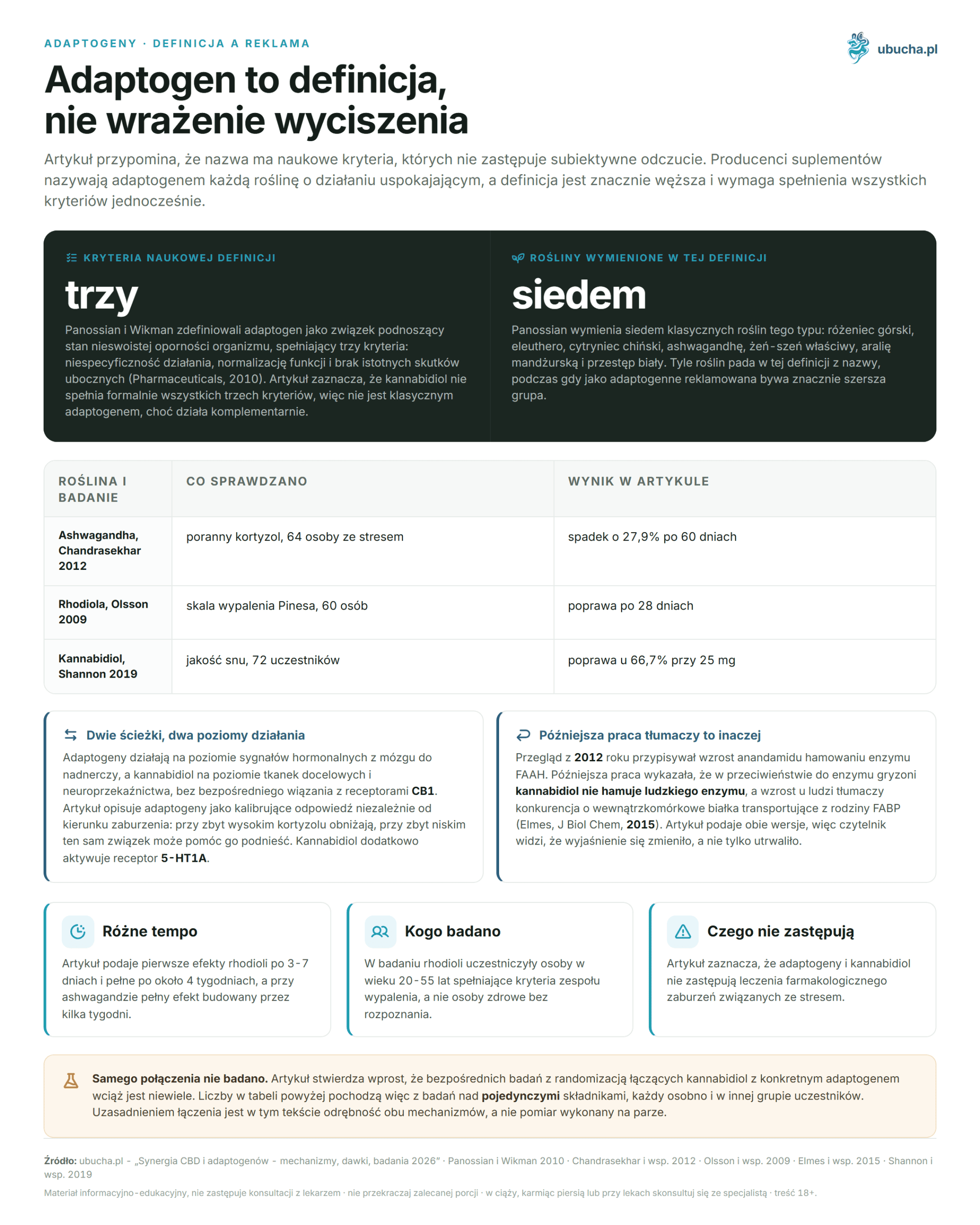
• Ashwagandha 300 mg taken twice daily reduced morning cortisol by 27.9% in the RCT by Chandrasekhara (2012).
• Rhodiola 576 mg daily significantly improved the Pines burnout scale score in the 28-day RCT by Olsson (2009).
• CBD 25 mg daily improved sleep quality in 66.7% of 72 participants in a study in the Permanente Journal (2019).
• Safety requires caution with medications metabolized by CYP2C9 and CYP3A (Bansal et al., 2023).
What is the synergy of CBD and adaptogens?
The synergy of CBD and adaptogens is the mutual supplementation of two stress regulation pathways: CBD works through the endocannabinoid system, while adaptogens work through the hypothalamic-pituitary-adrenal axis. Panossian and Wikman defined an adaptogen as a compound that raises the “state of nonspecific resistance” of the body, meeting three criteria: nonspecific action, normalization of function, and lack of significant side effects (Pharmaceuticals, 2010).
CBD does not formally meet all three criteria, so it is not a classic adaptogen, but it acts complementarily: it raises anandamide levels and enhances 5-HT1A receptor signaling (Campos et al., Philosophical Transactions of the Royal Society B, 2012). A 2012 review attributed this increase to the inhibition of the FAAH enzyme, but later work showed that unlike FAAH in rodents, cannabidiol does not inhibit the human enzyme, and the increase in anandamide in humans is explained by competition for intracellular transport proteins from the FABP family (Elmes, J Biol Chem, 2015). The differences between the two groups of compounds are best seen at the point of action:
- Adaptogens act “upward,” at the level of hormonal signals from the brain to the adrenal glands. Panossian lists seven classic plants of this type: rhodiola, eleuthero, schisandra, ashwagandha, ginseng, aralia, and white peony.
- CBD acts “downward,” at the level of target tissues and neurotransmission in the central nervous system, without directly binding to CB1 receptors.
- Adaptogens do not directly stimulate or suppress; they calibrate the neuroendocrine response regardless of the direction of the disturbance: if cortisol is too high, ashwagandha lowers it, and if too low, the same compound can help raise it.
Practically, this means that both mechanisms complement each other over time: the adaptogen acts at the level of the output signal from the brain, while CBD acts at the level of the reception of that signal by tissues, so combining both rarely leads to negating effects.
There are still few direct RCT studies combining CBD with a specific adaptogen, but both mechanisms have distinct, well-documented scientific bases, justifying their combination in practical anti-stress protocols. The distinction is practically important when purchasing: supplement manufacturers often call any plant with calming effects an “adaptogen,” while the scientific definition by Panossian is much narrower and requires meeting all three criteria simultaneously, not just a subjective feeling of calm. It is worth remembering this when comparing products marketed as “adaptogenic,” as some are based solely on marketing associations.
How do the HPA axis and endocannabinoid system work in chronic stress?
The HPA axis is responsible for the hormonal cascade response to stress: the hypothalamus releases CRH, the pituitary responds with ACTH, and the adrenal cortex secretes cortisol. Chronic activation of this axis is associated with insomnia, anxiety, and decreased immunity (Ulrich-Lai, Herman, Nature Reviews Neuroscience, 2009).
The endocannabinoid system acts as a natural brake on this axis. Anandamide and 2-arachidonoylglycerol bind to CB1 receptors in the hypothalamus, limiting the release of CRH. In chronic stress, anandamide levels drop, and the regulation of the HPA axis weakens, as described in a review of the endocannabinoid response to stress (Morena et al., 2016). CBD prolongs the action of anandamide by occupying FABP transport proteins that deliver it to the degrading enzyme (Elmes, J Biol Chem, 2015), and additionally activates the 5-HT1A receptor, alleviating the anxiety response.
Adaptogens work from the side of the adrenal glands and glucocorticoid signaling, each a bit differently:
- Ashwagandha affects GABA-A receptors and lowers the expression of cortisol synthesis genes.
- Rhodiola modulates the release of norepinephrine and dopamine, acting faster than ashwagandha.
- Reishi works through beta-glucans and triterpenes, modulating the immune response and sleep.
Chronically elevated cortisol also affects the immune system and metabolism: it promotes low-grade inflammation, hinders muscle recovery after exercise, and worsens glucose tolerance. Adaptogens and CBD do not replace pharmacological treatment for stress-related disorders, but they can support a return to a normal circadian rhythm under mild to moderate stress.
If you are looking for a broader overview of herbs and supplements that lower cortisol, check out our separate guide on supplements for stress and cortisol. Cortisol has a clear circadian rhythm under physiological conditions, peaking shortly after waking and gradually decreasing throughout the day. In chronic stress, this rhythm flattens, and evening levels remain elevated, making it difficult to fall asleep. This two-pronged intervention, adaptogen for the HPA and CBD for the ECS, provides broader coverage of the pathophysiology of stress than either component alone.
How to dose ashwagandha with CBD?
Ashwagandha is the best-studied adaptogen in the context of stress. The RCT by Chandrasekhara et al. from 2012 included 64 people with chronic stress: 300 mg of extract taken twice daily reduced morning cortisol by 27.9% compared to placebo after 60 days (Indian Journal of Psychological Medicine, 2012).
Results on other scales confirm the effect: a 44% decrease in the Perceived Stress Scale compared to 5.5% in placebo and a 75.6% decrease in the anxiety subscale of the DASS questionnaire compared to -4.3% in placebo. These are data from a randomized, placebo-controlled trial, which is the highest standard of evidence in medicine.
Practical dosing depends on the goal:
- Stress and anxiety during the day: 300 mg of extract taken twice daily plus 20 mg of CBD divided into two doses.
- Sleep: 600 mg of extract in the evening plus 25-40 mg of CBD sublingually 30-60 minutes before sleep.
- Recovery after training: The RCT by Wankhede et al. showed a significantly greater increase in strength during bench pressing (46.0 kg compared to 26.4 kg in placebo, p=0.001) after 8 weeks of 600 mg daily (Journal of the International Society of Sports Nutrition, 2015).
More dosing variants and practical experiences can be found in our guide ashwagandha and CBD together. Ashwagandha also has data regarding male fertility: the study by Ahmad et al. from 2010 showed that several months of supplementation improved sperm count and motility and raised testosterone levels in men diagnosed with infertility (PMID 19501822, 2010). CBD in this context does not yet have sufficient clinical data. Most studies on ashwagandha alone last 8-12 weeks, after which a 2-week break should be considered, although there is a lack of clear data on tolerance. CBD can be used continuously without the risk of addiction (WHO, 2018). Ashwagandha does not act acutely like a sedative: the full effect builds up over several weeks of regular intake, and those expecting an immediate change in well-being after the first dose often give up too early.
How does rhodiola with CBD support energy and resistance to fatigue?
Rhodiola rosea has the strongest data in the context of mental fatigue. The RCT by Olsson et al. from 2009 included 60 people with burnout syndrome: 576 mg of SHR-5 extract daily significantly improved the Pines burnout scale score after 28 days compared to placebo (interaction time x group, p=0.047; Planta Medica, 2009).
The studied group included individuals aged 20-55 who met the Swedish diagnostic criteria for burnout, randomly divided into a 30-person SHR-5 group and a 30-person placebo group. The mechanism of rhodiola is based on rosavins and salidroside, which modulate the release of norepinephrine, dopamine, and serotonin and alleviate the cortisol response to morning stress. Initial effects appear after 3-7 days, with full effects after about 4 weeks, which is faster than with ashwagandha. Rhodiola is not a stimulant like caffeine and acts more subtly, so combining a moderate dose of extract with a cup of coffee during the day usually does not cause excessive stimulation. The ideal candidate profile for rhodiola is a person with mental fatigue, brain fog, and decreased motivation, rather than someone with an acute, fresh anxiety episode, where stimulating effects may be undesirable.
The synergy with CBD utilizes different “working hours”:
- In the morning: 200-400 mg of rhodiola extract standardized to 3% rosavins and 1% salidroside, for people with mental fatigue and decreased concentration in the afternoon.
- Additionally: CBD 10-20 mg in the late morning, which in low doses does not cause drowsiness and enhances emotional stability through the 5-HT1A receptor.
- A milder alternative: eleuthero (Siberian ginseng) 300-800 mg daily for those who react to rhodiola with excessive stimulation. Eleuthero works similarly to rhodiola but more gently, so it may be a better choice for first-time users of stimulating adaptogens.
People with bipolar disorder in a manic phase should avoid rhodiola, as it may intensify euphoria, and taking it in the afternoon or evening can be problematic for sleep quality. Choosing the right adaptogen for a specific goal is facilitated by our comparison of adaptogens for stress.
How does reishi with CBD support sleep and immunity?
Reishi (Ganoderma lucidum) is a mushroom from traditional Chinese medicine, known as “Lingzhi.” The RCT by Tang et al. from 2005 included 132 people with neurasthenia: 5.4 g of polysaccharide extract daily for 8 weeks significantly reduced symptom severity and feelings of fatigue compared to placebo (Journal of Medicinal Food, 2005).
The synergy with CBD in the evening has clear justification: reishi works on sleep by modulating adenosine and GABA, while CBD works through the ECS and the 5-HT1A receptor. These are two different pathways leading to the same goal, which is faster falling asleep and deeper sleep. The practical protocol is 1-3 g of powdered reishi or 1000-1500 mg of standardized extract one hour before sleep, plus CBD 25-40 mg sublingually 30 minutes before sleep. The effect builds up over 2-4 weeks of regular use, so reishi does not replace an acute sleeping aid but gradually modifies sleep quality in the long term.
Reishi also has immunomodulatory properties that are worth knowing:
- Beta-glucans activate dectin-1 receptors on immune cells.
- A Cochrane review from 2016 included 5 RCTs in cancer patients: reishi as an adjunct to chemo- or radiotherapy was associated with a 1.27 times greater chance of treatment response and an increase in the percentage of CD3, CD4, and CD8 lymphocytes (Cochrane Database of Systematic Reviews, 2016).
- People with autoimmune diseases should consult with a doctor before following such a protocol, as reishi may enhance immune system activity.
Chaga and cordyceps are other adaptogenic mushrooms with a growing evidence base: cordyceps in a herbal mixture increased VO2max by 4.8 ml/kg/min after 3 weeks of taking 4 g daily (Hirsch et al., Journal of Dietary Supplements, 2017), and chaga has a strong antioxidant profile, although RCT data for it are still limited. Neurasthenia, a syndrome of symptoms including chronic fatigue, irritability, and difficulty concentrating, is now often described more as a stress-related disorder than a separate disease entity, but the scales used in Tang’s study remain a convenient tool for measuring subjective improvement in well-being.
How does lion’s mane with CBD support concentration?
Lion’s Mane (Hericium erinaceus) has been gaining scientific recognition since the early 21st century. Active substances, hericenones and erinacines, stimulate the production of nerve growth factor (NGF), as confirmed by the cell study by Mori et al. (Mori et al., 2008). These neurotrophins support regeneration and the formation of new neuronal connections in the hippocampus.
The groundbreaking RCT by Mori from 2009 included 30 people with mild cognitive impairment: 3 g of powdered Hericium daily for 16 weeks significantly improved the score on the Hasegawa Dementia Scale (HDS-R) compared to placebo (Phytotherapy Research, 2009). After discontinuation, the effect faded, indicating an active biological mechanism rather than a placebo.
CBD 10-20 mg in the morning acts complementarily: the 5-HT1A receptor influences mood and anticipatory anxiety, while NGF from lion’s mane supports neuronal regeneration. Dosing should be tailored to the goal:
- For older adults with subjective memory decline: 3 g of lion’s mane plus 20 mg of CBD in the morning.
- For students and mentally working individuals: 1.5-2 g plus 10-15 mg of CBD in the morning.
- Used less often in the evening, as some users report more vivid dreams.
Maca and tulsi (holy basil) can be an addition to this protocol. The study by Zenico et al. from 2009 included 50 men with mild erectile dysfunction: 2400 mg of dry maca extract daily for 12 weeks was associated with improved well-being and sexual performance in the subjective assessment of participants (Andrologia, 2009). A review of tulsi as an adaptogen describes its anti-stress and anti-anxiety effects, useful in chronic mental stress (Cohen, Journal of Ayurveda and Integrative Medicine, 2014). Excess cortisol damages hippocampal cells, the center of memory, which further justifies combining the neurotrophic effects of lion’s mane with stress reduction. Lion’s Mane is available as powdered fruiting body, standardized extract in capsules, or as an addition to coffee or cocoa, and the choice of form mainly depends on convenience of use, not on differences in effectiveness at comparable doses of active substances.
What are the safety rules for combining CBD with adaptogens?
Safety of synergy requires attention in three areas: interactions with drugs metabolized by cytochrome P450, autoimmune and thyroid diseases, and pregnancy and breastfeeding, where data is lacking for both groups of ingredients. CBD inhibits CYP2C9 and CYP3A enzymes, which in a clinical study in humans increased exposure to drugs metabolized by these pathways, such as losartan and midazolam (Bansal et al., 2023).
Adaptogens usually have a milder interaction profile, but ashwagandha may affect thyroid hormone metabolism, and reishi and chaga may stimulate immune response, which can be undesirable in lupus or multiple sclerosis. NIH/NCCIH recommends consulting a doctor before combining adaptogens with medications for autoimmune diseases. A broader overview of CBD pharmacology, including safety profiles in treatment-resistant epilepsy and other neuropsychiatric disorders, was described by Devinsky et al. (PMC4707667, 2014). The most common, usually mild side effects of CBD are dry mouth, drowsiness, and diarrhea at high doses, while with rhodiola, stimulation and insomnia may occur if taken too late in the day. A practical rule when taking prescription medications simultaneously: separate CBD from the medication dose by at least two hours and start with the lowest doses of both ingredients, observing the body’s reaction for the first week.
Groups requiring special caution:
- Pregnant and breastfeeding women: WHO does not recommend using CBD or wellness adaptogens in this group due to lack of data.
- Children: wellness products with CBD and adaptogens are not intended for individuals under 18 years of age.
- Older adults (65+): lower starting doses, usually 5-10 mg of CBD and 200-300 mg of ashwagandha, with attention to blood pressure-lowering medications, as CBD may further lower them.
From the editorial team at Bucha: customer inquiries often raise concerns about combining CBD with anticoagulants and statins. We typically advise consulting a pharmacist who has access to a real-time drug interaction database. If unusual symptoms occur after a dose change, such as stronger medication effects, it is advisable to reduce the dose by half and observe the reaction for 5-7 days before making further decisions.
What does a practical daily protocol for the synergy of CBD and adaptogens look like?
The daily protocol is based on the natural rhythm of cortisol, which usually peaks in the morning and decreases in the evening. Stimulating adaptogens and low doses of CBD or CBG fit into the morning part of the day, while calming adaptogens with medium doses of CBD fit into the evening, to enhance this rhythm rather than disrupt it.
The first week is an adaptation phase at minimal doses, usually 200 mg of adaptogen in the morning and evening and 5-10 mg of CBD before sleep. In the second week, adaptogen doses increase to 300-500 mg, and CBD to 15-25 mg. From the third week, the full protocol is applied with observation of effects. It is worth monitoring a few simple indicators: sleep quality, i.e., time to fall asleep and number of awakenings, energy level during the day on a scale of 1-10, and concentration ability during daily tasks. These simple measurements allow you to assess whether the protocol is actually working before deciding to increase doses.
| Time | Ingredients | Goal |
|---|---|---|
| 7:00 | Rhodiola 300 mg + lion’s mane 1 g + CBD 10-15 mg | Energy, concentration, emotional stability |
| 13:00 | Ashwagandha 300 mg or eleuthero 400 mg | Afternoon adaptation, cortisol reduction |
| 21:00 | Reishi 1 g + CBD 25-40 mg | Sleep, recovery, calming |
Specific configurations should be tailored to the goal: for chronic work-related stress, ashwagandha 600 mg daily (morning and evening) plus CBD 30 mg divided into two doses works well; for burnout, rhodiola 400 mg in the morning plus ashwagandha 300 mg in the evening plus CBD 20-30 mg in the evening; and for insomnia, reishi 1 g plus ashwagandha 600 mg plus CBD 40 mg 30 minutes before sleep. For brain fog and concentration difficulties, lion’s mane 1-2 g in the morning with rhodiola 200 mg and CBD 10-15 mg works well, and during periods of intense training, ashwagandha 600 mg daily plus cordyceps in the morning and CBD after training and in the evening.
What are the controversies and limitations of research on synergy?
It must be honestly admitted that there are few direct RCTs combining CBD with a specific adaptogen. Most data comes from studies on each ingredient separately, so CBD modulates the ECS, and adaptogens regulate the HPA at different levels, which justifies their combination in protocols but does not prove “multiplicative synergy” in the strict pharmacological sense.
Another limitation is the quality of raw materials. Adaptogens in stores vary in the concentration of active substances: generic ashwagandha may have 0.3% withanolides, while standardized extracts like KSM-66 declare 5%. CBD with a certificate of analysis (COA) ensures dose repeatability, and without a COA, dosing becomes a gamble.
The placebo effect also requires honest commentary: in studies on ashwagandha and rhodiola, it usually accounts for 5-20% improvement in stress indicators, which is clearly less than the changes observed in active groups. The routine of taking supplements, combined with mindfulness about one’s well-being, contributes to the biological effect. It is also worth remembering that some of the cited studies on individual adaptogens were funded by companies producing the extract, which does not invalidate the results but requires caution in interpreting marginal effects. Independent replication in multiple centers is still rare in this field.
Our observation: the greatest value of the synergy of CBD and adaptogens offers not as a ready “magic combination” but as a modular protocol tailored to individual physiology, in which CBD stabilizes the ECS, and the adaptogen regulates the HPA. More about combining supplements in a broader, thoughtful stack, including nootropics and collagen, can be found in our guide on biohacking and supplements. The research direction for 2027-2030 includes NIH grants for projects on CBD and adaptogens in the context of PTSD, generalized anxiety, and insomnia in veterans. Until then, available data remains fragmentary: solid in methodology for individual components separately, but insufficient to speak of “proven synergy” in the pharmacological sense. This does not mean that it is worth waiting for the results of future studies before practical application, only that the decision to combine ingredients should be made with awareness of these limitations, not with the conviction of a ready, fully confirmed protocol.
How to choose high-quality CBD and adaptogen products?
The choice of products determines the effectiveness of the entire protocol. Independent laboratory analyses have repeatedly shown discrepancies between the declared and actual cannabinoid content in CBD products available on the market, and adaptogens have a similar problem, especially ashwagandha, where the standardization of withanolides ranges from 0.3% to 5%.
When it comes to CBD oil, it is worth checking the certificate of analysis (COA) from a specific batch, THC content below 0.3%, terpene profile, and carrier oil, preferably MCT from coconut. The COA should come from an independent laboratory, have a date no older than the number of the current production batch, and specify the content of individual cannabinoids, not just the total value. For adaptogens, the standardization of active substances and the form are important:
- Ashwagandha: standardized to 5% withanolides (type KSM-66 or Sensoril).
- Rhodiola: standardized to 3% rosavins and 1% salidroside (type SHR-5).
- Reishi: standardized to 30% polysaccharides and 4% triterpenes.
- Form: dry or liquid extract works better than powdered raw material without standardization.
A product that is clearly cheaper than the market average for standardized extracts may signal lower quality raw material or lack of independent laboratory studies, although this is not an absolute rule. The forms of administration differ in speed of action: sublingual CBD oil has higher bioavailability and acts within 15-45 minutes, capsules act more slowly, within 60-120 minutes, and ointments and balms are not suitable for systemic synergy, as they do not enter the bloodstream in significant amounts. Similarly, the forms of adaptogens differ: capsules provide a repeatable dose and a long shelf life, powdered raw material is cheaper but requires weighing and may be less pleasant in taste, and liquid extract is absorbed faster and easy to dose in drops, although it usually costs more. In practice, store customers most often choose separate CBD and adaptogen products instead of ready-made mixtures, which allows for precise modification of the dose of each component separately. Ready-made mixtures may be convenient to start with, but they complicate separate dose adjustment when one component works stronger than the other for a given person. Before deciding on a permanent protocol, it is worth keeping a simple journal of doses and well-being for the first two weeks, which helps identify which element actually brings results.
Frequently Asked Questions
What is the synergy of CBD and adaptogens?
The synergy of CBD and adaptogens means the mutual supplementation of two stress regulation pathways: CBD modulates the endocannabinoid system (ECS), while adaptogens regulate the hypothalamic-pituitary-adrenal (HPA) axis. The classic definition of an adaptogen was described by Panossian and Wikman in a review in the journal Pharmaceuticals (PMC3991026, 2010), and the mechanism of CBD on anandamide and the 5-HT1A receptor is described in a review by Campos et al. (PMC3481531, 2012).
Can CBD be combined with ashwagandha?
Yes, this is the most commonly studied variant of synergy. The RCT by Chandrasekhara et al. from 2012 (PMC3573577) showed that 300 mg of ashwagandha taken twice daily reduced morning cortisol by 27.9% and the Perceived Stress Scale score by 44% compared to 5.5% in the placebo group after 60 days. CBD 25-50 mg taken orally additionally supports calming through the ECS and the 5-HT1A receptor.
Does rhodiola with CBD help with fatigue?
In the RCT by Olsson et al. from 2009 (Planta Medica, DOI 10.1055/s-0028-1088346), 576 mg of SHR-5 rhodiola extract daily significantly improved the Pines burnout scale score compared to placebo after 28 days (p=0.047). Combining with morning CBD 10-20 mg supports stress reduction without lowering drive during the day.
How to dose CBD and adaptogens together?
The standard protocol is 200-600 mg of adaptogen extract in the morning or evening and 10-50 mg of CBD divided into two doses. The start low, go slow principle recommends increasing the dose every 3-7 days. The full effect of synergy usually appears after 4-8 weeks of regular use, according to the duration of most cited RCT studies.
Is the synergy of CBD and adaptogens safe?
Bergamaschi et al. (PMID 22129319, 2011) assess CBD as well tolerated in clinical studies up to doses of 1500 mg per day. Adaptogens have a long safety profile, but CBD and ashwagandha inhibit CYP2C9 and CYP3A enzymes, as confirmed by the study by Bansal et al. (PMC11059946, 2023). People on anticoagulant or immunosuppressive medications should consult with a doctor before combining them.
Which adaptogen works best with CBD for sleep?
Reishi and ashwagandha have the strongest data for sleep. The study by Chandrasekhara et al. (PMC3573577, 2012) showed a significant improvement in stress scores in the ashwagandha group. CBD 25 mg daily improved sleep quality in 66.7% of 72 participants in a month-long study in the Permanente Journal (Shannon et al., PMC6326553, 2019).
Does lion’s mane with CBD support concentration?
Hericium erinaceus increases the production of nerve growth factor (NGF), as confirmed by the study by Mori et al. (PMID 18758067, 2008). The RCT by Mori from 2009 (PMID 18844328, Phytotherapy Research) showed improvement in the HDS-R scale after 16 weeks of taking 3 g daily. CBD 10-20 mg in the morning additionally supports emotional stability through the 5-HT1A receptor.
The full range of products supporting the protocols described in this article, including standardized extracts and CBD oils with a COA certificate, can be found in our adaptogens category.
This article is for informational and educational purposes only and does not constitute medical advice. Before starting to use CBD or adaptogens for therapeutic purposes, consult with a doctor, especially if you are taking other medications, are pregnant, or breastfeeding. The synergy of CBD and adaptogens requires individual calibration of doses and observation of the body’s reactions over a period of 4-8 weeks.
Author: Michał Waluk · Published: 2026-05-11 · Updated: 2026-08-17




