
CBDV (kannabidiwaryna) - kannabinoid badany przy padaczce i autyzmie
CBDV — co to, jak dziala i na co. Zrozumialy przewodnik u Bucha.
CBDV (cannabidivarin) remains in the shadow of its more famous cousin CBD, although it is attracting increasing scientific interest - particularly in the context of drug-resistant epilepsy and autism spectrum disorders (ASD). GW Pharmaceuticals, the maker of the only approved CBD drug (Epidiolex), has conducted clinical trials with CBDV in children with epilepsy and adults with ASD. Results indicate a biologically active cannabinoid profile for CBDV, although no drug containing CBDV has yet been approved. This guide explains what CBDV does in the body, how it differs from CBD, and what is truly known from research.
KEY INFORMATION
• CBDV is a homolog of CBD with a shorter side chain - non-psychoactive, legal in Poland and the EU.
• Preclinical studies show the anticonvulsant effect of CBDV by blocking TRPV1 channels and modulating GABA.
• GW Pharmaceuticals conducted Phase II clinical trials with CBDV in drug-resistant epilepsy and ASD - results are suggestive but insufficient for drug registration.
• CBDV nie jest zatwierdzonym lekiem - Epidiolex zawiera CBD, nie CBDV.
• CBDV products are a rarity on the market - always require a CoA certificate confirming the content when purchasing.
Czym jest CBDV - struktura i pochodzenie
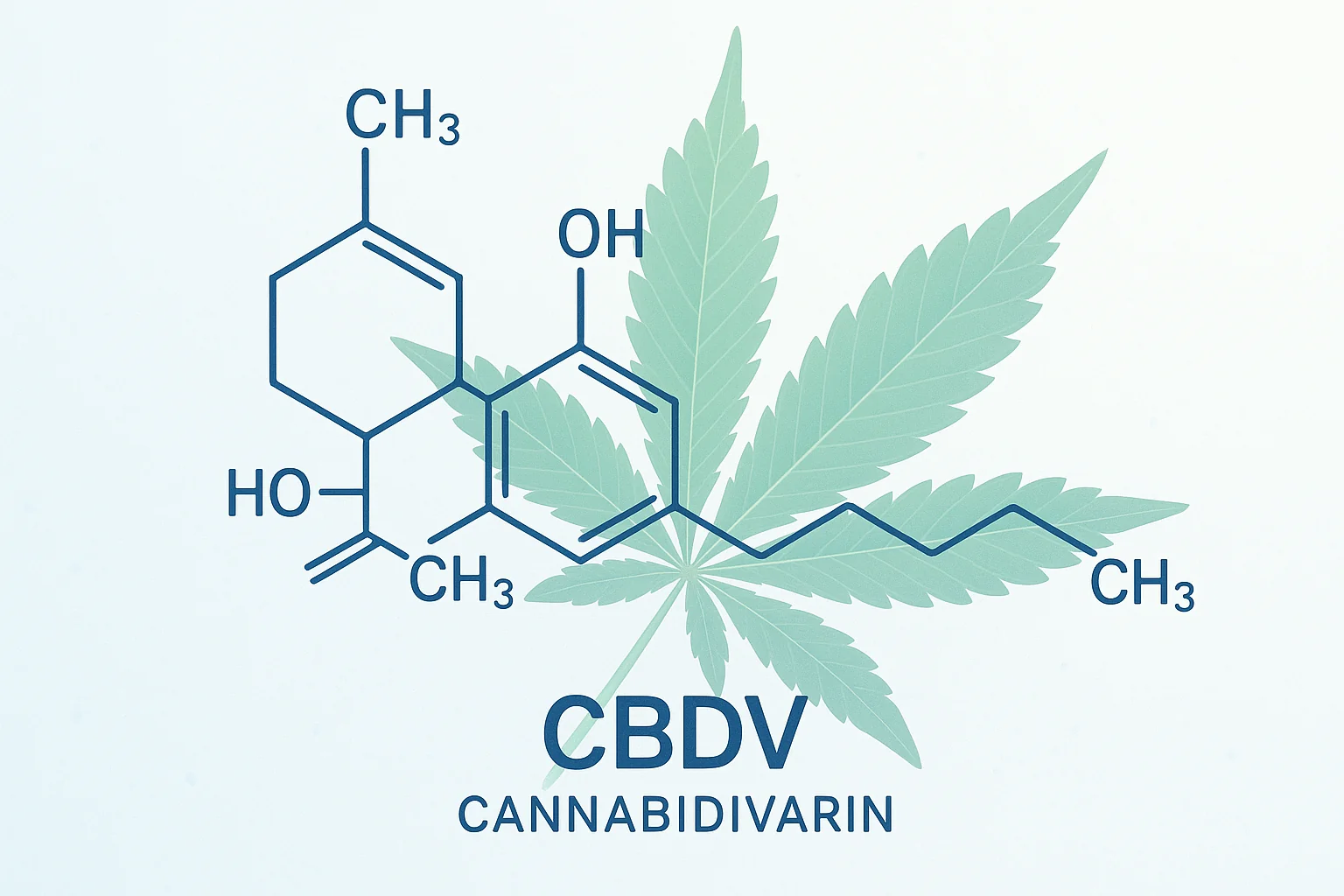
Cannabidivarin (CBDV) is a phytocannabinoid naturally present in the Cannabis sativa L. plant in relatively low concentrations. Chemically, it is a homolog of CBD - both molecules have the same resorcinol aromatic structure but differ in the length of the carbon side chain. CBD has a pentyl chain (five-carbon), while CBDV has a propyl chain (three-carbon) (Rock et al., British Journal of Pharmacology, 2013).
This seemingly minor structural difference has significant pharmacological consequences - CBDV binds to different receptors and has a slightly different biological activity profile than CBD. Like CBD, CBDV has no affinity for CB1 and CB2 receptors, which is why it does not produce psychoactive effects. It is not listed in the controlled substances lists in Poland or the EU.
Hemp strains with increased CBDV content are primarily low-THC plants from Central Asia and Sub-Saharan Africa - geographically distinct from high-CBD strains used for CBD oil production. In typical CBD products available for sale, CBDV is present as a trace component - usually 0.01-0.1% of the total cannabinoid profile.
How does CBDV affect the nervous system?
CBDV is a molecule with a broad pharmacological profile - it interacts with several biological pathways simultaneously, which partially explains its interest in neurological research.
TRPV1 and TRPA1 receptors
One of the key mechanisms of CBDV is the blockade of TRPV1 (Transient Receptor Potential Vanilloid 1) and TRPA1 ion channels. These same receptors are involved in pain perception, inflammatory states, and signaling in the respiratory tract. Rock and colleagues (2013) demonstrated in rat models that CBDV inhibits seizures induced by chemical agents (pilocarpine) through a TRPV1-dependent mechanism, which explains its potential anticonvulsant action (British Journal of Pharmacology, 2013).
The GABAergic and glutamatergic systems
Magnetic resonance spectroscopy (MRS) studies have shown that CBDV affects GABA levels (the main inhibitory neurotransmitter) and glutamate (the main excitatory neurotransmitter) in the brain. An altered GABA/glutamate ratio is observed in both epilepsy and autism, which explains the interest in CBDV in both conditions (Brambilla et al., Translational Psychiatry, 2020).
Inositol metabolism
CBDV also affects DAG lipase enzymes and inositol metabolism - a signaling pathway disrupted in several neurological diseases. This is a less studied mechanism, but it is worth noting in the context of neurobiology of ASD, where disturbances in the PI3K/Akt pathways are frequently described.
| Feature | CBD | CBDV |
|---|---|---|
| Side chain | Pentyl (C5) | Propyl (C3) |
| Psychotropic activity | None | None |
| Main receptors | 5-HT1A, TRPV1, CB1/CB2 indirectly | TRPV1, TRPA1, GABA-ergic |
| Clinical studies in humans | Tak - wiele RCT, lek Epidiolex | Faza II (padaczka, ASD) - brak rejestracji |
| Market availability | Common | Niszowa - nieliczni producenci |
| Legal status in Poland | Legal | Legal |
Clinical studies on CBDV in epilepsy
GW Pharmaceuticals (now Jazz Pharmaceuticals after acquisition) conducted clinical trials with CBDV under the code name GPW42006. Phase II studies included patients with drug-resistant epilepsy - including children with early-onset seizures and rare epileptic syndromes such as Ringer's syndrome and Rett seizures.
Phase II study results were mixed. CBDV showed some activity in reducing seizure frequency in preclinical models and suggestive effects in some patients, but did not achieve statistically significant primary endpoints in the large clinical trials required for drug registration. GPW42006 did not receive FDA or EMA registration and is not available as a prescription drug.
In comparison: Epidiolex (CBD) received FDA approval in 2018 for the treatment of seizures in Dravet syndrome and Lennox-Gastaut syndrome based on phase III study results showing statistically and clinically significant reductions in seizures. CBDV did not achieve similar results in clinical trials - despite a promising preclinical profile.
CBDV and autism - what do studies show?
The interest in CBDV in autism arises from the neurobiological similarities between ASD and epilepsy - both are associated with an impaired GABA/glutamate balance and abnormalities in synaptic neurotransmission. About 30% of individuals with ASD have comorbid epilepsy, suggesting a shared biological basis (Besag, Frontiers in Neurology, 2018).
A 2021 study by GW Pharmaceuticals (Phase IIa, randomized, placebo-controlled) evaluated CBDV (GPW42006) in 34 adults with ASD. MRS spectroscopy was used to assess GABA and glutamate concentrations in the brain as biomarkers. Results showed a trend towards changing the GABA/glutamate ratio in the CBDV group compared to placebo, but the effect did not reach statistical significance and did not translate into measurable clinical improvements on the ABC (Aberrant Behavior Checklist).
The MRS spectroscopy mechanism used in these studies is a highly specialized neuroimaging method, not routinely available in clinical facilities. These results have scientific value for understanding the biological effects of CBDV, but do not directly translate into clinical conclusions for parents of children with ASD seeking new therapeutic options.
CBDV and other rare cannabinoids - a place in the family of phytocannabinoids
The family of phytocannabinoids is much broader than just CBD and THC. It includes over 100 identified compounds - including CBG (cannabigerol), CBC (cannabichromene), CBN (cannabinol), and their propyl homologs: CBGV, CBCV, CBNV, and of course CBDV. Propyl homologs differ from their parent compounds only in the length of the side chain, but this slight structural difference translates into a different pharmacological profile.
Screening studies of all phytocannabinoids for biological activity conducted by research groups in the UK, Italy, and the USA indicate that CBDV has one of the more interesting profiles among niche cannabinoids - stronger affinity for TRPV1 than CBD and a more pronounced effect on inositol metabolism. In the context of cannabinoids studied in neurological diseases, CBDV ranks just behind CBD in terms of the number of clinical studies conducted.
Interestingly, cannabis strains rich in CBDV (with a propyl side chain) are genetically distinct from high-CBD strains. CBDV-dominant strains have been primarily identified in wild cannabis populations from Afghanistan and India - hence in some European research projects, the term "propyl indica chemotype" is used. Modern selective breeding of cannabis has led to the development of strains with increased CBDV content and low THC content, enabling the production of certified CBDV extracts in the EU market.
CBDV market status - availability and safety
CBDV is legal in Poland and the EU. As a phytocannabinoid without psychoactive effects, it does not appear on controlled substance lists. Products containing CBDV can be sold as dietary supplements after notifying GIS, or as cosmetics after registration on the CPNP portal.
The safety profile of CBDV is assessed as similar to that of CBD - with no risk of addiction and no significant toxicity in preclinical studies. Clinical studies by GW Pharmaceuticals did not show serious adverse events attributed to CBDV above those observed for placebo. However, data on long-term safety are limited due to relatively short observation periods in previous studies.
The market availability of CBDV products is niche. Most CBD oil manufacturers do not focus on CBDV as an active ingredient. Full-spectrum products contain CBDV as a trace ingredient - if you are looking for a specific CBDV content, look for a CoA certificate detailing the concentration of this cannabinoid.
Frequently Asked Questions
What is CBDV and how does it differ from CBD?
CBDV (cannabidivarin) is a phytocannabinoid from Cannabis sativa L. - a homolog of CBD with a shorter propyl chain instead of a pentyl chain. Due to this structural difference, CBDV binds to different receptors than CBD (mainly TRPV1, TRPA1, GABAergic system) and has a different, yet related biological activity profile. Like CBD, CBDV is non-psychoactive and legal in Poland.
Does CBDV work for epilepsy?
Preclinical studies show a clear anticonvulsant effect of CBDV (Rock et al., British Journal of Pharmacology, 2013). GW Pharmaceuticals conducted phase II clinical trials that showed suggestive effects but did not achieve the statistical significance required for drug registration. CBDV is not an approved drug - Epidiolex contains CBD, not CBDV.
What is CBDV in the context of autism?
Phase IIa studies (GW Pharmaceuticals, 2021) evaluated CBDV in adults with ASD, measuring GABA/glutamate levels in the brain using MRS. The results suggested biological changes in biomarkers but did not translate into clinical improvements on the ABC scale. The mechanism is scientifically justified (GABA/glutamate disturbances in ASD), but the clinical application of CBDV in autism remains experimental.
Is CBDV legal in Poland?
Yes - CBDV is not listed in the controlled substances lists in Poland or the EU. Like CBD, it is a phytocannabinoid without the status of a psychotropic substance. CBDV products can be sold as dietary supplements or cosmetics provided they meet general legal requirements and have quality certificates (CoA).
How does CBDV affect the nervous system?
CBDV acts in multiple ways: it blocks TRPV1 and TRPA1 channels (pain and inflammation receptors), modulates the GABAergic system (inhibitory neurotransmitter), affects glutamate levels in the brain, and inositol metabolism. The TRPV1-dependent mechanism explains the potential anticonvulsant action, while the effect on the GABA/glutamate ratio explains the interest in CBDV in autism (Rock et al., 2013).
This article is for informational and educational purposes and does not replace consultation with a doctor. If you are pregnant, breastfeeding, taking medications, or have chronic conditions, consult the use of supplements or herbs with a specialist.
Author: Michał Waluk · Published: 2026-05-04 · Updated: 2026-05-04