Prebiotics vs Probiotics: What Are the Differences and Why You Need Both

A prebiotic is food for bacteria, a probiotic is live cultures. We check ISAPP definitions, mood data, and probiotics available at Bucha, prices from August 8, 2026.
A probiotic, prebiotic, postbiotic, synbiotic: four words from the same family tree that marketing uses interchangeably. The difference is simple and can be remembered once. A probiotic is live bacteria. A prebiotic is the food that these bacteria ferment. A postbiotic is the metabolites resulting from this fermentation. A synbiotic combines the first two in one preparation. The practical consequence is that a probiotic alone without a supply of fermentable fiber rarely changes the microbiome for longer than a few weeks. The capsule adds bacteria, the diet decides whether they will stay. Therefore, the question is not so much “which probiotic,” but “what to feed it with.” Below you will find definitions from ISAPP consensus documents, an overview of the best-researched prebiotics, guidelines for combining both groups, and a comparison of probiotic preparations available in the Bucha store along with the cost of one serving.
KEY INFORMATION
• A prebiotic is a substrate selectively utilized by host microorganisms (Gibson et al., Nature Reviews Gastroenterology and Hepatology, 2017), a probiotic is live cultures.
• Butyrate accelerates the assembly of tight junctions in the epithelium through AMPK kinase (Peng et al., The Journal of Nutrition, 2009).
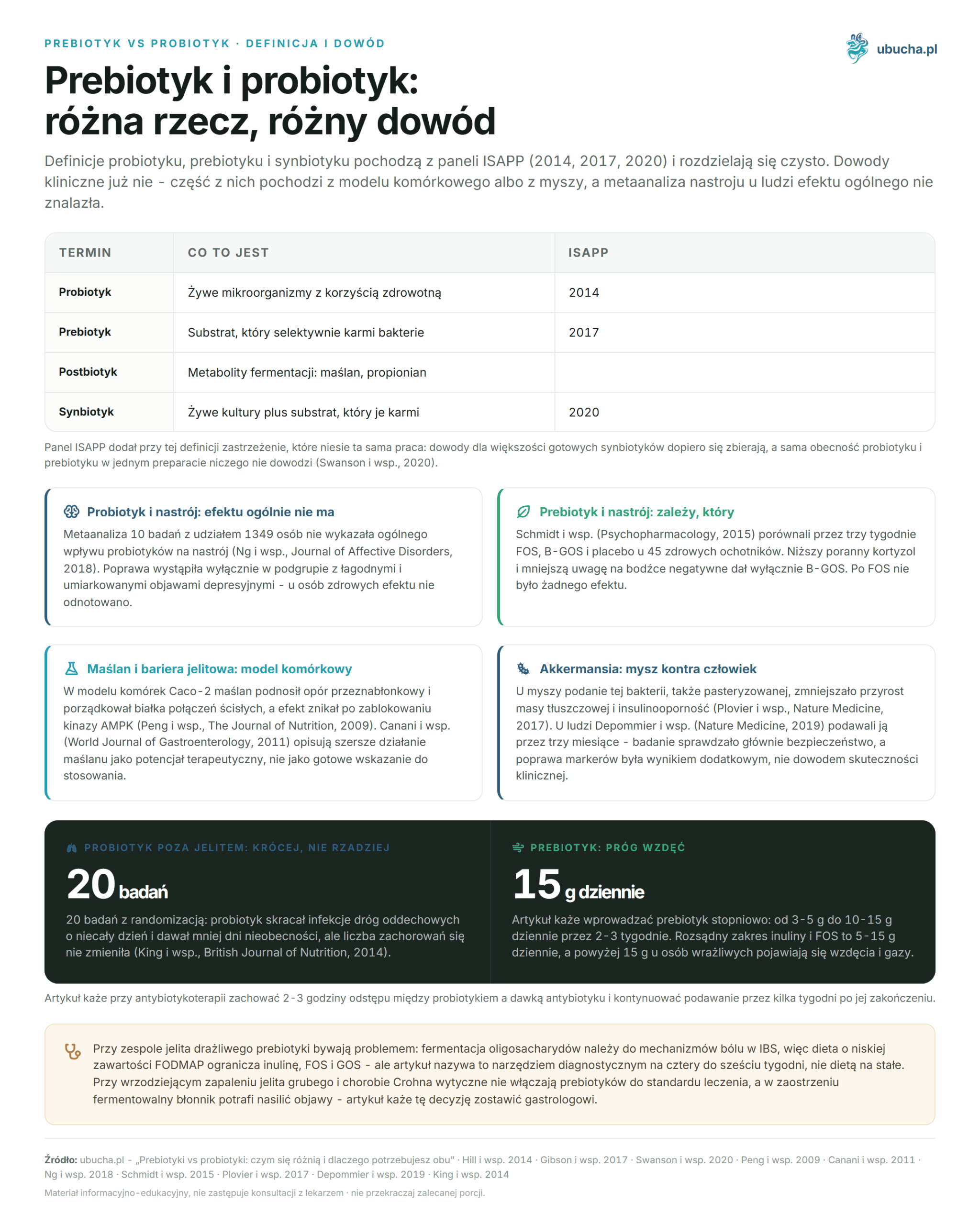
• A meta-analysis of 10 studies found no overall effect of probiotics on mood (Ng et al., 2018).
• Introduce prebiotics gradually, from 3-5 g to 10-15 g daily over 2-3 weeks.
What is the difference between a prebiotic and a probiotic?
A probiotic is live microorganisms that, when administered in appropriate amounts, confer a health benefit to the host. A prebiotic is a substrate selectively utilized by host microorganisms. The first definition was confirmed by the ISAPP panel (Hill et al., Nature Reviews Gastroenterology and Hepatology, 2014), the second was updated by the ISAPP panel three years later.
The word on which the definition of a probiotic stands is “live.” Bacteria or yeasts, such as Saccharomyces boulardii, must survive the acidic environment of the stomach and reach the intestine in sufficient numbers, usually from 10⁸ to 10¹⁰ colony-forming units. The definition of a prebiotic is based on the word “selectively”: the substrate must feed beneficial bacteria, not every microorganism in the intestine, including pathogens. The condition of selectivity was maintained by the ISAPP panel in the 2017 document, expanding the scope of the concept beyond carbohydrates and beyond the gastrointestinal tract.
A postbiotic is the third tier of this structure, meaning the metabolites produced from fermentation: butyrate, propionate, acetate, alongside lactic acid and some B vitamins. They can be delivered directly, bypassing fermentation, and that is exactly how sodium butyrate supplements work. A synbiotic, on the other hand, is a mixture of live microorganisms and a substrate selectively utilized by them, according to the ISAPP definition from 2020.
What types of prebiotics have the strongest data?
The best-documented are inulin and fructooligosaccharides from chicory, galactooligosaccharides enzymatically produced from lactose, and resistant starch. Each of these groups feeds different bacteria, so diversity in the diet provides a broader effect than a single high-dose supplement.
Inulin and FOS mainly come from chicory root, Jerusalem artichoke, onions, and garlic. They stimulate the growth of Bifidobacterium and Lactobacillus. A reasonable range is 5-15 g daily, and above 15 g in sensitive individuals can cause bloating and gas, as fermentation kicks in rapidly. FOS has a lower degree of polymerization than long-chain inulin, so it ferments earlier and shallower, while the long chain reaches further in the colon.
GOS are produced from lactose by the action of beta-galactosidase, and the final product contains no free lactose. They support Bifidobacterium longum and B. breve. The same mechanism is used in the modified milk industry, where GOS serves as an analogue of human milk oligosaccharides. In adults, 4-8 g daily is often tolerated better than FOS at the same dose.
Resistant starch is divided into fractions. RS1 is physically inaccessible, as it is found in whole grains. RS2 is raw starch with a dense structure, such as green bananas and raw potatoes. RS3 forms when cooked starch is cooled, so you will find it in cold rice and potatoes from the previous day. Its breakdown depends more on one species than on diet: Ze et al. (The ISME Journal, 2012) showed that Ruminococcus bromii plays a keystone species role, and without it, other amylolytic bacteria ferment resistant starch to a small extent.
Why does butyrate determine the integrity of the intestinal barrier?
Butyrate is the primary fuel for colonocytes and also a signal that accelerates the assembly of tight junctions in the epithelium. Peng et al. (The Journal of Nutrition, 2009) demonstrated in a Caco-2 cell model that butyrate increases transepithelial resistance and organizes tight junction proteins, and the effect disappears when AMPK kinase is blocked.
It is produced by colonic bacteria, primarily Faecalibacterium prausnitzii, Roseburia intestinalis, and Eubacterium hallii. The substrate is fermentable fiber, so the supply of butyrate directly depends on how many prebiotics end up on your plate. This is the shortest explanation of why a probiotic supplement taken with a diet low in vegetables provides less than the package promises.
Beyond the intestine, butyrate inhibits histone deacetylases, which are enzymes regulating gene expression. Canani et al. (World Journal of Gastroenterology, 2011) gathered evidence for its role in fluid transport across the epithelium and in alleviating mucosal inflammation, also mentioning extraintestinal effects in hypercholesterolemia and insulin resistance. The authors describe them as therapeutic potential, not as ready-to-use indications.
The cheapest way to increase butyrate production is a diet rich in resistant starch and inulin. An alternative is sodium butyrate supplement, a postbiotic delivered bypassing fermentation. It has a characteristic smell that one must get used to, but it bypasses the problem for those who cannot tolerate large portions of fermentable fiber.
How does the microbiome affect mood through the gut-brain axis?
Gut bacteria communicate with the brain via the vagus nerve, the immune system, and fermentation metabolites. Cryan and Dinan (Nature Reviews Neuroscience, 2012) described this bidirectional pathway and the mechanisms through which the microbiota modifies stress response and behavior. The mechanisms of this axis are broken down into elementary factors in a separate post about the influence of the microbiota on stress and sleep.
Clinical data are weaker than marketing suggests, and this must be stated plainly. A meta-analysis by Ng et al. (Journal of Affective Disorders, 2018) included 10 studies involving 1349 people and found no overall effect of probiotics on mood. Improvement appeared only in a subgroup of individuals with mild to moderate depressive symptoms, and no effect was recorded in healthy individuals.
Individual studies with specific strains perform better. Messaoudi et al. (British Journal of Nutrition, 2011) administered Lactobacillus helveticus R0052 together with Bifidobacterium longum R0175 for 30 days and noted a decrease in daily free cortisol excretion in urine and lower scores on HSCL-90 and HADS scales.
On the prebiotic side, the results are more selective than usually summarized. Schmidt et al. (Psychopharmacology, 2015) compared FOS, B-GOS galactooligosaccharides, and placebo in 45 healthy volunteers over three weeks. A lower morning cortisol response and less attention directed at negative stimuli were noted only after B-GOS. There was no effect after FOS, so the type of prebiotic determines the outcome here.
When does a synbiotic work better than the individual components?
When the substrate is selected for a specific strain. The ISAPP panel (Swanson et al., Nature Reviews Gastroenterology and Hepatology, 2020) called such a preparation a synergistic synbiotic and distinguished it from a complementary one, where the probiotic and prebiotic simply lie next to each other in a capsule.
This distinction has practical significance when reading labels. A preparation described as “ten strains plus inulin” is usually a complementary synbiotic, and then each component must meet the evidence requirements separately. A synergistic synbiotic sets a lower bar for individual components because the effect is supposed to result from their cooperation, but it requires data for the entire mixture.
The selection of substrate for the strain is based on what the given bacterium can break down. Bifidobacterium longum handles inulin well, so pairing it with chicory inulin makes biochemical sense. Bacteria specialized in starch breakdown fit better with resistant starch than with FOS. Which strain for what, we outline in the guide on choosing probiotics for the gut and immunity.
The ISAPP panel also pointed out an inconvenient truth for manufacturers: evidence for most ready-made synbiotics is still being gathered, and the mere presence of two components in the composition proves nothing. Treat the label “synbiotic” as information about the formula, not as a promise of effectiveness.
What really increases the abundance of Akkermansia muciniphila?
Akkermansia muciniphila lives in the mucus layer of the colon, and its low abundance is associated with obesity and insulin resistance. Plovier et al. (Nature Medicine, 2017) showed in a mouse model that administering this bacterium, even pasteurized, reduces fat mass gain and insulin resistance.
The transfer to humans looks more cautious than the headlines suggest. Depommier et al. (Nature Medicine, 2019) administered 10¹⁰ cells daily for three months to overweight and insulin-resistant individuals. The study was exploratory and primarily showed the safety of such supplementation, while improvement in some metabolic markers was an additional result, not evidence of clinical efficacy.
Dietary tools are readily available and cost less. The mucus layer inhabited by this bacterium thrives on a diet rich in diverse fermentable fiber and polyphenols from vegetables, berries, and green tea. This is a real argument for a wide range of prebiotics in the diet, rather than a single supplement with inulin.
We have noticed in conversations with readers that the name of this bacterium comes up more often than any specific way to nourish it. The order is often reversed from what is needed: first diet, then possibly a preparation.
Are prebiotics safe with IBS?
With irritable bowel syndrome, prebiotics can be both a problem and a help. The fermentation of oligosaccharides is one of the pain mechanisms in IBS, which is why a low FODMAP diet limits inulin, FOS, and GOS. However, this limitation is a diagnostic tool, not a target way of eating.
The paradox is that long-term adherence to a low FODMAP diet impoverishes the microbiome, which can worsen the situation in the long run. The practice looks like this: an elimination phase for four to six weeks, then gradual reintroduction in small portions, for example starting from 2-3 g of inulin daily, while observing symptoms. The individual tolerance threshold can be much higher than what results from the first week of elimination.
In ulcerative colitis and Crohn’s disease, the situation is more complicated. Faecalibacterium prausnitzii, one of the main butyrate producers, is clearly reduced in these patients, so the idea of feeding it with inulin looks logical. Gastroenterological guidelines do not include prebiotics in the standard treatment, and during active exacerbation, experiments with fermentable fiber can exacerbate symptoms. Make decisions with a gastroenterologist, not based on a leaflet.
How to use probiotics and prebiotics in practice?
Take a probiotic daily at a fixed time, and during antibiotic therapy, maintain a 2-3 hour gap from the antibiotic dose and continue for several weeks after its completion. Introduce a prebiotic gradually, as bloating is caused by a rapid increase in fermentation, not the fiber itself.
The approach to dosing looks like this: start with 3-5 g of inulin or FOS daily and reach 10-15 g over 2-3 weeks. For GOS, the starting point may be lower, and tolerance better. The target fiber intake overall is 25-35 g daily, with the diversity of sources counting more than the dose of a single component.
- Leek, onion, garlic, and Jerusalem artichoke: inulin and FOS.
- Oats and barley: beta-glucans.
- Legume seeds: resistant starch with galactooligosaccharides.
- Cooked and then cooled rice and potatoes: resistant starch RS3.
A meta-analysis by King et al. (British Journal of Nutrition, 2014) included 20 randomized studies and clearly shows what to expect from probiotics in respiratory infections: shorter episodes of illness by less than a day and fewer days absent from work and school. The number of episodes did not change, so the probiotic shortens the illness rather than protects against getting sick. What to take after the treatment, we gathered in the post about restoring gut flora after antibiotics.
What gut products are available at Bucha?
In the Bucha catalog, there are currently eight items related to the microbiome: seven Aura Care preparations and sodium butyrate as a postbiotic delivered directly. Prices are from the store, as of August 8, 2026. The last column converts the price to one serving for horizontal readability.
| Product | Form | What distinguishes it | Price | Cost per serving |
|---|---|---|---|---|
| Aura Care Probiotic Reconstruction | 30 capsules | 9 strains with Saccharomyces boulardii, sodium butyrate 300 mg per serving | 129.00 PLN | 4.30 PLN |
| Aura Care Probiotic Immunity | 30 capsules | 10 strains, 35 billion CFU, bovine colostrum 300 mg, contains milk | 129.00 PLN | 4.30 PLN |
| Aura Care Detoxbiotic AQS | 30 capsules | 13 strains, 30 billion CFU, chlorella 300 mg plus inulin 35 mg | 129.00 PLN | 4.30 PLN |
| Aura Care Probiotic Energy | 30 capsules | 5 strains, 32 billion CFU, chicory inulin 280 mg | 129.00 PLN | 4.30 PLN |
| Aura Care Probiotic Weight Loss | 30 capsules | live cultures protected by microencapsulation, inulin 280 mg | 129.00 PLN | 4.30 PLN |
| Aura Care Probiotic Kids Happy Tummy | 30 twist-off capsules | 6 strains, 30 billion CFU, contents can be sprinkled into a cool meal | 129.00 PLN | 4.30 PLN |
| Aura Care Probiotic Healthy Intestines | liquid 50 ml | 10 strains with yeasts, 10 billion CFU, daily serving is 32 drops | 109.00 PLN | 2.18 PLN per 1 ml |
| Sodium Butyrate 585 mg | 120 capsules | postbiotic without fermentation stage, vegan formula | 39.00 PLN | 0.33 PLN |
The last column says more than the price on the shelf. The multi-strain capsules of Aura Care come out to 4.30 PLN per day, as the daily serving is one capsule. Sodium butyrate at 0.33 PLN per capsule plays in a different price league, but it does something else: it does not colonize the intestine but delivers a metabolite that would normally arise from fiber fermentation. Preparations with inulin in the composition, namely the Energy, Weight Loss, and Kids variants, are complementary synbiotics in the understanding of the ISAPP definition from 2020.
Frequently Asked Questions
What are prebiotics?
A prebiotic is a substrate selectively utilized by host microorganisms, which confers a health benefit (Gibson et al., Nature Reviews Gastroenterology and Hepatology, 2017). In practice, it is indigestible fiber: inulin, FOS from chicory, GOS from lactose, resistant starch from cooled potatoes, and pectins from apples.
What is the difference between a prebiotic and a probiotic?
A probiotic is live microorganisms administered in amounts that confer a health benefit to the host (Hill et al., Nature Reviews Gastroenterology and Hepatology, 2014). A prebiotic is food for these bacteria. The probiotic corresponds to the gardener, the prebiotic to the fertilizer. A lasting change in the microbiome requires both, as the preparation alone without fiber in the diet works briefly.
What is a synbiotic?
A synbiotic is a mixture of live microorganisms and a substrate selectively utilized by them (Swanson et al., Nature Reviews Gastroenterology and Hepatology, 2020). The ISAPP panel distinguished the complementary variant, where the components act independently, from the synergistic one, where the substrate is selected for a specific strain. The label on the package proves nothing.
Do probiotics help with low mood?
The evidence is weaker than marketing suggests. A meta-analysis by Ng et al. (Journal of Affective Disorders, 2018) included 10 studies and 1349 people, finding no overall effect. Improvement occurred only in a subgroup with mild to moderate depressive symptoms, and no effect was noted in healthy individuals.
When to take a probiotic and when to take a prebiotic?
Take a probiotic daily at a fixed time, and during antibiotic therapy 2-3 hours after the antibiotic dose and for several weeks after its completion. Take a prebiotic with meals, gradually increasing the dose from 3-5 g to 10-15 g over 2-3 weeks to avoid bloating from rapid fermentation.
Do prebiotics exacerbate IBS symptoms?
They can, as the fermentation of oligosaccharides is one of the pain mechanisms in IBS, which is why a low FODMAP diet limits inulin, FOS, and GOS. However, the elimination lasts four to six weeks and serves for diagnosis. Then they are reintroduced in small portions, observing the tolerance threshold.
If you prefer to start with a ready-made preparation before restructuring your diet, you can find probiotics with prebiotics in the supplements category.
This article is for informational and educational purposes and does not replace consultation with a doctor. If you are pregnant, breastfeeding, taking medications, or have chronic conditions, consult the use of supplements or herbs with a specialist.
Author: Michał Waluk · Published: 2026-06-22 · Updated: 2026-08-08