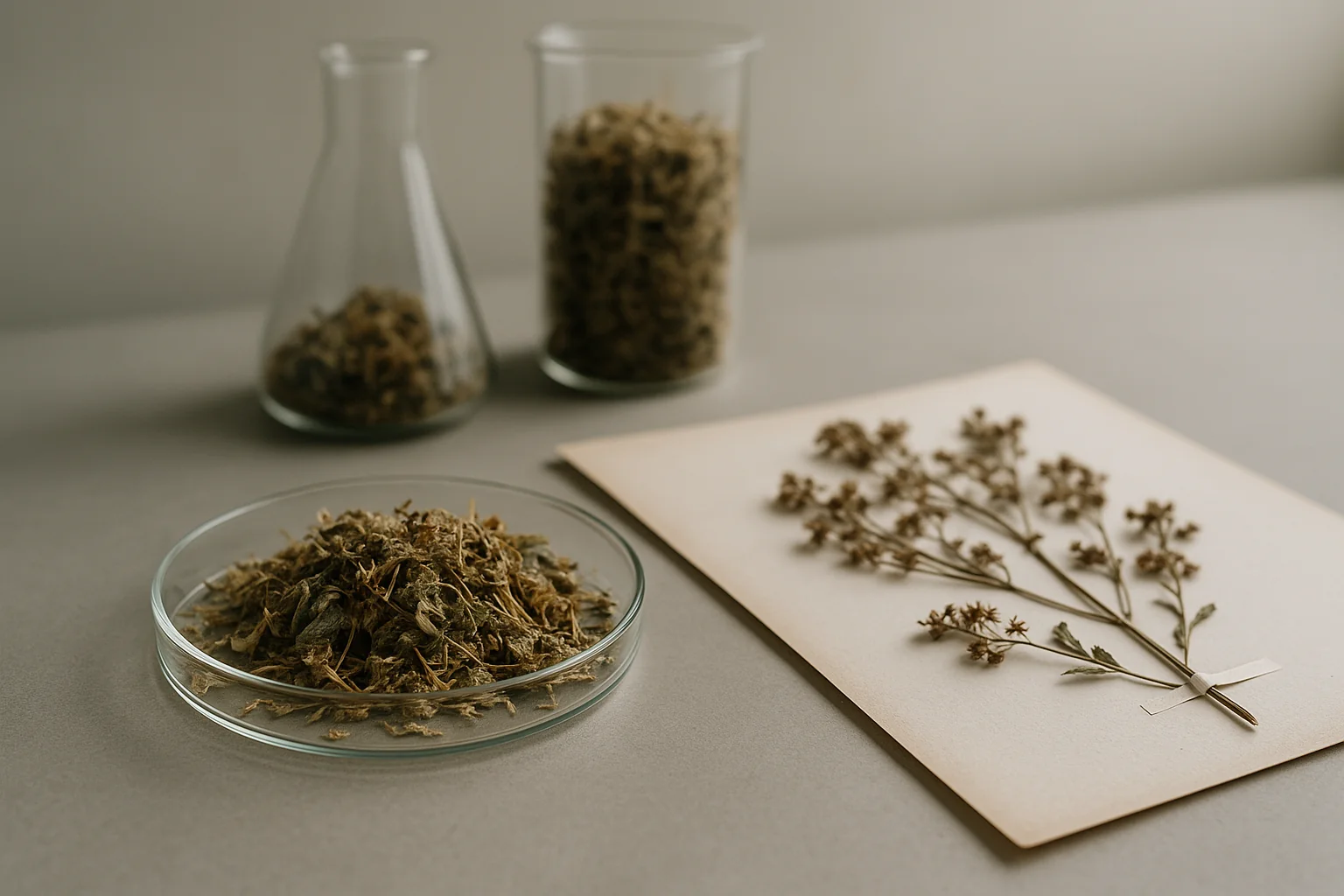

Triangle Mints (S-LAB and Synoptis Pharma): a descendant of Triangle Kush and three varieties from this parent.
Triangle Mints was created by crossing Triangle Kush with Animal Mints, and in Polish pharmacies, it has three strains related to the same pedigree graph. The text collects the lineage, the composition of the terpene profile, two pharmacy versions, and what has not been researched for this cultivar.
What is Triangle Mints and where does it come from?
Triangle Mints is a hybrid resulting from the cross between Triangle Kush and Animal Mints, developed by Seed Junky Genetics. The lineage is documented in two independent seed databases, so there is no need to guess based on the name. Pharmacy position descriptions consistently classify this cultivar as a hybrid with a sativa dominance, and the breeder JBeezy is noted under the cross.
The parents are two varieties with their own separate lineages. In this cluster, neither Triangle Kush nor Animal Mints appears as an independent pharmacy position, so no description of either parent can be based on the Polish list of raw materials. The parental names themselves come from seed databases maintained by the breeding community, not from the documentation of the dried flower producer: the pharmacy registration position does not carry information about the plant's origin.
The lineage tells where the plant came from and is silent about what will end up in the jar. The chemical composition is determined during cultivation and after harvest, so two batches of the same cultivar can differ in profile more than two varieties with a common ancestor. Among the 85 cultivars present in Polish pharmacies, the lineage has been established for 60, while 25 remain unknown because the breeder did not disclose it or the sources contradict each other. Triangle Mints belongs to the first group.
Which producers supply Triangle Mints to Polish pharmacies?
Two: S-LAB and Synoptis Pharma. Both positions describe the same cultivar issued exclusively by prescription, in the Rpw category. They differ in declared potency, so after adding a ten percent tolerance from the producer, the common THC content range for both versions extends from 19.8% to 27.5%. Each enters the pharmacy as a separate registration position.
| Producer | How does this version differ | What remains the same in both versions |
|---|---|---|
| S-LAB | The lower of the two potency declarations in the pair, i.e., the lower end of the common range. | The same set of terpenes in the source description. |
| Synoptis Pharma | The higher of the two potency declarations, i.e., the upper end of the common range. | The same genetics and the same leading terpene. |
We do not list the declared percentage next to the producer's name because a single number from the label does not describe the content of the jar. The producer is entitled to a deviation of one-tenth of the declaration in either direction, so each declaration is essentially a range, and two different declarations create an even wider range. The combination of both Triangle Mints positions results in 19.8-27.5%, and this number is more honest than either of the two values from the label.
The composition of the assortment can be unstable. A position disappears from the wholesaler, returns after a few months under a different potency declaration or from a different producer, and sometimes the cultivar remains on the list even though it is not available in any pharmacy in the city. Therefore, the current state and prices are only available in the compilation of available strains, updated separately. The entire assortment of both producers is collected in their own entries: S-LAB and Synoptis Pharma.
How does Triangle Mints smell and taste?
The source describing both pharmacy positions lists three notes: spicy, earthy, and herbal. There is no mention of sweetness or citrus, which the name with the mints component might lead one to expect. This is a sensory characteristic recorded by the database, not a measurement result. Both versions have the same scent description there.
The spicy note aligns with what leads in the profile. Caryophyllene is the same compound responsible for the sharpness of black pepper and is found outside of hemp in cloves and hops. Earthiness and the herbal note are often attributed to myrcene and humulene, but attributing a scent to a single component of the mixture is more of a descriptive convention than a result of chemical separation.
It is worth remembering where such descriptions come from. The naming of scent notes is not standardized; each database uses its own list of adjectives, and neither of the two producers publishes sensory analysis for this position. Additionally, terpenes are volatile: dried flower stored longer or in heat smells weaker than freshly opened, so the same cultivar from two different batches can provide two different experiences.
How long does it take for Triangle Mints to take effect and how long does the effect last?
The course is determined by the method of administration, not the strain name. For Triangle Mints, no separate measurement has been published, so the following ranges describe vaporization and oral administration in general, not this cultivar. The difference between them is significant enough that confusing one method with another results in a double dose. The name on the jar does not change this distribution.
The route of administration determines the course more than the variety itself. After vaporization, the substance passes from the lungs to the blood almost immediately, so the first sensations appear after a few minutes, the intensity increases for another ten to thirty minutes, and the whole effect lasts for two to four hours. After ingestion, the raw material first passes through the intestine and liver, so the first sensations are awaited from half an hour to two hours, and the episode can last six, sometimes eight hours. Hence the most common mistake with oral administration: anyone who thinks nothing is happening after thirty minutes and takes another dose will receive both doses at once. The above ranges describe the route of administration, not this variety; pharmacokinetic studies for a single cultivar have not been published.
A practical conclusion for someone receiving this dried flower from a pharmacy does not depend on what the commercial descriptions say about the strain. The same raw material administered in two different ways produces two different effects over time, and the choice of administration route and dosage size is up to the attending physician, not the cultivar description online.
What is known, and what is not known about the effects of Triangle Mints?
It is known what beta-caryophyllene does in mice, but it is not known what Triangle Mints does in humans. Two studies describe the leading terpene of this profile in pain and inflammation models. Neither pertains to this strain or any other single cultivar, as such studies have not been conducted. The separation of these two aspects is the entire content of this section.
The terpene profile of this cultivar is described by one source, the database budcare.pl, and lists farnezen, humulen, caryophyllene, linalool, and myrcene. The composition comes from one source, so there is nothing to compare it with. We do not write the shares in percentages because the denominator can be different for each source in such listings: measured totals for the same entries come out to 46, 73, or 83 percent at different times. Each of these five terpenes has its own entry in the cluster: farnezen, humulene, caryophyllene, linalool and myrcene.
Beta-caryophyllene itself has two studies that are worth separating from what is said about it. Gertsch and colleagues described in 2008 in the Proceedings of the National Academy of Sciences (PNAS), PMID:18574142, selective binding of (E)-beta-caryophyllene to the CB2 receptor with a Ki of 155 nM and inhibition of carrageenan-induced paw edema in wild-type mice, which was not observed in mice lacking this receptor; the anxiety tests were not included in this study. Klauke and colleagues in 2014 in European Neuropsychopharmacology, PMID:24210682, administered the same compound orally to mice. In the formalin test, the pain response weakened only in the second, inflammatory phase, while the first phase remained intact, and the entire effect disappeared after the CB2 receptor was disabled. In animals with nerve injury, hypersensitivity to heat and touch decreased, and with prolonged administration, the response did not weaken.
Neither of the two studies tested caryophyllene on humans or in inhaled form from dried flower; both studies pertain to oral or systemic administration in mice in pain and inflammation models, not sleep or mood.
The rest falls into a different category than evidence. The note about possible stimulating effects is a commercial characteristic of the strain, patient reports describe individual experiences without a comparative group, and none of these things have the status of study results.
What side effects have been reported after Triangle Mints?
None assigned to this name. Pharmacotherapy safety supervision links reports to a specific medicinal product and its batch, not to the cultivar, so there is no separate list for Triangle Mints, and none will be created under the current data collection method. This is an answer, not a gap in this text.
Reports of adverse effects are collected for medicinal products with a batch number, not for the strain name, so the following pertains to hemp dried flower as a group of raw materials. The most frequently reported symptoms are dry mouth, red eyes, and increased heart rate. Dizziness upon rapid standing, daytime drowsiness, and temporary worsening of short-term memory are less frequently described, as well as anxiety that increases with dosage. A separate issue is medications taken concurrently, especially sedatives and those affecting coagulation: their assessment requires knowledge of the entire list of preparations, not just the description of the plant. We do not provide the frequency of these symptoms numerically, as public compilations for hemp dried flower in Poland do not separate them by individual products.
One difference between the two versions of Triangle Mints does matter here: the declared potency is not the same in both. With the same strain and the same amount of dried flower, a higher declaration means a greater dose of active substance, and some of the symptoms mentioned above intensify with dosage. Therefore, switching from one version to another is not the same as switching to the same.
At what temperature should Triangle Mints be vaporized?
There is no temperature specific to the strain; there is only a temperature specific to the compound, and even that is reported differently in tables. Beta-caryophyllene, the leading terpene of this profile, has boiling point records scattered between 130 and 257 degrees Celsius, depending on the measurement pressure. The vaporizer setting is yet another number different from both of these values.
The variation comes from the method. The record of 257 degrees comes from a measurement at atmospheric pressure, while 130 degrees comes from distillation under reduced pressure to 14 mmHg, meaning from completely different conditions. Tables circulating on forums combine both values in one column, without stating the pressure, and that is where the conflicting recommendations for the same terpene come from. A separate entry rozbiera te tabele na czynniki pierwsze.
The second trap is equipment-related. The number on the display describes the heater or chamber, not the dried flower that lies in that chamber and is cooler for most of the inhalation. Instead of targeting the point assigned to caryophyllene, it is wiser to treat the setting as a range to try out. Separately the evaporation temperatures of terpenes are collected, a osobno the difference between the setting and the actual temperature of the dried flower.
Which strains are related to Triangle Mints?
Three, all available in Polish pharmacies: Kush Mints, Original Gangster Deluxe, and Wedding Pop Triangle. Triangle Mints is related to Animal Mints as a parent strain, and to the other two by Triangle Kush. The sibling relationships in the pedigree chart speak to lineage, not how the strains perform, and these three cases illustrate that well.
| Strain | Common parent | Second parent | Leading terpene in the profile description |
|---|---|---|---|
| Kush Mints | Animal Mints | Bubba Kush | limonene |
| Original Gangster Deluxe | Triangle Kush | OG Kush Breath, Josh D OG | terpinolen |
| Wedding Pop Triangle | Triangle Kush | Wedding Cake | caryophyllene |
The common parent does not promise a common profile, and these three cases illustrate this clearly. Kush Mints, sharing with Triangle Mints the parent Animal Mints, leads in the profile description with limonene. Original Gangster Deluxe it is led by terpinolene, although it inherits double from Triangle Kush: this strain appears in its recorded pedigree on both sides of the cross. Only Wedding Pop Triangle has the same leading terpene in its description as Triangle Mints.
The reverse mistake is also easy to make. In the same pharmacies, there is Animintz, whose name carries the same minty hint as the two previous ones, but is not a sibling: its parents are Animal Cookies and SinMint Cookies, so the graph does not connect it to Triangle Mints by any edge. A common word in the name does not prove kinship, and its absence does not exclude anything.
Siblings can be rarer in this cluster than one might think: the kinship field has content in 29 out of 85 cultivars. An empty list does not indicate a lack of data. Parents can be landraces or broad style families, and two strains sharing only such an ancestor are not siblings, as these are categories, not identified individual plants.
Frequently Asked Questions about Triangle Mints
Below are the questions that come up most often regarding this strain, along with brief answers. Each summarizes what is detailed above and does not replace a conversation with a healthcare provider or information from the leaflet attached to a specific pharmacy item. The order of questions does not indicate importance.
Can Triangle Mints be purchased without a prescription?
No. Both pharmacy versions of Triangle Mints are dried flower in the Rpw category, which means a pharmaceutical raw material issued only with a prescription from a doctor. Hemp products available in stores belong to a different product category and do not contain this raw material.
How much THC does Triangle Mints have?
Depending on the version, from 19.8 to 27.5 percent. The two pharmacy items differ in declared potency, and each declaration is valid with a tolerance of about one-tenth of the value in both directions, so a single number on the label does not describe the contents of the jar. We provide a range covering both versions.
Are Triangle Mints and Kush Mints the same strain?
No. Both have Animal Mints in their lineage, but the second parent is different: Triangle Kush with Triangle Mints, Bubba Kush with Kush Mints. They are also distinguished by the leading terpene in the profile description, which is caryophyllene for Triangle Mints and limonene for Kush Mints.
Which terpene leads in the profile of Triangle Mints?
Caryophyllene. The source describing this cultivar lists five terpenes in the profile, with caryophyllene leading both in the share breakdown and in the description of both medicinal products. The composition comes from a single database, so there is nothing to compare it with.
Has the effect of Triangle Mints been studied?
No. Research is conducted for medicinal products and individual substances, not for strain names, so there is neither a pharmacokinetic study nor a compilation of adverse effects for this cultivar. There are studies on caryophyllene itself, conducted on mice in pain and inflammation models.
Is Triangle Mints consistently available in pharmacies?
Not always. Availability depends on wholesale supplies and can vary in different pharmacies within the same week, and products can disappear from the list and return months later under a different potency declaration. The current state collects a separate, updated compilation of available strains.
The material is for informational purposes only and does not replace medical advice. Dried flower in the Rpw category seems to be available only by prescription, while the store category dried hemp includes products of a different kind. Editorial: ubucha.pl.