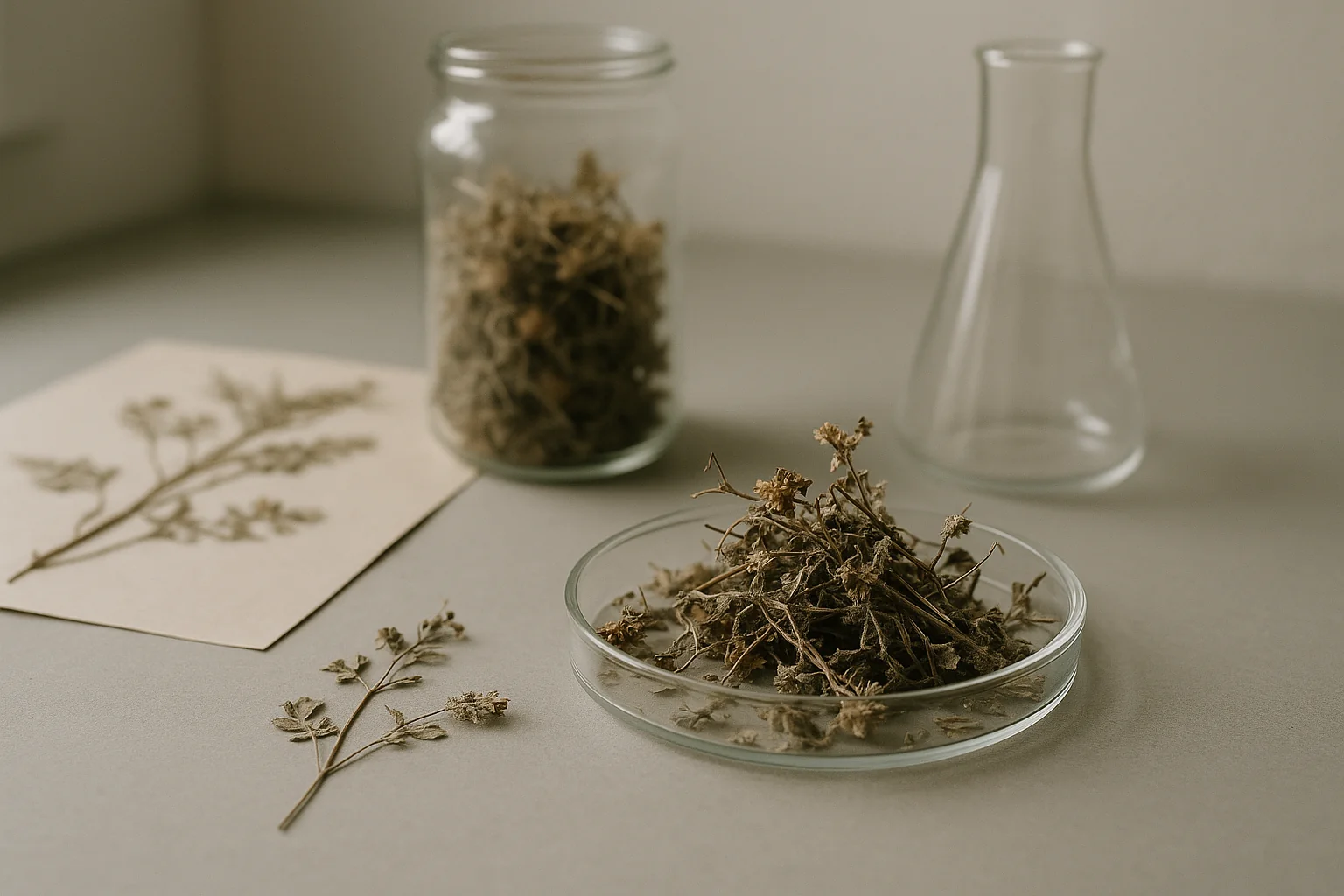

Farnesene in strain profiles: a compound without mammalian studies
Farnesene appears in the description of eleven strains from the Polish market, and all literature about it concerns aphids and plants. We gather in one place what is known about this compound and what no one has verified.
What is farnesene and where does it occur outside of hemp?
Farnesene is a sesquiterpene with the formula C15H24 and a molecular weight of 204.35, which means it is one and a half times larger than monoterpenes like limonene. Outside of hemp, it has primarily been described in the world of aphids and the plants they inhabit. PubChem lists this compound under the name (E)-beta-farnesene with the number 5281517.
The systematic name is (6E)-7,11-dimethyl-3-methylidene-dodeca-1,6,10-triene. The public card for this compound is lacking in measurement details: in the physical description section, there is just one word, liquid. Myrcene has four boiling point entries in the same registry from four institutions, while farnesene has none.
Under one name, several different molecules are hidden. Farnesene occurs in both alpha and beta forms, and each has variants differing in the position of the double bond. The profile databases from which our terpene set originates simply state farnesene without specifying the isomer. The evidence we have clearly pertains to the (E)-beta form. As long as the composition description does not specify which molecule is indicated, conclusions drawn from studies on one of them cannot be applied to the contents of the package.
The best-documented place for this compound outside of hemp is insect communication. Aphids release (E)-beta-farnesene as an alarm signal, and the plants they attack emit it into the environment. PubChem also notes it among food ingredients, citing the FooDB database. In our compilation, farnesene appears in the profile of eleven out of eighty-five cultivars.
How long does it take for farnesene to reach the body and how long does it stay there?
Unknown. Neither of the two studies on farnesene measured its concentration in the blood of either humans or animals, so absorption time cannot be provided. Our boiling point file does not even have such a number for this compound: a query to PubChem ends with a 404 response.
This file lists eleven compounds, and two of them have no entries, namely farnesene and bisabolol. Six have values measured under atmospheric pressure. Humulene has the only reading taken at a pressure of 3 mm Hg, which is in conditions close to a vacuum, where the same substance boils hundreds of degrees lower than in an open vessel exposed to air. Comparing such a reading with the others would be a mathematical error, not a minor inaccuracy.
We do not provide the device settings, and this is not editorial caution, but a lack of basis: such a number does not arise from this data. The boiling point describes a pure reagent heated in a vessel, not resin broken down on the inflorescence in the vaporizer chamber. We separately analyze this in the text about the evaporation of terpenes.
The route of administration determines the course more than the variety itself. After vaporization, the substance passes from the lungs to the blood almost immediately, so the first sensations appear after a few minutes, the intensity increases for another ten to thirty minutes, and the whole effect lasts for two to four hours. After ingestion, the raw material first passes through the intestine and liver, so the first sensations are awaited from half an hour to two hours, and the episode can last six, sometimes eight hours. Hence the most common mistake with oral administration: anyone who thinks nothing is happening after thirty minutes and takes another dose will receive both doses at once. The above ranges describe the route of administration, not this variety; pharmacokinetic studies for a single cultivar have not been published.
What have studies shown about the effects of farnesene?
Nothing about its effects on mammals. The evidence base for this project has two entries for farnesene: an experiment on a plant infested with aphids and a review of insect literature. The first yielded a negative result, and the second does not address mammalian organisms at all. There is no third entry for this compound in the database.
The first was described by Kunert G, Reinhold C, Gershenzon J in the journal BMC Ecology in 2010 (PMID:21092302), and the model was a plant and an insect (transgenic radish, aphid). The radish modified to continuously release (E)-beta-farnesene did not deter the peach-potato aphid: the emission did not discourage winged or wingless forms from settling, did not reduce aphid fertility, and did not increase the proportion of winged offspring. The authors concluded that the result does not support the hypothesis of a direct defensive role for this compound.
The second entry is a paper authored by Wang B, Jacquin-Joly E, Wang G in the journal Annual Review of Entomology in 2025 (PMID:39378330); its model is a review of insect literature (without a mammalian model). The review describes (E)-beta-farnesene as an alarm pheromone for aphids and a signal attracting their predators, discussing its biosynthesis, insect receptors, and evolutionary significance. The entire review concerns the plant-aphid-predator system and indicates directions for research on aphid control.
Let's compare this with the entire database. It consists of 22 entries spread across eleven terpenes, and none of them include humans. Two are outside the biology of mammals, and both belong to farnesene. No other compound from this set has a file composed solely of studies on plants and insects. This is not a criticism of the authors: both works answer questions in entomology and do so reliably. The point is that the question of the impact on the patient was not raised in either.
What has not been shown about farnesene?
Farnesene has no studies on humans or mammals. The literature on this compound pertains to aphids, their alarm pheromone, and plant defense, not pharmacology. No therapeutic effect attributed to it comes from studies on mammalian organisms. This is the record from the database of this project, and it speaks to the state of the literature, not to the safety of use.
Let's break this down. The 2010 experiment did not concern mammals at all, and even in insects, it did not confirm what it was looking for: the radish continuously releasing this compound did not deter aphids from settling. A negative result in an entomological study says nothing about humans, but it does say a lot about how cautiously one should read statements about the alleged defensive role of this molecule.
To say anything about the effect of farnesene on a patient, three things would be needed, which are absent: the quantification of the compound in a specific batch of dried flower, measurement of how much of it passes into the blood after heating, and observation with a defined endpoint described in humans. All three are lacking simultaneously, not just one.
Additionally, there is a limitation that popular strain descriptions remain silent about. Profile databases list only the name without the isomer, so even if a paper on (E)-beta-farnesene in rodents were published tomorrow, it would not be known whether it pertains to what is indicated in the flower. Thus, the statement about the lack of studies on mammals is the first of two limitations, not the only one.
In comparison: the other ten terpenes from this set have at least one study in the database on rodents or in cell culture. Farnesene is the only one for which there are neither such studies nor any others. An honest answer is therefore: there is nothing to summarize, and we do not fill the gaps with generalities about the role of terpenes, as a statement about a group of compounds does not become data about one of them.
What adverse effects have been reported after farnesene?
None. There is not a single report in this project's database regarding this compound, as both entries concern aphids and radishes, not individuals taking the drug. However, the lack of reports is not evidence of safety here, but rather a consequence of no one conducting such observations.
The statement that terpenes at high concentrations can be irritating to the respiratory tract and skin describes an entire group of volatile compounds and does not come from measurements made for farnesene. Transferring it to a single name from the composition would be exactly the error that the previous section warns against. We also do not know the quantity: none of our databases state how much of this compound remains in the vapor after heating the flower, nor how much was there before heating.
Reports of adverse effects are collected for medicinal products with a batch number, not for the strain name, so the following pertains to hemp dried flower as a group of raw materials. The most frequently reported symptoms are dry mouth, red eyes, and increased heart rate. Dizziness upon rapid standing, daytime drowsiness, and temporary worsening of short-term memory are less frequently described, as well as anxiety that increases with dosage. A separate issue is medications taken concurrently, especially sedatives and those affecting coagulation: their assessment requires knowledge of the entire list of preparations, not just the description of the plant. We do not provide the frequency of these symptoms numerically, as public compilations for hemp dried flower in Poland do not separate them by individual products.
Which strains from Polish pharmacies have farnesene as the leading terpene?
None. The pharmacy list, which includes our inventory of 141 entries, recognizes only six terpene names: myrcene, caryophyllene, limonene, terpinolene, pinene, and nerolidol. Farnesene is not among them, so it could not be indicated as leading for any entry. In profile databases, this compound appears in the composition of eleven strains.
The distinction between these two lists is substantive, not formal. The pharmacy list assigns one leading terpene to each entry and draws from the dictionary of six names. Profile databases list the entire composition and have a broader dictionary. A strain can therefore have farnesene in its profile, while the list indicates limonene or myrcene. This is the case with Mac 1 and GMO: the share table on budcare.pl places farnesene first, while the pharmacy list indicates limonene and myrcene for these entries.
The following table lists all eleven strains, along with the producer from the list and the terpene that the list recognizes as dominant. The last column indicates whether the profile composition is confirmed by one source or two differing sources.
| Strain | Producer from the list | Dominant terpene in the list | Profile description compliance |
|---|---|---|---|
| GMO | Four 20 Pharma | myrcene | one source |
| Gelato 33 | Cantourage | limonene | one source |
| Mac 1 | Cantourage, Four 20 Pharma | limonene | one source |
| Modified Gas | Cantourage | limonene | one source |
| Mystic Wonder | Suprobion | myrcene | sources differ |
| Northern Berry | S-LAB | caryophyllene | sources differ |
| Orange Cake | Cantourage | limonene | one source |
| Pavé S1 | Cantourage | caryophyllene | one source |
| Purple Octane | S-LAB | caryophyllene | one source |
| Triangle Mints | S-LAB, Synoptis Pharma | caryophyllene | one source |
| Ultra Jack | Canopy Growth | myrcene | one source |
Six manufacturers are responsible for these products: Cantourage, Four 20 Pharma, S-LAB, Suprobion, Synoptis Pharma, and Canopy Growth. The availability of individual products changes from month to month, depending on what each manufacturer has released for sale. a summary of available strains. The items listed here are raw materials issued by a doctor's prescription, not a store assortment; this is collected separately. dried flower category.
How do the profile bases differ in the description of farnezen?
By scale and consistency. The service budcare.pl lists farnezen in the composition of fourteen items out of one hundred and forty-six, while medweed.pl lists it in two out of sixty-five. Additionally, both lists within the same service can diverge: for two strains, the composition lists farnezen, while the share table from the same page omits it.
These two strains are Purple Octane and Northern Berry. In both cases, the composition starts with farnezen, while in the share table, its place is taken by bisabolol, which is not present in the composition. The divergence also goes the other way: for two other items, marked as Facade and Big Purple Dragon, farnezen appears in the share table, although it is omitted from the composition.
The combined profile, which arises from both sources, assesses consistency separately for each strain. Out of eleven strains with farnezen, both services describe only two at the same time, namely Mystic Wonder and Northern Berry, and in both cases, the composition does not match. For the remaining nine, farnezen comes from one service, as the other either does not describe that item or provides a shorter composition.
For the reader, one conclusion follows. The presence of farnezen in the strain description is information about what the service has written, not a result of a designation assigned to a batch of raw material. Two services looking at the same product can provide two different compositions, and they did so for both strains they describe concurrently.
Why don't we provide the share of farnezen in numbers?
Because we do not know the denominator. In those items from the budcare.pl service where farnezen has an assigned number, the sums of all shares from one item range from 73 to 125. A value above one hundred cannot be a share in total, so the number next to the compound name would suggest a measurement that no one has performed.
The distribution of these sums looks like this: fourteen items with a number next to this compound yield ten different results, three hit exactly one hundred, and two go higher. The lowest sum is 73, the highest is 125. If the components were provided as weight shares of the entire oil, none of these sums could exceed one hundred, as the whole is never less than its parts.
Numbers from such a table are also not comparable between strains. For Ultra Jack, the sum is exactly one hundred, and all listed components received equal parts, which seems more like editorial rounding than a result of designation. For Pave S1, the sum exceeds one hundred by one quarter. Providing a value taken from such a summary in the text would promise the reader precision that is not present in the source.
We therefore provide the composition as a composition: the names of compounds mentioned by the source, without numbers. This is less impressive than a table with percentages, but corresponds to what can actually be read from this data.
Frequently Asked Questions
Does farnezen have a calming or pain-relieving effect?
It is unknown. In the evidence base of this project, there is not a single study with a mammalian model for farnezen, so based on this, no effect in humans can be confirmed or excluded.
Is there any strain from Polish pharmacies that has farnezen indicated as the leading terpene?
No. The pharmacy list on which our inventory stands recognizes six names of terpenes, and farnezen is not among them. Eleven strains, however, have it listed in their composition in profile databases.
At what temperature does farnezen evaporate?
We do not provide this number because we do not have it. An inquiry about the boiling point of this compound ends with a 404 response in PubChem, and the boiling point of the pure reagent is still not the setting of the device.
Is farnezen from the flower the same compound as the alarm pheromone of aphids?
From our data, this cannot be determined. Entomological studies concern the (E)-beta form, while profile databases list only the name without the isomer.
How many strains from this list have farnezen in their profile?
Eleven out of eighty-five. For nine of them, the source comes from one service, while for two, namely Mystic Wonder and Northern Berry, the sources provide a different composition.
Why don't you provide the percentage of farnesene in numbers?
Because the sums of all percentages given for one item range from 73 to 125, and a set in which parts exceed the whole does not yield a quotable number.
Dried flower is a pharmaceutical raw material issued by a doctor's prescription in the Rpw category, and advertising of prescription medicinal products directed to the public is prohibited. The material is for informational purposes only and does not replace medical consultation. Editorial text ubucha.pl.