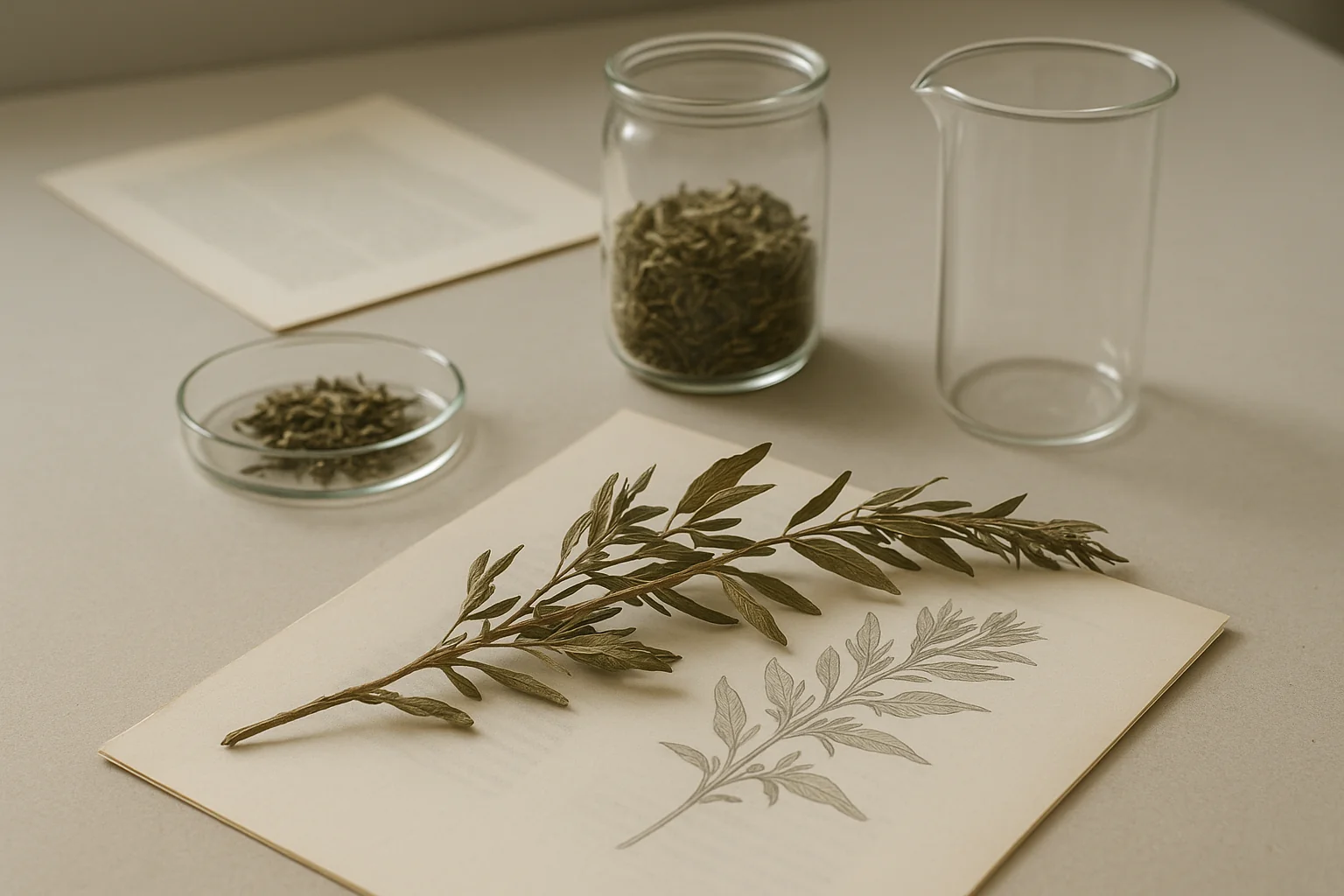

Strawberry OG from Bliss Pharma: lineage and profile with nerolidol
Strawberry OG reaches Polish pharmacies in one version, and its terpene profile is described by only one database. We gather what can be said about it without guessing: pedigree, terpenes, effects according to the method of administration, and the limits of evidence.
What is Strawberry OG and where does this strain come from?
Strawberry OG is a hybrid developed from the crossbreeding of Bruce Banner #3 and SFV OG IBL. The lineage is provided by the breeder's site The Cali Connection and the Leafly service, and both Polish databases describing the medicinal position consistently refer to it as a hybrid. It is available in Polish pharmacies in one version, from the producer Bliss Pharma.
The lineage is based here on two addresses recorded in our database: the official seed breeder's website and the strain card in a popular catalog. None of these sources leave the parents to speculation, so we do not need to write a sentence about unknown origins. In this comparison, such a sentence often appears: out of eighty-five cultivars, twenty-five do not have established parents because the breeder did not disclose them or the available descriptions contradict each other.
The names of both parents carry the designation of a selected line, not a broad family. The first one has a phenotype number, while the second has an inbred line abbreviation. For the last section of this entry, this has practical consequences: a parent named broadly, like afghani or haze, does not allow anyone to identify siblings, as it is a category, not a single plant.
The OG component in the name is sometimes interpreted as belonging to a family. In this comparison, three names carry it, and there are three separate lineages behind them with no common part. Both Polish databases describe the genetics with the same word, hybrid, and that is where their agreement ends, as one provides clearly more information than the other.
Which manufacturer supplies this strain to Polish pharmacies?
One: Bliss Pharma. In our comparison, this strain has one medicinal position, described by two Polish strain databases under the same registration name. The name is Cannabis flos with the producer's note, and we omit the numerical component in it, as it repeats the declared, not measured value.
| Description section | budcare.pl | medweed.pl |
|---|---|---|
| Producer | Bliss Pharma | Bliss Pharma |
| Registered name without a numerical component | Cannabis flos, Bliss Pharma | Cannabis flos, Bliss Pharma |
| Genetics | hybrid | hybrid |
| Terpene profile | humulene, limonene, nerolidol, pinene | empty section |
| Aroma description | citrusy, woody, herbal | none |
| Availability | defined as high | not specified |
One supplier is the norm in this comparison, not an exception: sixty-four cultivars out of eighty-five have exactly one producer, and more than three have two. Bliss Pharma is responsible here for two strains, each in a single position, so the question about differences between versions of the same strain currently has nothing to refer to.
Both databases describe the same product, only to varying degrees. The first fills in the aroma and composition sections, while the second leaves them empty, although it provides the same registration name and the same producer. The discrepancy therefore concerns not the product, but how much has been recorded about it, and this is a difference worth understanding when comparing catalogs.
Current assortment and prices are collected by a comparison of strains available in pharmacies, as the permit for the raw material expires, and the wholesaler's offer changes faster than the text about the strain. A separate shelf is dried hemp flowers sold without a prescription, whose dispensing path has nothing to do with this strain.
What does Strawberry OG smell and taste like?
Pharmacy bases describe this item by its scent, not its taste, and the only public description mentions three tones: citrus, woody, and herbal. Strawberries, to which the name refers, are not mentioned in this description at all. The trade name comes from the seed breeder and is not a declaration about the scent of the dried flower sold in the pharmacy.
The terpene profile of this entry is known from one source, which lists four names: humulene, limonene, nerolidol, and pinene. The second database describes the same product, but leaves the terpene section empty, so there is nothing to compare. This means we cannot say that the descriptions are consistent or that they contradict each other. The state of knowledge about the other components of this set, that is about humulenie, limonenie and pinenie, is described in separate entries dedicated to these terpenes.
We do not provide percentage shares for these names, and the reason is quantifiable. The four numbers that this base assigns to the terpenes of this item sum up to sixty-one, not one hundred. Therefore, there are thirty-nine parts missing, about which the source says nothing: neither that they are other terpenes nor that they are the rest of the dried flower mass. Among the one hundred forty-five items in the same base, the sum can be arbitrary, from fourteen to one hundred twenty-five, usually falling around eighty-two. The number without a denominator looks like a measurement, but it is a record in the column.
The scent of the dried flower still depends on the batch, storage conditions, and how long the jar has been open. The catalog description refers to the strain's standard, not to a specific package issued in the pharmacy.
How long does it take for this strain to take effect, and how long does the effect last?
The method of administration determines the course more than the strain itself. For Strawberry OG, no measurement of the duration of effect has been published, and both bases describing this item do not provide a single number in this regard. Therefore, it can only be honestly described what pertains to the two methods of consuming the dried flower in the same form.
The route of administration determines the course more than the variety itself. After vaporization, the substance passes from the lungs to the blood almost immediately, so the first sensations appear after a few minutes, the intensity increases for another ten to thirty minutes, and the whole effect lasts for two to four hours. After ingestion, the raw material first passes through the intestine and liver, so the first sensations are awaited from half an hour to two hours, and the episode can last six, sometimes eight hours. Hence the most common mistake with oral administration: anyone who thinks nothing is happening after thirty minutes and takes another dose will receive both doses at once. The above ranges describe the route of administration, not this variety; pharmacokinetic studies for a single cultivar have not been published.
For this item, there is not even a producer's description that would say anything about the onset of action, so any number assigned specifically to this name would be pulled out of thin air. The intervals given above describe physiology, not a single cultivar, and should be read as such.
What has been shown about the effects of this strain, and what has not been shown?
Two things have been shown, both in mice and both concerning nerolidol, not the strain. For the cultivar Strawberry OG itself, there is no clinical or observational study, so what circulates about its effects comes from catalog descriptions and patient reports, not from scientific work.
The first paper was published in 2016 in the journal Fundamental & Clinical Pharmacology (Fonsêca DV, Salgado PR, de Carvalho FL, Salvadori MG, Penha AR, Leite FC, Borges CJ, Piuvezam MR, Pordeus LC, Sousa DP, Almeida RN; PMID:26791997). Nerolidol (200-400 mg/kg) reduced the number of abdominal cramps induced by acetic acid in mice and lowered the levels of pro-inflammatory cytokines TNF-alpha and IL-1beta; the authors suggested the involvement of the GABAergic system in the analgesic effect, unlike the opioid mechanism and potassium channels.
The second is more recent, from 2026, published in Arquivos de Neuro-Psiquiatria (Hojjat SH, Rasouli F, Shakeri F; PMID:42447923). Oral nerolidol (25-100 mg/kg) prolonged the latency to seizures induced by pentylene tetrazole (MCS and GTCS phases) in mice and reduced markers of oxidative stress in the brain.
It has not been shown that nerolidol alleviates anxiety or insomnia in humans; both available studies concern rodents and describe analgesic, anticonvulsant, and antioxidant effects, not sleep or mood.
On the other side is the catalog material. The database from which the composition comes assigns this entry a balanced effect, but that is just a label in the column, not a measurement result, and there is no work behind it that could be pointed out. Nerolidol reappears in this comparison as a leading component in six strains, which is why we describe the state of knowledge about it once, in a separate in the post about this terpene.
What side effects have been reported for this strain?
None. There is no separate compilation of reports for this name, as a single pharmacy item from one manufacturer does not create its own safety statistics, and the same is true for strains with many versions. The description below pertains to the raw material, not the cultivar, and should only be read as such.
Reports of adverse effects are collected for medicinal products with a batch number, not for the strain name, so the following pertains to hemp dried flower as a group of raw materials. The most frequently reported symptoms are dry mouth, red eyes, and increased heart rate. Dizziness upon rapid standing, daytime drowsiness, and temporary worsening of short-term memory are less frequently described, as well as anxiety that increases with dosage. A separate issue is medications taken concurrently, especially sedatives and those affecting coagulation: their assessment requires knowledge of the entire list of preparations, not just the description of the plant. We do not provide the frequency of these symptoms numerically, as public compilations for hemp dried flower in Poland do not separate them by individual products.
If such a record for this name were to be created, it still could not be related to earlier batches, as the composition of the dried flower can vary between harvests. Symptoms should be reported to the attending physician or pharmacist, not to the author of the strain description.
Is it possible to create a vaporization temperature table for it?
No. Among the four terpenes listed in the profile of this item, the public chemical database provides boiling points along with pressure for only two. The third has a record without specified pressure, and the fourth only a measurement in nearly vacuum, so placing these numbers in one column would be misleading.
| Terpene from the profile | Database entry | Pressure during measurement | Comparable to the others |
|---|---|---|---|
| pinene | 156 degrees Celsius | 760 mm Hg | Yes |
| limonene | about 177.8 degrees Celsius | 760 mm Hg | Yes |
| nerolidol | 275-277 degrees Celsius | not specified | NO |
| humulene | 99-100 degrees Celsius | 3 mm Hg | NO |
The leading component performs the worst here. For nerolidol, the database provides the number without pressure at which it was measured, and the boiling point without pressure cannot be compared to anything else. The popular advice to aim for the temperature of your leading terpene has no point of reference here, and we break this down in a separate entry about tabelach temperatur.
Humulene shows the same problem from the other side: its value was measured under pressure close to vacuum, which is not the condition present in a vaporizer. When placed in the table next to atmospheric values, it looks innocent and is simply untrue. The number selected on the device describes, in fact, the heating element or air, not the dried flower, which is cooled by the flow when inhaled and heats unevenly.
Vaporization begins below the boiling point, so these points are not activation thresholds. The method of administration is determined by the attending physician, as the dried flower is dispensed by prescription, and this entry discusses the limits of public data, not equipment operation.
Which strains from Polish pharmacies are related to it?
None. In the pedigree graph of this comparison, there is no cultivar that has Strawberry OG among its parents, nor one that shares even a single parent with it. Both of its parents appear in this graph exactly once, solely in its own row, and that is the entire answer.
The data contains something else. The graph includes eighty-five names and ninety-eight different parents, of which seventy-seven appear only once. Eleven names appear in a dual role: once as a strain from a pharmacy, once as a parent of someone’s pedigree. The parents of Strawberry OG do not belong to this eleven, so there is no reference to base.
The common part of the name proves nothing. Galaxy Walker OG has parents who have nothing in common with the parents of this strain, and OG Kush is a separate cultivar from the pharmacy in this comparison, not an ancestor of Strawberry OG. Three names share one word here, and that is where the kinship ends.
An empty sibling list can also be a correct result when parents are described broadly, as no one can derive anyone from the style category. Here, the reason is different and narrower: the parents are named precisely, they just do not appear in any other pedigree from this list. If they did, the graph would add the siblings, not the author of the text.
Frequently Asked Questions
Is Strawberry OG an indica or sativa?
Both Polish databases describing this strain refer to it as a hybrid and do not provide any proportions. The registered name of such a division does not include it at all.
How many versions of this strain are available in Polish pharmacies?
One, from the manufacturer Bliss Pharma. This is the only entry for this strain in our listing.
Why don't you provide the active substance content for this strain?
Because the source provides a single declared number and does not give the manufacturer's tolerance, and without it, the declared value looks like a measurement. Providing it alone would be misleading.
Do two sources confirm the terpene profile of this strain?
No. Only one of the two databases describing this product lists it, while the other leaves the terpene section blank.
Does nerolidol help with sleep?
This has not been demonstrated in humans. Available studies concern mice and describe analgesic, anticonvulsant, and antioxidant effects.
Does Strawberry OG smell like strawberries?
The only public description of the aroma of this strain mentions citrus, woody, and herbal notes and does not mention strawberries.
The material is for informational purposes only and does not replace medical advice or pharmaceutical consultation. Dried flower is a pharmaceutical raw material dispensed by a doctor's prescription in the Rpw category. Editorial text: u Bucha editorial.