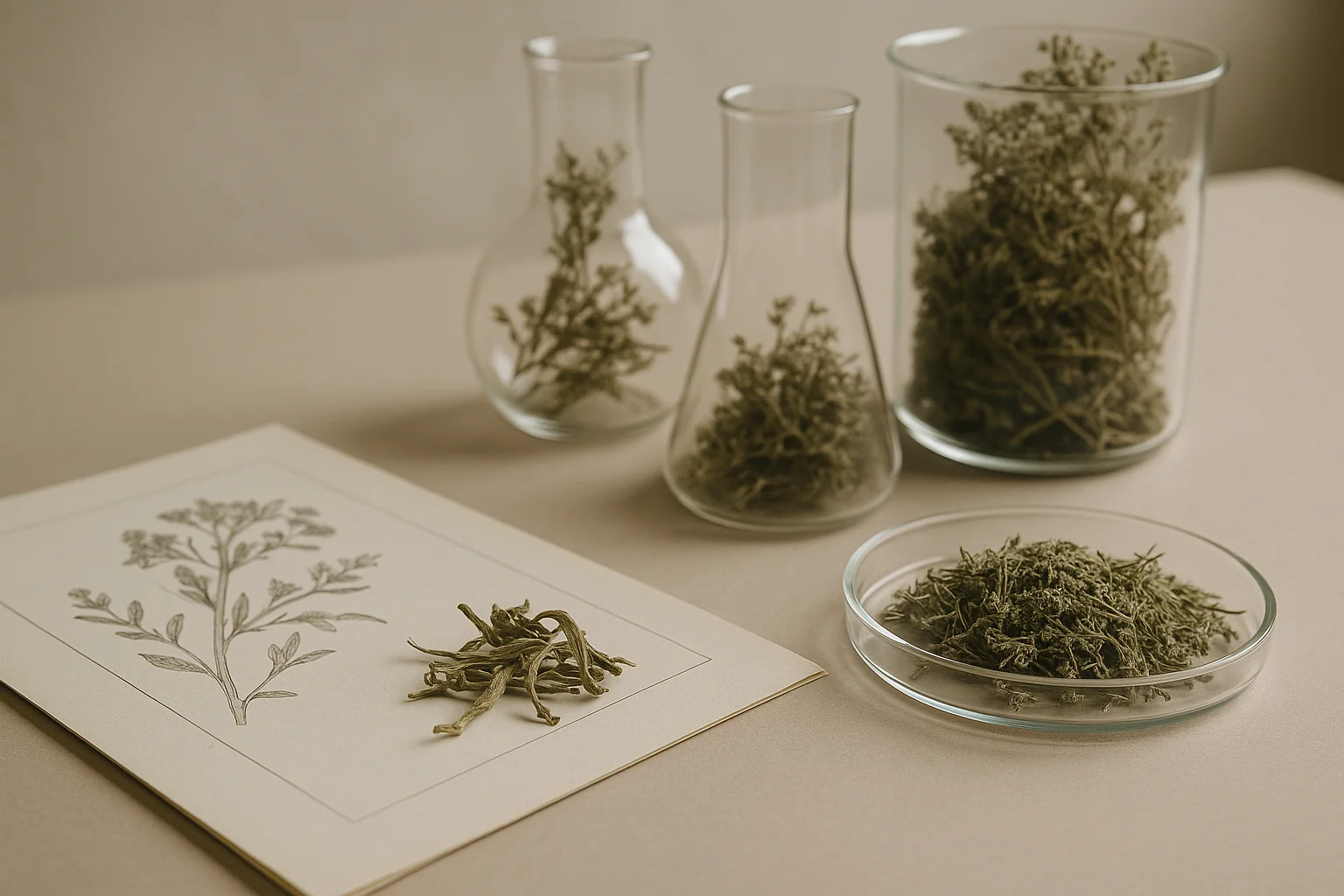

Jean Guy (ODI Pharma and S-LAB): how many versions reach pharmacies and how do they differ
Jean Guy reaches Polish pharmacies in two versions, and no source confirms its lineage. The text gathers the profile composition, differences between versions, and the limits of what has actually been studied about this strain.
What is this strain and where does it come from?
Jean Guy is a cultivar of hemp available in Polish pharmacies as a prescription-only raw material, whose lineage is not confirmed by any available source. No one provides the parent plants, and two pharmacy descriptions even differ regarding the type of plant. That's about all that can be said about the origin of this strain without guessing.
An uncertain lineage is not a gap that can be filled by more thorough searching. It means that the breeder never disclosed the parents to the public or that the descriptions circulating in industry services contradict each other enough that accepting any of them would be a fabrication. Among the 85 cultivars currently present in Polish pharmacies, 25 have such a status, so Jean Guy is not an exception here, but part of a group that is not marginal.
The name tempts one to read its origin, and that is precisely why it should not be trusted. It sounds French, suggesting a Canadian connection, but the trade name does not record the cross and is often assigned long after the plant has entered cultivation. In the same set, the term kush is used for both cultivars with established parents and those whose origin has not been confirmed, and the common word connects them only by sound. A lineage added by intuition creates false connections between strains and spoils the very graph that the reader was supposed to use for comparisons.
The discrepancy also includes the type of plant itself. One entry describes this raw material as a hybrid, another as a hybrid with a predominance of sativa, even though both refer to the same trade name. The division into indica and sativa actually comes from gardening tradition, not measurement, so even a consistent entry would carry less information than we expect from it.
Which producers supply this strain to Polish pharmacies?
Two manufacturers: ODI Pharma and S-LAB. Both entries are marketed as dried flower available by prescription under the same trade name, but they differ in declared strength, description of the type of plant, and scent notes in the documentation. The availability of individual batches can be intermittent, so check the current status in the list of strains.
| Manufacturer | Type of plant in the source description | Scent notes in the source description | Character provided by the source |
|---|---|---|---|
| ODI Pharma | hybrid with a sativa dominance | spicy, peppery, pungent | stimulating or balanced |
| S-LAB | hybrid | camphor, fruity, peppery | balanced |
The declared strength is what mostly divides these versions. The total range for both is 16.2-22.0%, and this is because a deviation of up to ten percent in either direction is allowed from the label value. The number on the package describes the midpoint of the range in which a specific batch falls, not the content of that one package. Both entries have different declared values, so the stated range encompasses them together and does not describe either of them separately.
Availability changes from batch to batch and is not a characteristic of the plant itself. Imports can be interrupted, permits have their deadlines, and pharmacies order based on prescriptions, which means that an entry present in the list a month ago can be unavailable today. The current status and compilation of all strains is maintained by the list of strains available in Polish pharmacies. What else do both producers provide is described in separate entries: ODI Pharma and S-LAB.
It is worth separating two things that often get mixed up in the search engine. The raw material described in this text seems to be available only by prescription marked as Rpw, whereas dried flower from retail sales this is a different category of products, with a different composition and a different method of administration.
How does this strain smell and taste?
Spicy and peppery, with a resinous background. Descriptions of both medicinal versions converge on a peppery note, but diverge with the rest: one features camphor and a fruity accent, while the other leans towards a spiciness closer to culinary spices. The impression also changes with the temperature of the dried flower being heated.
The peppery note is attributed to caryophyllene, the same compound that gives spiciness to black pepper and cloves. In the profile of this strain, it is considered the leading compound, so the spicy notes in the ODI Pharma version and the peppery notes in the S-LAB version create a unified picture, even though they come from two separate descriptions. The camphor mentioned in one of them seems like an anomaly, but it fits within the same register: cool, sharp, without sweetness.
The rest of the set adds background. Terpinolene brings a freshness reminiscent of pine resin with a slight acidity, nerolidol adds a woody note with a floral undertone, and bisabolol contributes a gentle chamomile-like resonance, which is usually only detectable once the sharper components have faded. The order in which these sensations appear depends on how quickly the temperature rises in the chamber.
The aroma remains a subjective description. There is no sensory panel for it, nor a unit; the scent notes come from distributors and patients, and the same packaging can smell different after a month of storage. The taste during vaporization also changes with the temperature setting, as discussed below.
How long does it take for the strain to take effect and how long does the effect last?
This is determined by the method of administration, not the strain name. Vaporization provides initial sensations within a few minutes and encompasses the entire experience within a few hours, while oral administration delays the onset by half an hour to two hours and clearly extends the episode. No separate measurements for Jean Guy have been published.
The route of administration determines the course more than the variety itself. After vaporization, the substance passes from the lungs to the blood almost immediately, so the first sensations appear after a few minutes, the intensity increases for another ten to thirty minutes, and the whole effect lasts for two to four hours. After ingestion, the raw material first passes through the intestine and liver, so the first sensations are awaited from half an hour to two hours, and the episode can last six, sometimes eight hours. Hence the most common mistake with oral administration: anyone who thinks nothing is happening after thirty minutes and takes another dose will receive both doses at once. The above ranges describe the route of administration, not this variety; pharmacokinetic studies for a single cultivar have not been published.
With this strain, there is another variable unrelated to physiology. Medicinal versions from two manufacturers have different declared values, so a dose measured from one package does not correspond to the same dose from another. The course over time remains unchanged, but the intensity shifts, and these are two different things that can easily be confused.
What is known, and what is not known about the effects of this strain?
Almost nothing verified is known about the strain itself. There are no clinical studies conducted on Jean Guy, but there are two papers on caryophyllene, recognized in this profile as the leading terpene, as well as descriptions from manufacturers and patient reports, which have not been compiled in a controlled comparison.
The profile composition is provided by one source, not two independent databases, and lists bisabolol, caryophyllene, nerolidol, and terpinolene. You will not find percentage shares next to these names here on purpose: the measured sums of shares in three compared datasets were 46, 73, and 83 percent, meaning each source counts to a different whole, and such numbers cannot be compared. One source also means that there is nothing to compare this composition to, and it is unknown whether the second database would describe it the same way.
The evidence for the terpene itself comes from mice. A previous publication (PMID:18574142, PNAS 2008) measured the affinity for the CB2 receptor at a level of Ki 155 nM and showed the reduction of inflammatory response in the paw after carrageenan in animals with the active Cnr2 gene; mice without this gene did not respond at all, indicating the involvement of the receptor itself. This work did not include any anxiety tests. A second publication (PMID:24210682, European Neuropsychopharmacology 2014) administered the compound orally and observed pain responses: the second phase of the formalin test, the inflammatory one, was shortened while the untouched first phase remained intact, and after nerve damage, the animals' responses to thermal and tactile stimuli weakened, with the effect persisting even after multiple doses, without signs of habituation.
Neither of the two studies tested caryophyllene on humans or in inhaled form from dried flower; both studies pertain to oral or systemic administration in mice in pain and inflammation models, not sleep or mood.
On the other side is what sounds like knowledge but is a commercial description. Terms like stimulating or balanced come from product sheets and have no measurement behind them, while patient reports describe individual experiences, not the properties of the strain.
What side effects have been reported for this strain?
None attributed to this name. Reporting in safety monitoring is linked to a specific medicinal product and batch number, so there is no public compilation of symptoms for the Jean Guy cultivar. What can be reliably described pertains to dried flower as a group of raw materials, not this single item.
Additionally, under this name, there are two products from different manufacturers, with different declared strengths. Even if someone were to collect reports under the trade name, they would describe two separate batches, not one plant, so the number associated with the words Jean Guy would mislead the reader.
Reports of adverse effects are collected for medicinal products with a batch number, not for the strain name, so the following pertains to hemp dried flower as a group of raw materials. The most frequently reported symptoms are dry mouth, red eyes, and increased heart rate. Dizziness upon rapid standing, daytime drowsiness, and temporary worsening of short-term memory are less frequently described, as well as anxiety that increases with dosage. A separate issue is medications taken concurrently, especially sedatives and those affecting coagulation: their assessment requires knowledge of the entire list of preparations, not just the description of the plant. We do not provide the frequency of these symptoms numerically, as public compilations for hemp dried flower in Poland do not separate them by individual products.
How to vaporize this strain?
Lower settings first release the lighter aromatic components, while higher ones reach the heavier ones, and caryophyllene from this profile is among the least volatile. The boiling temperatures in the tables refer to pure compounds under laboratory conditions, not to dried flower in the device chamber, so read them as a point of reference.
The differences between the components of this profile are significant. For terpinolene, public compilations of physicochemical properties indicate a boiling point around 183-185 degrees Celsius, for caryophyllene 256-259 degrees, for nerolidol 275-277 degrees, and for bisabolol, there is no reliable measurement in the same collection. If one were to read these numbers directly, it would imply that the leading component evaporates only above the threshold at which the dried flower begins to decompose, which is a false conclusion.
False, because the same compilations provide 130 degrees for caryophyllene at a pressure of 14 mmHg, which is under reduced pressure. Thus, the same substance has two different values depending on the measurement conditions, and neither reproduces what happens in the vaporizer chamber. Why do such tables contradict each other, opisuje osobny wpis, podobnie jak to, w at what temperature do terpenes evaporate from the dried flower.
Praktyczny wniosek jest jeden: ustawienie on the display is not the temperature of the dried flower. Between the heater and the material, there is airflow, packing density, and moisture content of the raw material, which means that one setting in two devices gives two different profiles. What is known about the terpene itself kariofilenie, collected in a separate text.
Which strains are related to it?
None that can be proven to be related. The list of siblings is built from a pedigree graph, and with unknown parents, there is nothing to compile it from. An empty list does not mean that the strain stands alone; it means that common ancestors cannot be identified by any source today.
In the entire set, the siblings include 29 cultivars out of 85, and not because the rest lack data. An empty list can also be a correct result even with a known pedigree when the parents are landraces or broad style families, as these are categories, not identified individual plants. Two strains sharing only such an ancestor are not yet siblings, just as two strains sharing one word in the name are not.
There are other ways to compile. Strains with similar profile compositions are easier to find through individual components: caryophyllene, terpinolen, nerolidol and bisabolol have their own entries collecting strains where they are described. A complete list of cultivars available in Polish pharmacies is in the strain comparison, updated along with changes in circulation.
Frequently Asked Questions
Below are collected questions that frequently arise regarding this strain, along with how much can be answered with available sources. Where there is no answer, it is stated directly, instead of filling the space with a general description of the hemp raw material.
Is Jean Guy a sativa or a hybrid?
Sources provide different answers. One pharmacy entry describes this raw material as a hybrid, another as a hybrid with a sativa predominance, although both refer to the same trade name. The division itself comes from gardening tradition, not from laboratory measurement, so even a consistent entry would not say much about the composition of the raw material.
How many producers supply Jean Guy to Polish pharmacies?
Two: ODI Pharma and S-LAB. Each introduces its own entry under the same trade name, and the entries differ in declared strength and description of the plant type. The availability of the series changes over time, so the current state must be checked in the list, not in this text.
What THC content is reported for the Jean Guy strain?
A range of 16.2-22.0%, covering both pharmacy entries together. A single number from the label describes the declared value, from which a deviation of up to ten percent in either direction is allowed, which is why we provide a range instead of a single value.
Is the pedigree of the Jean Guy strain known?
No. No available source provides a pair of parental plants for this cultivar, so the pedigree remains undetermined. The French sound of the name is not an indication of origin, as the trade name does not record the cross.
Which terpene is considered leading in this profile?
Caryophyllene. This is stated by the only source describing the composition of this strain, listing bisabolol, nerolidol, and terpinolene alongside it. We do not provide percentage shares because sources count them towards different totals and they cannot be compared.
Can Jean Guy be purchased without a prescription?
No. Dried flower of this category is a pharmaceutical raw material issued only with a prescription marked as Rpw, issued by a doctor. Retail cannabis products belong to a different category and have a different composition.
The text is for informational purposes and does not replace medical consultation. The dried flower described above is a pharmaceutical raw material issued only by a doctor's prescription in the Rpw category. Developed by: ubocha.