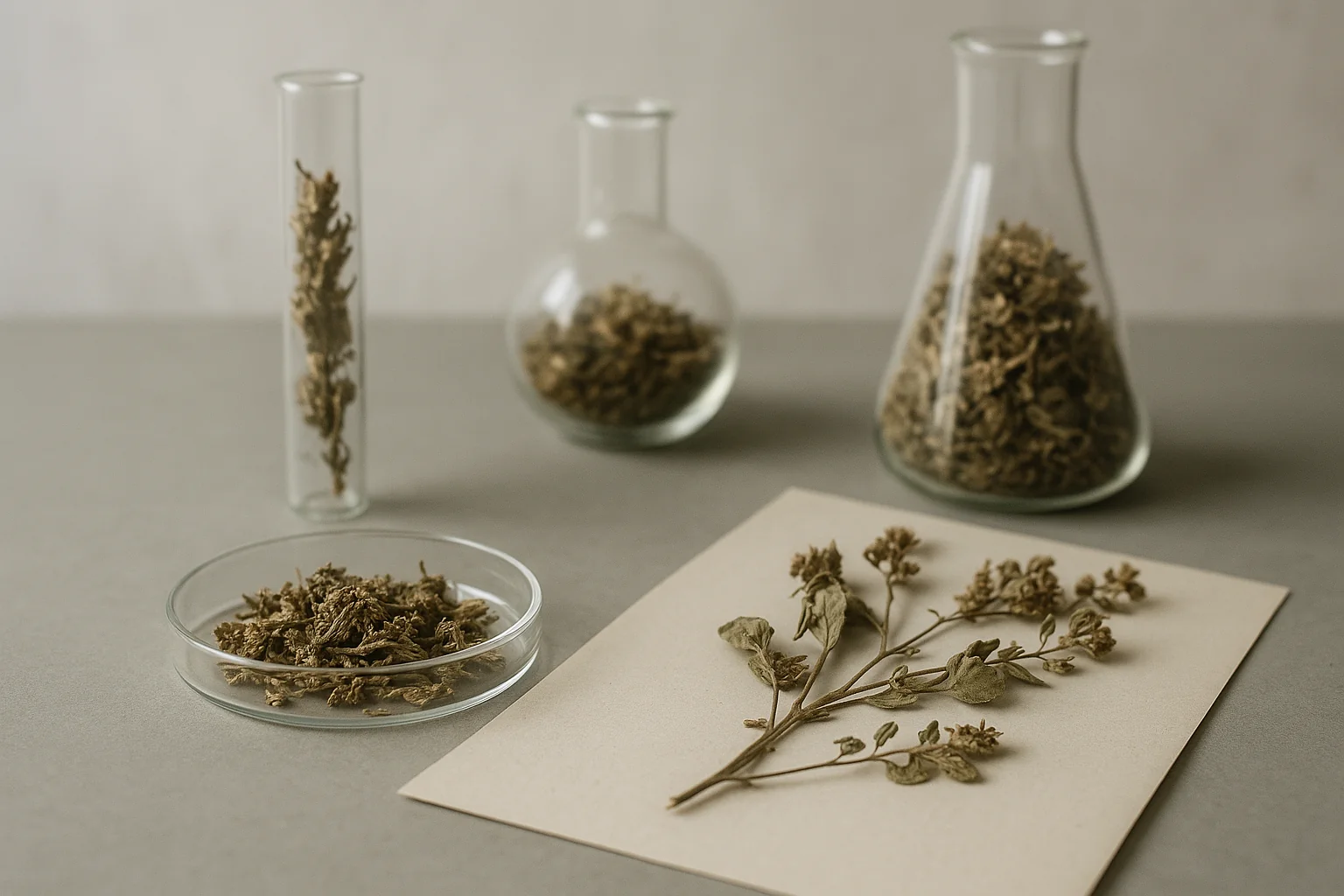

Synoptis Pharma: name on the packaging, cultivation elsewhere
Thirteen strains are available in pharmacies under the label of a company that does not cultivate anything itself. We check what the documents reveal about the origin of this dried flower and what the industry press has added.
Who is Synoptis Pharma and where does its dried flower come from?
Synoptis Pharma is a Warsaw-based limited liability company, registered in the National Court Register at the end of December 2004, with NEUCA as its sole partner. It does not conduct any cultivation itself. The dried flower sold under its name is produced by someone else, and the company is responsible for its distribution and labeling.
The NEUCA Group describes this entity on its own website as a tool for managing private labels and dates the investment to 2008. An excerpt from the business register confirms the full dependency: NEUCA S.A. is listed there as the sole partner. The Synoptis website lists prescription medications, over-the-counter products, dietary supplements, medical devices, and dermocosmetics. There is not a word about dried hemp flower, even though several products are available in pharmacies under this name.
Where does the raw material come from, says a statement from a third company. Swedish ODI Pharma AB announced on August 7, 2023, that through its Polish subsidiary, it has entered into an exclusive supply agreement for dried hemp flower with Synoptis Pharma: for five years with an option to extend for three and a half years, covering twenty-three markets in Eastern and Southeastern Europe. According to this statement, Synoptis sources its dried flower exclusively from ODI and sells it under its own pharmaceutical brands.
The industry press adds a second name and writes that the dried flower under the Synoptis label is grown in Portuguese Tilray Brands farms. No statement from Synoptis, NEUCA, or Tilray confirms this, and the texts that repeat it do not indicate a source. Separately, it is known that ODI Pharma signed a supply agreement with Aphria in November 2020, which was later acquired by Tilray Brands. The Portuguese lead is therefore likely, but undocumented.
Which strains from Synoptis Pharma are available in Polish pharmacies?
Thirteen cultivars, listed in our inventory as fifteen pharmacy items. Two of them, Lilac Diesel and Pink Kush, have two separate registration entries each. The table below lists all thirteen along with the dominant terpene for the Synoptis entry and a list of other producers of the same strain.
| Strain | Dominant terpene for the Synoptis entry | The same strain from other producers |
|---|---|---|
| Beach Crasher | caryophyllene | S-LAB, Tilray |
| Cataract Kush | myrcene | S-LAB, Tilray |
| Facade | limonene | from no one |
| Frosted Cherry Cookies | pinene | S-LAB, Tilray |
| Galaxy Walker OG | nerolidol | S-LAB, Tilray |
| Island Sweet Skunk | pinene | S-LAB, Tilray |
| Lilac Diesel | terpinolen | S-LAB, Tilray |
| Master Kush | myrcene | S-LAB, Tilray |
| Pink Kush | nerolidol | Aurora, Polfarmex, S-LAB, Tilray |
| Powdered Donuts | caryophyllene | S-LAB |
| Purps | caryophyllene | S-LAB, Tilray |
| Triangle Mints | caryophyllene | S-LAB |
| Wappa | caryophyllene | S-LAB |
This list describes a moment, not a permanent state. The permission to market the raw material expires after five years, deliveries can be delayed by a quarter, and a position removed from the list can be restored under a different declared content of active substances. We maintain a compilation of all strains currently available in pharmacies, along with their manufacturers, in the strain cluster hub, which is the only one in the service that refreshes variable numbers.
It is important to separate two things that blend into one in common descriptions. A cultivar is the name of the genetics, while a pharmacy position is a specific entry in the list of pharmaceutical raw materials, described by the responsible entity and declared content. One does not correspond to the other one-to-one: two strains from the table above may have two positions at once, and one, Facade, has no equivalent with any other entity. Those searching by strain name will find several packages that do not necessarily come from the same batch or even the same harvest year.
What distinguishes the raw material from Synoptis Pharma from that of other manufacturers?
Almost nothing in terms of genetics. Twelve out of thirteen strains sold under this label are available in pharmacies simultaneously under the S-LAB label, and nine also under the Tilray label. Only one, Facade, is exclusive to Synoptis. Therefore, the difference lies not in the plant, but in who is responsible for the registration position.
What can be said about this raw material from the documents is common to the entire category. The dried flower is marketed as a pharmaceutical raw material for the preparation of prescription medications, dispensed by a doctor's prescription. The registered name consists of the designation of the raw material, the designation of the responsible entity, and the declared content of active substances, and in newer entries, the strain name is added at the end. The numerical component in this name is a declared value with an allowable deviation of ten percent, not the result of measuring a specific package, which is why we do not write it here plainly.
The rest of the descriptions circulating around this label come from sales materials. Phrases about rigorous laboratory conditions or ideal growing conditions are repeated by store blogs, not registration documentation. This does not mean they are untrue. It means that they cannot be verified: the company does not publish either a description of the process or the results of batch tests, nor the name of the facility where the dried flower was dried and packaged.
What is known and what is not known about the raw material from Synoptis Pharma?
It is known who is responsible for the trade and where the delivery formally comes from. It is not known where the dried flower grows or who collects it, as none of the interested companies have announced this. The company also does not publish analysis certificates for individual batches, and its own website does not mention hemp at all.
Documents reveal four things. The responsible entity is Synoptis Pharma sp. z o.o. based in Warsaw. The only partner of this company is NEUCA S.A. The exclusive supplier of hemp flower remains, according to the stock market announcement from August 2023, ODI Pharma AB. The active substance listed with these entries is Cannabis sativa flos, and the packages visible in the pharmacy list contain fifteen grams.
Two claims come from outside the documents. The first states that the raw material grows in Portugal at Tilray Brands, and comes from industry portals and store blogs without referencing a source. The second is patient reports on the effects of individual strains under this label, collected on forums and in comments. Neither has the status of data that could be verified with the manufacturer.
There is a separate issue with the declarations themselves. Twelve strains can be compared because Facade has no equivalent with any other entity. In ten of these twelve, the leading terpene indicated in the Synoptis position matches the declarations of the other manufacturers. For Master Kush, the Synoptis position indicates myrcene, while the S-LAB and Tilray positions indicate caryophyllene. For Frosted Cherry Cookies, it is pinene compared to myrcene in the other two. If the plant material indeed has one source, such a discrepancy means that the declaration describes a batch, not a strain.
What adverse effects have been reported after using the raw material from Synoptis Pharma?
None specifically for this label. Public compilations do not break down reports by responsible entities, and the Registration Office collects them for a specific product with a batch number. Therefore, for the dried flower under this name, there is neither a number of reports nor a list of symptoms that could be distinguished from other entries.
Reports of adverse effects are collected for medicinal products with a batch number, not for the strain name, so the following pertains to hemp dried flower as a group of raw materials. The most frequently reported symptoms are dry mouth, red eyes, and increased heart rate. Dizziness upon rapid standing, daytime drowsiness, and temporary worsening of short-term memory are less frequently described, as well as anxiety that increases with dosage. A separate issue is medications taken concurrently, especially sedatives and those affecting coagulation: their assessment requires knowledge of the entire list of preparations, not just the description of the plant. We do not provide the frequency of these symptoms numerically, as public compilations for hemp dried flower in Poland do not separate them by individual products.
Reports are accepted by the Office for Registration of Medicinal Products, Medical Devices and Biocidal Products, as well as the responsible entity indicated on the packaging. Reports can be made by a patient, caregiver, or a medical professional, and there is no need to be certain about the connection between the symptom and the medication.
Why does the same strain appear under three different labels?
Because the label indicates who is responsible for the registration position, not who sowed the field. The same plant material can end up with several entities introducing it to the market, each reporting it separately and each giving it its own trade name. The patient then sees several products, even though the cultivation may have been one.
The scale of this phenomenon in our inventory is larger than it appears from a single package. Pink Kush is available in pharmacies under five labels at once, including Synoptis. Eight other strains from the table above have three each. The common denominator is simple: both Synoptis Pharma and S-LAB operate in the Polish market as importers and responsible entities, not as growers, so their strain lists must overlap wherever they source from the same supplier.
For the patient, this results in one practical consequence, and it is not interchangeability. Two entries with the same strain name may differ in declared active substance content, the leading terpene indicated, and the year of harvest, as each entry has its own declaration and its own batch. Therefore, changing the label with the same strain name is not neutral, and the decision about it is made by the attending physician, not the buyer at the counter.
How does the availability of strains under this label change?
Unevenly and without warning. New entries from Synoptis appeared in pharmacies in batches, not all at once. Industry portals recorded them individually throughout 2025 and the first months of 2026, announcing each entry separately, strain by strain, at intervals measured in weeks or months.
The pace of adding new strains has a formal cause, which the company itself mentions. In March 2025, while presenting a plan for several dozen product projects, among which it listed hemp products, it indicated the process of obtaining import permits as a challenge. The raw material under this label does not originate in Poland, so each new entry first waits for approval from the office, then for delivery, and finally for distribution to pharmacies. A ready agreement with the supplier does not therefore translate into the presence of packaging on the shelf within a predictable timeframe.
Hence the principle we maintain throughout the cluster: no entry about a strain or a producer is an inventory list. Availability is checked in the pharmacy or in the list, not in an article from six months ago. You can view the packaging with dried flower in the dried flower category, while the pharmaceutical raw material described on this page is not available for sale in the store and cannot be.
Frequently Asked Questions about Synoptis Pharma
Does Synoptis Pharma cultivate the dried flower it sells?
No. The company acts as the responsible entity introducing the raw material to the market, not as a grower. According to the ODI Pharma AB statement from August 2023, it obtains hemp flower exclusively from this supplier.
Who owns Synoptis Pharma?
NEUCA S.A. An excerpt from the National Court Register indicates it as the sole partner of Synoptis Pharma sp. z o.o. based in Warsaw, registered on December 29, 2004.
Has it been confirmed that the raw material from Synoptis Pharma comes from Tilray?
No. The claim about Tilray Brands' Portuguese cultivation is repeated by industry portals and store blogs, but it is not confirmed by any statement from Synoptis, NEUCA, or Tilray. However, a documented exclusive supply agreement between Synoptis and ODI Pharma AB is in place.
How many strains of Synoptis Pharma are in Polish pharmacies?
In our inventory, there are thirteen cultivars listed across fifteen pharmacy entries. Lilac Diesel and Pink Kush each have two separate entries, while the other strains have one each.
Is the strain under the Synoptis label the same plant as that from S-LAB?
The strain name is the same, but the registration entries are separate. Each has its own declaration of active substance content and its own batches, so switching one for the other is a decision made by the attending physician, not a formality.
Can Synoptis Pharma's dried flower be purchased without a prescription?
No. Hemp flower is a pharmaceutical raw material dispensed by a doctor's prescription in the Rpw category. No entry described on this page is available without a prescription.
Editorial text: redakcja ubucha.pl. The material is for informational purposes and does not replace medical advice.