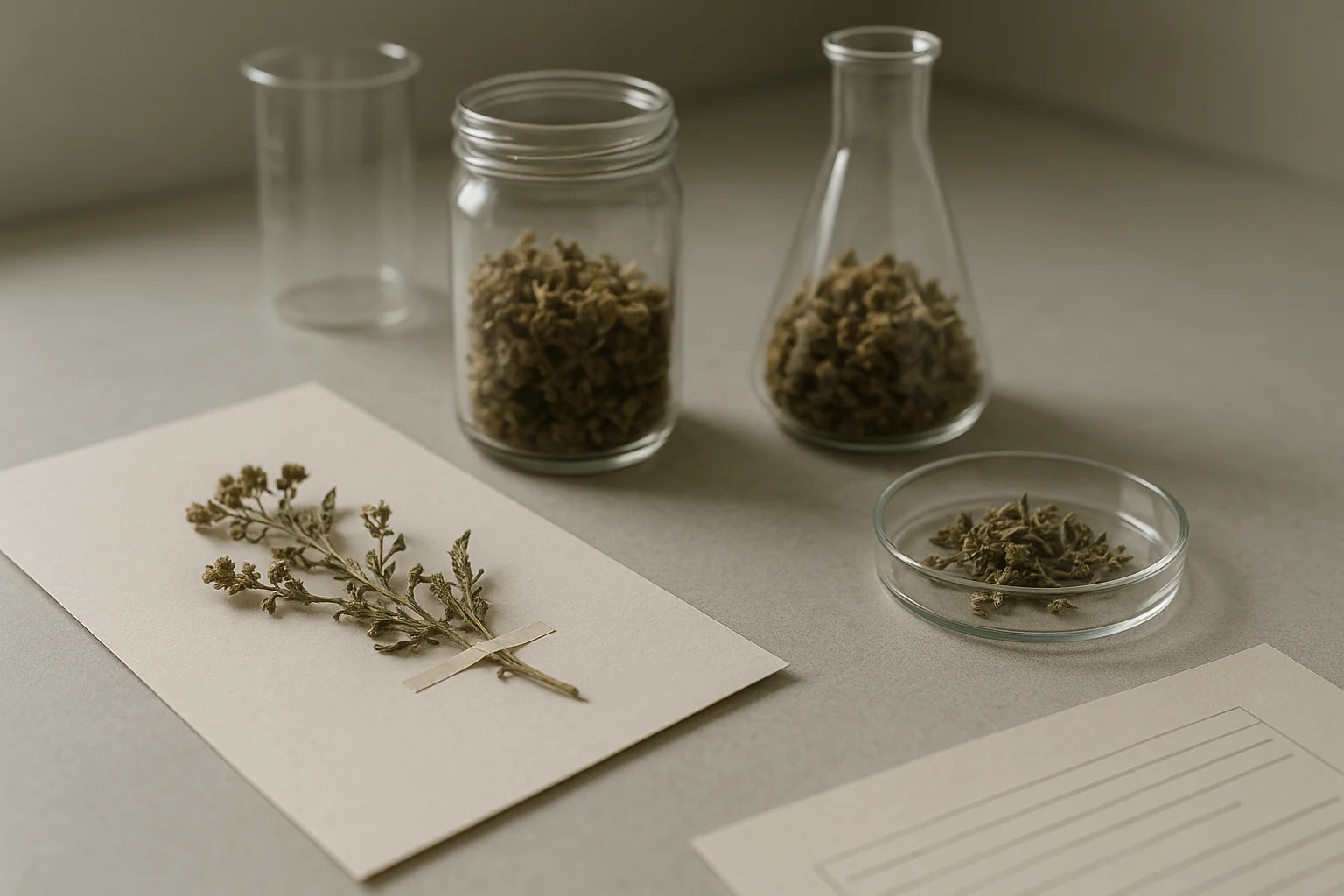

Mac Monkey, also known as Blue Monkey (Cannabis flos COSMA): lineage from Gorilla Glue #4
The lineage, terpene profile, and evidence status for the strain sold under two names. One manufacturer, one source of the profile, with THC content given as a range instead of a single number.
What is Mac Monkey, sold also as Blue Monkey, and where does it come from?
It is a hybrid from Exotic Seed, created by crossing Gorilla Glue #4 with Black Blueberry, available in Polish pharmacies as dried flower from Cosma. The same registration entry appears in two databases under two trade names, Mac Monkey and Blue Monkey, and these are not two different raw materials.
The lineage is established here, not recreated from the name's sound. The parent arrangement is provided by the genealogical database maintained by the seed breeder, and the same record is repeated in the Polish discussion of the strain from February 2025. Among the twenty-five strains in this listing, the origin remains uncertain because the breeder has never disclosed it or the available entries contradict each other, so a position with confirmed both parents is rather an exception than the norm.
The genetic classification is not consistent in the sources: one database describes this position as a hybrid, the other as a hybrid with an indica dominance. The difference concerns the descriptive label, not the manufacturer's declaration, and does not translate into anything that the patient will see on the packaging. The registered name Cannabis flos COSMA appears on it, while the breeding name is used solely for identification in lists maintained outside the pharmacy.
We keep the current supply status separately, in the list of strains available in Polish pharmacies, because the list of items changes faster than the description of the plant itself.
Which manufacturer supplies this strain to Polish pharmacies?
One. Mac Monkey reaches Polish pharmacies exclusively as dried flower from Cosma, and in our listing, it corresponds to one assortment item. The strain supplied concurrently by several manufacturers can be compared between batches; here such a comparison cannot be made because the material comes from a single supply chain.
| What the source states | Pharmacy version of Mac Monkey |
|---|---|
| Producer | Cosma |
| Registered name | Cannabis flos COSMA |
| Genetics | hybrid or hybrid with indica dominance, depending on the database |
| Declared THC content | 18.9-23.1% considering the deviation from the declared value |
| Terpenes indicated in the profile | bisabolol, humulene, caryophyllene, limonene, linalool, myrcene, pinene, terpinolene |
| Number of items in our listing | one |
One source of supply means that a break at this manufacturer is a break in the availability of the entire name. For strains ordered from several suppliers, a version with a similar declaration sometimes occurs, entered on the prescription as a backup variant; for this position, there is no such backup because there simply is no second manufacturer.
The list of items is not fixed and cannot be. Import permits expire, wholesalers change orders, and pharmacies purchase batches at uneven rates, causing each calculation to become outdated within weeks. For this reason, we keep the current list exclusively in the cluster hub, and here we describe the item itself. We have gathered the other strains from the same manufacturer in a separate text about Cosmo.. Outside the pharmacy, the service maintains the dried flower category, in which there are no raw materials dispensed by a doctor's prescription.
What does Mac Monkey smell and taste like?
Descriptions converge on a citrus note with a peppery background, further mentioning pine resin and earthiness. They come from a single source describing this strain, so we treat them as a catalog characteristic rather than a result of sensory testing conducted on a specific batch of dried flower by an independent laboratory.
The terpene profile recorded for this item includes bisabolol, humulene, caryophyllene, limonene, linalool, myrcene, pinene, and terpinolene. Limonene is considered the leading compound, the same compound responsible for the scent of citrus peel; what has been shown for it and what has not, rozpisujemy osobno. Caryophyllene from the same list is often associated with peppery sharpness, while pinene is linked to a resinous background.
We do not provide percentage shares for these names, and this is not editorial caution. Databases publishing such numbers for the same strains sum them to values that do not add up to one hundred: the measured totals from three compilations were forty-six, seventy-three, and eighty-three percent. The denominator is therefore different or unknown in each source, and a number without a denominator in a text about anxiety looks like a measurement, which it is not.
The scent also changes over time and depends on storage: some volatile compounds evaporate from an open package faster than others, so the same dried flower smells different after a few weeks than on the day of release. The description of the aroma is the least durable information on this page.
How long does it take to take effect and how long does it last?
It depends on the method of administration, not the name on the prescription. The manufacturer does not publish the duration of effect for this strain, so below is a typical course for hemp flower, distinguishing between vapor inhalation and ingestion. The numbers refer to the method of administration, not the Mac Monkey strain.
The route of administration determines the course more than the variety itself. After vaporization, the substance passes from the lungs to the blood almost immediately, so the first sensations appear after a few minutes, the intensity increases for another ten to thirty minutes, and the whole effect lasts for two to four hours. After ingestion, the raw material first passes through the intestine and liver, so the first sensations are awaited from half an hour to two hours, and the episode can last six, sometimes eight hours. Hence the most common mistake with oral administration: anyone who thinks nothing is happening after thirty minutes and takes another dose will receive both doses at once. The above ranges describe the route of administration, not this variety; pharmacokinetic studies for a single cultivar have not been published.
When comparing reports from different places, this has practical significance: the description of the same strain after vaporization and after eating refers to two different courses over time, so comparing them without specifying the method of administration says little about the raw material itself.
What is known, and what is not known about the effects of this strain?
There are no studies on the strain itself. What can be said pertains to limonene, the terpene indicated in its profile as leading, and comes from studies on rodents. The rest of the descriptions circulating around this name are catalog material or patient reports that no one has collected in a controlled manner.
The first of these studies was published in Phytomedicine in 2002 (to Vale TG, Furtado EC, Santos JG, Viana GS; PMID:12587690). Limonene administered intraperitoneally in mice showed muscle relaxant effects (rota-rod test) from a dose of 50 mg/kg and prolonged sleep time induced by pentobarbital at a dose of 200 mg/kg (about 2.6 times); in the elevated plus maze test, already at a dose of 5 mg/kg, it reduced the number of entries into the open arms, which the authors described as an anxiogenic effect, not anxiolytic.
The second is fresh: Fakhri S and colleagues, Behavioural Pharmacology, 2025 (PMID:40622197). Limonene reduced paw swelling induced by carrageenan in rats and pain responses in the formalin test in mice; the effect was associated with the l-arginine/nitric oxide/cGMP/KATP channel pathway and the involvement of opioid and benzodiazepine receptors.
Both studies discuss the isolated compound administered to animals, most often intraperitoneally, and not the dried flower inhaled by humans. Transferring their conclusions to patient experiences would be an overreach, so we draw the line clearly.
No anxiolytic effect of limonene has been demonstrated in humans. It has also not been shown that isolated limonene acts anxiolytically in animals; the only available data from the elevated plus maze test showed an opposite effect in mice, reducing the number of entries into the open arms even at a low dose.
What side effects have been reported for this strain?
None attributed to this name. The reporting system links an event with a medicinal product and a batch number, not with the cultivar, so there is no separate compilation for Mac Monkey, and under this counting method, one will not arise. Below is what is known about hemp flower as a group of raw materials.
Reports of adverse effects are collected for medicinal products with a batch number, not for the strain name, so the following pertains to hemp dried flower as a group of raw materials. The most frequently reported symptoms are dry mouth, red eyes, and increased heart rate. Dizziness upon rapid standing, daytime drowsiness, and temporary worsening of short-term memory are less frequently described, as well as anxiety that increases with dosage. A separate issue is medications taken concurrently, especially sedatives and those affecting coagulation: their assessment requires knowledge of the entire list of preparations, not just the description of the plant. We do not provide the frequency of these symptoms numerically, as public compilations for hemp dried flower in Poland do not separate them by individual products.
For the reader of descriptions of this strain online, the conclusion is clear: the statement about the good tolerance of Mac Monkey is not based on any event registry, but on the fact that no one counts events under this name. The absence of reports and the absence of effects are two different things.
At what temperature does dried flower with this profile vaporize?
There is no target point for this strain, as the boiling points of the terpenes in its profile vary by over one hundred degrees. Limonene boils at about 178 °C, pinene significantly lower, caryophyllene much higher, so a single vaporizer setting will never capture the entire recorded composition.
| Terpene from the profile | Boiling under atmospheric pressure | Note for measurement |
|---|---|---|
| pinene | about 156 °C | the lowest threshold in this set |
| myrcene | about 167 °C | source records agree on the degree |
| limonene | about 178 °C | position indicated as leading |
| terpinolen | about 184 °C | source records differ by three degrees |
| linalool | about 196 °C | source records from 194 to 198 degrees |
| caryophyllene | about 258 °C | above temperatures used in vaporization |
| humulene | no atmospheric measurement | the available record refers to pressure reduced to three millimeters of mercury |
| bisabolol | no entry in the database | querying this position does not return boiling data |
The vaporizer setting is not the temperature of the dried flower. The heater shows its own reading, the material in the chamber can be cooler, and the difference increases with short, strong inhales. We describe how far apart these two numbers can be in a separate text about ustawieniu i temperaturze surowca.
The boiling point itself is also not the threshold for evaporation. The compound transitions to vapor even below this point, just more slowly, so the threshold tables do not indicate what will actually be present in the vapors. We explain separately why the available online temperature tables provide different numbers for the same item, and what evaporation actually means. terpenu z suszu.
For this strain, the conclusion is narrow. The recorded profile stretches from pinene to caryophyllene, two of its components have no comparable measurement, and the lowest threshold in the table only indicates that part of the aroma escapes first.
Which strains from Polish pharmacies are related to it?
One: Zookies. The common parent is Gorilla Glue #4, and the other parent of this strain, Black Blueberry, has no other offspring in Polish pharmacies. Zookies is supplied by Medalchemy, so the relationship concerns only the genetics and says nothing about the series' convergence or the cultivation method.
The second parent of Zookies is Animal Cookies, so both strains share only half of the genealogical record. We detail the profile of this item in a separate text about the strain. Zookies.
A short list of siblings is not a gap in the data. The parent can be the entire family style, not a single, recognized plant, and then the common record does not relate anyone to anyone. It also happens that two databases name the same parental line differently, causing the number of relatives to change along with the agreement on names, not with genetics.
The common part of the trade name does not determine anything in either direction. Therefore, we take siblings exclusively from the parents' record, not from name similarities or from the fact that two positions come from the same producer.
Frequently asked questions about the Mac Monkey strain
Are Mac Monkey and Blue Monkey the same strain?
Yes. These are two trade names for the same registered position supplied by Cosma: one database lists it under the first name, the other under the second, and the genetic record and producer are the same in both.
What THC content does the source provide for this strain?
Taking into account a ten percent deviation from the declared value, the range is 18.9-23.1%. A single number from the commercial description would suggest a precision that the series measurement does not have, which is why we provide a range.
Does the terpene profile of this strain confirm more than one source?
No. The composition describes one source, and the other of the services we compared does not provide any terpene list for this item. Therefore, we treat the profile as an indication rather than a result of independently repeated analysis.
Does limonene have anxiolytic effects?
This has not been demonstrated. In the only available behavioral test, isolated limonene produced an effect opposite to calming in mice, and such effects have not been studied in humans in a way that allows for a conclusion.
Can this strain be purchased without a prescription?
No. The dried flower used in treatment is a pharmaceutical raw material dispensed by a doctor's prescription in category Rpw, while hemp products from retail sales belong to a completely different category of goods.
Which strains from Polish pharmacies are related to Mac Monkey?
One, Zookies, through a common parent Gorilla Glue #4. The second parent, Black Blueberry, has no other offspring among the strains in this comparison, so the list of siblings ends with one entry.
Dried flower is a pharmaceutical raw material dispensed by a doctor's prescription in category Rpw. The material is for informational purposes only and does not replace medical consultation.
The editorial text was prepared by redakcja ubucha.pl.