
Orange Cream Pop (Cannabis flos COSMA): a profile that sources do not agree on
The pedigree, terpene profile composition, and state of evidence for the Orange Cream Pop strain, supplied to Polish pharmacies by one manufacturer. Without prices and without recommendations.
What is Orange Cream Pop and where does this strain come from?
It is a hybrid from the cross of hella jelly and orange creamsicle bx3, developed by the American breeder Humboldt Seed Company, and it reaches Polish pharmacies under the registered name Cannabis flos COSMA. Therefore, the patient sees a different name on the prescription than in strain databases, as the breeder name and the medicinal product name are two different things.
The lineage is based on two independent descriptions: the product card in the Polish strain database and the breeder's website, which provides the same cross for seeds sold under this name. Such consistency is an exception here. In the entire compilation from which this description comes, the origin remains undetermined for twenty-five entries out of eighty-five, and it is simply impossible to reconstruct it from the commercial name alone.
The registered name carries a number, but we provide it without that component. The number included in the product name is a declaration from the manufacturer, not a measurement result of a specific batch, and the permissible deviation from it reaches one-tenth of the value in both directions. Therefore, an honest record of THC content is a range of 18.0-22.0%, not a round number from the label. One database provides the range, while the other stops at the nominal value and does not disclose the tolerance. What this number means for the patient is discussed separately in the text about the potency of dried flower and the influence of the strain.
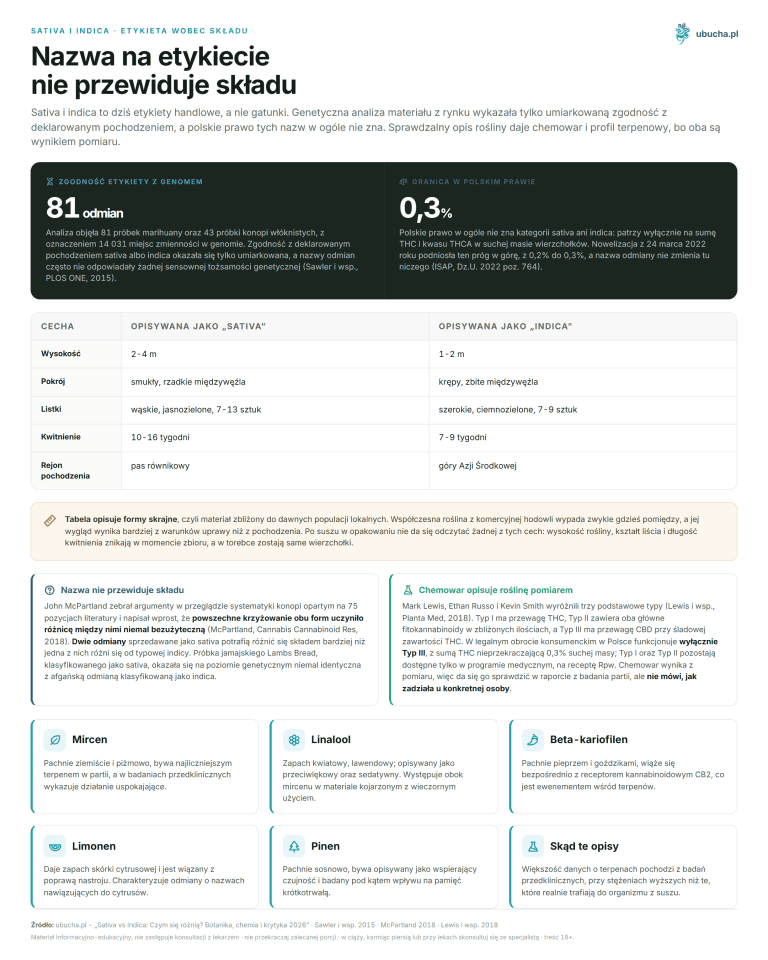
Both databases describe the genetics differently: one lists it as a regular hybrid, while the other as a hybrid with a sativa dominance. This discrepancy is not an error on either side. The division into indica and sativa refers to the plant's growth habit in cultivation, not to the composition of the raw material that reaches the pharmacy. For selecting the pharmacy version, the profile description is more important, and that is where both databases cease to agree.
Which producers supply this strain to Polish pharmacies?
One. Orange Cream Pop is listed in our registry as a single pharmacy item from Cosma and there is no competitive version for it. For strains supplied by several manufacturers, it is possible to compare differences in declared content and profile description, but here there is no such material, so comparison of versions is out of the question.
| Producer | Registered name | THC content | Databases describing the profile |
|---|---|---|---|
| Cosma | Cannabis flos COSMA | 18,0-22,0% | budcare.pl and medweed.pl |
Cosma supplies five cultivars to Polish pharmacies, and the strain described here is one of them. The others are Balasa (Gorilla Girl), Mac Monkey (Blue Monkey), Hindu Kush and Black R. We compile the entire assortment of this manufacturer in osobnym opisie.
The supply composition changes in rhythm with permits and individual batches, so each list of pharmacy versions becomes outdated faster than its description is created. An item can disappear from the wholesaler for several weeks and return without any announcement, and sometimes it does not return at all. Therefore, we maintain the current assortment exclusively in one document, in the overview of strains available in Polish pharmacies, and we update it there, instead of duplicating it for each item separately.
Two things merge into one with this name, and it's better to separate them. The pharmaceutical raw material dispensed by a doctor's prescription belongs to the Rpw category, while dried flower sold over the counter is subject to different regulations and has a different composition. The strain name can be identical in both worlds, and that may be the only thing that connects them.
What does Orange Cream Pop smell and taste like?
Citrusy, with a distinct note of orange peel and a sweet, vanilla cream background, under which sits an earthy, slightly skunky base. Commercial descriptions summarize it as orange ice cream on a stick, and this shorthand captures the impression accurately, although it refers to the smell of the dried flower, not the taste of vapor from the vaporizer.
This characteristic comes from sales descriptions and user reports, not from measurement. The nose is a fickle tool: the same box may be described by some as sweet, by others as sour, and after a few weeks in a sealed package, the impression shifts anyway, as volatile components evaporate faster than the rest of the material.
The profile composition is provided as a composition, without shares. Two databases describing this product differ from each other: the first lists humulene, caryophyllene, limonene and myrcene, the second exclusively myrcene and caryophyllene, in weight order. Therefore, humulene and limonene appear in the description of only one of the two sources.
Why do we not state percentages with these names? It can be calculated for this very position. The shares entered for it in one of the databases sum up to eighty-seven percent, and no one says what the missing remainder is or what the denominator is counted for. The same database provides 46 different sums for 145 positions, and the highest of them exceeds one hundred, which is impossible with a whole share. A number without a denominator looks like a measurement, but it is not; how to read such records is explained in the guide to strain profiles..
How long does it take for this strain to take effect and how long does the effect last?
This is determined by the method of administration, not the cultivar name on the package. No one has published a measurement made separately for Orange Cream Pop, so the only numbers that can be provided here honestly relate to absorption through the lungs or the gastrointestinal tract. The paragraph below remains in the same form throughout the entire compilation.
The route of administration determines the course more than the variety itself. After vaporization, the substance passes from the lungs to the blood almost immediately, so the first sensations appear after a few minutes, the intensity increases for another ten to thirty minutes, and the whole effect lasts for two to four hours. After ingestion, the raw material first passes through the intestine and liver, so the first sensations are awaited from half an hour to two hours, and the episode can last six, sometimes eight hours. Hence the most common mistake with oral administration: anyone who thinks nothing is happening after thirty minutes and takes another dose will receive both doses at once. The above ranges describe the route of administration, not this variety; pharmacokinetic studies for a single cultivar have not been published.
For Orange Cream Pop, this changes nothing in either direction. Neither the declared content nor the profile composition shifts these ranges in a way that could be indicated by a number. A higher THC content affects how much raw material corresponds to the intended dose, not how many minutes it takes for the dose to take effect.
What is known, and what is not known about the effects of this strain?
Nothing specific is known about this strain that comes from research. There are studies on a single compound that databases indicate as leading in this profile, but they were conducted on rodents and at doses detached from what a patient inhales from the dried flower.
Three studies on myrcene show how strongly the result depends on the conditions of the experiment. Vale TG, Furtado EC, Santos JG, Viana GS described in 2002 in the journal Phytomedicine (PMID:12587690) that after intraperitoneal administration, the compound reduced the motor activity of mice and prolonged sleep induced by pentobarbital, and in the elevated maze, it produced a slightly anxiogenic effect. Rao VS, Menezes AM, Viana GS reported in 1990 in the Journal of Pharmacy and Pharmacology (PMID:1983154) that the same compound weakened pain responses in mice, with the effect being reversed by naloxone. Wagner JK, Gambell E, Gibbons T, Martin TJ, Kaplan JS described in 2024 in NeuroSci (PMID:39728677) the opposite result regarding anxiety: after short puffs of vapor, the compound acted anxiolytically in females.
In humans, myrcene alone has not been shown to alleviate insomnia at doses typical for inhalation of dried flower. The direction of the effect in rodents depends on the route of administration and sex: intraperitoneal injection in 2002 described a slightly anxiogenic effect, while inhalation in 2024 showed an anxiolytic effect in females. These two results do not negate each other; they simply show that the conclusion depends on conditions that no popular strain database provides.
On the other side stands what cannot be called research: sales descriptions speaking of stimulating and balanced effects, as well as reports from patients themselves. Both can be consistent with the experience of a specific person, but they are not evidence, as they arise without a control group and without blinding.
What side effects have been reported for this strain?
None, if the question concerns this specific name. The report goes to the registry with the medicinal product's batch number, and the cultivar name is not a label under which anything is collected in this system. The description below thus covers dried flower in general and repeats itself in this compilation unchanged.
Reports of adverse effects are collected for medicinal products with a batch number, not for the strain name, so the following pertains to hemp dried flower as a group of raw materials. The most frequently reported symptoms are dry mouth, red eyes, and increased heart rate. Dizziness upon rapid standing, daytime drowsiness, and temporary worsening of short-term memory are less frequently described, as well as anxiety that increases with dosage. A separate issue is medications taken concurrently, especially sedatives and those affecting coagulation: their assessment requires knowledge of the entire list of preparations, not just the description of the plant. We do not provide the frequency of these symptoms numerically, as public compilations for hemp dried flower in Poland do not separate them by individual products.
For Orange Cream Pop, there is no separate compilation of reports, and it cannot be constructed from publicly available data. The upper limit of the declared content matters here in that the intensity of anxiety or increased heart rate rises with the size of the dose, not with the name printed on the package.
At what temperature should this strain be vaporized?
There is no single correct value, as what we set on the vaporizer is not the temperature of the dried flower in the chamber. A more sensible reference point is the boiling temperatures of the compounds from the profile of this strain, which vary by over ninety degrees, so no single setting extracts them all at once.
| Compound from the profile | Boiling under atmospheric pressure | Disclaimer for the record |
|---|---|---|
| myrcene | 166.8 °C | source records fall within a narrow range |
| limonene | 177.8 °C | one of the records converted from the Fahrenheit scale |
| caryophyllene | 257.5 °C | a separate measurement of 130 °C was made at a pressure of 14 mmHg |
| humulene | no record | the only measurement in the database is 99.5 °C at a pressure of 3 mmHg |
The boiling temperature indicates when a liquid begins to boil in an open vessel, not when a compound starts to vaporize. Vaporization occurs much lower and increases gradually, so myrcene leaves the dried flower long before reaching its value from the table. On the other hand, no home vaporizer will reach the number given for caryophyllene, yet caryophyllene is present in the vapor. Therefore, treating these numbers as thresholds for activating individual compounds is a misunderstanding.
Two rows of this table require additional clarification. The entry for humulene exists in our database only under reduced pressure, so it cannot be compared with the others without conversion, which has not been performed by anyone; the same applies to the second measurement for caryophyllene. We break down why popular temperature tables provide divergent values for the same compounds. separate parts., and we describe the difference between the vaporizer setting and the material temperature in a separate text.
Which strains are related to it?
None of those available in Polish pharmacies. Both parents of this strain, hella jelly and orange creamsicle bx3, appear in the pedigree graph of the entire compilation exactly once, exclusively with this strain itself, and no other cultivar has it as a parent. Therefore, there is no sibling to document.
The common part of the name is not a clue here. In the same compilation stand Orange Cake i Blood Orange Kush, both with completely different parents. The part "pop" is also carried by Gastro Pop and Wedding Pop Triangle, whose pedigrees have no common point with this strain. The name Black Jelly It reminds one of the name of one of the parents, but its origin remains uncertain, so it is impossible to even check if there is any connection between them.
An empty sibling list does not always mean the same thing here. With many strains, the parent can be a broad family of styles, such as og kush or white widow, and such a term encompasses dozens of lines and does not indicate a single strain with which someone can be related. In the entire graph, there are 98 parental names, of which 77 appear once, so a single occurrence is the rule here, not the exception of this entry.
Frequently Asked Questions
Is Orange Cream Pop a sativa strain?
Sources do not agree here: one database describes it as a regular hybrid, while the other describes it as a sativa-dominant hybrid. This division refers to the plant's growth pattern, not the composition of the raw material reaching the pharmacy, so it contributes little to the selection of the pharmaceutical version.
What is the THC content of Orange Cream Pop?
The pharmaceutical version from Cosma is described with a range of 18.0-22.0%. The range notation, rather than a single number, arises from the fact that the value on the label is a declaration from the manufacturer with an allowable deviation of one-tenth in either direction.
Which compound is predominant in this strain?
Both databases list myrcene as the leading compound, although they differ in the rest of the composition. One also mentions humulene, caryophyllene, and limonene, while the other stops at caryophyllene, so the agreement concerns only the first item on the list.
How many pharmaceutical versions of this strain are available in Poland?
One. The strain is supplied exclusively by Cosma, and in our listing, it corresponds to a single entry, so there is nothing to compare between manufacturers. The composition of deliveries can vary, which is why we describe the current assortment separately in the overview of strains available in Polish pharmacies.
Does Orange Cream Pop help with insomnia?
It is unknown. Research on myrcene has been conducted on rodents, and their results depend on the route of administration and the sex of the animals, so they do not directly translate to humans inhaling vapor from dried flower. The choice of raw material is determined by the attending physician, not the strain description.
What does the name Cannabis flos COSMA on the prescription mean?
It is the name of a medicinal product, not the breeding name of the strain. The full registration entry additionally includes the declared content, which we provide separately as a range, because the same number in the name has an allowable deviation and is not a result of measuring the batch.
Dried flower is a pharmaceutical raw material dispensed by a doctor's prescription in the Rpw category. The material is informational in nature and does not replace medical advice.
Editorial text: redakcja ubucha.pl.