
Cannabis strain profile - how to read genetics, terpenes, and effects (guide)
Profil odmiany konopi — co to, jak dziala i na co. Zrozumialy przewodnik u Bucha.
You walk into a CBD flower shop and see dozens of strain names: Gelato, OG Kush, Blue Dream, Gorilla Glue, Sour Diesel. Each has a description with THC percentages, a list of terpenes, and assurances of "relaxing" or "energizing" effects. How to distinguish marketing from actual information? How to read the strain profile to really know what to expect? This guide explains all the elements of the profile step by step - from genetics to terpenes and cannabinoid composition.
KEY INFORMATION
• The strain profile is a set of data about genetics, cannabinoid content, and terpenes - together they allow you to predict effects before you use the product.
• The THC:CBD ratio is more important than the THC percentage itself - it modifies the intensity and character of the effects.
• Terpenes have a real impact on effects through the entourage effect mechanism - myrcene sedates, limonene energizes, linalool calms.
• The indica/sativa division is scientifically questionable - genetic studies (Sawler et al., PLOS ONE, 2015) do not confirm separate clades; the terpene profile is a better predictor of effects.
What makes up a cannabis strain profile?
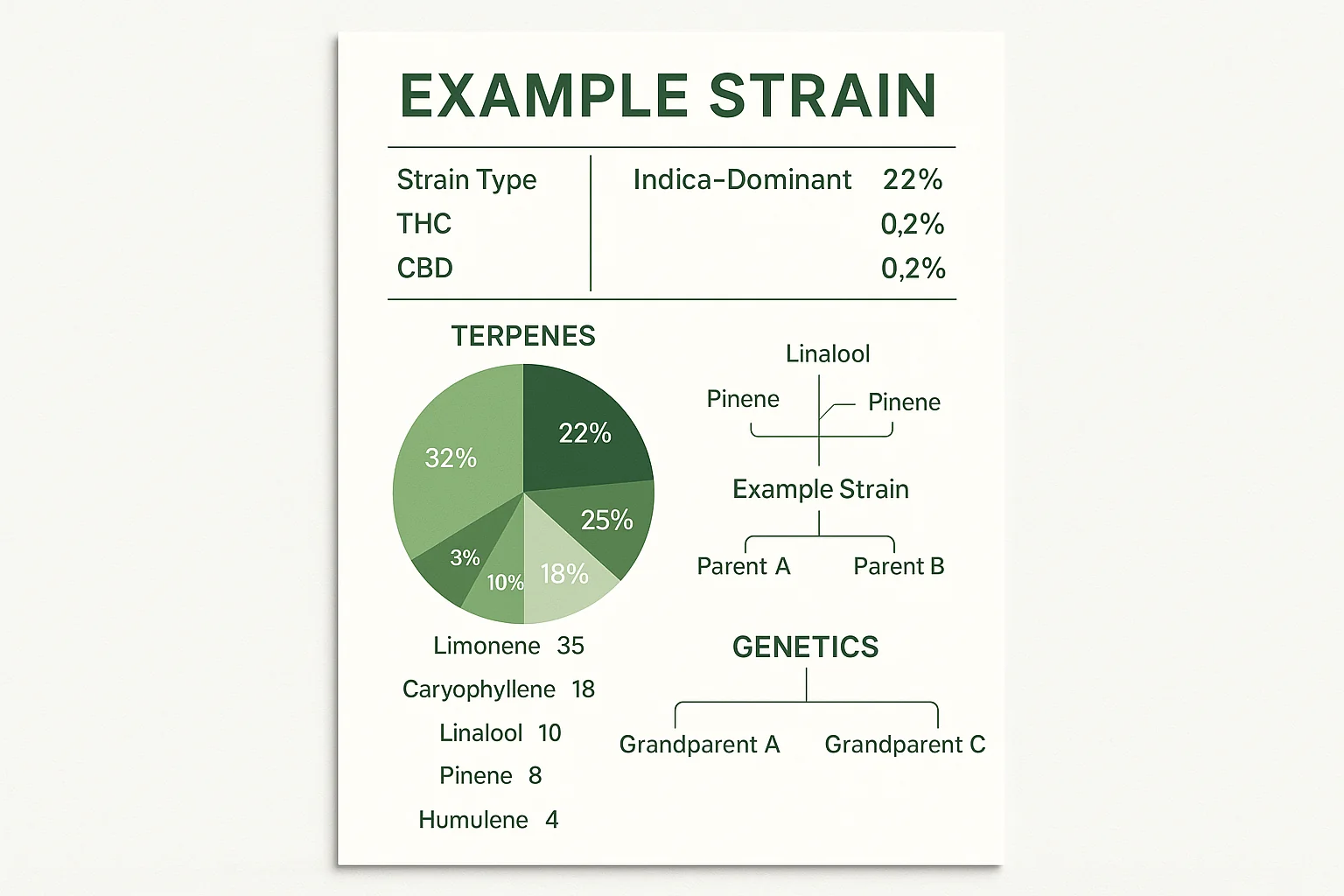
A good strain profile is more than just a name and THC percentage. It consists of five layers of information that together create a coherent chemical and effectual picture of the plant. The first layer is genetic lineage (lineage) - information about the parent strains from which a given strain originates. The second element is profil kannabinoidowy - the percentage content of THC, CBD, CBG, CBN, and other cannabinoids detected in the laboratory certificate. The third layer is terpene profile - a list of dominant terpenes with their approximate concentrations.
The fourth element is morphological characteristics - the appearance of the flower, color, density of trichomes, aroma. This is a subjective layer, but experienced users treat it as a quality indicator. The fifth layer is effects description - the declared effects by the producer or collected user feedback. This last layer is the most susceptible to marketing and should be approached with caution: producers have an interest in describing effects attractively, and subjective experiences can vary greatly.
Cannabinoids - how to read THC, CBD, and CBG in the profile
The THC content is given in weight percentage of the dry material (% w/w). When vaporizing or smoking, most THC enters the bloodstream within minutes - the effect is quick and proportional to the dose and percentage of THC in the material. An important rule: the percentage of THC is not the only variable. Studies Elikkottila et al. (Journal of Studies on Alcohol and Drugs, 2019) have shown that the perceived intensity of effects does not increase linearly with THC content - other cannabinoids and terpenes modify the perception.
CBD in the strain profile is a key piece of information modulating the effects of THC. CBD acts as a negative allosteric modulator of the CB1 receptor - it does not block THC but changes the shape of the receptor so that THC binds to it less effectively. In practice, a strain with 20% THC and 5% CBD will produce a different, milder effect than a strain with 20% THC and 0% CBD. High CBD in the profile is a signal of a "buffer" - it reduces the risk of paranoia and the intensity of psychoactivity. CBG (cannabigerol) is increasingly appearing in profiles as a third cannabinoid. CBG is non-psychoactive and is being preliminarily studied for its anti-inflammatory and neuroprotective properties.
| Cannabinoid | Action | What does a high % mean in the profile |
|---|---|---|
| THC | Psychoactive, CB1 agonist | Stronger psychoactive effect, higher risk of paranoia in the absence of CBD |
| CBD | Modulates THC, anxiolytic | A milder, calmer effect; a "buffer" for THC |
| CBG | Non-psychoactive, precursor to cannabinoids | Enriched profile, potential anti-inflammatory effects |
| CBN | Product of THC degradation, mildly sedative | Indicates an older or improperly stored product or intentional fermentation |
| THCA | Unconverted THC, non-psychoactive | Raw content - when heated, it becomes psychoactive THC |
Terpenes - the aroma that changes effects
Terpenes are volatile organic compounds produced by the resin glands of cannabis trichomes. They are responsible for the characteristic aroma of the strain and - through a mechanism called entourage effect (entourage effect) - modify and enhance the action of cannabinoids. The entourage effect theory, described by Raphael Mechoulam and Shimon Ben-Shabat (European Journal of Pharmacology, 1998), posits that the full spectrum of cannabis compounds works synergistically - better than any isolated component alone.
The most important terpenes in strain profiles and their effects: Myrcene (myrcene) - the most common terpene in cannabis, with an earthy and musky scent; it has sedative effects and enhances the permeability of the blood-brain barrier for THC, which may intensify its effects. Limonene (limonene) - citrus scent; studies indicate anxiolytic and mood-enhancing effects (Guimarães et al., Phytomedicine, 2013). Linalool (linalool) - floral, lavender scent; has calming effects and may enhance GABA activity. Beta-caryophyllene - peppery scent; the only terpene that binds directly to CB2 receptors, giving it anti-inflammatory properties without psychoactive effects. Pinene (pinen) - pine scent; has bronchodilatory properties and may counteract short-term deterioration of working memory caused by THC.
A practical takeaway for the reader: if you want an energizing and anxiolytic effect, look for strains with dominant limonene or pinene. If you are looking for a relaxing and sedative effect, myrcene as a dominant is the right choice. If you want anti-inflammatory effects without sedation, high concentrations of beta-caryophyllene are a valuable signal. The terpene profile is a much better guide than the label "indica" or "sativa."
Indica, sativa, hybrid - does this classification have scientific basis?
For decades, the cannabis industry has relied on a division into three categories: indica (sedative effects, "body high"), sativa (energizing effects, "head high"), and hybrid (a mix). This is an intuitively convenient classification and still commonly used in stores - but scientifically questionable. A study by Sawler and his team (PLOS ONE, 2015) analyzed the genomes of 81 cannabis samples and found that commercial strains sold as "indica" and "sativa" do not form separate genetic clades - their DNA is heavily mixed due to decades of breeding hybridization.
This means that the strain name or indica/sativa label will tell you less about the effects than a laboratory certificate with a terpene and cannabinoid profile. Two strains sold as "indica" may have completely different terpene profiles and produce different effects. Conversely, a "sativa" with dominant myrcene may act just as sedatively as a "typical indica." Therefore, experienced users and experts increasingly ignore indica/sativa labels in favor of analyzing the terpene profile and THC:CBD ratio.
How to read the laboratory certificate (COA) of a strain
Certificate of Analysis (COA) is a document issued by an independent analytical laboratory confirming the chemical composition of a sample of material. A good COA includes: sample collection date and analysis date, testing method (gas chromatography GC-MS or liquid HPLC), results of cannabinoid content in percentages, terpene profile results (often as a list with percentages), and results of tests for pesticides, heavy metals, and fungi. Lack of a COA or a COA older than 12 months is a warning sign - the composition of the material changes over time, especially if not stored properly.
When reading a COA, pay attention to the discrepancy between THCA and THC in the results. The material before heating mainly contains THCA (inactive form) - THC is only produced through decarboxylation. Laboratories usually report "Total THC" calculated from the formula: Total THC = THC + (THCA × 0.877). This value tells you how much THC the user will approximately obtain during vaporization or smoking. If you see "THCA 18%, THC 0.5%" - "Total THC" is about 16.3%, not 18.5%.
Frequently Asked Questions
What is a cannabis strain profile?
The strain profile is a set of information describing the characteristics of a specific Cannabis strain: genetic origin, cannabinoid content (THC, CBD, CBG), terpene composition, expected effects, and potential applications. A good profile is a chemical map of the strain, allowing you to predict its effects before using it - particularly useful when choosing CBD material.
What do the THC and CBD indicators in the strain profile mean?
THC (tetrahydrocannabinol) is the main psychoactive cannabinoid - the higher the percentage, the stronger the effect in the absence of CBD. CBD (cannabidiol) modulates the effects of THC through negative allosteric modulation of the CB1 receptor. The THC:CBD ratio is more important than the percentage itself - a strain with 15% THC and 5% CBD will produce a milder effect than a strain with 15% THC and 0% CBD.
How do terpenes affect the effects of cannabis strains?
Terpenes modify the effects of cannabinoids through the entourage effect (Mechoulam and Ben-Shabat, 1998). Myrcene has a sedative effect and enhances THC. Limonene has energizing and anxiolytic effects. Linalool calms. Beta-caryophyllene binds to CB2 and has anti-inflammatory effects. The terpene profile is a better predictor of effects than the indica/sativa label.
Is the division into indica and sativa reliable?
Scientifically - not fully. Genetic studies (Sawler et al., PLOS ONE, 2015) have shown that commercial indica and sativa strains do not form separate genetic clades - the DNA has been heavily mixed through decades of hybridization. The division is culturally useful, but the terpene profile and cannabinoid ratio are much better predictors of effects.
How to read the hemp flower label?
Look for: strain names, THC and CBD content in percentages, terpene profile (list of 3-5 dominant terpenes), harvest date and validity, laboratory certificate (COA). Lack of a lab certificate is a warning sign - you don't know the actual composition. "Total THC" on the COA = THC + (THCA × 0.877) - this is the real dose available after heating.
This article is for informational and educational purposes and does not replace consultation with a doctor. If you are pregnant, breastfeeding, taking medications, or have chronic conditions, consult the use of supplements or herbs with a specialist.
Author: Michał Waluk · Published: 2026-05-04 · Updated: 2026-05-04