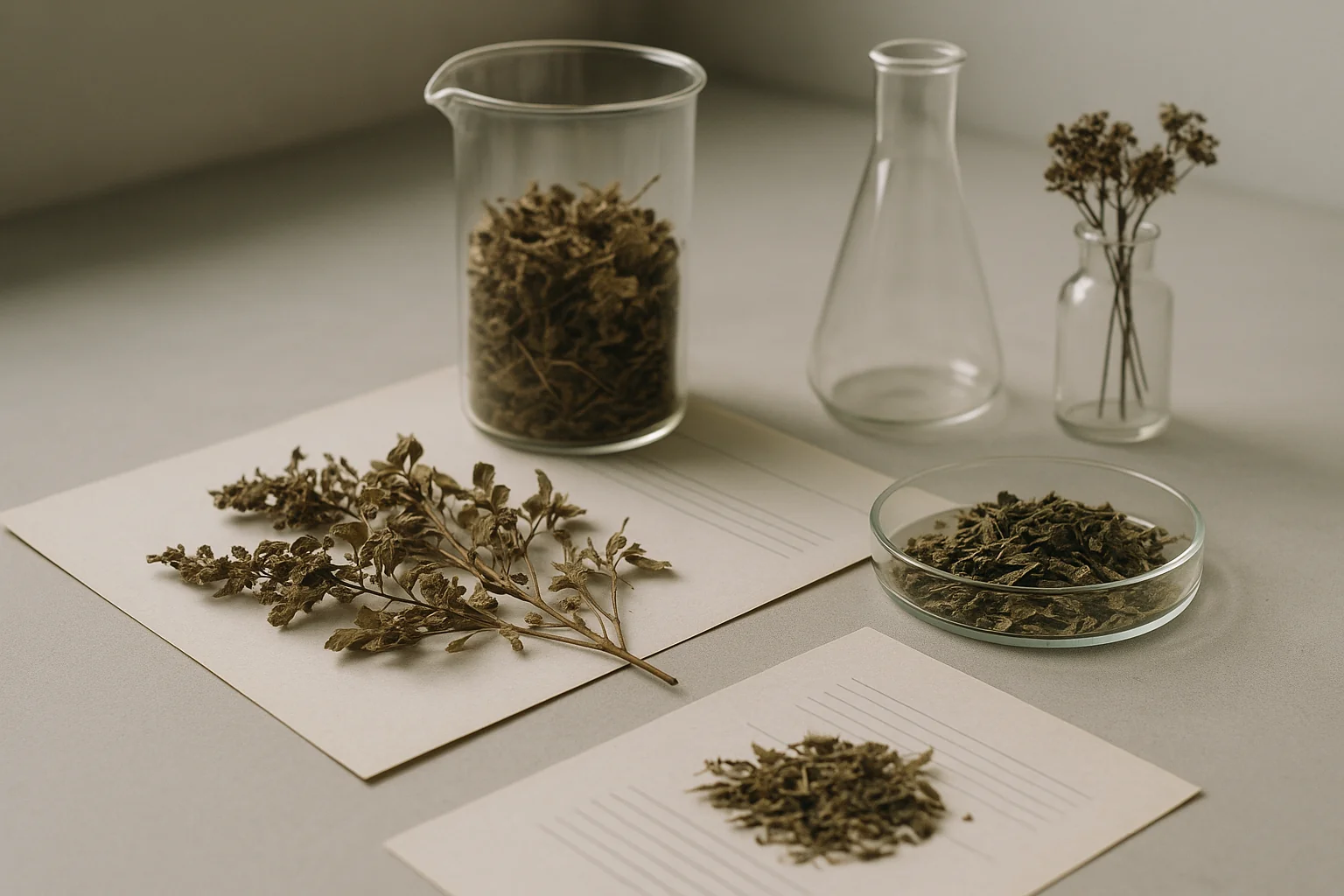

Cosma in Polish pharmacies: five strains under a registration name that does not distinguish them
Cosma S.A. is a responsible entity based in Warsaw, not a grower. The dried flower is cultivated for it by companies from Portugal and Spain, and five of its strains are listed under names that differ only in the declared number.
Who is Cosma and where does the dried flower sold under its name come from?
Cosma S.A. is a Warsaw joint-stock company listed on NewConnect, which does not cultivate hemp itself. The plants are grown for it by contract partners abroad, and the company is responsible for the registration of the raw material, its import, and its introduction to the market through pharmaceutical wholesalers. Therefore, the dried flower cultivated outside Poland reaches pharmacies under its Polish name.
The company in its current form has existed since March 31, 2023, when Cosma Cannabis Sp. z o.o. merged through a reverse takeover with an entity already listed on NewConnect. The business press refers to this acquired entity in various ways: Forbes writes about the company Vabun, while bizblog.spidersweb.pl mentions Cosma Group. The date and mechanism are repeated in both accounts, but the predecessor's name is not.
The registration of the raw material started on October 11, 2024. The President of the Office for Registration of Medicinal Products issued two positive decisions allowing the marketing of Cannabis flos COSMA preparations, each for five years. As the producer of the raw material, the company's announcement indicates Cannprisma Pharma Lda from Vila Real de Santo António in Portugal, and attributes the import and sale through wholesalers to the company.
Portugal is not a coincidence. The founders explained in press interviews that cultivation for pharmaceutical purposes is practically unfeasible in Poland due to the lack of implementing regulations, while Portugal allows it for business entities under the supervision of the local authority. Later, a second direction emerged: part of the offer is described as cultivated in Spain.
Which strains of Cosma are available in Polish pharmacies?
Five: Balasa (Gorilla Girl), Black R, Hindu Kush, Mac Monkey (Blue Monkey), and Orange Cream Pop. In a list of 141 pharmacy items, which includes this cluster, Cosma is responsible for five of them. Four strains are supplied exclusively by it, while Hindu Kush is listed with one other producer.
Each of them has a separate entry in this cluster. Balasa (Gorilla Girl) was the first to enter the market, followed by Mac Monkey (Blue Monkey), potem Black R, then Hindu Kush, a jako ostatni Orange Cream Pop. The order is significant when reading older listings, as the last three were added only in 2026.
| Strain | THC content range after tolerance (in percent) | Leading terpene | First appearance in pharmacies according to commercial descriptions |
|---|---|---|---|
| Balasa (Gorilla Girl) | 18,0-22,0 | caryophyllene | autumn 2024, return in March 2025 |
| Mac Monkey (Blue Monkey) | 18,9-23,1 | limonene | end of March 2025 |
| Black R | 19,8-24,2 | caryophyllene | the turn of March and April 2026 |
| Hindu Kush | 19,8-24,2 | myrcene | May 2026 |
| Orange Cream Pop | 18,0-22,0 | myrcene | July 2026 |
In the listing where this cluster stands, one position corresponds to one pharmaceutical product. Four strains of Cosma have one such position each, while Hindu Kush has two, as the same plant is also reported by Canopy Growth. Hemp products issued without a prescription are collected separately. dried flower category In the store, there is no shared shelf with pharmaceutical raw material.
The terpene profile of these positions is divided into three groups. Balasa and Black R are led by caryophyllene, Hindu Kush oraz Orange Cream Pop myrcene, a Mac Monkey limonene. Pharmaceutical data and profiles of industry services indicate the same leading terpene for each of the five positions, which is not a rule in this cluster.
Why does the registered name of the Cosma position not indicate the variety?
Because it carries a number instead of the plant's name. Cosma positions are traded as Cannabis flos COSMA with the declared THC content and CBD ceiling added, not with the commercial name of the variety. Two pairs of varieties share the same numerical component, so the registered name alone is not enough to identify what is in the jar.
Balasa and Orange Cream Pop have the same declared value in the list, while Black R and Hindu Kush have a second value, common to both. Only Mac Monkey has a separate number. Therefore, in this text, the name goes without the numerical component, and the content is listed separately as a range.
The number in the name is a declaration from the manufacturer, not a result of measuring a specific batch. The permissible deviation from the declared value is ten percent in either direction, so a position described as twenty-two percent corresponds to a range from 19.8 to 24.2 percent THC content. Providing only the nominal value would suggest a precision that the batch certificate does not guarantee.
The second trap lies not in the number, but in the commercial name. Hindu Kush from Cosma and Bakerstreet from Canopy Growth are the same plant sold under two names by two manufacturers in this comparison, so searching the list by one of them loses the other half of availability. Cosma has also changed its own commercial names: Gorilla Girl returned to pharmacies as Balasa, and Blue Monkey as Mac Monkey.
What distinguishes Cosma's raw material from that of other manufacturers?
The method of cultivation and who conducts it. Cosma does not have its own plantation, so the difference begins with the choice of the contract manufacturer. Commercial descriptions consistently state greenhouse cultivation with UV lighting in GACP standard, manual trimming, and packaging in an argon atmosphere, but none of these elements are exclusive to this company.
Let's separate what is a document from what is a description. The document consists of the decisions of the President of the Registration Office allowing the raw material to be traded, valid for five years, and the indication of the manufacturer in the company's current report. The description consists of statements about cultivation without pesticides and artificial fertilizers, repeated by industry services based on the manufacturer's materials, which no one has independently verified.
For some varieties, the manufacturer itself is disputed. Descriptions of Mac Monkey and Balasa indicate Portugal, the description of Hindu Kush indicates Spain, and for Black R, one industry source cites the Portuguese company Cannprisma, while another cites a Spanish cultivation. The company's own website generally speaks of certified cultivations in Portugal, so the discrepancies cannot be resolved without a batch certificate.
The GACP standard, which these descriptions refer to, pertains to cultivation and harvesting, not the production of medicine. It is not equivalent to a pharmaceutical manufacturer's certificate and does not say anything about how a specific batch performed. Read as a guarantee of dried flower quality, it promises more than it covers.
What is known, and what is not known about this company's raw material?
It is known who allowed the raw material to be traded, for how long, and who grew it for the first two positions. It is not known how the batches perform in independent testing, as there are no public analysis certificates, and the manufacturer does not publish any data on the efficacy or tolerance of its dried flower.
On the documentation side, there are three things. Registration decisions from October 11, 2024, issued for five years and included in the company's current report. The name of the manufacturer of the first two items, namely Cannprisma Pharma Lda from Vila Real de Santo António. Finally, the method of issuance: the dried flower goes from the pharmacy on prescription in the Rpw category.
On the commercial description side, everything related to effects is presented. Statements about calming, sleep support, or appetite improvement come from sales materials and patient reports collected by industry services, not from studies on this raw material. No clinical work has compared this company's dried flower with that of another manufacturer.
The terpene profile stands separately. The manufacturer provides it in milligrams per gram, meaning with an explicit denominator, while services converting the same profile into shares of the denominator do not show it. This is a rare case in this cluster, where the number comes from the manufacturer, not from a secondary calculation.
What adverse effects have been reported from the Cosmy raw material?
None specifically for this company. Safety oversight is conducted by the product's batch number, and public compilations for Poland do not go down to the manufacturer level, so there is simply no number describing only Cosmy's dried flower. The silence of the data is not the same as proof of safety.
Reports of adverse effects are collected for medicinal products with a batch number, not for the strain name, so the following pertains to hemp dried flower as a group of raw materials. The most frequently reported symptoms are dry mouth, red eyes, and increased heart rate. Dizziness upon rapid standing, daytime drowsiness, and temporary worsening of short-term memory are less frequently described, as well as anxiety that increases with dosage. A separate issue is medications taken concurrently, especially sedatives and those affecting coagulation: their assessment requires knowledge of the entire list of preparations, not just the description of the plant. We do not provide the frequency of these symptoms numerically, as public compilations for hemp dried flower in Poland do not separate them by individual products.
For Cosmy itself, we checked two paths, and both lead to nothing. The company does not publish a safety report or a compilation of reports on its website, and publicly available official materials regarding the Cannabis flos raw material do not separate events by responsible entities. Patient reports in industry services describe individual cases without a denominator, so their frequencies cannot be calculated.
Why does the range of Cosmy strains change over time?
Because the permit, the contract with the grower, and the harvest itself have their own timelines. The permit for market approval is issued for five years, delivery depends on the contract with the manufacturer, and there can be breaks between batches. Therefore, the list of this company's items in the pharmacy looks different every few months.
This is evident in the history of these five items. Gorilla Girl entered pharmacies in the fall of 2024, disappeared, and returned under the name Balasa in March 2025. Mac Monkey appeared at the end of the same month, and in January 2026, industry descriptions noted its return in new packaging with unchanged chemical specifications. A simple label change can thus appear in the search engine as a new item, even though the contents of the jar have not changed.
Black R reached pharmacies at the turn of March and April 2026, Hindu Kush in May, and Orange Cream Pop in July. Three strains in six months is a pace at which any strain compilation ages in months, not years. Therefore, read the availability status in the updated strain compilation, not in this text.
Frequently asked questions about the Cosmy raw material
Does Cosma cultivate hemp in Poland?
No. The company is based in Warsaw and is responsible for registration, import, and bringing the raw material to market, while the plants grow with contract manufacturers in Portugal and, for some strains, in Spain.
How many Cosmy strains are in Polish pharmacies?
Five: Balasa (Gorilla Girl), Black R, Hindu Kush, Mac Monkey (Blue Monkey), and Orange Cream Pop. Four of them are supplied exclusively by Cosma, while Hindu Kush is listed with a second manufacturer as well.
Why is there a number in the name of Cosma's product?
Because the registration name carries the declared THC content and CBD ceiling instead of the strain name. The same number is assigned to two different strains in two cases, so it is not sufficient for identifying the plant.
Is Hindu Kush from Cosma the same strain as Bakerstreet?
In this compilation, yes. Bakerstreet is the trade name for Hindu Kush used by Canopy Growth, so the same plant appears in the list twice, under two names and from two different manufacturers.
Does Cosma publish analysis certificates for its batches?
It does not make them available for download on its website. The product page provides the terpene profile in milligrams per gram and a leaflet, but the results of testing a specific batch are not publicly available there.
What adverse effects have been described for Cosmy's dried flower?
There are no separate data for this company. Reports are conducted by product batch number, and public compilations for Poland do not separate them by manufacturers, so the description covers hemp flower as a group of raw materials.
Hemp dried flower is a pharmaceutical raw material dispensed by prescription in the Rpw category. The material is informational in nature and does not replace consultations with the attending physician or advice from a pharmacist.
Editorial text: redakcja ubucha.pl.