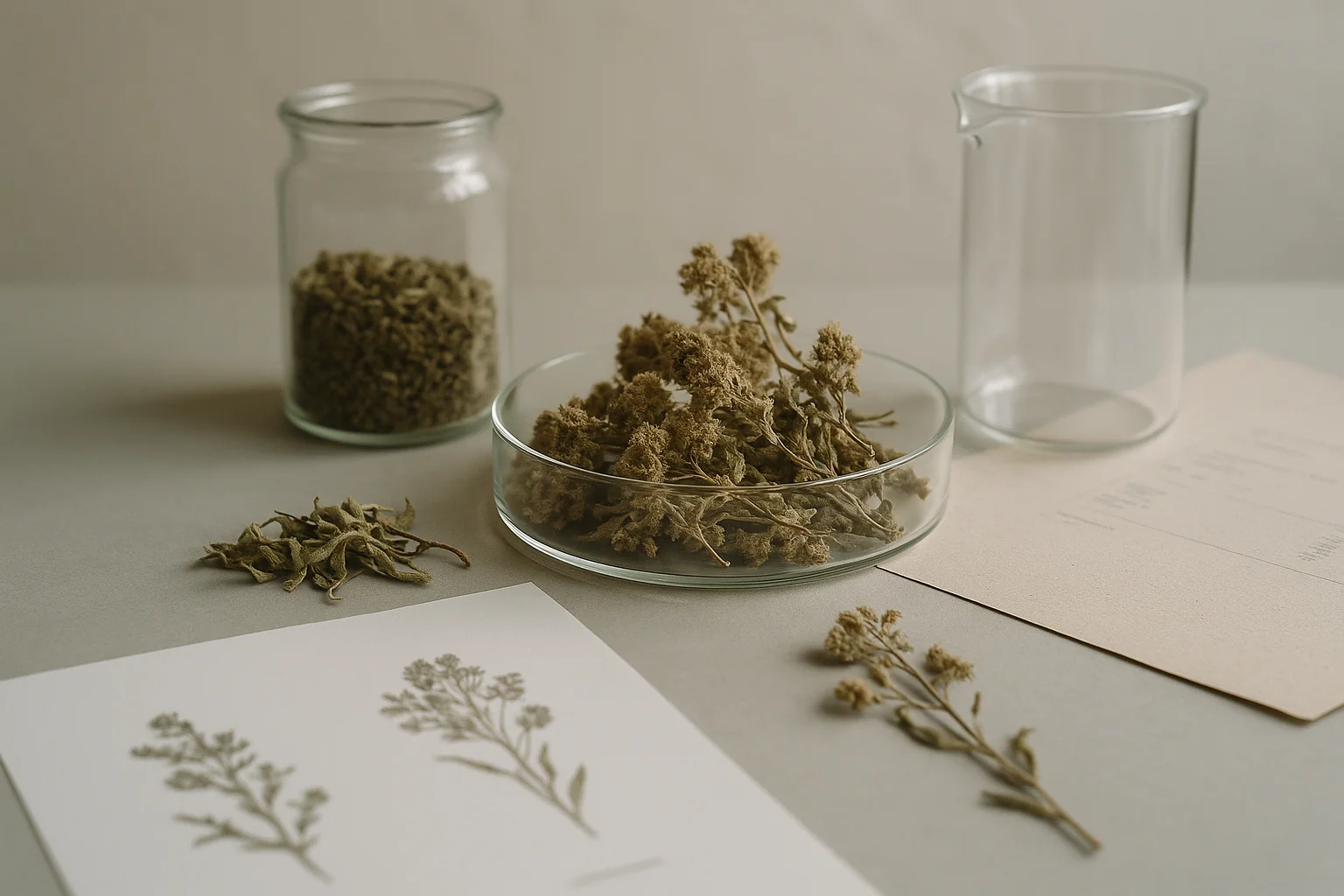

Mimosa (Cannabis flos S-LAB): lineage from Clementine and Purple Punch, a single source of the profile
Mimosa reaches Polish pharmacies in one version, from S-LAB. We have gathered its pedigree, terpene composition described by a single source, and what studies on pinene have not shown.
What parents did Mimosa come from?
From Clementine and Purple Punch. This lineage is provided by seedfinder.eu and strainpedia.com, attributing the cross to the breeder Symbiotic Genetics. Thus, Mimosa belongs to that part of our listing which has a confirmed origin, rather than the twenty-five cultivars described in the graph as having an unknown lineage.
We read the origin from breeding databases, not from the documentation of the dried flower producer. This distinction has practical consequences: a pharmacy package does not carry any information about the plant's parents, so the lineage cannot be confirmed at the counter. The name also gives no hints, as it contains no common element with either Clementine or Purple Punch, and guessing the relationship based on the sound of the name creates connections in the graph that do not actually exist.
The description of the genetics is based on the same single foundation: the pharmacy database classifies Mimosa as a hybrid with a sativa dominance, and no one independently confirms this classification. We treat the division into sativa and indica here as a catalog label, not as a prediction of effects. Two dried flowers described with the same word can have different sets of terpenes, as seen in our profiles across dozens of entries. The second parent, Purple Punch, has another significance here: it connects Mimosa with the only pharmacy strain that the graph recognizes as its sibling.
Who supplies Mimosa to Polish pharmacies?
One producer: S-LAB. In our listing, Mimosa has exactly one pharmacy entry, so the patient does not choose between versions of the same strain. The registered name is Cannabis flos S-LAB, and we provide it without a numerical element, as the number included in this name is a declared value, not measured in a specific package.
| Producer | Registered name without a numerical component | Genetics description in the source | Availability according to the source |
|---|---|---|---|
| S-LAB | Cannabis flos S-LAB | hybrid with a sativa dominance | described as tall |
The declared THC content for this entry ranges from 19.8% to 24.2%. The range, not a single number, comes from the tolerance granted to the producer: the measurement result can deviate from the declaration by one-tenth of its value in either direction. The number printed on the package thus describes the midpoint of the range, not the content in that specific jar.
The pharmacy assortment ages faster than any text about strains. Licenses can be revoked, supplies can be interrupted, and a wholesaler can have an entry on the list and not have it on the shelf, so we maintain the current state exclusively in the list of strains available in Polish pharmacies. The source describes the availability of Mimosa as high, but this description pertains to the day the data was collected.
It is important to separate two things that share the same word: pharmacy raw material is not dried flower sold retail outside the pharmacy, as the latter category includes products without the status of a medicinal product and different dispensing methods.
How does Mimosa smell and taste?
Citrusy and woody, with a fruity and earthy background. This set of associations is recorded by the database describing pharmacy strains, and it is a sensory description, not a measurement result. The patient's nose does not measure composition, and these same four adjectives can describe dried flowers with completely different sets of terpenes.
In the descriptions of terpenes, pinene is attributed a resinous note, limonene a citrus note, linalool a floral note, and caryophyllene a peppery note. Thus, the four entries from Mimosa's profile cover this entire spectrum, explaining why its aroma is sometimes described as fruity and sometimes as spicy. However, attributing a scent to a compound should not be read as an analysis: dozens of volatile substances are at work in the jar at once, and only four have names in our source.
The same database assigns Mimosa stimulating and balanced descriptors. This is a catalog declaration, not a study result, and it says nothing about what a specific patient will feel. The aroma actually changes after opening the package and after breaking down the raw material, as volatile components escape faster the larger the surface area of the material. The adjectives are, in fact, a common vocabulary of the catalog, not a distinctive feature of the strain: the term earthy appears with 68 out of 146 described entries, and fruity with 49. Exactly the same set of four descriptors is found in this database for another entry.
How long does it take for Mimosa to start working?
Depending on the method of administration, not the strain name. With vaporization, the first sensations come within a few minutes, while with ingestion, one has to wait much longer. For Mimosa itself, no one has measured either the onset or the duration, so below we describe the method of administration, not this specific pharmacy entry.
The route of administration determines the course more than the variety itself. After vaporization, the substance passes from the lungs to the blood almost immediately, so the first sensations appear after a few minutes, the intensity increases for another ten to thirty minutes, and the whole effect lasts for two to four hours. After ingestion, the raw material first passes through the intestine and liver, so the first sensations are awaited from half an hour to two hours, and the episode can last six, sometimes eight hours. Hence the most common mistake with oral administration: anyone who thinks nothing is happening after thirty minutes and takes another dose will receive both doses at once. The above ranges describe the route of administration, not this variety; pharmacokinetic studies for a single cultivar have not been published.
There is no separate measurement for Mimosa, and it is difficult to expect one to be created. Such a measurement is performed on a product with a consistent composition, while plant material varies enough between batches that a result from one batch would say little about the next. For the patient, there is one conclusion: the method of intake determines the effect, not the label on the jar.
What has really been shown for the components of Mimosa?
For Mimosa itself, nothing. No published work specifically addresses this cultivar by name. However, there are studies on individual terpenes present in its profile, conducted on mice and cell cultures, and these define the limits of what can be said about this strain.
The composition of the profile is described by one source, budcare.pl, and lists caryophyllene, limonene, linalool and pinene. We do not place bets on these names, as it is unclear what total they refer to: when summing the values assigned by Polish databases to the positions of the same dried flower, sometimes it yields less than half, and other times more than four-fifths. As long as the denominator remains unknown, such a number appears to be a measurement, but it is not. Our data also presents two different indications for the leading terpene: the compilation of pharmaceutical positions describes Mimosa as pinene-dominant, while the database shares prioritize caryophyllene.
The first study on pinene was published in 2016 in Molecular Pharmacology (PMID:27573669), and the team led by Yang recorded its findings as follows. Orally administered (-)-alpha-pinene prolonged NREM sleep time in mice and shortened sleep latency (EEG/EMG recording), acting as a partial modulator that binds directly to the benzodiazepine site of the GABA-A receptor, without affecting the intensity of NREM sleep or the duration of REM sleep.
A year earlier, in The American Journal of Chinese Medicine (PMID:26119957), Kim's group described a completely different effect obtained outside the organism. Alpha-pinene reduced the secretion of IL-6, TNF-alpha, and nitric oxide, as well as the expression of iNOS and COX-2, in LPS-stimulated mouse peritoneal macrophages by inhibiting the MAPK and NF-kB pathways.
The boundary between these two studies should be stated clearly. No anxiolytic or analgesic effects of pinene have been demonstrated in humans; available data only concern its impact on sleep in mice after oral administration and its anti-inflammatory effects on mouse macrophages in culture. Everything else circulating about Mimosa online consists of user reports or catalog material, neither of which constitutes evidence.
What symptoms have been reported after using dried flower from this strain?
None specifically attributed to it. The oversight of pharmacotherapy safety links reports to packaging and batch numbers, not to the commercial name of the plant, which is why there is no separate list for Mimosa. This does not mean that the raw material is free from adverse effects, only that data is collected at a different level.
Reports of adverse effects are collected for medicinal products with a batch number, not for the strain name, so the following pertains to hemp dried flower as a group of raw materials. The most frequently reported symptoms are dry mouth, red eyes, and increased heart rate. Dizziness upon rapid standing, daytime drowsiness, and temporary worsening of short-term memory are less frequently described, as well as anxiety that increases with dosage. A separate issue is medications taken concurrently, especially sedatives and those affecting coagulation: their assessment requires knowledge of the entire list of preparations, not just the description of the plant. We do not provide the frequency of these symptoms numerically, as public compilations for hemp dried flower in Poland do not separate them by individual products.
One circumstance, however, directly arises from the profile of this product. A raw material with a high declared content is easier to measure with excess, as the same volume carries more active substance than a weaker product, and the habit from the previous packaging remains in hand. The selection of the dose is the responsibility of the prescribing physician and the dispensing pharmacist, not the description of the strain.
At what temperature should Mimosa be vaporized?
There is no single correct temperature for the strain; there are boiling points for individual terpenes. Four positions from the Mimosa profile evaporate under very different conditions, so a single setting never extracts everything at once. Below, we provide values from the PubChem database, measured for pure substances, not for dried flower in the chamber.
| Terpene from the profile | Boiling temperature at atmospheric pressure |
|---|---|
| pinene | about 156 degrees Celsius |
| limonene | about 178 degrees Celsius |
| linalool | about 196 degrees Celsius |
| caryophyllene | about 258 degrees Celsius |
The range between the extreme positions of this quartet exceeds one hundred degrees. Thus, a setting from the lower part of the scale primarily releases what is most volatile, while heavier components remain in the raw material. Raising the setting reverses this proportion and brings the dried flower closer to the boundary, beyond which smoke is produced instead of vapor. The practical conclusion from this range is that one session at a constant setting does not recreate the entire aroma from the grinder, as the heaviest position in the profile remains untouched.
The numbers in the table describe pure compounds in a laboratory vessel, not the plant in the device's chamber. The vaporizer setting refers to the heater temperature or airflow, not the temperature of the dried flower itself, and these two values can differ by several dozen degrees. We explain separately why temperature tables in different compilations do not agree. the evaporation of terpenes. This is already evident in the database itself: for caryophyllene, there is a second measurement taken under reduced pressure, which occurs at 130 degrees Celsius instead of 258.
Which pharmacy strain is related to Mimosa?
One: Sweet Berry Kush. Both have Purple Punch in their lineage, so they share a common parent, not a similarity in name. The second parent is different in each case, so the relationship remains partial and does not guarantee compatibility in either composition or effects on the patient.
Sweet Berry Kush was created by crossing Banana OG with Purple Punch and is available in Polish pharmacies from the same producer as Mimosa. However, its terpene profile is described differently: it leads with limonene, while the pharmacy position listing indicates pinen for Mimosa. Thus, the common parent did not equalize the composition, which clearly shows how little the pedigree graph determines the chemistry of the final product.
Aside from this one entry, the graph does not connect Mimosa with anything that can currently be purchased in Polish pharmacies. Clementine does not appear in our listing, nor does Purple Punch, so there is no parental pair to compare with offspring in this market. The short list of siblings is not a data gap here, but a reflection of what has been realistically allowed for sale. The sibling field has content in this cluster with 29 out of 85 cultivars, so one entry is not a poor result, but rather the norm for a graph built solely from confirmed pedigrees.
Frequently Asked Questions about the Mimosa strain
Is Mimosa available in Polish pharmacies?
Yes, in one version, provided by S-LAB. Current availability should be checked on the day of the visit, as the list of items in wholesalers changes independently of what is stated in the article.
What is the lineage of Mimosa?
Clementine crossed with Purple Punch. This lineage is provided by the seedfinder.eu database and the strainpedia.com service, attributing the cross to the breeder Symbiotic Genetics.
Which terpene leads in the profile of Mimosa?
It depends on what counts. The pharmacy position listing describes Mimosa as pinen-based, while the shares provided by the database place caryophyllene in the first position.
Are there studies on Mimosa itself?
There are none. Publications concern individual terpenes, not this cultivar, and were conducted on mice and cell cultures.
Can Mimosa be purchased without a prescription?
No, dried flower is issued in the Rpw category, meaning it is only available with a prescription from a doctor.
How does Mimosa differ from Sweet Berry Kush?
The common parent of both strains is Purple Punch, but the second parent is different, and the source indicates limonene as the leading terpene for Sweet Berry Kush.
Editorial text from the editorial team of ubucha.pl, for informational purposes. The material is for informational purposes only and does not replace the advice of a doctor or pharmacist. Dried flower is a pharmaceutical raw material issued by a doctor's prescription in the Rpw category.