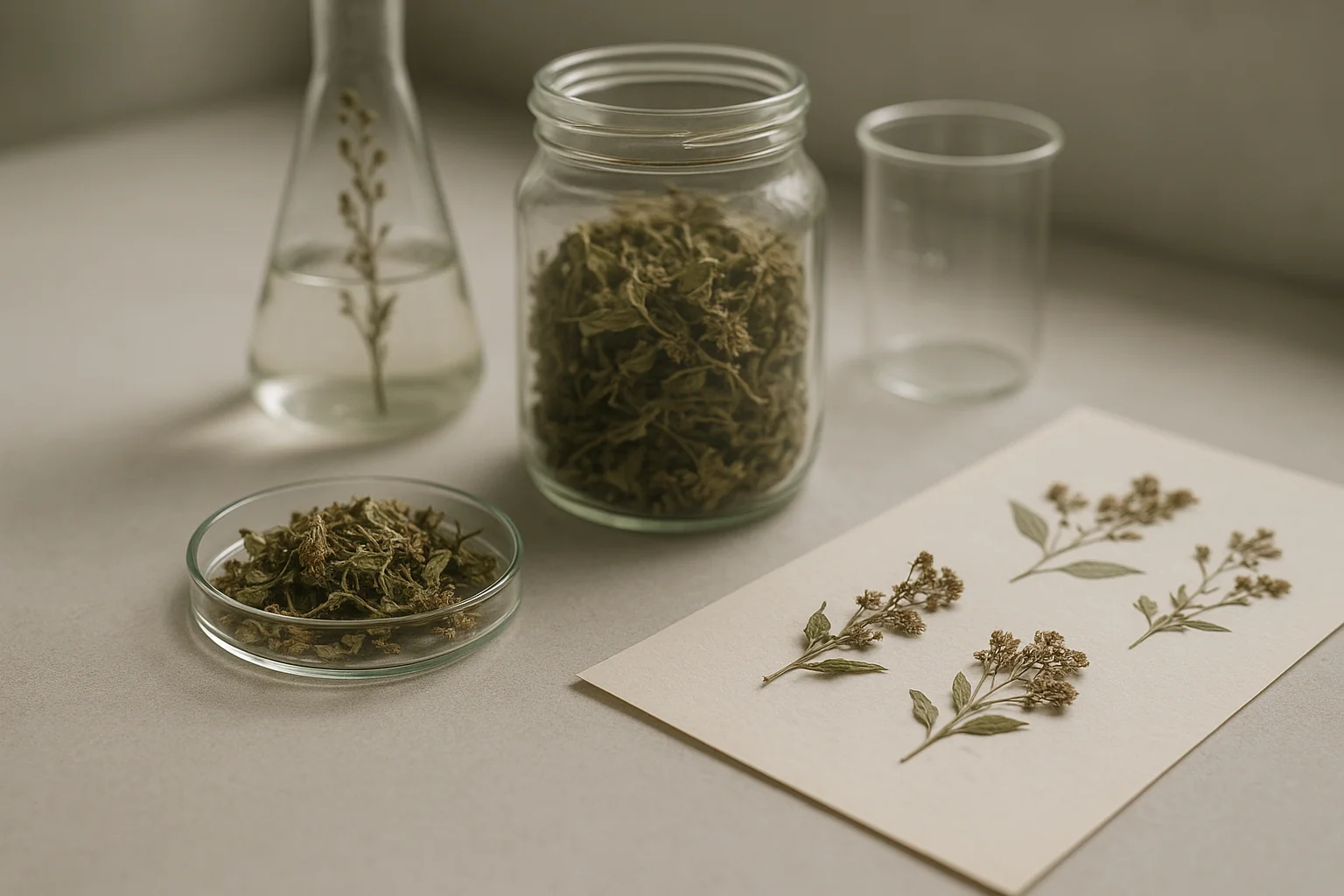

Balasa, or Gorilla Girl (Cannabis flos COSMA): a caryophyllene hybrid in pharmacies
The same strain is sold in Polish pharmacies under the name Balasa, and in breeding catalogs as Gorilla Girl. We gather the pedigree, the dispute of sources regarding the terpene composition, and what studies on caryophyllene have not shown.
Is Balasa and Gorilla Girl one strain or two?
One. In Polish pharmacies, this cultivar is listed under the trade name Balasa, assigned by the producer Cosma, while in breeding catalogs it appears as Gorilla Girl. A patient searching for just one of these names will not find the other, even though we are talking about the same plant material and the same lineage.
The lineage is established and comes directly from the breeder. Sweet Seeds states it is a cross of Gorilla Glue with Girl Scout Cookies, using the Thin Mint phenotype from the Girl Scout Cookies side. This is the breeder's declaration, not a result of genetic analysis, so we treat it as a primary source, not as laboratory evidence.
It is worth expanding both components, as they explain the character of this strain. Gorilla Glue was created by crossing Chem's Sister, Sour Dubb, and Chocolate Diesel, which are lines with a heavy, resinous profile. Girl Scout Cookies, on the other hand, is the offspring of OG Kush and Durban Poison, thus combining a compact indica with a South African sativa.
Descriptive genetic classification is a separate matter, and here the sources diverge. One of the Polish databases cataloging pharmacy strains describes this strain simply as a hybrid, while another adds that it has a sativa dominance. The discrepancy does not arise from measurement, but from the fact that the indica or sativa label remains a descriptive convention, not a parameter measured in raw material testing.
Who supplies this strain to Polish pharmacies?
One producer: Cosma. In the collected assortment, the strain has one registration position and one pharmacy version, so there is no choice between suppliers, as is often the case with more popular cultivars. The declared THC content, considering the producer's ten percent tolerance, falls within the range of 18.0-22.0%, while the content of the second measured component is described only as trace.
| What describes the pharmacy version | The value provided by sources |
|---|---|
| Producer | Cosma |
| Trade name in pharmacy | Balasa |
| Cultivar name | Gorilla Girl |
| Number of pharmacy versions | one |
| Leading terpene by shares | caryophyllene |
| Genetic classification | hybrid according to one source, hybrid with sativa dominance according to another |
| CBD content | reported as trace |
One pharmacy version means that comparing producers here has no basis. For strains managed by several entities, it is possible to compare batches, harvest times, and drying methods; here, the reference point remains a single batch from one supplier and what the registration card states about it. The other products from this producer opisujemy osobno.
Availability is often confused with a permanent feature of the strain, but it is a feature of the moment. The product can disappear from circulation for several months, return in a different batch, or change packaging, and one of the databases that cataloged it marked it as unavailable at the time of data collection. Therefore, we keep the current state in one place, in the compilation of available strains, and not in the descriptions of individual cultivars.
One distinction is worth making clear. Pharmacy strains are raw materials dispensed by a doctor's prescription in the Rpw category, while available over the counter dried hemp from the store is a completely different category of product and does not serve as a substitute.
What does Balasa smell like and what remains in the taste?
Descriptions collected by Polish databases reduce the aroma of this strain to three notes: peppery, nutty, and earthy. There are no citrus or fruity sweetness notes that follow the name Girl Scout Cookies. The scent is dry and more spicy than dessert-like. This description comes from catalog material, not from sensory analysis.
The peppery note is the most expressive, as it corresponds with the leading terpene. Caryophyllene is responsible for the sharp, spicy aroma known from black pepper, and it ranks first in both descriptions of this strain. What this terpene does beyond its aroma, we break down in a separate article.
However, aroma is not a reliable indicator of composition. The nose detects compounds present in trace amounts while overlooking those present in larger quantities, and the dried flower changes its scent with humidity and storage time. Two batches of the same strain can smell noticeably different, even though the registration card remains identical.
The taste in vaporization can be weaker than the aroma wafting from an open package, as some volatile components escape earlier, at a temperature lower than that set on the device. With a profile driven by caryophyllene, the difference can be significant, as discussed further below.
When does the effect begin and how long does it last?
This is determined by the method of intake, not the name of the cultivar. Vaporized dried flower provides initial sensations after a few minutes, while the same plant ingested in processed form takes several dozen minutes. No separate pharmacokinetic study for Balasa has been published, so the only reliable ranges describe the absorption pathway. The following paragraph collects them.
The route of administration determines the course more than the variety itself. After vaporization, the substance passes from the lungs to the blood almost immediately, so the first sensations appear after a few minutes, the intensity increases for another ten to thirty minutes, and the whole effect lasts for two to four hours. After ingestion, the raw material first passes through the intestine and liver, so the first sensations are awaited from half an hour to two hours, and the episode can last six, sometimes eight hours. Hence the most common mistake with oral administration: anyone who thinks nothing is happening after thirty minutes and takes another dose will receive both doses at once. The above ranges describe the route of administration, not this variety; pharmacokinetic studies for a single cultivar have not been published.
For this product, it matters that the dried flower dispensed in pharmacies is intended for vaporization, not oral preparation. Those who prepare it for ingestion change the entire characteristic of the course, even though the plant material remains the same. The method of intake is determined by the attending physician, and it is they, not the strain description, who decides the dosage.
What has been confirmed by research, and what is just a description?
Two things have been demonstrated. Both concern caryophyllene itself. Both were conducted on mice. None of this is a study of this strain. Everything read about Balasa as a strain for a specific condition comes from catalog descriptions or user reports. Below, we separate one from the other.
The first study comes from Gertsch's team, published in PNAS in 2008 (PMID:18574142). Model: mouse (in vivo) and test tube (receptor binding, human cells). (E)-caryophyllene selectively bound to the CB2 receptor (Ki = 155 nM) and inhibited carrageenan-induced paw swelling in wild-type mice, but not in CB2 receptor-deficient mice (Cnr2-/-), indicating a CB2-dependent mechanism; the study did not include any anxiety tests.
The second study comes from Klauke's team, published in European Neuropsychopharmacology in 2014 (PMID:24210682). Model: rodent (mouse). Oral caryophyllene reduced the late inflammatory phase of pain in the formalin test in a CB2 receptor-dependent manner, with no effect on the early phase; in the neuropathic pain model, it alleviated thermal hyperalgesia and mechanical allodynia without developing tolerance with chronic administration.
The boundary of both results is defined by one sentence. Let's read it literally. In neither of the two studies was caryophyllene tested on humans or in inhaled form from dried flower; both studies concern oral or systemic administration in mice in pain and inflammation models, not sleep or mood.
A separate issue is the discrepancy in the description of the composition itself. Two Polish services cataloging pharmaceutical strains provide different sets of terpenes for this product. One lists only caryophyllene. The other adds five more: humulene, linalool, myrcene, pinene, terpinolene. We consciously do not mention percentage shares. The denominator of such listings remains unknown, and varies in each source.
What side effects have been reported for Balasa itself?
None. No separate statistics for this name are kept, as adverse event reports are attributed to a medicinal product with a specific batch number, not to a cultivar. The following paragraph therefore describes hemp flower as a group of raw materials, and this is the maximum that can be honestly stated here. Linking a symptom to a strain would require reports associated with a batch, and there are none publicly available.
Reports of adverse effects are collected for medicinal products with a batch number, not for the strain name, so the following pertains to hemp dried flower as a group of raw materials. The most frequently reported symptoms are dry mouth, red eyes, and increased heart rate. Dizziness upon rapid standing, daytime drowsiness, and temporary worsening of short-term memory are less frequently described, as well as anxiety that increases with dosage. A separate issue is medications taken concurrently, especially sedatives and those affecting coagulation: their assessment requires knowledge of the entire list of preparations, not just the description of the plant. We do not provide the frequency of these symptoms numerically, as public compilations for hemp dried flower in Poland do not separate them by individual products.
For this strain, there is one more circumstance. The profile is driven by caryophyllene, a terpene studied so far in animal models, not in patients using dried flower. Therefore, there is no basis to associate a distinct pattern of symptoms with it, whether milder or more severe than with other pharmacy cultivars.
What does the vaporization temperature change with this profile?
It changes which aromatic components will leave the dried flower at all. The terpenes listed for this strain boil over a very wide range, from about 156°C for pinene to about 257°C for caryophyllene, so no single setting on the device will release them all at once. This range is greater here than with citrus profiles.
| Terpene from the profile | Boiling temperature according to public chemical compound databases |
|---|---|
| caryophyllene | 257.5°C at atmospheric pressure |
| linalool | 195.5°C at atmospheric pressure |
| terpinolen | 184.0°C at atmospheric pressure |
| myrcene | 166.8°C at atmospheric pressure |
| pinene | 156.2°C at atmospheric pressure |
| humulene | no record for atmospheric pressure, reported 99.5°C at 3 mmHg |
However, the numbers from such a table describe the pure substance in the chamber, not the behavior of the plant in the vaporizer chamber. The compound begins to vaporize long before reaching the boiling point, and in a mixture with resin and plant material, it behaves differently than in isolation. This is why comparisons of such temperatures can contradict each other, We explain this separately..
A separate trap concerns the reading on the device itself. The value set on the vaporizer describes the heating element or the incoming air, not the temperature of the raw material itself; this can be lower by several dozen degrees and drifts as the session progresses. We expand on this in the text about the difference between the setting and the temperature of the material, along with this, in at what temperature terpenes actually evaporate.
There is no single correct value that could be provided as recommended. The setting is chosen according to the session's goal and the patient's tolerance, and this is a decision made with the attending physician, not based on boiling point temperature tables.
Which pharmacy strains share a common parent with it?
Two: Electric Honeydew and GMO. Both share one parent with Balasa, which is Girl Scout Cookies. This is the only relationship that can be demonstrated in the pedigree graph constructed for strains available in Polish pharmacies, and it results from established pedigrees, not from name similarity. The second parent is different in each case.
Electric Honeydew was created by crossing Girl Scout Cookies with the 91 OG Krypt Melon line, as stated directly by the manufacturer on their product page. The melon part of the name refers to the second parent and is responsible for a completely different direction of aroma than the peppery accent of Balasa.
GMO is a cross of Chemdawg with Girl Scout Cookies, also known as GMO Cookies, featuring a distinctive garlic phenotype selected outside of the parent breeding. A common parent does not imply similar effects: offspring from the same mother inherit very different traits.
One name is missing from this list, and this is intentional. Gorilla Glue appears in Polish pharmacies as a separate entry, but in relation to Balasa, it is an ancestor, not a sibling, so it does not count in this comparison. We also do not add strains that share only a broad family style, as name similarity is not evidence of lineage.
Frequently asked questions about Balasa and Gorilla Girl
Are Balasa and Gorilla Girl the same strain?
Yes. Balasa is the trade name under which the Gorilla Girl cultivar reaches Polish pharmacies through the manufacturer Cosma. Searching for only one of these names overlooks half of the available descriptions.
What is the lineage of Gorilla Girl?
The breeder Sweet Seeds states it is a cross of Gorilla Glue with Girl Scout Cookies, with the Thin Mint phenotype on the latter's side. This is a breeder's declaration, not the result of genetic analysis.
Which terpene stands out in this profile?
Caryophyllene. Both sources describing this strain indicate it, although we do not provide percentage shares, as terpene comparisons do not state the denominator.
How many pharmaceutical versions of this strain are available?
One, from the manufacturer Cosma. Availability changes over time, so the current status should be checked in the list of available strains, not in the cultivar description.
Do studies confirm the effects of this strain in humans?
No. Available studies focus on beta-caryophyllene and were conducted on mice and in vitro, in pain and inflammation models.
Which pharmacy strains are related to it?
Electric Honeydew and GMO. Both share with Balasa the parent strain Girl Scout Cookies, with the second parent being different in each case.
Is this strain available without a prescription?
No. This item falls under the Rpw category, so the pharmacy dispenses it only with a prescription, and the method of administration is determined by the attending physician.
The described raw material belongs to the Rpw category, so the pharmacy dispenses it only for individuals with a valid prescription. The material was collected for informational purposes and does not replace a conversation with the attending physician. Editorial: ubocha.