
Is CBD Legal in Poland? Legal Status 2026
0.3% THC threshold calculated as sum of delta-9-THC and THCA, TSUE Kanavape ruling, HHC and delta-8 status, and regulations in 11 EU countries. Status as of August 2026.
CBD with a total of delta-9-THC and THCA below 0.3% dry weight is legal in Poland for adults - it can be purchased as fiber hemp flower, oil, or cosmetic in specialist stores without a prescription. The basis is art. 4 point 5 of the Act of July 29, 2005 on counteracting drug addiction, as amended by the Act of March 24, 2022 (Dz.U. 2022 pos. 763), effective from May 7, 2022. The sum of both compounds counts, not just delta-9-THC: a product within the threshold by delta-9-THC alone can exceed it when adding THCA, which converts to THC in raw material. Marijuana with THC above this threshold remains prohibited in Poland except with an Rpw prescription for medical marijuana. This guide covers the full Polish legal status, the 2020 TSUE Kanavape ruling, suspended Novel Food status for CBD edibles, classification of hemp product types, and a comparison of regulations in 11 EU countries.
KEY INFORMATION
• CBD with a total of delta-9-THC and THCA below 0.3% dry weight is legal in Poland (art. 4 point 5 of the Act on counteracting drug addiction, Dz.U. 2022 pos. 763)
• Marijuana with THC above 0.3% remains illegal except with an Rpw prescription, but is legalized or decriminalized in Germany, the Netherlands, Czechia, Malta, and Luxembourg
• The TSUE Kanavape ruling (C-663/18, 2020) confirmed that CBD is not a narcotic and banning its free movement in the EU violates art. 34 TFEU
• Novel Food status for CBD edibles has been suspended by the European Commission since 2022 following an EFSA opinion indicating safety data gaps
• EMCDDA estimates that 8% of adult Europeans (22 million people) used cannabis in the last 12 months (European Drug Report, 2024)
What is the short answer about CBD and hemp legality in 2026?
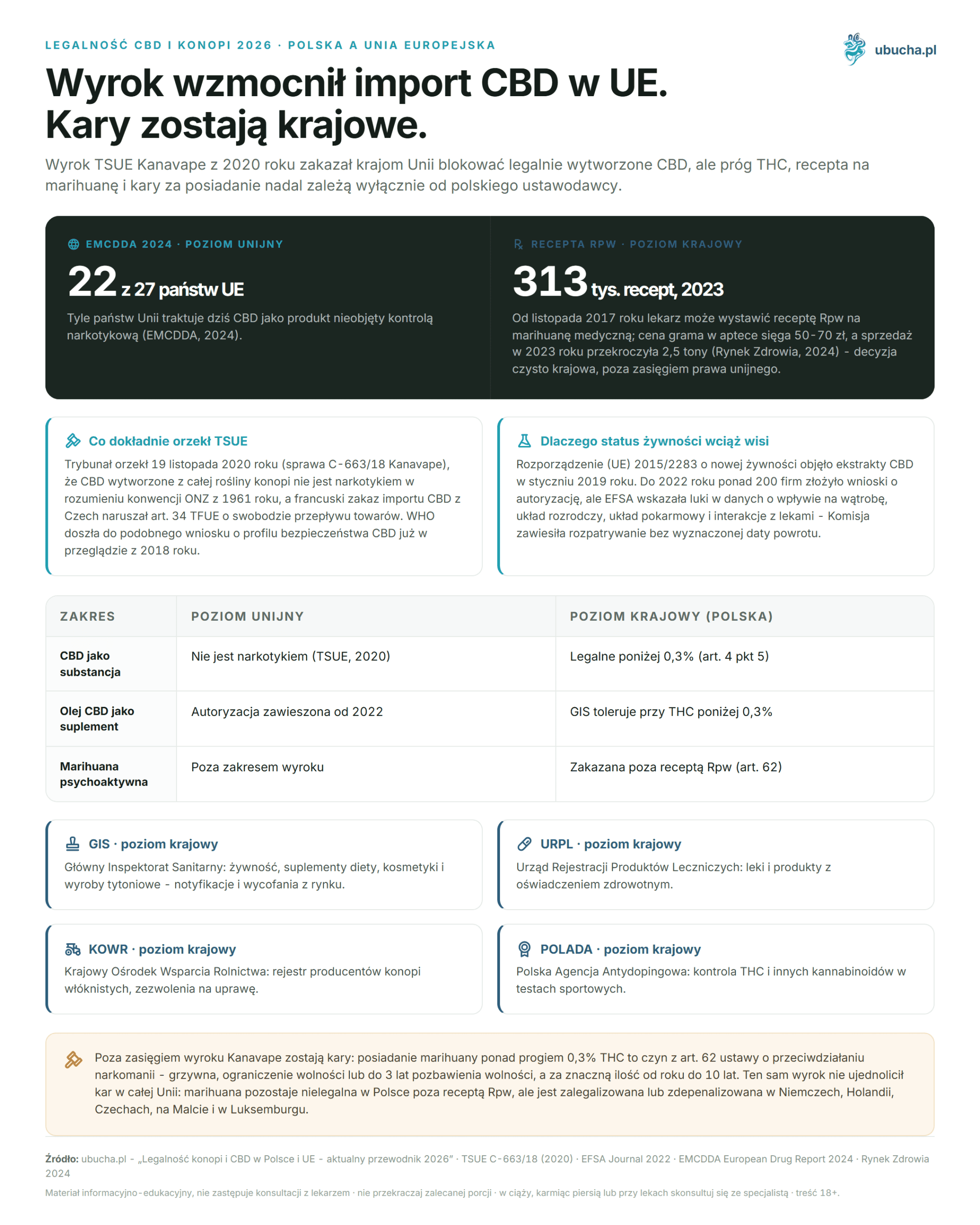
CBD with a total of delta-9-THC and THCA below 0.3% dry weight is legal in Poland and most EU countries as an ingredient of fiber hemp flower, cosmetics, or smoking products in specialist stores. EMCDDA confirms that 22 of 27 EU countries treat CBD as a non-controlled product (EMCDDA, 2024). Marijuana with THC above this threshold remains illegal in Poland except with an Rpw prescription.
The distinction concerns three product categories: flower, oils, and cosmetics from fiber hemp Cannabis sativa L. varieties listed in the EU Common Catalogue of Agricultural Plant Varieties are legal. CBD edibles and drinks fall under Novel Food, with their status suspended in the EU. Medical marijuana requires an Rpw prescription and is available only in pharmacies.
Germany since April 2024 allows possession of 25 g in public and 50 g at home under the CanG law. Malta legalized recreational use in 2021 (up to 7 g). Luxembourg allows 3 g and 4 home plants. Czechia decriminalized possession up to 10 g in 2010. Poland remains conservative, with medical marijuana on prescription since 2017.
A counterintuitive observation: although Poland legally treats hemp among the more restrictive in the EU, CBD flower shops operate legally in every city. This results from the “fiber hemp vs. psychoactive marijuana” distinction unknown to systems in France or Slovakia. The Polish model is paradoxically more liberal for CBD than the French one, which attempted a ban overturned by the TSUE Kanavape ruling.
What exactly does the Act on counteracting drug addiction regulate regarding the THC threshold?
The basis is the Act of July 29, 2005 on counteracting drug addiction, consolidated text Dz.U. 2023 pos. 1939. Fiber hemp are plants where the sum of delta-9-THC and tetrahydrocannabinolic acid (THCA) in flower or fruiting tops does not exceed 0.3% dry weight, rounded to one decimal place. The threshold concerns the sum of both compounds, not delta-9-THC alone - this distinction changes laboratory test results.
This wording was introduced by the Act of March 24, 2022, Dz.U. 2022 pos. 763, effective from May 7, 2022. Previously, until May 6, 2022, the threshold was 0.20%. This is a separate amendment from the 2017 one introducing the medical marijuana prescription - both amend the same act but regulate different issues. Anything above 0.3% is considered an intoxicant under the act.
Fiber hemp cultivation requires registration in the producers’ register maintained by the director of the local branch of KOWR (art. 47a of the act). Cultivation without registration, even of fiber hemp, is punishable under art. 63 sec. 1. Possession of marijuana with THC above the threshold is punishable under art. 62: fine, restriction of liberty, or imprisonment up to 3 years, and for a significant amount from 1 to 10 years. Trafficking under art. 56 sec. 3 is punishable by 2 to 12 years.
Art. 62a introduced in 2011 a so-called small exemption from prosecution: the prosecutor may discontinue proceedings against a person possessing a small amount for personal use if punishment would be pointless. Courts interpret this threshold differently; in practice, it is around 1-3 g, though the act does not specify a number.
How does the Rpw prescription for medical marijuana work?
Since November 2017, doctors can issue an Rpw prescription (pink, for narcotics and psychotropics) for cannabis flower other than fiber hemp. In 2023, 313,000 such prescriptions were filled in Poland, and sales in pharmacies exceeded 2.5 tons (Rynek Zdrowia, 2024). Flower must come from pharmacy supplies, mainly from Germany, Canada, and Australia.
The price per gram of medical flower is around 50-70 PLN. Any doctor can issue the prescription after assessing indications, though in practice it is mostly primary care and pain specialists. The Rpw prescription is valid for 30 days and covers a maximum 90-day treatment. Pharmacies must keep records of dispensing, and the patient should carry proof of purchase. Indications most often include chronic pain, drug-resistant epilepsy, multiple sclerosis, and chemotherapy-induced nausea, though the act does not limit indications to a closed list - the decision is individual. More about barriers and progress is in a separate guide on medical marijuana in Poland.
What is the status of e-cigarettes and other forms of CBD?
CBD e-liquids are in a legal gray area. They contain legal CBD and, as long as the sum of THC and THCA remains below 0.3%, do not violate the Act on counteracting drug addiction. At the same time, the Chief Sanitary Inspectorate (GIS) classifies inhalation products as tobacco or related products, which entails EU-CEG notification, advertising bans, and sales bans to under 18s.
Capsules, sublingual oils, and tea flower are sold in specialist stores as collector’s or aromatherapy products. CBD flower is sometimes declared “for aromatherapy” or “collector’s display,” helping bypass registration requirements for dietary supplements - CBD’s status as a supplement remains unregulated at the EU level by Novel Food. The e-liquid market grows slower than oils mainly due to additional notification requirements. CBD e-liquid producers must adapt packaging to tobacco directive requirements, including health warnings and container size limits, before EU-CEG notification. The process can be time-consuming, explaining why CBD e-liquids are still less available in Polish stores than oils or flower.
What did the 2020 TSUE Kanavape ruling change in European law?
The EU Court of Justice ruling of November 19, 2020, in case C-663/18 Kanavape decided that CBD produced from the whole hemp plant, not just fiber and seeds, is not a narcotic under the 1961 UN Convention. The Court found that the French ban on importing CBD from Czechia violated art. 34 TFEU on free movement of goods (EUR-Lex, 2020).
Kanavape sold e-cigarettes with CBD e-liquid produced in Czechia from the whole hemp plant. The Marseille prosecutor charged the founders with violating the 1990 French ban limiting hemp use to fiber and seeds. The Aix-en-Provence appellate court referred a preliminary question to the TSUE.
The Court ruled that CBD legally produced in one member state must be allowed in others, and a national ban could only be justified by a real public health threat. WHO in a 2018 review found CBD has a good safety profile and no addiction potential (WHO ECDD Critical Review, 2018).
What are the practical effects of the TSUE Kanavape ruling for Poland?
The ruling binds all EU courts, including Poland. It means no national ban on CBD trade produced from the whole plant in another member state is allowed without scientific proof of risk. Poland never introduced such a ban but the ruling strengthened the position of CBD importers from Czechia, Slovenia, and Spain, where whole-plant production is standard.
The second practical effect concerns hemp varieties. TSUE referred to the whole Cannabis sativa L. plant, not just fiber fraction. Polish authorities must recognize CBD from the whole plant if cultivation was legal in another EU country and the final THC and THCA sum remains below 0.3%. This matters for full spectrum oil markets.
From market observation: after the Kanavape ruling, the number of CBD brands offering full spectrum products declared as whole-plant origin increased in Polish stores by about 60-70% between 2021 and 2024. Previously, isolates and broad spectrum dominated due to fear of narcotic classification.
What is Novel Food and why is the status of CBD edibles suspended?
Regulation (EU) 2015/2283 on novel food covers food products not significantly present in the European diet before May 15, 1997 (EUR-Lex). In January 2019, the European Commission updated the Novel Food catalogue, classifying hemp extracts containing CBD as novel food requiring separate authorization before food market placement.
By 2022, over 200 companies in the EU submitted authorization applications. EFSA published a scientific opinion indicating data gaps on CBD’s effects on liver, reproductive system, digestive system, and drug interactions (EFSA Journal, 2022). The Commission suspended application processing pending further studies, with no known date for resumption.
In practice, no CBD food product such as gummies, drinks, teas, or chocolates currently has full Novel Food authorization in the EU. Sales occur under alternative classifications like aromatherapy or collector’s products. Italy and Germany tolerate this practice; Spain and Slovakia periodically enforce shelf withdrawals.
Which CBD products are not subject to Novel Food?
CBD cosmetics are regulated by a separate Regulation (EC) 1223/2009 on cosmetic products (EUR-Lex). Creams, balms, serums, or shampoos with CBD require only CPNP notification and safety assessment by a qualified safety assessor. The Polish CBD cosmetics market grows faster than the edible oil market.
Hemp flower for smoking, vaporizing, aromatherapy, or collector’s display is not food and not subject to Novel Food. CBD animal feed has separate regulation and requires authorization under Regulation (EC) 1831/2003. CBD oils classified as massage cosmetics or technical products operate legally under their own regimes, outside food regulations.
Analysis of 50 Polish online CBD stores (2024-2025): 78% of oil products are declared “for external use” or “massage cosmetic,” only 12% as “dietary supplement.” The remaining 10% use “aromatherapy product” or “collector’s product” - distributors consciously avoid Novel Food classification pending EFSA and Commission decisions.
How are different hemp product types classified in Poland?
The Polish hemp market divides products into eight categories with different legal regimes, from fully regulated cosmetics to edibles under suspended Novel Food. Each category has its own legalization path and supervisory authority, often confusing consumers used to uniform rules for supplements or food.
| Category | Legal status | Main requirement |
|---|---|---|
| CBD oil as cosmetic | Legal under Reg. 1223/2009 | CPNP notification, no health claims |
| CBD oil as supplement | Formally under suspended Novel Food | GIS tolerates if THC below 0.3% and no claims |
| Hemp flower | Legal for adult sale | EU catalogue variety, COA from accredited lab |
| CBD e-liquids | Tobacco-related product | EU-CEG notification, sales ban under 18 |
| CBD edibles and drinks | No Novel Food authorization | Risk of withdrawal by GIS |
| CBD capsules | Supplement in Novel Food gray zone | No health claims, otherwise URPL registration |
| CBD animal feed | Separate feed regulation | Authorization under Reg. 1831/2003 |
| Medical marijuana | Fully legal on prescription | Only Rpw prescription, pharmacy trade under URPL |
Are HHC, THCP, delta-8, and other abbreviations legal in Poland?
No. These abbreviations denote controlled substances, not legal hemp substitutes. HHC and HHC-O have been listed since May 5, 2023 (Dz.U. 2023 pos. 744), HHC-P and delta-9-THCP since May 22, 2025 (Dz.U. 2025 pos. 598), and delta-8-THC and delta-10-THC appear under position 96 of the psychotropic substances list group I-P.
The Minister of Health’s regulation of July 7, 2026, effective July 28, 2026 (Dz.U. 2026 pos. 934), added delta-8 and delta-10 under common names and moved HHC within the list. This was a relocation, not a removal of control, though sometimes described otherwise online. A full list of derivatives with references is in the text on HHC, HHC-O, and THCP status, and separately on delta-8 and delta-10 THC.
Brand names require a separate assessment. Canapuff, THP420, or t9hc are marketing labels, not legal categories; status depends on the actual substance in the product, not the packaging label. Composition may also differ from declaration, and the list changes several times a year to keep pace with EU decisions.
How does the 2026 comparison of 11 EU countries look?
EMCDDA currently classifies EU countries into three groups: liberal (Germany, Malta, Luxembourg, Netherlands), intermediate with decriminalization (Czechia, Spain, Portugal, Belgium, Italy), and conservative (Poland, Slovakia, Hungary, Sweden). According to the European Drug Report 2024, nearly half of EU countries have introduced or plan some form of liberalization by the end of 2026 (EMCDDA, 2024).
Germany remains the leader of change: the Cannabisgesetz (CanG) law from April 1, 2024 allows adults to possess 25 g in public and 50 g at home, and licensed cannabis clubs operate from July 2024. The Netherlands from April 2025 pilots in 10 cities where coffeeshops source only from licensed domestic producers. Czechia, with the highest CBD limit in the EU, debates full market commercialization. The full table below includes a column showing the legal basis and date; regulations change several times a year, so the date weighs as much as the content. A broader context of international regulatory coordination is described in the guide on international cooperation in CBD regulation.
| Country | CBD (THC limit) | Recreational cannabis | Medical marijuana | Status in 2026 | Basis and status as of |
|---|---|---|---|---|---|
| Poland | below 0.3% | Illegal | Yes (Rpw, since 2017) | Conservative | Dz.U. 2022 pos. 763, since 7.05.2022 |
| Germany | below 0.3% | Yes (25 g, clubs) | Yes (reimbursement) | CanG from IV 2024 | CanG, since 1.04.2024 |
| Czechia | below 1% | Decriminalized (10 g) | Yes | Commercialization plan | EMCDDA, 2024 |
| Netherlands | below 0.2% | Tolerance (5 g coffeeshops) | Yes | Pilot in 10 cities | pilot from 04.2025 |
| Spain | below 0.2% | Cannabis social clubs | Yes (regional) | Status quo | EMCDDA, 2024 |
| France | below 0.3% | Illegal (penalty) | Yes (experiment) | Conservative | EMCDDA, 2024 |
| Italy | below 0.5% | Decriminalized | Yes | Cannabis light | EMCDDA, 2024 |
| Portugal | below 0.2% | Decriminalized since 2001 | Yes | Health model | EMCDDA, 2024 |
| Malta | below 0.2% | Yes (7 g, 4 plants) | Yes | Legalized since 2021 | EMCDDA, 2024 |
| Luxembourg | below 0.3% | Yes (3 g, 4 plants) | Yes | Legalized since 2023 | EMCDDA, 2024 |
| Belgium | below 0.2% | Decriminalized (3 g) | Yes (limited) | Status quo | EMCDDA, 2024 |
How do Spain, France, Italy, and Benelux countries regulate cannabis?
Spain tolerates cannabis social clubs for private consumption, though public possession is fined. France bans recreational cannabis, but the TSUE Kanavape ruling forced lifting the national CBD ban. Italy decriminalized small amounts in 2014 and has a legal cannabis light market - flower with THC up to 0.5% sold in hemp shops.
Portugal decriminalized all drugs in 2001 - cannabis possession is an offense with a health program, not a crime. Malta in December 2021 was the first EU country to legalize recreational use, up to 7 g and 4 home plants. Luxembourg in 2023 allowed 3 g and 4 home plants. Belgium decriminalized 3 g since 2003. Each country maintains different approaches to commercial sales despite similar CBD THC thresholds. This diversity complicates unified EU cannabis policy despite growing pressure for harmonization after the 2024 German reform. Polish tourists traveling in these countries should always check local rules before purchase, as similar THC thresholds do not mean identical possession rules.
Why is it not worth transporting cannabis across the border?
The Schengen Convention removes border controls but not national drug laws. Possession of 25 g cannabis legal in Germany becomes a crime immediately upon crossing into Poland. Penalty: up to 3 years imprisonment under art. 62 of the Act of July 29, 2005 on counteracting drug addiction.
Border Guard and Police officers conduct random checks on routes from Berlin, Dresden, and Prague, especially on weekends and holidays. Ignorance of the destination country’s law does not exempt from liability - courts treat such defense as irrelevant for sentencing. The safe rule is: cannabis bought abroad stays abroad, regardless of quantity. This also applies to products legally purchased in German cannabis clubs - membership and legal purchase do not change product status after crossing the Polish border. Being caught with a small amount also leads to confiscation and lengthy proceedings, even if ultimately discontinued under art. 62a.
How to travel with medical marijuana in the European Union?
A patient with an Rpw prescription has the right to transport within the Schengen area based on a certificate issued under art. 75 of the Schengen Implementing Convention. The certificate is issued by a competent authority - in Poland the Chief Sanitary Inspectorate - and is valid for 30 days. Without this document, even legally possessed medical marijuana may be considered smuggling.
Outside Schengen, e.g., in the UK or Norway, rules differ and require individual verification before travel, preferably directly with the embassy or consulate of the destination country. It is advisable to carry the original pharmacy-labeled packaging and a copy of the prescription - this speeds up checks and reduces misunderstandings with officials. The amount carried should correspond to the planned trip length and doctor’s dosage - excess over a reasonable personal amount may be questioned even with a valid certificate. Before flying, check the airline’s rules on carrying medicines in hand luggage, as they may be stricter than national laws.
Where to safely buy CBD in Poland?
A safe purchase path includes four criteria. The seller should have a Polish NIP and KRS or CEIDG registration verifiable online. Each product should have available COA from an accredited laboratory, preferably external to the producer. The brand should have verifiable history - reviews on Trustpilot, Google, or industry forums. Finally, the product description should not contain medical claims, as such claims require URPL registration as a medicine, and their presence signals disregard for regulations.
Consumers in Poland have three safe paths: buy CBD from a Polish distributor with COA access, document purchase with invoice or receipt, and never transport cannabis across borders. This is how CBD oils are bought, where COA and seller data can be checked before ordering. Domestic purchases minimize legal risk as the entire supply chain is under Polish GIS and KOWR supervision, and proof of purchase helps demonstrate legal origin during checks. A full overview of store selection criteria, with questions to ask before first order and examples of compliant stores, is in the CBD oil purchase guide.
What information must a CBD product label contain?
A reliable CBD product label contains nine elements. Their absence, especially batch number, is the first warning sign when buying - a producer unwilling to disclose batch usually also hides lab test results. Polish food and cosmetic law requires a similar set of information regardless of whether the product is sold as flower, oil, or cosmetic, though exact scope differs between categories.
- Trade name and classification (cosmetic, supplement, flower)
- Exact CBD content in mg or percent
- Declaration of THC content below 0.3%
- Other cannabinoids if present (CBG, CBN, CBC)
- Name and address of producer or distributor
- Production date and expiration or minimum durability date
- Batch number
- Net volume or weight
- Method to link batch number to current COA on producer’s website
A responsible producer provides COA for each batch on their website, usually by entering the number from the package. Lack of batch number or inability to verify COA is a signal to look for another seller.
How to interpret the Certificate of Analysis (COA) when buying CBD?
COA should come from an ISO 17025 accredited laboratory. A complete document contains cannabinoid composition, terpene profile, and four safety test categories.
- Cannabinoid composition: CBD, THC, CBG, CBN, CBC, CBDV, usually in mg/g or percent
- Terpene profile: myrcene, limonene, pinene, linalool
- Pesticide test
- Heavy metals test: lead, arsenic, cadmium, mercury
- Microorganism test: E. coli, salmonella, molds
- Residual solvent test if extraction was CO2 or ethanol-based
The sum of all cannabinoids on COA should approximately match the label declaration. If oil declares 10% CBD, COA should show 95-105 mg/ml CBD - a downward deviation over 10% signals poor quality control. THC must be below 0.3% in Poland, though some EU countries allow up to 1%. The COA issue date also matters - a document from years ago does not confirm current batch quality, so check if test date matches production date on the batch label.
How to verify a Polish CBD seller before purchase?
Verification takes 5-10 minutes and protects against buying from illegal, unreliable, or non-complaint sellers. Five steps suffice for a basic credibility check before the first order, all doable independently using free public search engines and government registers.
- Check seller’s NIP in the REGON GUS search - confirms company exists, has correct PKD code (47.78.Z or 47.91.Z), and is not in liquidation
- Check KRS in eKRS for companies or CEIDG for sole proprietors
- Read store terms, including return policy - 14 days for consumers under art. 27 of the Consumer Rights Act
- Check COA availability - a credible store links them from product page or by batch number entry
- Review opinions on Trustpilot, Google Maps, Opineo, and Ceneo - a single negative review is normal, but repeated issues are a warning sign
What are Polish and EU control instruments over the CBD market?
The Polish oversight system relies on four main institutions. Each covers a different segment of the chain, from cultivation to retail and anti-doping control, with overlapping competencies for products on category boundaries, like oils sold as both cosmetics and supplements - in such cases, the decisive factor is product description on the label and marketing materials.
| Institution | Responsibility |
|---|---|
| GIS - Chief Sanitary Inspectorate | Food, dietary supplements, cosmetics, and tobacco products; notifications and market withdrawals |
| URPL - Office for Registration of Medicinal Products | Medicines and products with health claims |
| KOWR - National Agricultural Support Center | Fiber hemp producers register, cultivation permits |
| POLADA - Polish Anti-Doping Agency | THC and other cannabinoid testing in sports |
WADA removed CBD from the banned substances list in 2018, but THC remains banned during competitions for most sports. CBD product controls are a growing but still smaller part of GIS activities compared to classic dietary supplements.
What does the German CanG law change for the entire European Union?
Germany is the largest hemp market in the EU, and its legalization changes social and economic expectations in other member states. After the CanG law came into force in April 2024, CBD imports from Germany to Poland increased by several percent year-on-year, and cross-border hemp tourism to Berlin and Frankfurt raises questions about enforcement of Polish border regulations. Polish CBD sellers increasingly source raw material directly from German producers, shortening supply chains and facilitating product origin documentation for COA and GIS control.
The domino effect is visible in parliamentary debates in other countries - German liberalization became a reference point in EU cannabis law reform discussions. Commercial sales in Germany remain limited to a pilot program, so the full supply chain is still forming, and its final shape will also affect raw material prices available to Polish importers. More on the CanG mechanism and its effects for citizens and tourists is in a separate guide on marijuana legalization in Germany.
Will Poland change hemp regulations in the coming years?
In July 2024, the Parliamentary Petitions Committee considered a decriminalization project for possession up to 15 g and one home plant. The project did not gain majority support and remains in consultation. The Ministry of Health’s position emphasizes the existing solution under art. 62a. Real decriminalization in Poland by 2026-2027 seems unlikely despite growing social pressure and examples from neighboring Germany and Czechia.
The July 3, 2026 amendment, Dz.U. 2026 pos. 1004, effective August 27, 2026, does not change the THC threshold, substance classification, or retail sale rules - it concerns substitution treatment, laboratories, and GIF reporting. More realistic are changes in the CBD Novel Food area, where the European Commission’s decision is awaited after additional EFSA studies, and clarification of e-liquid regulations. Until then, Polish consumers should assume the legal status described in this guide remains valid at least until the end of 2027, unless a new legislative initiative directly concerning hemp emerges.
Frequently Asked Questions
Is CBD legal in Poland in 2026?
Yes, CBD with a total of delta-9-THC and THCA below 0.3% is legal in Poland for adults based on art. 4 point 5 of the Act of July 29, 2005 on counteracting drug addiction. Oils, flower, and cosmetics can be purchased in specialist stores; psychoactive marijuana remains prohibited except with an Rpw prescription.
What is the allowable THC limit in CBD products in Poland?
In Poland, the limit is 0.3% dry weight, calculated as the sum of delta-9-THC and THCA, rounded to one decimal place (Dz.U. 2022 pos. 763). In the Czech Republic, the limit is 1%, in Italy 0.5%, and in most other EU countries 0.2-0.3%.
Can I transport CBD or cannabis from Germany to Poland?
CBD with a total THC and THCA below 0.3% legally purchased in Germany can be transported to Poland without issue. Recreational cannabis, even if legally possessed in Germany, becomes illegal upon crossing the border - punishable by up to 3 years imprisonment under art. 62 of the Act on counteracting drug addiction.
What is Novel Food and does it apply to my CBD oil?
Novel Food is a category of new food under Regulation (EU) 2015/2283. CBD as a food ingredient requires authorization, and the process has been suspended since 2022 following an EFSA opinion indicating data gaps on safety. Most Polish producers classify CBD oils as cosmetics, which bypasses this requirement.
Is medical marijuana available in Poland?
Yes, since November 2017 doctors can issue an Rpw prescription for cannabis flower other than fiber hemp. In 2023, 313,000 such prescriptions were filled in Poland, and the price per gram in pharmacies is about 50-70 PLN (Rynek Zdrowia, 2024).
What penalties apply for possession of marijuana in Poland?
Possession under art. 62 of the Act on counteracting drug addiction is punishable by a fine, restriction of liberty, or imprisonment up to 3 years, and for a significant amount from 1 to 10 years. Art. 62a allows the prosecutor to discontinue proceedings for a small amount for personal use.
Can tourists legally buy cannabis in Germany?
No. The German CanG law allows purchase only in cannabis clubs reserved for residents and members. Tourists may legally possess up to 25 g in public if the product was legally purchased in another country.
Does CBD show up in THC tests?
Pure CBD isolates should not yield a positive result. Full spectrum oils with THC below 0.3% at very high doses may theoretically affect tests, though the risk is minimal. WADA removed CBD from the banned substances list in 2018, but THC remains banned during competitions.
Summary: hemp and CBD legality in 2026
The year 2026 marks the greatest regulatory diversity in EU hemp market history. CBD with a total THC and THCA below 0.3% remains legal in Poland and most EU countries as a cosmetic, fiber hemp flower, and smoking product. Psychoactive marijuana is banned in Poland except with an Rpw prescription, but legalized or decriminalized in Germany, the Netherlands, Czechia, Malta, Luxembourg, and others.
The 2020 TSUE Kanavape ruling secured free movement of CBD in the EU. Novel Food status for edibles remains suspended pending EFSA studies. The 2024 German CanG law triggered a domino effect in other member states, but Poland maintains a conservative stance on recreational cannabis.
From a two-year market observation perspective: countries that first legalized CBD as a cosmetic, Poland and Czechia, had smoother market liberalization than those that tried bans and lost in courts. For Polish consumers, three rules remain key: buy CBD only from Polish distributors with COA access, do not transport cannabis across borders even from legal countries, and consult a lawyer if in doubt.
If you seek a specific product, check legal hemp flower in the category with current stock and confirmed THC content below 0.3%.
This article is for informational and educational purposes and does not constitute legal advice. The legal status described is valid as of publication date: hemp regulations may change. Consult a lawyer or current legal acts before making decisions.
Author: Michał Waluk · Published: 2026-05-11 · Updated: 2026-08-24