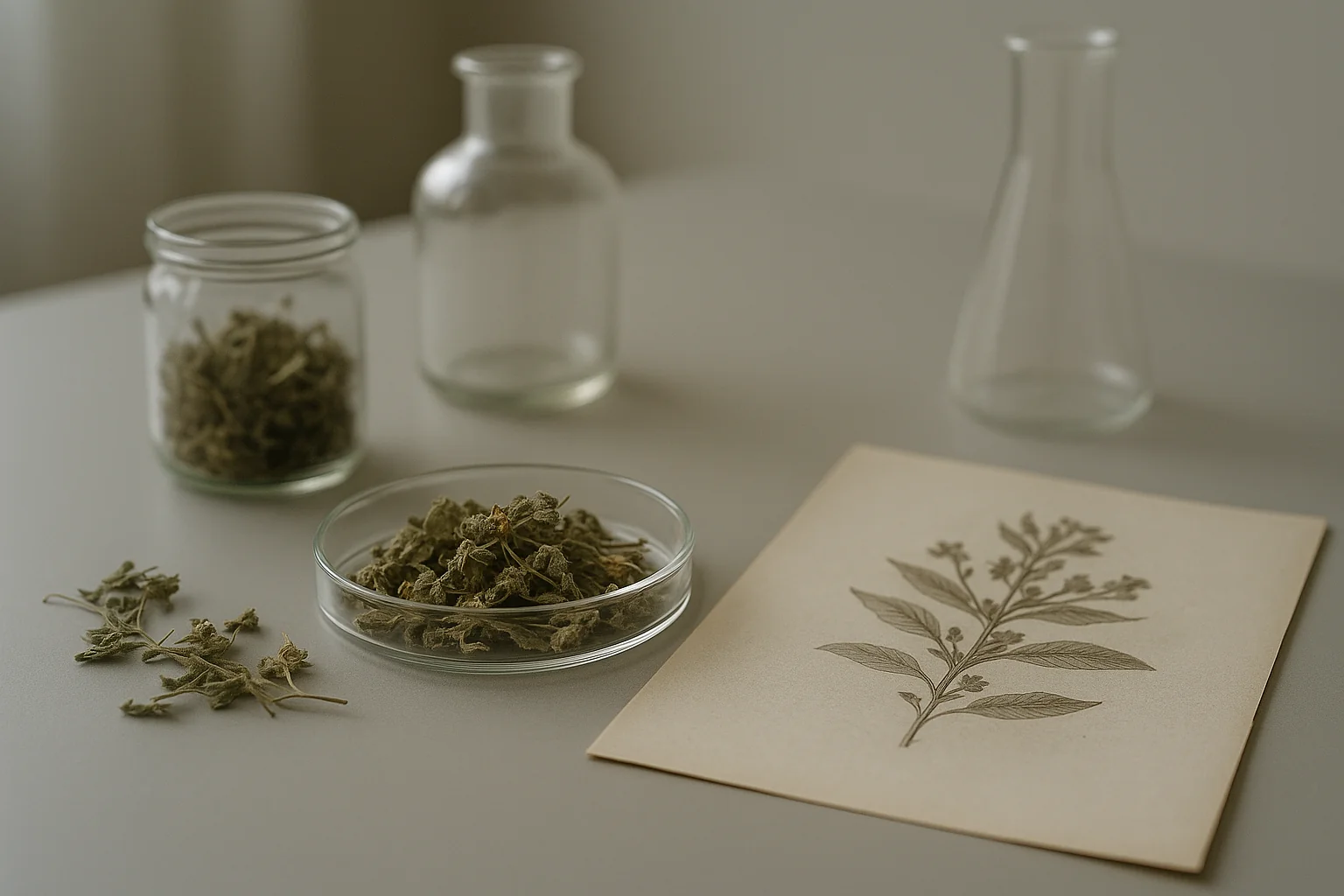

Girl Scout Cookies (Cannabis flos S-LAB): one pharmaceutical version and three descendant strains
The pedigree after OG Kush and Durban Poison, the terpene profile from one source, and only one pharmacy version. In this cluster, Girl Scout Cookies appears more often as a parent than as a commercial entry.
What is Girl Scout Cookies and where does this strain come from?
Girl Scout Cookies is a Californian cultivar with lineage from OG Kush and Durban Poison, popularized by the Cookie Fam breeding collective from the San Francisco Bay area. In Polish pharmacies, it is represented by one manufacturer, and the description of its genetics as indica comes from a single source and is not the result of measurement.
The established lineage is not a rule in this cluster: for twenty-five out of eighty-five strains, the parents remain unknown because the breeder did not disclose them or the available records contradict each other. Here, two independent breeding descriptions indicate the same parents, and the name Cookie Fam refers to a group of breeders, not a single seed company.
The indica label contradicts the second part of this lineage. Durban Poison is considered a South African strain belonging to the opposite side of this classification, and the classification itself describes the plant's morphology, not its chemical composition, and in pharmaceutical descriptions, it may be inherited from the sales material. We do not resolve the dispute; we only show where this discrepancy comes from.
The first component, OG Kush, is the name of an entire family of strains, not a single, identified plant. In Polish pharmacies, there is a separate entry under this name, but its own origin has not been established. A common term in two names does not prove kinship in any direction, and in this compilation, the term kush is carried by both strains with established pedigrees and those that have no pedigree at all.
Which producers supply this strain to Polish pharmacies?
One. Girl Scout Cookies is available in the Polish pharmaceutical market exclusively as dried flower S-LAB and corresponds to a single commercial entry in our comparison. Comparing versions among manufacturers is impossible in this market state because there is nothing to compare, not because the versions would be identical.
| Producer | Registered name without a numerical component | What does this version carry |
|---|---|---|
| S-LAB | Cannabis flos S-LAB | The only pharmaceutical version of this strain. The declared THC content ranges from 16.2% to 19.8%, the genetics are described as indica, and the terpene profile comes from a single database. |
The registered name carries a number in the middle because the doctor and the pharmacy are bound by the producer's declaration. However, this declaration has an allowable deviation upwards and downwards of one-tenth of the value, so quoted alone suggests a precision that does not exist. Therefore, we record the name without the numerical component, and the content separately, with a range.
Availability changes over time, and this entry illustrates that well: the database from which the profile description comes marked it as unavailable at the time of data collection, although it left the description. Pharmaceutical dried flower disappears from circulation due to depletion of the series, a break in supply, or expiration of the permit, and after months, it returns under the same name. We do not repeat stock status in the cultivar description; one place that monitors it is a separately updated list of strains.
Dried flower issued by a doctor's prescription is a different category than dried hemp available over the counter, although both names sound similar. The full list of strains from this producer zbieramy osobno, along with what distinguishes it from the other sixteen suppliers present in this comparison.
What does Girl Scout Cookies smell and taste like?
The source description is brief: spicy, peppery, and earthy aroma. This is a record from the taxonomy of one database, not the result of sensory analysis, so we treat it as a commercial label. The strain's name suggests cookie sweetness, which this record does not confirm at all, and the divergence between the name and description is more common in this cluster.
The peppery tone corresponds to what in volatile chemistry is attributed to kariofilenowi, also present in black pepper and cloves. The earthy note is more often associated with humulenem, known from hop cones. However, this assignment is based on aroma, not on analysis: neither of these two statements comes from measurements taken on a specific batch of dried flower.
The dictionary from which these terms are taken is closed. It covers 146 pharmaceutical entries with only 28 terms, and all three from this description are among the most common: earthy appears in 68 entries, peppery in 57, and spicy in 43. The description that each entry receives roughly every second entry in the database does not distinguish one strain from another and should not be read as a characterization of this dried flower.
The aroma of the dried flower is not a fixed feature. It changes with the harvest time, drying method, and storage conditions, and the volatile fraction diminishes the fastest of everything that can be described in this raw material. The commercial description is created once and remains on the page, even though the batch it referred to has long since left the shelf. The name itself is also not a clue here: the cookie association is driven by marketing, and the source record for this entry speaks of spice and earth.
How long does it take for the strain to take effect and how long does the effect last?
Not after this strain, but after the method of administration. Inhaled vapor acts within a few minutes and diminishes in a few hours, while an ingested portion takes effect much later and lasts longer. No one has measured these times for the strain itself, so the difference between strains cannot be indicated here.
The route of administration determines the course more than the variety itself. After vaporization, the substance passes from the lungs to the blood almost immediately, so the first sensations appear after a few minutes, the intensity increases for another ten to thirty minutes, and the whole effect lasts for two to four hours. After ingestion, the raw material first passes through the intestine and liver, so the first sensations are awaited from half an hour to two hours, and the episode can last six, sometimes eight hours. Hence the most common mistake with oral administration: anyone who thinks nothing is happening after thirty minutes and takes another dose will receive both doses at once. The above ranges describe the route of administration, not this variety; pharmacokinetic studies for a single cultivar have not been published.
The strain contributes one specific number to this picture, the declared content of the active substance, which determines the size of the dose, not the clock. Anyone comparing two entries of different potency with the same method of administration is comparing the dose, not the course. The method of intake and the size of the dose are determined by the attending physician, as they know the patient's other medications.
What is known, and what is not known about the effects of this strain?
Little is known, and it is better to say that directly. No one has published research on the strain itself. There are studies on caryophyllene, the terpene assigned to this entry in our pharmaceutical inventory, but they were conducted on mice and in cell cultures, not on patients inhaling vapor from dried flower.
The first of two studies in the evidence base of this project is Gertsch et al. from 2008 (PMID:18574142) in the Proceedings of the National Academy of Sciences: (E)-caryophyllene selectively bound to the CB2 receptor (Ki = 155 nM) and inhibited carrageenan-induced paw edema in wild-type mice, but not in mice lacking the CB2 receptor (Cnr2-/-), indicating a CB2-dependent mechanism; the study did not include any anxiety tests.
The second is Klauke et al. from 2014 (PMID:24210682) in European Neuropsychopharmacology: Oral caryophyllene reduced the late inflammatory phase of pain in the formalin test in a CB2 receptor-dependent manner, with no effect on the early phase; in a neuropathic pain model, it alleviated thermal hyperalgesia and mechanical allodynia without developing tolerance with chronic administration.
Neither of the two studies tested caryophyllene on humans or in inhaled form from dried flower; both studies pertain to oral or systemic administration in mice in pain and inflammation models, not sleep or mood.
The terpene profile of this entry describes one source and mentions humulene, caryophyllene, limonene and myrcene. We do not provide shares in percentages because the denominator can vary in such comparisons; additionally, two entries are tied at the top, so even this one database does not indicate a single leader. Caryophyllene is listed as the dominant terpene for another reason: this strain was classified as such in the pharmaceutical data, which is a different criterion than the ranking of shares. Separate from the studies is the sales material, attributing a relaxing effect to this strain. This statement comes from the commercial side, not from scientific work, and we mark it here as such.
What side effects have been reported for this strain?
Nothing has been reported separately for this strain, as the reporting system does not use strain names. The registry links an event to the medicinal product and batch number, and one trade name can be associated with many batches. Therefore, below is an image for hemp dried flower as a group.
Reports of adverse effects are collected for medicinal products with a batch number, not for the strain name, so the following pertains to hemp dried flower as a group of raw materials. The most frequently reported symptoms are dry mouth, red eyes, and increased heart rate. Dizziness upon rapid standing, daytime drowsiness, and temporary worsening of short-term memory are less frequently described, as well as anxiety that increases with dosage. A separate issue is medications taken concurrently, especially sedatives and those affecting coagulation: their assessment requires knowledge of the entire list of preparations, not just the description of the plant. We do not provide the frequency of these symptoms numerically, as public compilations for hemp dried flower in Poland do not separate them by individual products.
Additionally, there is the scale. One trade entry corresponds to one strain from one producer, so even when breaking down reports by individual products, the sample would be small. An adverse event is reported to the attending physician or to the national monitoring system, and the strain name is not a decisive field in such a report.
How to vaporize this strain and at what temperature?
There is no single correct number, as temperature tables for terpenes contradict each other. Caryophyllene boils around 257 degrees at atmospheric pressure, but the same compound has been measured at 130 degrees when the pressure was reduced to fourteen millimeters of mercury. The boiling point is not a setting for the vaporizer.
The discrepancy does not arise from careless tables, but from measurement conditions. The lower the pressure, the lower the number in the column, and sources rarely provide both side by side. Humulene has in our data exclusively a measurement taken under reduced pressure, around 99-100 degrees at three millimeters of mercury column, and does not carry atmospheric value at all. Placing such a number next to the atmospheric value of another compound creates a table in which the rows are not comparable. Even rows measured the same way diverge: in the same data, limonene has an atmospheric value around 178 degrees, while myrcene is around 167.
Another issue is the gap between the setting and the temperature of the raw material itself. The display shows the heater setting, not the state of the dried flower in the chamber, and the difference depends on the device's construction and the method of inhalation. For this reason, we do not provide a single number as a recommendation here. The method of consuming the raw material is described by the doctor in the recommendation, and the evaporation temperatures of individual components zbieramy osobno.
Which strains are related to it?
None, if we are asking about siblings. In our pedigree chart, there is no pharmaceutical strain that shares an identified parent with this position. Durban Poison does not appear in any other pedigree of this comparison, and OG Kush is the name of a family of strains, and such a parental community does not imply anything.
Three other positions have OG Kush recorded in their pedigree: Cataract Kush, Chemango Kush, and Galaxy Walker OG. This does not make them siblings of this strain, as the commonality lies in the family name, not an established plant. An empty sibling list with a known pedigree can be a correct result in this project, rather than a gap to be filled.
The reverse direction looks more interesting. Girl Scout Cookies returns in this cluster primarily as a parent: in the pedigrees, it has Electric Honeydew, GMO oraz Balasa, also described as Gorilla Girl. This is offspring, not siblings, and the graph treats both relationships separately.
Osobnym przypadkiem jest Gelato 33, whose pedigree lists thin mint gsc. This name indicates a phenotype derived from the same line, but it has been recorded as a separate entry, so the graph does not automatically connect both entries, and we do not do that either. A parent added by intuition is harder to remove later than to add.
Frequently Asked Questions about Girl Scout Cookies
Can you buy Girl Scout Cookies at a pharmacy without a prescription?
No. Dried flower is a pharmaceutical raw material in Poland issued by a doctor's prescription in the Rpw category, and the pharmacy fulfills a prescription issued by a doctor. The strain name does not change the dispensing mode.
What is the THC content in the pharmaceutical version of this strain?
The manufacturer's declaration for the only pharmaceutical version gives a range of 16.2-19.8%. We provide a range, not a single number, because the declared value has an allowable deviation of one-tenth in either direction.
Is Girl Scout Cookies an indica strain?
One database describes it that way, but this description is not a measurement. The pedigree lists Durban Poison, which is classified on the opposite side of this division, and the division itself refers to the plant's structure, not its chemical composition.
Which terpene dominates in this strain?
In pharmaceutical data, this position is assigned to caryophyllene. However, the ranking of shares from the source database does not indicate a leader, as two positions are equal in it, so both records answer slightly different questions.
Are there studies on the effects of this strain in humans?
No. Our evidence base carries two studies on caryophyllene, both conducted on mice or in cell systems. No clinical study has been published for the cultivar itself, and sales material is not evidence.
Why don't you provide percentage shares of terpenes?
Because the denominator is unknown. The total shares provided by Polish databases for the same positions reach 46 percent in one comparison and 83 percent in another, so numbers from different sources do not describe the same whole.
Where can I check if this strain is currently available?
In the list of available strains, which we update in one place. The description of a single strain intentionally does not carry stock status, as pharmaceutical dried flower disappears from circulation and returns under the same name after months.
Dried flower is a pharmaceutical raw material issued by a doctor's prescription in the Rpw category. The material is informational and does not replace medical advice or the content of the product characteristics. The editorial text was prepared by redakcja ubucha.pl.