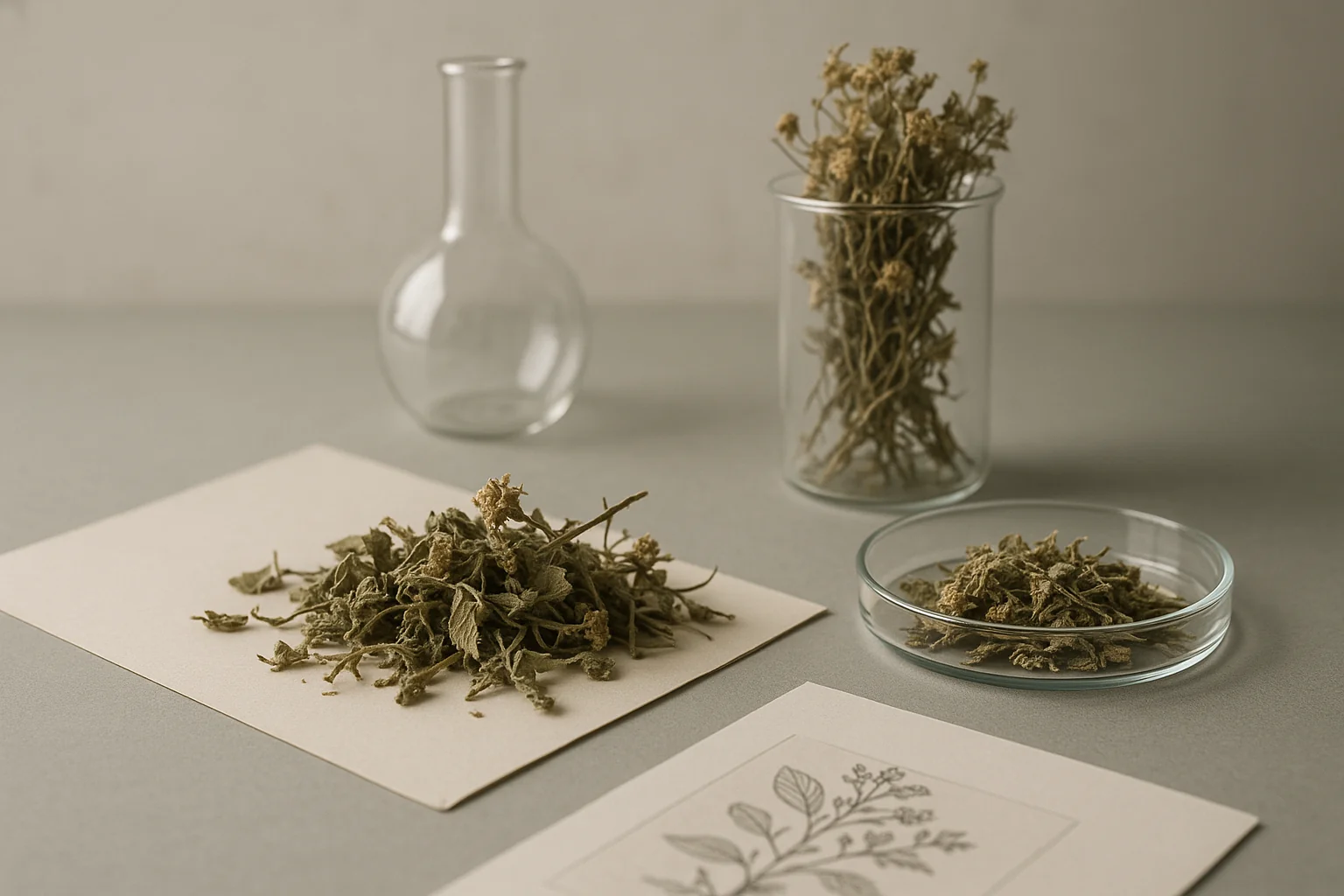

GMO, or Garlic Cookies (Cannabis flos Four 20 Pharma): lineage and two pharmacy entries
The GMO strain in Polish pharmacies has a pedigree from Chemdawg and Girl Scout Cookies, one producer, and two products differing in declared potency. The profile composition is described by one source, and the abbreviation in the name has nothing to do with genetic modification.
What is the GMO strain and where does it come from?
GMO is a cultivar resulting from the crossbreeding of Chemdawg and Girl Scout Cookies. The abbreviation in the name has no connection to genetically modified organisms, and none of the sources on which this text is based provide an expansion of these three letters, so you won't find it here or in the tables below.
The line is managed by Mamiko Seeds, and the garlic-scented phenotype was selected by a breeder known by the pseudonym Skunkmasterflex. This same pharmacy entry is sometimes described under the second name, Garlic Cookies, and that is how it is signed by one of the Polish services cataloging pharmacy offers. The identity of both names was manually verified on the source page, and was not derived from the similarity of the writings, as the mere sound of the name in this cluster proves nothing.
The botanical classification differs in two sources: one describes this strain as a hybrid with an indica dominance, while the other simply as an indica. This discrepancy concerns the catalog label, not measurement, as neither of the two sources provides a laboratory or analysis certificate. The lineage remains the same in both versions and says more than the label: Chemdawg brings a fuel and sharp line, while Girl Scout Cookies brings a dessert line. The lineages of other cultivars from the Polish market are collected in a separate compilation conducted in the hub.
Which producers supply GMO to Polish pharmacies?
One. The dried flower of this name is supplied to Polish pharmacies exclusively by Four 20 Pharma, and the cataloging services note two entries from this manufacturer, differing in declared THC content. No other manufacturer reports in this compilation any dried flower described by the name GMO or Garlic Cookies.
| Producer | Declared THC content given as a range | Availability noted at the time of the inventory | Name used by the source |
|---|---|---|---|
| Four 20 Pharma | 22,5-27,5% | none | GMO |
| Four 20 Pharma | 24,3-29,7% | high | GMO, in the second service Garlic Cookies |
The registration name of both entries carries a number within it, which is why we provide it without this component: Cannabis flos Four20Pharma. The value entered in the name is a declaration from the manufacturer with a deviation of ten percent in either direction, so quoted as a bare number it would promise precision that does not exist. The strength stands separately, in the column with the range, and it should only be read that way. Aside from this declaration, the source notes no difference between the two entries: the profile composition is recorded for them identically, so they are distinguished solely by the number in the registration name.
The table itself ages faster than the paragraph about the pedigree. One of the products was listed at the time of the inventory as unavailable, the other as widely available, and such a state can reverse within a few weeks: it depends on the wholesale supply and whether the producer maintains permission for the raw material. The current state is maintained exclusively in the cluster hub, along with numbers changing from month to month. We also separately explain how to read the declared potency of the dried flower.
How does this strain smell and taste?
The source cataloging this entry describes the aroma as musky, earthy, and herbal, while the cultivation description adds a garlic note, from which the second circulation of the name originated. These are descriptive terms, written by people smelling the dried flower, and not the result of measurement, so they are suitable for comparisons and nothing more.
One source describes the terpene profile composition for this strain and lists farnezen, humulen, caryophyllene, limonene, and myrcene. We do not transcribe the shares, as the denominator is unknown: the total shares provided by Polish databases for the same entries reach only forty-six percent in one case, and eighty-three percent in another, so the numbers from both places do not describe the same whole and cannot be compared. The aroma cannot actually be derived from this list: the source provides a description of the scent separately, without indicating which component is responsible for which note.
The order in this source places farnezen at the top, while the list of pharmacy products labels this strain with a single terpene, myrcene. This is not a measurement contradiction, but two different criteria: one organizes the composition within the profile, the other assigns a single aroma label to the product. For both, we maintain separate discussions, for farnezenu i dla mircenu, as well as for humulenu, kariofilenu and limonene.
How long does it take for the strain to take effect and how long does the effect last?
This has not been measured for GMO. Neither the onset, peak, nor end of the episode has been described in the literature for this cultivar, so the only honest information that can be provided are the ranges resulting from the route of administration. Physiology of absorption determines them, not the composition of this strain.
The route of administration determines the course more than the variety itself. After vaporization, the substance passes from the lungs to the blood almost immediately, so the first sensations appear after a few minutes, the intensity increases for another ten to thirty minutes, and the whole effect lasts for two to four hours. After ingestion, the raw material first passes through the intestine and liver, so the first sensations are awaited from half an hour to two hours, and the episode can last six, sometimes eight hours. Hence the most common mistake with oral administration: anyone who thinks nothing is happening after thirty minutes and takes another dose will receive both doses at once. The above ranges describe the route of administration, not this variety; pharmacokinetic studies for a single cultivar have not been published.
Both pharmaceutical products from this manufacturer differ only in declared strength, so the above time ranges apply to them equally. The method of administration is determined by the attending physician, and the dried flower is dispensed by prescription.
What is known, and what is not known about the effects of this strain?
A single terpene has been studied, not the strain. The evidence base for this project carries three studies on mice for myrcene, while there is not a single study involving humans for GMO. Everything circulating about the effects of this strain comes from catalog descriptions or patient reports.
The catalog description assigns a balanced effect to this product. This is a service label, not a measurement result: there is no protocol, comparative group, or calculated number of participants behind it. The three studies below concern myrcene administered to animals in isolation, thus something different than dried flower, where myrcene coexists with other components of the profile. The closest to the realities of inhalation is the one from 2024, as the terpene was administered as vapor, not in an injection; however, it studied mice and a single compound, not dried flower.
| Work | Model | What was shown |
|---|---|---|
| to Vale TG, Furtado EC, Santos JG, Viana GS, Phytomedicine 2002 (PMID:12587690) | rodent (mouse, intraperitoneal administration) | Beta-myrcene administered intraperitoneally (100-200 mg/kg) reduced the locomotor activity of mice in the open field test, prolonged sleep induced by pentobarbital (by about 2.6 times at 200 mg/kg), and decreased the number of entries into the open arms of the elevated plus maze, which the authors described as a weak anxiogenic effect rather than anxiolytic. |
| Rao VS, Menezes AM, Viana GS, Journal of Pharmacy and Pharmacology 1990 (PMID:1983154) | rodent (mouse) | Myrcene (10-40 mg/kg) reduced pain responses in mice in hot plate and writhing tests induced by acetic acid; the effect was reversed by naloxone and yohimbine, indicating the involvement of alpha2-adrenergic receptors and the release of endogenous opioids. |
| Wagner JK, Gambell E, Gibbons T, Martin TJ, Kaplan JS, NeuroSci 2024 (PMID:39728677) | rodent (mouse, inhalation pairs) | With short inhalations mimicking human inhalation, beta-myrcene exhibited anxiolytic effects in the elevated plus maze in female mice, and in males only with a single inhalation. Unlike linalool, myrcene did not produce a synergistic effect with cannabidiol in either sex. |
In humans, myrcene alone has not been shown to alleviate insomnia at doses typical for inhalation of dried flower. The direction of the effect in rodents depends on the route of administration and sex: intraperitoneal injection in 2002 described a slightly anxiogenic effect, while inhalation in 2024 showed an anxiolytic effect in females. These two results do not negate each other; they simply show that the conclusion depends on conditions that no popular strain database provides.
What side effects have been reported for this strain?
None under this name. The reporting system links symptoms with the medicinal product and its batch, not with the cultivar, so there is simply no separate compilation for GMO. Instead of pretending, we provide below what is known about the raw material itself and clearly mark the scope of this knowledge.
Reports of adverse effects are collected for medicinal products with a batch number, not for the strain name, so the following pertains to hemp dried flower as a group of raw materials. The most frequently reported symptoms are dry mouth, red eyes, and increased heart rate. Dizziness upon rapid standing, daytime drowsiness, and temporary worsening of short-term memory are less frequently described, as well as anxiety that increases with dosage. A separate issue is medications taken concurrently, especially sedatives and those affecting coagulation: their assessment requires knowledge of the entire list of preparations, not just the description of the plant. We do not provide the frequency of these symptoms numerically, as public compilations for hemp dried flower in Poland do not separate them by individual products.
No separate compilation of reports has been published for either of the two GMO products, although they differ in declared strength. This does not mean that symptoms do not occur, only that no one counts them under this trade name.
What is known about the evaporation temperature of the terpenes from this profile?
Less than suggested by popular tables. The public database provides boiling temperatures along with pressure only for some components of this profile, does not provide it at all for one of them, and one value was measured almost in a vacuum. Compiling such numbers in one column compares measurements taken under different conditions.
For myrcene, the base provides 166-167 °C at atmospheric pressure, for limonene around 176 °C, and for caryophyllene 256-259 °C. Humulene has only a measurement at 3 mm Hg, which is 99-100 °C under conditions close to vacuum, and farnezen does not have a boiling point at all in this base. Inserting the value of humulene next to the others gives a false number, not rounded.
Moreover, vaporization does not only start at boiling: the component also evaporates below this temperature, and the rate increases gradually with the vapor pressure. The value set on the device describes the heating element or air, not the temperature of the dried flower itself, which is cooled by airflow during inhalation and heats unevenly. No range is provided here as recommended; the method of consumption is determined by the attending physician. The dried flower sold over the counter, described in our the category of dried flower, is a different raw material than the pharmaceutical product described above.
Which strains are related to it?
Three, all available in Polish pharmacies: Electric Honeydew, Balasa (Gorilla Girl), and Tilray Sirius. The first two share a parent with the GMO strain Girl Scout Cookies, while the third shares Chemdawg. The strain described here is the only one among them that connects with both of these lines at once.
Electric Honeydew comes from Girl Scout Cookies crossed with 91 OG Krypt Melon, supplied by Aurora, and the pharmacy list labels it with the same leading terpene as GMO. Balasa, previously sold as Gorilla Girl, combines Gorilla Glue with Girl Scout Cookies and reaches pharmacies from the producer Cosma. Tilray Sirius derives from Chemdawg crossed with Alien Tech and is the only one of this trio that does not have a cookie line in its pedigree.
We only count siblings where the parents are identified strains, not broad families of style. A common part of the name is not sufficient in either direction: two cultivars with similarly sounding names can have separate pedigrees, while strains named completely differently can be siblings because they share the same parent. The entire kinship graph for the Polish market is collected by the cluster hub. Each of these three strains actually reaches pharmacies from a different producer than GMO, so genetic kinship does not align here with the division among suppliers.
Frequently asked questions about the GMO strain
Does the name GMO mean that the strain is genetically modified?
No. The abbreviation in the strain name has nothing to do with genetically modified organisms. The described origin is simply the crossing of two cannabis strains, Chemdawg and Girl Scout Cookies, and the expansions of these three letters are not provided by the sources used in this text.
Are GMO and Garlic Cookies the same strain?
Yes. The same pharmaceutical product from Four 20 Pharma is sometimes cataloged under the name Garlic Cookies. The identity of both names was manually verified on the source page, not derived from the similarity of the writings.
How many producers supply GMO to Polish pharmacies?
One: Four 20 Pharma. Two products from the same producer are listed, differing in declared strength, and their availability changes with the supplies from the wholesaler.
Why do you provide the THC content as a range, rather than a single number?
Because the number in the registration name is a declaration from the producer with a deviation of ten percent in either direction. Providing a bare number would promise an accuracy that this product does not have.
Does the terpene profile of GMO confirm two sources?
No. The composition describes one source and lists farnezen, humulen, caryophyllene, limonene, and myrcene. The second cataloging service for pharmacy offerings lists this item without a terpene list.
Have studies been published for the GMO strain itself?
Not involving humans. The evidence base for this project carries three studies on myrcene, all on mice, and none of them examined this strain or the dried flower as a whole.
Which strains are related to GMO?
Electric Honeydew, Balasa (Gorilla Girl), and Tilray Sirius. The first two share a parent with Girl Scout Cookies, while the third shares a parent with Chemdawg.
Dried flower is a pharmaceutical raw material dispensed by prescription in the Rpw category. The material is informational in nature and does not replace medical consultation. Editorial: ubocha.