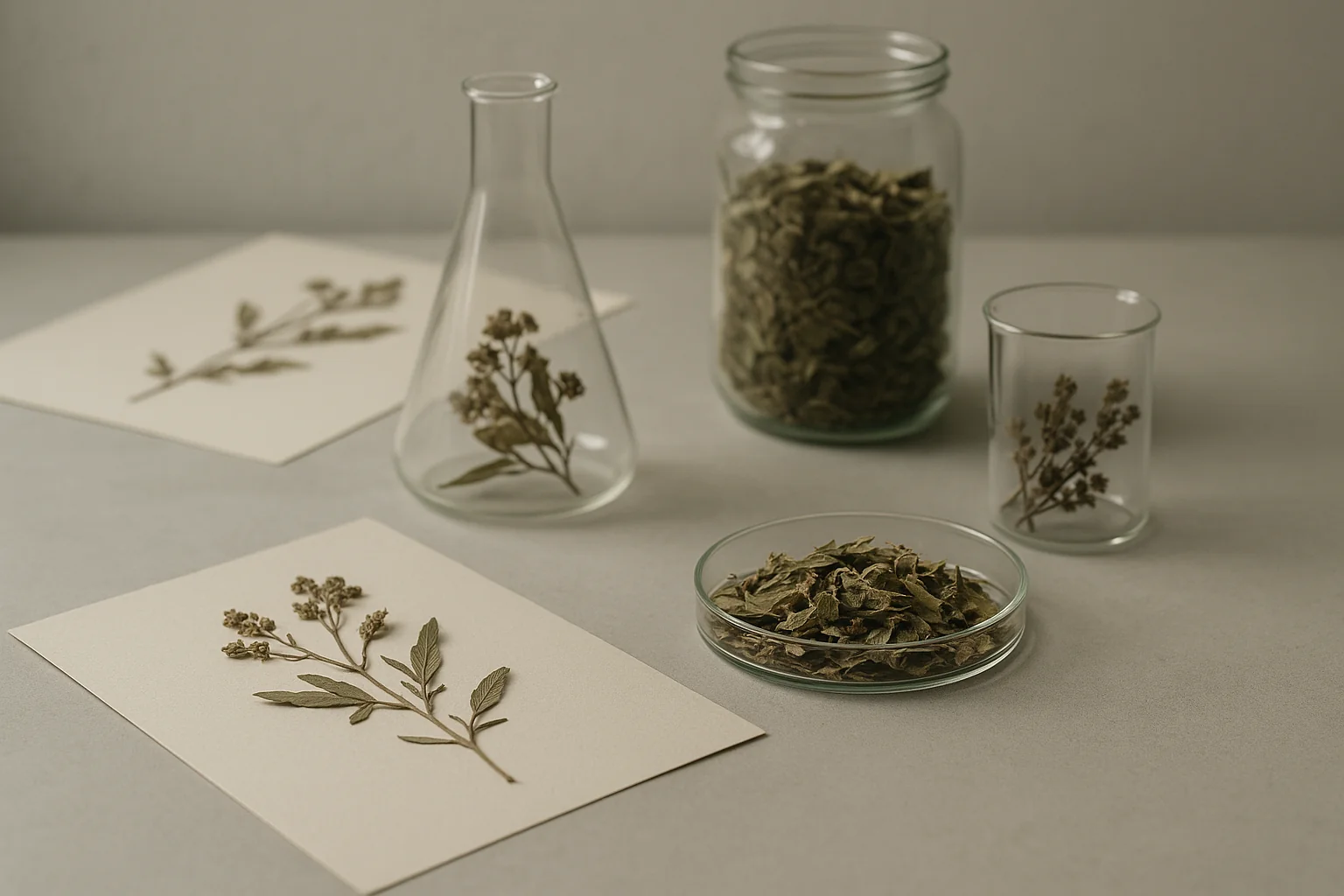

Gorilla Glue and Cataract Kush: caryophyllene versus myrcene, two sources versus one
Gorilla Glue leads with caryophyllene, Cataract Kush with myrcene, and the difference goes further: the profile of the first is described by two inconsistent sources, while the profile of the second by one. The comparison also shows where such wide content ranges come from.
How do these two strains really differ?
In three ways at once. The leading terpene: caryophyllene leads in Gorilla Glue, while myrcene leads in Cataract Kush. The lineage: the pedigree chart does not provide a common parent for them. The producer: none of the four companies supplying the first strain to Polish pharmacies also supplies the second. The THC content is the fourth difference, not the first.
The indication of the leading terpene represents something different on each side. The profile database describes five registry entries for Gorilla Glue, and in each of them, caryophyllene is at the forefront, even when the rest of the list looks completely different. For Cataract Kush, there are four entries, but the description of the shares is repeated in terms of quantity, so myrcene leads there in one description used four times, not in four independent readings. This asymmetry returns below, when asking about sources.
The producers are completely different. Gorilla Glue reaches Polish pharmacies from CanPoland, Four 20 Pharma, PhytoPur Bio, and Suprobion, while Cataract Kush comes from S-LAB, Synoptis Pharma, and Tilray. There is not a single common producer, although both strains have four entries in their inventory; for the second one, one producer is responsible for two.
| Feature | Gorilla Glue | Cataract Kush |
|---|---|---|
| Leading terpene by shares | caryophyllene | myrcene |
| Parents according to the pedigree chart | chem’s sister, sour dubb, chocolate diesel | la confidential, og kush |
| Genetics provided by databases | hybrid or hybrid-indica, conflicting sources | indica, consistent sources |
| Producers in Polish pharmacies | CanPoland, Four 20 Pharma, PhytoPur Bio, Suprobion | S-LAB, Synoptis Pharma, Tilray |
| Registry entries in the inventory | cztery | cztery |
| Sources describing the profile | two, inconsistent in composition | one |
The declared content separates this pair the least of all four characteristics, as the ranges of both strains overlap over a larger part of their length. Therefore, the first sentence of this page talks about terpenes, not potency. A separate page about the strain Gorilla Glue collects its lineage and pharmaceutical versions, while a separate page about the strain Cataract Kush does the same for the second side of the pair.
What connects them?
A set of terpenes, not kinship. The six names listed in the Cataract Kush profile are exactly the same names that appear in the Gorilla Glue profile, and the latter has bisabolol on the list as well. Both leading terpenes are present on both sides of the pair, so the difference concerns the order, not presence.
There is no common parent, and the graph of this cluster reaches back only one generation, so further relatives are simply not checked. The three names from the lineage of Gorilla Glue, namely chem's sister, sour dubb, and chocolate diesel, do not appear in the graph under any other strain from Polish pharmacies. The lineage of Cataract Kush leads to la confidential and og kush, and the latter name appears in the lineages of three more cultivars in this comparison and is itself a strain of uncertain origin.
The sibling field is empty for both strains, each for a different reason. With Gorilla Glue, none of the three parents has a second offspring in this set, so there is no one to compare it to. With Cataract Kush, OG Kush acts like a broad family style rather than a single, identified strain, so dividing such a parent does not make two cultivars siblings. The empty list is a design decision here, not a gap to be filled.
Moreover, they share the method of issuing and the way the content is described: both have four registered entries in their inventory, and the content range was created by combining the declarations of several separate entries, not from the ranges of one. Both sides of the pair are also described by the same profile database; what distinguishes them is whether someone has verified this description with a second voice.
How do we know what the terpene profile of each of them looks like?
With varying degrees of certainty on both sides. The composition of Gorilla Glue is provided by two Polish databases, and these sources differ from each other: bisabolol and humulene are only listed in one. For Cataract Kush, there is only one source left, as the second database does not have this strain at all, so there is nothing to compare.
The discrepancy with Gorilla Glue goes beyond two additional names. For the same registered entry from the same manufacturer, one database opens the list with caryophyllene, while the other with myrcene, so both sources disagree on both the composition and what is at the forefront of that composition. The dispute cannot be resolved from the outside: in the data on which this cluster stands, there is neither a method of designation nor a batch number for any of the profiles.
The reverse is true for Cataract Kush. One source describes all four entries of this strain with the same set of shares, so repetition here is not confirmation but duplication of one description. There is no second voice at all, as the database that was used for comparison with Gorilla Glue does not describe this strain. Therefore, neither of the two profiles is confirmed, only for two different reasons: one has two conflicting voices, the other one voice that no one has verified.
This is why there is a ban on providing shares in percentages. Five entries for Gorilla Glue yield five different totals in one database when all reported shares are added: 64, 67, 78, 83, and 98. Four entries for Cataract Kush consistently yield 94, as the description is the same. None of these totals adds up to one hundred, and since the total can vary for each entry of the same strain, the denominator is unknown. A number without a denominator appears in the text about the pharmacy raw material as a result of designation, but it is not.
How do the THC ranges of both strains compare to other strains?
Widely, both. Gorilla Glue has a range of 18.0-26.4% in this comparison, the widest among sixty-nine ranges collected for strains from Polish pharmacies. Cataract Kush has 16.2-24.2%, and the same range is shared by fourteen other strains, so it does not say anything particular about it.
Both are composed of several separate registered entries, not from the ranges of one declaration. The manufacturer's tolerance reaches one-tenth of the declared value, so the entry for Cataract Kush with a declaration of eighteen percent gives 16.2-19.8%, while the entry with a declaration of twenty-two percent gives 19.8-24.2%; only the combination of both segments yields 16.2-24.2%.
For Gorilla Glue, such declarations take four different values, from twenty to twenty-four percent, and these define four overlapping segments: 18.0-22.0%, 19.8-24.2%, 20.7-25.3%, and 21.6-26.4%. The combination of four separate registered entries gives 18.0-26.4%, a range that has no equivalent in this comparison. The width here speaks to the number of reports on the market, not that one batch is sometimes weaker and sometimes stronger.
The common part of both ranges is 18.0-24.2%, which is about three-quarters of the length of each. The patient does not receive a strain at the pharmacy, only a specific registered entry with its own declaration, so comparing strains solely by their range says more about how many manufacturers reported them than about how they differ. The availability of individual entries also changes over time, as permits expire and manufacturers withdraw batches; the current state collects a summary of available strains.
What has been shown for caryophyllene, the leading terpene in Gorilla Glue?
Two studies, both on rodents, both about pain and inflammation, neither about sleep or mood. The first showed that the effect disappears in animals lacking the CB2 receptor, the second that with chronic administration, tolerance does not develop. None of them reaches a human inhaling vapor from dried flower.
The Gertsch team published a paper in 2008 in the Proceedings of the National Academy of Sciences (PNAS) with the identifier PMID:18574142. The study model is a mouse (in vivo) and a test tube (receptor binding, human cells). (E)-caryophyllene selectively bound to the CB2 receptor (Ki = 155 nM) and inhibited paw swelling induced by carrageenan in wild-type mice, but not in mice lacking the CB2 receptor (Cnr2-/-), indicating a CB2-dependent mechanism; the study did not include any anxiety tests.
The second study, PMID:24210682, was published in 2014 in European Neuropsychopharmacology, and its model is a rodent (mouse). Oral caryophyllene reduced the late inflammatory phase of pain in the formalin test in a CB2 receptor-dependent manner, with no effect on the early phase; in a neuropathic pain model, it alleviated thermal hyperalgesia and mechanical allodynia without developing tolerance with chronic administration.
The boundary of both studies is stated directly. In neither of the two studies was caryophyllene tested on humans or in inhaled form from dried flower; both works concern oral or systemic administration in mice in pain and inflammation models, not sleep or mood. Everything else said about the effects of this strain comes from patient reports or manufacturer materials and does not have the status of a study result. More broadly about the kariofilenie is discussed on a separate page of this comparison.
What is known about myrcene, the leading terpene in Cataract Kush?
Three studies, all on mice, and the outcome depends on the route of administration. Intraperitoneal injection produced a slightly anxiogenic effect in 2002, inhaled vapor produced an anxiolytic effect in females in 2024, and a study from 1990 described the abolition of pain responses after naloxone. Insomnia in humans was not studied in any of them.
The 2002 study, PMID:12587690, was published in Phytomedicine, and its model is a rodent (mouse, intraperitoneal administration). Myrcene administered intraperitoneally (100-200 mg/kg) reduced the locomotor activity of mice in the open field test, prolonged sleep induced by pentobarbital (by about 2.6 times at 200 mg/kg), and reduced the number of entries into the open arms of the elevated plus maze, which the authors described as a weak anxiogenic effect, not anxiolytic.
The year 1990 brought the study PMID:1983154 in the Journal of Pharmacy and Pharmacology, conducted on a model described in the database as a rodent (mouse). Myrcene (10-40 mg/kg) reduced pain responses in mice in hot plate and writhing tests induced by acetic acid; the effect was abolished by naloxone and yohimbine, indicating the involvement of alpha2-adrenergic receptors and the release of endogenous opioids.
The latest of the three, PMID:39728677 from 2024 in NeuroSci, used a model closer to inhalation, namely mice exposed to vapors. With short puffs of vapor, mimicking inhalation in humans, beta-myrcene acted anxiolytically in the elevated plus maze in female mice, and in males only with a single puff.
The boundary of these works stands in one sentence. In humans, it has not been shown that myrcene alone alleviates insomnia at doses typical for inhaling dried flower. The direction of the effect in rodents depends on the route of administration and sex: after intraperitoneal injection in 2002, a slightly anxiogenic effect was described, while after inhalation in 2024, an anxiolytic effect was observed in females. These two results do not negate each other; they simply show that the conclusion depends on conditions that no popular strain database provides. More broadly about the mircenie is discussed on a separate page of this comparison.
How long does it take for the dried flower from each of these strains to start working?
Identically, and that is the entire answer here. The onset time and duration of the episode depend on the method of intake of the raw material, and the name of the cultivar does not shift anything in this calculation. For neither of these two strains has anyone announced a measurement of concentrations over time, so the difference in profile remains untranslatable to the clock.
The route of administration determines the course more than the variety itself. After vaporization, the substance passes from the lungs to the blood almost immediately, so the first sensations appear after a few minutes, the intensity increases for another ten to thirty minutes, and the whole effect lasts for two to four hours. After ingestion, the raw material first passes through the intestine and liver, so the first sensations are awaited from half an hour to two hours, and the episode can last six, sometimes eight hours. Hence the most common mistake with oral administration: anyone who thinks nothing is happening after thirty minutes and takes another dose will receive both doses at once. The above ranges describe the route of administration, not this variety; pharmacokinetic studies for a single cultivar have not been published.
For the same reason, it cannot be said that one of these two strains works longer than the other. Such a statement would require measurement on humans for each cultivar separately, and such measurements do not exist for either; the difference in the terpene profile does not replace it, although it is often used that way in commercial descriptions.
What side effects have been reported for each of these two strains?
For neither individually. The register of side effects links the report to the medicinal product packaging, marked with a batch number, not to the cultivar name, so separating reports between these two strains is impossible. If one had more, it would indicate sales volume, not the safety of the raw material.
Reports of adverse effects are collected for medicinal products with a batch number, not for the strain name, so the following pertains to hemp dried flower as a group of raw materials. The most frequently reported symptoms are dry mouth, red eyes, and increased heart rate. Dizziness upon rapid standing, daytime drowsiness, and temporary worsening of short-term memory are less frequently described, as well as anxiety that increases with dosage. A separate issue is medications taken concurrently, especially sedatives and those affecting coagulation: their assessment requires knowledge of the entire list of preparations, not just the description of the plant. We do not provide the frequency of these symptoms numerically, as public compilations for hemp dried flower in Poland do not separate them by individual products.
There is also a calculation that cannot be performed: both strains have four registration positions, but the number of dispensations in pharmacies is not published, so the denominator is missing here just as it is for shares in the profile. Without a denominator, comparing the two strains by the number of reports is arithmetic without a basis.
Frequently Asked Questions
Is Gorilla Glue stronger than Cataract Kush?
The declared ranges of both strains overlap for a larger part of their length, and the pharmacy dispenses a specific registration position, not a strain, so comparing by name alone does not resolve anything. The choice of raw material is determined by the attending physician.
Are these two strains related?
The lineage graph of this comparison does not provide a common parent for them, and the sibling field is empty for both. The lineage of Gorilla Glue leads to chem's sister, sour dubb, and chocolate diesel, while the lineage of Cataract Kush leads to la confidential and og kush.
Why are there no percentage shares for the terpene names?
Because the denominator is unknown. The sum of shares given for the five positions of Gorilla Glue is sometimes 64, sometimes 98, while for Cataract Kush it is always 94, because the base replicates the same description for all four positions.
Where does the width of the THC content range for one strain come from?
From the composition of declarations of several separate registration positions. For Gorilla Glue, there are four nominal declarations, each with its own manufacturer's tolerance, so the range of the strain 18.0-26.4% is the sum of four narrower segments, not the margins of a single batch.
Does either of them work better for sleep?
There is no data to resolve this. Studies on myrcene were conducted on mice, and their results vary with the method of administration; studies on caryophyllene concern pain and inflammation, not sleep. None of them studied humans inhaling vapor from dried flower.
Can these strains be purchased without a prescription?
No. Dried flower is a pharmaceutical raw material dispensed by a doctor's prescription in category Rpw, and both cultivars are available in Poland only as registration positions dispensed in pharmacies with a prescription.
Dried flower is a pharmaceutical raw material dispensed by a doctor's prescription in category Rpw. The material is for informational purposes and does not replace the advice of the attending physician.
The editorial text was prepared by redakcja ubucha.pl.