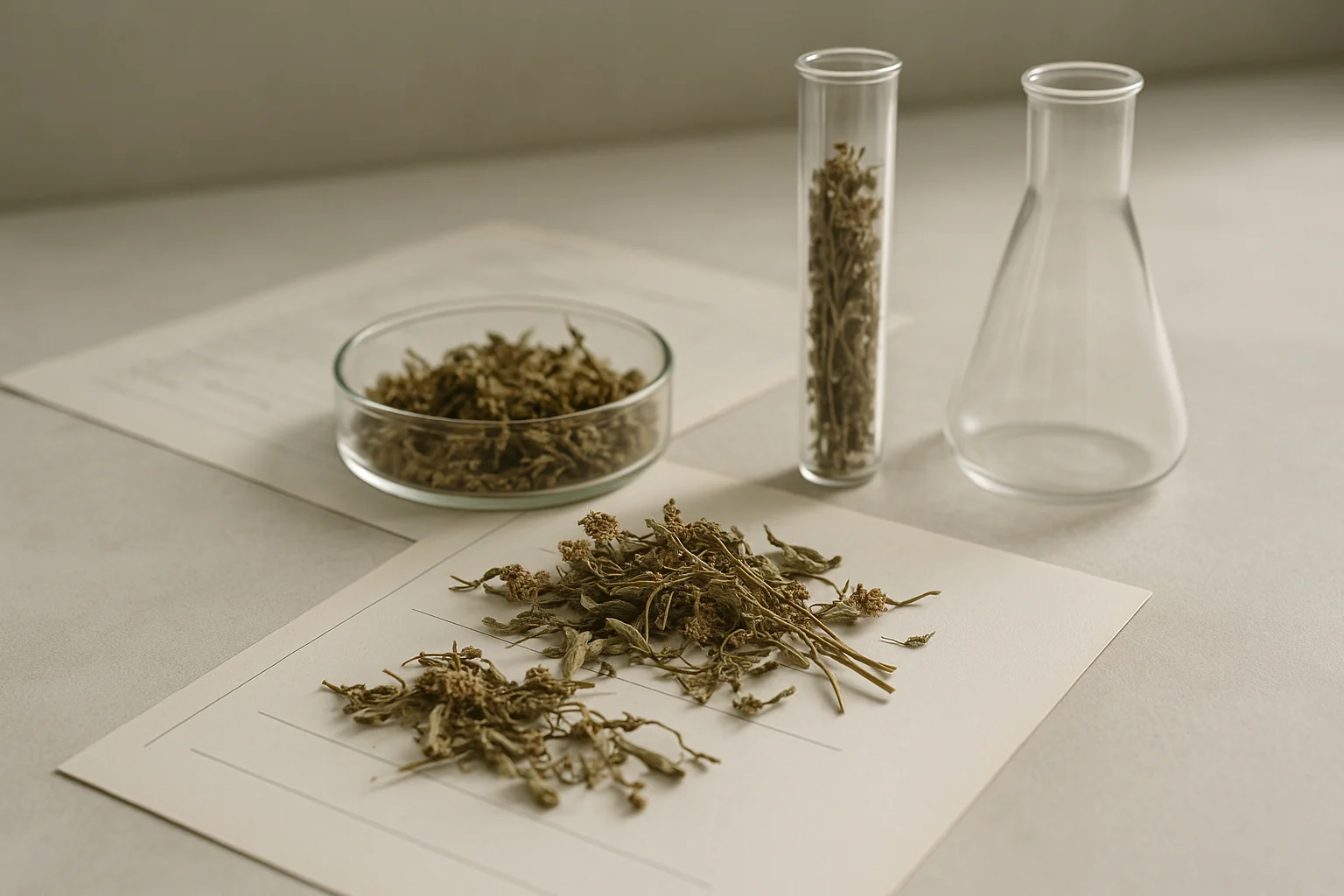

Purple Octane (Cannabis flos S-LAB): a lineage derived from three lines and caryophyllene in the profile
Purple Octane reaches Polish pharmacies from one producer, and its origin has been recorded from three breeding lines. We gather here what the data says about this strain and mark the places where it is absent.
What is Purple Octane and where does this strain come from?
Purple Octane is a hybrid with a predominance of the indica line, recorded in the pedigree graph as a combination of three breeding lines: Biscotti, Sherb BX1, and Jealousy F2. The authorship of the cross is attributed to the breeder Seed Junky Genetics. It reaches Polish pharmacies as dried flower from a single producer, and there is one registration entry corresponding to it.
The designations with two parents refer to the breeding technique. The abbreviation BX1 indicates the first backcross generation, meaning offspring crossed back with one of the parents to stabilize the traits of that side of the lineage. The symbol F2 describes the second generation of offspring, in which traits spread more widely than in the first. Therefore, the pedigree record pertains to the breeding material, not a specific batch of dried flower that ends up on the pharmacy shelf.
The origin is recorded from two independent sources: a seed bank maintaining the genealogy of strains and a Polish description of this pharmacy entry. In this cluster, such a complete record is not the norm. For twenty-five out of eighty-five described cultivars, the origin remains undetermined because the breeder did not disclose it or the available records provide conflicting versions. Purple Octane belongs to the better-documented part of this collection.
The assignment to a hybrid with a predominance of indica comes from one description and is not confirmed in another Polish database, as it does not include this strain at all. The indica or sativa label still speaks today about the plant's structure and the history of the line, rather than what the dried flower contains in the package. We will break down the composition below, along with what is not known about it.
Which producers supply Purple Octane to Polish pharmacies?
One. The strain is supplied by S-LAB, and in the compilation we are working on, it corresponds exactly to one registration entry and one catalog number. Therefore, there are no parallel versions to choose from, nor a second producer with which to compare the declared composition of the same name.
| Producer | Registered name without a numerical component | Declared THC content as a range | CBD content | Positions in pharmacies |
|---|---|---|---|---|
| S-LAB | Cannabis flos S-LAB | 19,8-24,2% | declared as not exceeding one percent | one |
The registration name carries the declared content, which is why it appears in the table without a numerical component. The value from the label has a ten percent tolerance from the producer, so the quoted bare number returns to the text as a measurement that it is not. The range of 19.8-24.2% is the same declaration after distributing the tolerance on both sides.
The database from which the description of this entry comes marked its availability as none at the time of data collection. This is a state of the wholesaler, not a characteristic of the strain: deliveries come in batches, and a single entry can disappear from circulation for weeks and return without notice. We maintain a current list of what can actually be purchased in the list of strains available in Polish pharmacies, and prices are also listed there. This text describes the strain itself.
Store category dried flower this is a separate circulation: raw material sold over the counter, in which there are no pharmacy positions. Purple Octane does not belong to it. We also separately collect everything that this producer supplies to Polish pharmacies, as in this cluster, it is responsible for thirty-eight cultivars.
What does Purple Octane smell and taste like?
Descriptions come from a single source, the only one that characterizes this strain at all: they mention a fuel-like and earthy aroma, with spicy, pine, and fruity notes. These are verbal labels, not measurement results: they arise from the impression of the person describing a single batch of raw material and do not have a scale on which they could be reproduced elsewhere.
The set of compounds provided for this entry aligns with this description. At the forefront is caryophyllene, described as having a peppery and spicy note, alongside it humulene associated with hop bitterness and linalool a floral profile. Further in the composition are limonene, terpinolen, nerolidol and farnezen. We break down each of them in a separate article.
Fragrance descriptors do not predict effects and are not stable over time. The scent of a batch may differ after a few weeks from opening the package, as volatile compounds deplete faster than cannabinoids, and the rate of depletion depends on temperature and the airtightness of the container. The list of scents comes from the same base entry as the composition, so it is not an independent confirmation.
How long does it take for Purple Octane to take effect and how long does the effect last?
The onset of effects depends on the method of consumption, not the name on the package. No one has measured the onset or duration of effects for Purple Octane specifically, as no study has focused on this cultivar separately. Therefore, the description of the experience depends on whether the material first reaches the lungs or the stomach.
The route of administration determines the course more than the variety itself. After vaporization, the substance passes from the lungs to the blood almost immediately, so the first sensations appear after a few minutes, the intensity increases for another ten to thirty minutes, and the whole effect lasts for two to four hours. After ingestion, the raw material first passes through the intestine and liver, so the first sensations are awaited from half an hour to two hours, and the episode can last six, sometimes eight hours. Hence the most common mistake with oral administration: anyone who thinks nothing is happening after thirty minutes and takes another dose will receive both doses at once. The above ranges describe the route of administration, not this variety; pharmacokinetic studies for a single cultivar have not been published.
The width of the declared range does not change anything in this rhythm. The notation 19.8-24.2% indicates how much active substance a batch may contain, not how long it will take for a patient to feel anything. The method of consumption and dosage are determined by the attending physician; they write the prescription for the material from the Rpw category.
What is known and what is not known about the effects of Purple Octane?
What is known is based on one of the compounds from its profile, and that is from animal studies. The strain itself does not have its own study involving patients, and the description of its relaxing effects comes from a commercial database, not from scientific work. We separate these two levels below because they often mix in descriptions.
The team of Gertsch J, Leonti M, Raduner S, Racz I, Chen JZ, Xie XQ, Altmann KH, Karsak M, Zimmer A described in 2008 in the Proceedings of the National Academy of Sciences (PNAS) the following (PMID:18574142): (E)-caryophyllene selectively bound to the CB2 receptor (Ki = 155 nM) and inhibited carrageenan-induced paw swelling in wild-type mice, but not in mice lacking the CB2 receptor (Cnr2-/-), indicating a CB2-dependent mechanism; the study did not include any anxiety tests.
Six years later, Klauke AL, Racz I, Pradier B, Markert A, Zimmer AM, Gertsch J, Zimmer A showed in European Neuropsychopharmacology (PMID:24210682): Oral caryophyllene reduced the late inflammatory phase of pain in the formalin test in a CB2 receptor-dependent manner, with no effect on the early phase; in a neuropathic pain model, it alleviated thermal hyperalgesia and mechanical allodynia without developing tolerance with chronic administration.
We record the boundaries of both studies literally, as they are also results: In neither of the two studies was caryophyllene tested on humans or in inhaled form from dried flower; both studies concern oral or systemic administration in mouse models of pain and inflammation, not sleep or mood. On the other side is the descriptive material: the database indicates relaxing and balanced effects for this entry. This is a catalog label, not a measurement result from patients.
What adverse effects have been reported after using Purple Octane?
None under this name. Safety monitoring in Poland is conducted based on the registration position and batch number, so reports do not carry the name of the cultivar and cannot be attributed to it. Purple Octane has one entry in pharmacies, which still does not create a separate signal for counting.
Reports of adverse effects are collected for medicinal products with a batch number, not for the strain name, so the following pertains to hemp dried flower as a group of raw materials. The most frequently reported symptoms are dry mouth, red eyes, and increased heart rate. Dizziness upon rapid standing, daytime drowsiness, and temporary worsening of short-term memory are less frequently described, as well as anxiety that increases with dosage. A separate issue is medications taken concurrently, especially sedatives and those affecting coagulation: their assessment requires knowledge of the entire list of preparations, not just the description of the plant. We do not provide the frequency of these symptoms numerically, as public compilations for hemp dried flower in Poland do not separate them by individual products.
The assessment of whether a particular pharmacy item is safe for the patient belongs to the attending physician and the pharmacist dispensing the material. Neither the strain description nor the list of its volatile compounds can replace this.
Is it possible to create a vaporization temperature table for the Purple Octane profile?
Not in the form that such tables circulate online. Of the eleven terpenes described in this project, the public database PubChem provides boiling points along with pressure for only six, and the profile of this strain includes several entries that perform the worst in such a comparison.
Caryophyllene, the leading compound in this profile, has its measurement provided along with pressure. Humulene is only listed under reduced pressure: the database notes 99-100 degrees at 3 mm Hg, which is under near-vacuum conditions. Nerolidol has a record without specified pressure, so it cannot be compared with the previous ones, and farnezen does not have a boiling point listed in the database at all. Therefore, three out of seven entries in this profile cannot be included in a common table without falsifying measurement conditions.
The idea of targeting a single terpene is based on a misunderstanding. Vaporization occurs below the boiling point as well, and its rate increases exponentially with temperature; the boiling point is the temperature at which the vapor pressure equals the surrounding pressure, not a threshold for initiating vaporization. Separately we break down the evaporation of terpenes from dried flower and the comparability of circulating tables. We do not suggest temperatures or equipment here: the method of consumption is determined by the attending physician.
Which strains from Polish pharmacies are related to Purple Octane?
One: Sherbert Scotti, which shares a parent named Biscotti. The relationship goes through one side of the pedigree, so it is closer to half-sibling status than to a pair from the same cross. Aside from this name, the pedigree graph does not connect Purple Octane with any other cultivar from this set.
Sherbert Scotti comes from crossing Sunset Sherbet with Biscotti, reaching pharmacies from the same producer, and its profile leads with the same terpene. Therefore, both strains are close not only in lineage but also in what the source provides about their composition. We describe it separately.
The name component does not prove anything in either direction. Sherb from the record Sherb BX1 returns in the names King Sherb and Mystic Wonder, ale pierwsza ma w rodowodzie Blue Sherbet, a druga Garlic Sherbert, czyli osobno nazwane linie. Gelato 33 shares the second parent, Sunset Sherbet, with Sherbert Scotti, but there is no connection in the graph with Purple Octane.
On the side of the first component, there is the same problem. Big Purple Dragon it descends from Purple Urkle, and the lineage of the strain Purps remains undetermined, which means that the common word in the name does not create kinship between them nor does it exclude it. There is no sibling added by intuition in this cluster: an empty list can be a correct result, not a gap to fill.
Frequently Asked Questions about Purple Octane
Is Purple Octane an indica or sativa strain?
The description of this strain classifies it as a hybrid with indica dominance, while the second Polish listing of the strain does not include it at all. The label comes from one description and speaks about the breeding line's history, not the contents of the package.
What is the THC content in Purple Octane?
The declared content is given in the range of 19.8-24.2%, as the value on the label has a ten percent tolerance from the producer. We do not provide a single number, as it would suggest a precision of measurement that the declaration does not have.
Who supplies Purple Octane to Polish pharmacies?
S-LAB, as the only producer in this listing, in one registration entry. We check current availability in the list of strains available in Polish pharmacies, as a single strain can disappear from wholesalers and return after weeks.
Does Purple Octane have siblings among strains from Polish pharmacies?
It has one: Sherbert Scotti, with which it shares a parent named Biscotti. The remaining name similarities in this listing are not confirmed in the lineage graph.
Have clinical studies been published regarding Purple Octane?
No. Available works concern a single terpene from its profile and were conducted on mice, not on humans. For the cultivar itself, neither a clinical study nor a pharmacokinetic measurement has been published.
Why do you not provide the percentage shares of terpenes in the profile?
Because the denominator is unknown. The sum of the shares provided by the source for this strain amounts to 82 instead of one hundred, so the numbers do not add up to a whole and cannot be read as a measurement. We provide the composition as is.
Dried flower is a pharmaceutical raw material dispensed by a doctor's prescription in the Rpw category. The material is informational in nature, describes the state of available data, and does not replace medical advice. Editorial: ubocha.