
CBG + CBD and other hemp cannabinoids - use together or separately?
CBG, CBD, CBN, and CBC: what studies really showed about combining cannabinoids, where the entourage effect is a hypothesis, and what the CBG survey does not confirm.
The question “together or separately” comes up in discussions about cannabinoids more often than the question about dosage. The answer usually circulates in the form of ready-made sets: CBG in the morning for focus, CBN in the evening for sleep, a trio of ingredients for pain. We checked each of these sets at the source, reading the studies they refer to and noting the research model in which each result was obtained. Some hold up well, some are based on studies in mice or cell cultures, and one of the most frequently repeated has directly contradictory data in the publication cited as its proof. The difference between these three situations determines how much can be inferred from a given result. This guide separates these three categories and shows where pharmacology ends and sales begin.
KEY INFORMATION
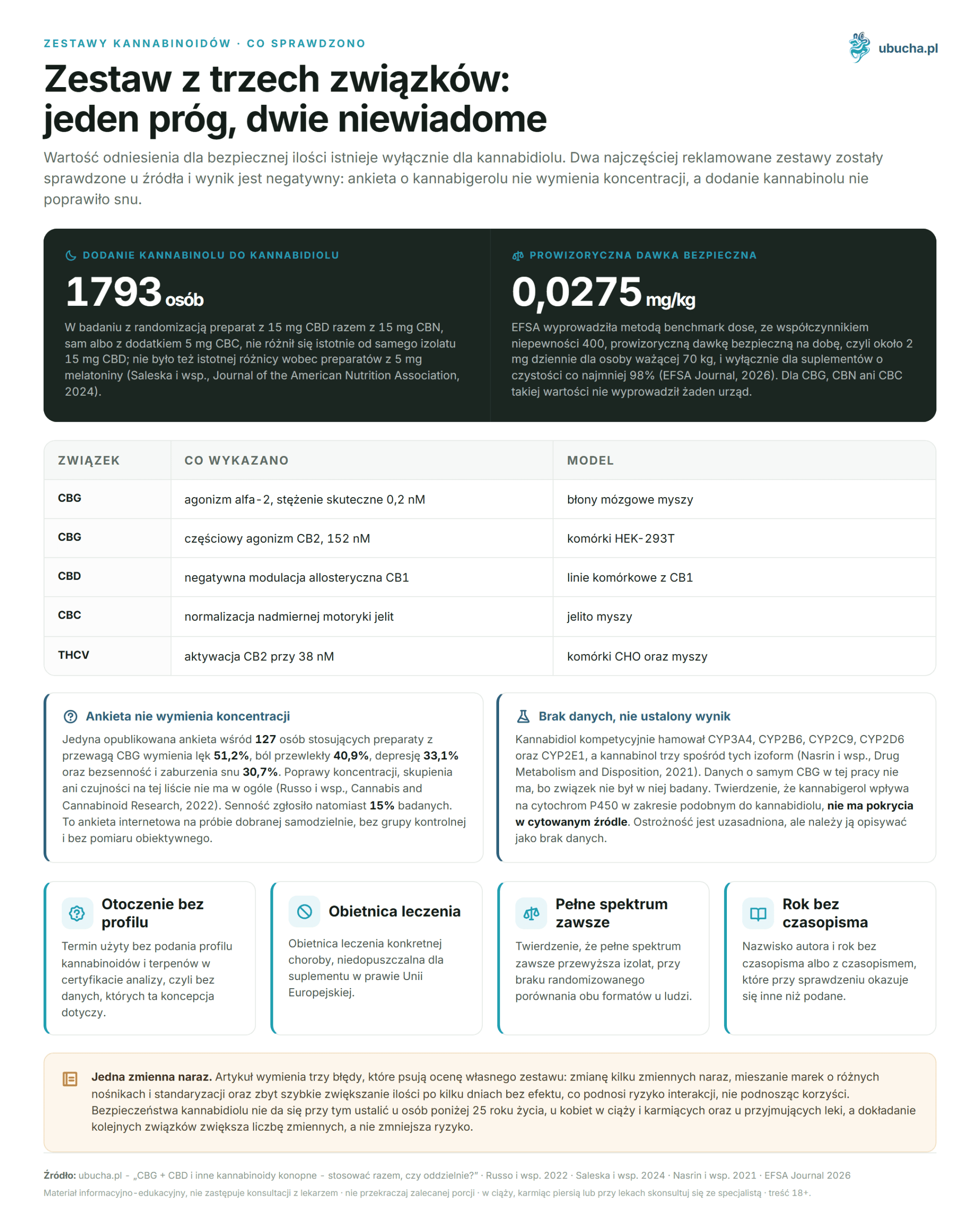
• CBG acts as a strong alpha-2-adrenergic receptor agonist, with an effective concentration of 0.2 nM in mouse brain membranes (Cascio et al., British Journal of Pharmacology, 2010).
• In a survey of 127 people using CBG-dominant products, the most common reasons were anxiety (51.2%), chronic pain (40.9%), depression (33.1%), and insomnia (30.7%); improvement in concentration is not on this list.
• In a study of 1793 people, adding 15 mg of CBN to 15 mg of CBD did not improve sleep quality compared to CBD alone.
• The entourage effect remains a hypothesis: Russo formulates it conditionally, and Finlay found no terpene synergy on cannabinoid receptors.
What are the differences between CBG, CBD, and other minor cannabinoids?
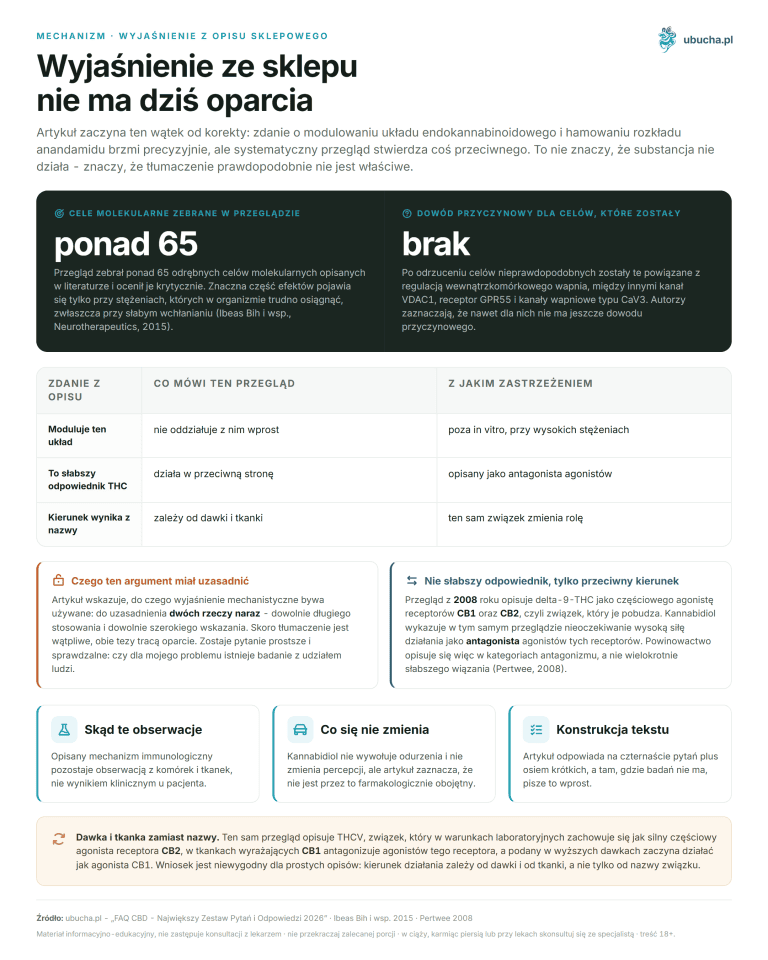
The differences begin at the level of molecular target, not on the label. Each of these compounds targets a different receptor system, so combining them only makes sense if you know what you are aiming for. The following table provides one finding for each cannabinoid and the model in which it was obtained, as the latter determines how much of the result can be transferred to humans.
| Compound | Molecular target | What was shown | Model |
|---|---|---|---|
| CBG | alpha-2-adrenergic receptor | agonism with an effective concentration of 0.2 nM, antagonism towards 5-HT1A | mouse brain membranes |
| CBG | CB2 receptor | partial agonism, binding constant 152 nM in live cells | HEK-293T cells |
| CBD | CB1 receptor | negative allosteric modulation, reduces agonist efficacy | CB1 cell lines |
| CBC | TRPA1 channel | normalization of excessive intestinal motility caused by inflammation | mouse intestine |
| THCV | CB2 receptor, CB1 blockade | CB2 activation at 38 nM, reduced swelling and hyperalgesia | CHO cells and mice |
The rows of the table come from the works of: Cascio et al. 2010 and Navarro et al. 2018 for cannabigerol, Laprairie et al. 2015 for cannabidiol (British Journal of Pharmacology), Izzo et al. 2012 for cannabichromene, and Bolognini et al. 2010 for tetrahydrocannabivarin (British Journal of Pharmacology).
Two things in this table are worth reading carefully. First: CBG and CBD do not compete for the same receptor, so the argument that one “enhances” the other does not arise from receptor pharmacology. Second: the model column in most rows is cellular or mouse, not human. A finding from cell culture tells what a given compound can do, not what it will do after swallowing a drop of oil.
Separately, it is worth noting one finding regarding CBC, as it is counterintuitive. Izzo et al. showed that cannabichromene normalizes inflammation-induced excessive intestinal motility in mice, but this effect did not disappear after administering cannabinoid receptor antagonists or TRPA1 antagonist (British Journal of Pharmacology, 2012). In other words, the mechanism remains undetermined, although the effect itself is repeatable. This compound is described more broadly in the entry what is CBC.
What does the term “mother of cannabinoids” really mean?
The term refers solely to biosynthesis in the living plant and is only true there. Cannabigerolic acid is the precursor from which synthase enzymes produce the acidic forms of the other cannabinoids. After harvesting and extraction, this enzymatic machinery no longer works.
The practical consequence is more important than it seems. When you buy CBG oil, you are buying a stable end product that will not convert to CBD or THC in the body. The expectation that cannabigerol supplementation will “turn into” cannabidiol comes up regularly in conversations and is biochemically unfounded. The botanical name has been transferred in marketing to pharmacology, where it has no application.
CBG is thus a full-fledged, standalone cannabinoid with a profile unlike CBD. Cascio et al. studied it for its action on G protein-coupled receptors and described it as a strong alpha-2-adrenergic receptor agonist, with an effective concentration of 0.2 nM in mouse brain membranes. In the same study, CBG behaved as an antagonist of the 5-HT1A receptor and, at a concentration of 10 micromolar, as a competitive antagonist of the CB1 receptor (British Journal of Pharmacology, 2010).
A later work complements this picture from the perspective of cannabinoid receptors. Navarro et al. demonstrated that CBG is a partial agonist of the CB2 receptor, with a binding constant of 152 nM measured in live cells, and that it modifies receptor signaling at concentrations of 0.1-1 micromolar; the effect on the CB1 receptor was measurable, but the mechanism remained unexplained (Frontiers in Pharmacology, 2018). More about the compound itself can be found in the entry CBG, what is it cannabinoid.
What is the entourage effect and does it have scientific confirmation?
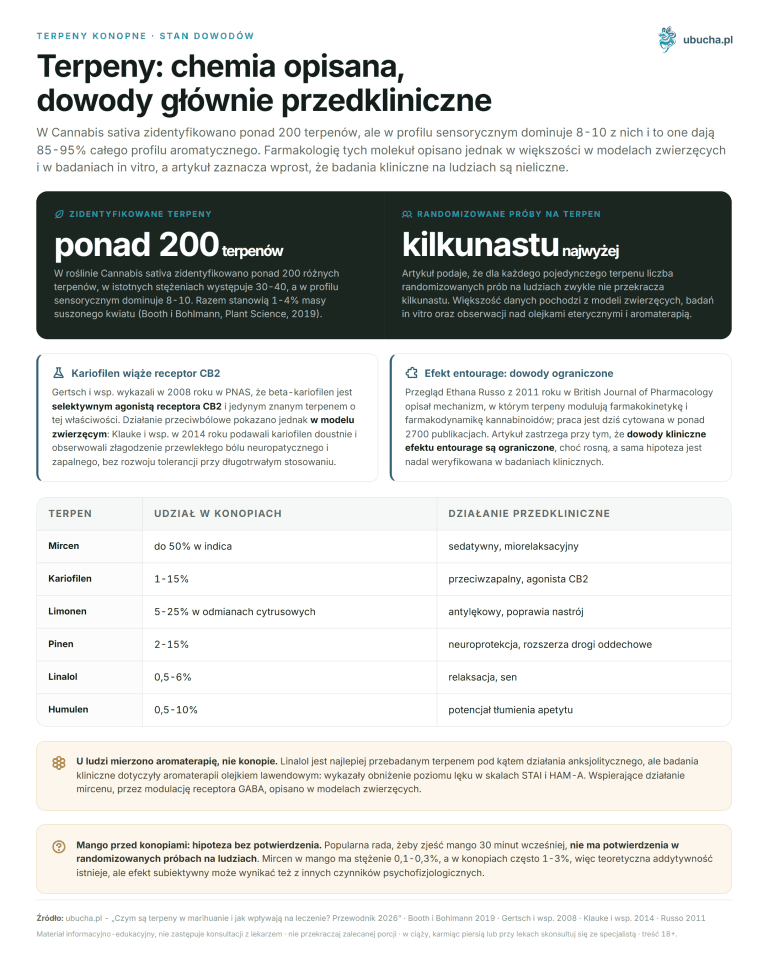
The entourage effect assumes that cannabinoids and terpenes work together differently than separately. The concept was developed by Ethan Russo in a 2011 review, and the way he formulated it there is often lost in citations. Cannabinoid-terpene synergy is conditionally posed in this work as a hypothesis requiring proof, and a significant portion of the text is devoted to proposing methods to study it (British Journal of Pharmacology, 2011).
Biochemical foundations exist, and the strongest of them was provided by a study on beta-caryophyllene. Gertsch et al. showed that this common volatile plant component selectively binds to the CB2 receptor, with a binding constant of 155 nM, and acts as its functional agonist. Administered orally at a dose of 5 mg per kilogram of body weight, it significantly reduced the inflammatory response in wild-type mice, but not in mice lacking the CB2 receptor (PNAS, 2008). Thus, the terpene turned out to be a functional cannabinoid present in ordinary food.
Russo returned to the topic in a review published in 2018, arguing for moving away from calling varieties “strains” in favor of chemovars and writing that the argument for synergy is now strong enough that a single molecule is unlikely to match the potential of the whole plant (Frontiers in Plant Science, 2018). However, this is still an argument, not a clinical study result.
A separate review gathered literature on terpenes associated with cannabinoids in mood and anxiety disorders, discussing possible mechanisms of antidepressant and anxiolytic action (Ferber et al., Current Neuropharmacology, 2020). This is a review paper indicating research directions, not proof of the effectiveness of a specific set.
Why do studies on the entourage effect yield conflicting conclusions?
Because they study it at different levels, and only one of them has been rigorously tested so far. Finlay et al. checked whether cannabis terpenoids act through cannabinoid receptors and published a result that is already visible in the title of the paper: cannabis terpenoids do not mediate the entourage effect through action on cannabinoid receptors (Frontiers in Pharmacology, 2020).
This does not close the matter; it only closes one hypothesis. If synergy occurs, it is not at the level of affinity for CB1 and CB2, because it is not visible there. Other possible levels remain: pharmacokinetic, ion channel, and molecular targets outside the endocannabinoid system, such as serotonin receptors. None of these have been studied with the same rigor as cannabinoid receptors.
The sharpest critical voice was formulated by Cogan. In an analysis published in the Expert Review of Clinical Pharmacology, he describes the entourage effect as a concept coined in 1998 as a hypothetical note on the margins, which then began to function in scientific reviews and marketing campaigns as a purely beneficial phenomenon. His conclusion is that claims about the entourage effect refer to poorly defined and unconfirmed pharmacological actions, used to popularize and sell products (Expert Review of Clinical Pharmacology, 2020).
It is worth noting one thing we checked while organizing this text. Cogan’s criticism is sometimes attributed in Polish materials to the journal “Minerva Pneumologica,” which has nothing to do with this work. The name of the journal is the most frequently misquoted element in cannabinoid citations and is also the easiest to verify.
Do full spectrum, broad spectrum, and isolate produce different effects?
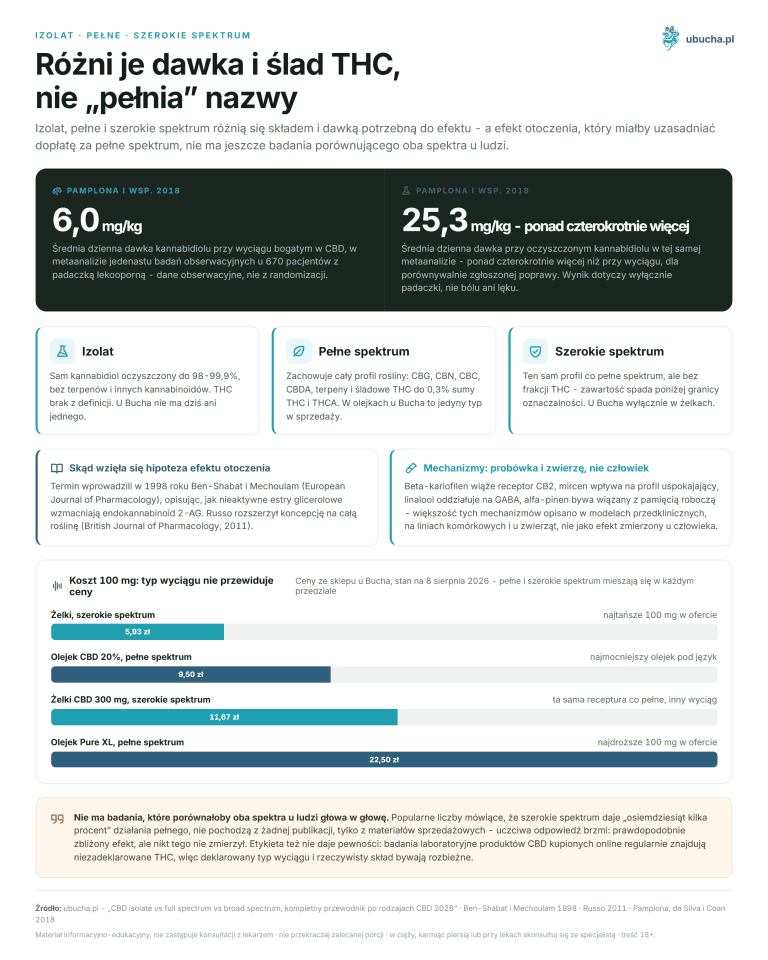
They differ in composition, and whether they differ in effect is a separate question, and the answer is: unknown. Full spectrum contains the entire natural profile of the plant along with trace THC, broad spectrum retains the rest of the components after THC removal, and isolate is a single compound with a purity above 99%. This distinction is analytical and verifiable in the certificate of analysis.
What is missing? A randomized study in humans that would compare these three formats at the same dose of cannabidiol and show a difference. The argument for full extract is based on preclinical works and reviews, not on a comparison in the human population. A seller who presents the advantage of full spectrum as an established fact is ahead of the data.
Isolate, however, has three practical advantages that no one questions. It does not contain THC, thus eliminating the risk of a positive test result for this substance. It allows for milligram dosing without variable content of minor cannabinoids. It is tasteless and odorless, which simplifies formulation.
The choice between formats thus comes down to life situation, not potency. A professional driver or an athlete subject to anti-doping control has a specific and verifiable reason to choose broad spectrum or isolate. A person without such restrictions chooses based on hypothesis, and it is good to know this when comparing prices. The technical differences between forms of extract are broken down in the entry hemp distillate vs isolate.
What does the survey among CBG users say about focus?
Nothing, and this is the most important finding of this chapter. The set “CBG in the morning for focus” usually refers to the only existing survey among people using CBG-dominant preparations. It included 127 adult residents of the United States who had used products containing over 50% CBG in the last six months (Russo et al., Cannabis and Cannabinoid Research, 2022).
The list of ailments for which respondents used CBG looks like this: anxiety 51.2%, chronic pain 40.9%, depression 33.1%, and insomnia and sleep disorders 30.7%. Improvement in concentration, focus, or alertness is not on this list at all. The thesis of the “focusing cannabinoid” does not come from this work, even though it is cited as its source.
What else did the survey show? Efficacy was rated highly: 80% of people with depression, 78.3% with anxiety, 73.9% with chronic pain, and 73% with insomnia declared an advantage of CBG products over their previous pharmacological treatment. 44% of respondents reported no side effects, and among those reported, the most common were dry mouth (16.5%), drowsiness (15%), and increased appetite (11.8%). Withdrawal symptoms were not observed by 84.3% of respondents.
How to read this? This is an online survey on a self-selected sample, without a control group and without objective measurement, so it speaks to why people reach for CBG and how they evaluate it. The authors themselves state that this is the first such survey and that CBG-dominant products should be tested in randomized clinical trials. Drowsiness among side effects is difficult to reconcile with advertising CBG as a means for alertness.
Does CBN really help with sleep?
The evening set with CBN is today the best-tested of popular sets, and the result of this testing is negative. A review dedicated directly to this question searched the literature and qualified eight full-text studies for detailed analysis. The author found not a single published clinical study that examined the relationship between CBN and validated sleep questionnaire outcomes or polysomnography (Corroon, Cannabis and Cannabinoid Research, 2021).
So where does the reputation come from? Most human studies date back to the 1970s and 1980s, on small samples with little demographic diversity. Studies assessing subjective feelings of sedation or fatigue are rare, and evidence that CBN itself produces effects similar to cannabis in humans is ambiguous, with most available data indicating a lack of such action.
After this review, a large randomized study was published that checked the matter directly. There were 1793 participants who were randomly assigned to one of six capsule preparations for four weeks; sleep disturbances were measured using the PROMIS Sleep Disturbance SF 8A questionnaire. All preparations improved sleep in within-group comparisons, and clinically significant improvement was noted by 56% to 75% of participants (Saleska et al., Journal of the American Nutrition Association, 2024).
However, the decisive comparison is between the arms. The preparation containing 15 mg of CBD together with 15 mg of CBN, either alone or with the addition of 5 mg of CBC, did not differ significantly from the 15 mg CBD isolate alone. There was also no significant difference compared to preparations with 5 mg of melatonin. The authors conclude that adding low doses of CBN and CBC may not improve the efficacy of cannabidiol preparations. All preparations had a favorable safety profile: 12% of participants reported adverse effects, and none were severe.
There is one more lead that the author of the review states directly, which changes the whole discussion about CBN. Cannabis products marketed as supporting sleep usually contain no more than 5 mg of cannabinol, and Corroon recommends that future randomized studies use doses significantly higher than those currently found on the market. It is therefore possible that the question of CBN’s effectiveness has not yet been posed at a dose that could show anything. The topic is further developed in the entry does CBD help with sleep.
What is known about combining cannabinoids for pain?
Here, the evidence is the richest, but entirely preclinical, so it must be read with species and model noted. Anand et al. administered CBG, CBD, and THC individually and in combination on cultures of rat spinal ganglion neurons, checking the blocking of the response to capsaicin. The greatest inhibition was obtained at 30 micromolar CBG, 100 micromolar CBD, and 100 micromolar THC separately, and with a mixture of the three compounds in a ratio of 1 to 1 to 1 at 90 micromolar (Journal of Pain Research, 2021).
The authors formulate the conclusion cautiously and it is worth quoting in their wording: the combination may increase the potency of these compounds compared to administration separately, and the efficacy and tolerance of THC could improve in a mixture with CBG and CBD, which deserves further investigation in a living organism. This is a premise for research, not a protocol for application.
The second work is closer to application and concerns post-traumatic pain. Khajuria et al. studied CBD and CBG in a mouse model of tibial fracture. Both compounds normalized pain sensitivity to mechanical, cold, and hot stimuli, and their analgesic effect was comparable to non-steroidal anti-inflammatory drugs. At the same time, unlike these drugs, cannabinoids supported healing: they increased the number of progenitor cells in the hematoma of the healing bone and accelerated mineralization (Journal of Bone and Mineral Research, 2023).
The third work concerns CBD and CBC administered to the periaqueductal gray matter in anesthetized rats. Both compounds reduced the activity of neurons in the ventromedial part of the medulla oblongata and elicited an analgesic response, and the effect was abolished by administering antagonists of CB1 receptors, adenosine A1, and TRPA1, but not TRPV1 (Maione et al., British Journal of Pharmacology, 2011). None of these three studies were conducted in humans.
Does combining cannabinoids change the risk of drug interactions?
Yes, and this is the best-documented aspect of the entire topic. A review of data from product information on cannabidiol-containing medications found that nearly half of users experienced adverse effects, with a general dose-dependent relationship, and the most common included increased aminotransferase activity, sedation, sleep disturbances, and infections (Brown and Winterstein, Journal of Clinical Medicine, 2019). The authors point to the influence of CBD on cytochrome P450, mentioning CYP3A4 and CYP2C19, as well as P-glycoprotein.
A laboratory work specified the list of isoforms. In microsomes with overexpressed individual enzymes, cannabidiol competitively inhibited CYP3A4, CYP2B6, CYP2C9, CYP2D6, and CYP2E1, while cannabinol inhibited three of these isoforms (Nasrin et al., Drug Metabolism and Disposition, 2021). This study also evaluated tetrahydrocannabinol along with its metabolites, which are present in higher concentrations in plasma and persist longer than the parent compounds.
Here, a gap appears that materials on cannabinoid sets usually remain silent about. There is no data on the inhibition of liver enzymes by CBG in this work, as the compound was not studied there. The claim that cannabigerol affects cytochrome P450 to a similar extent as cannabidiol, repeated in guides on combinations, therefore has no backing in the cited source. Caution is warranted, but it should be described as a lack of data, not as an established result.
When does a conversation with a doctor stop being a formality? With drugs that have a narrow therapeutic window, with antiepileptic drugs, during pregnancy and breastfeeding, and before the age of 25, i.e., in groups for which EFSA could not establish safety. Adding additional cannabinoids to the set increases the number of variables, not decreases the risk.
How much cannabidiol is safe according to EFSA?
Since 2026, there is a number to refer to. The European Food Safety Authority derived a provisional safe dose of 0.0275 mg per kilogram of body weight per day using the benchmark dose method, with an uncertainty factor of 400, which for a person weighing 70 kg gives about 2 mg per day (EFSA Journal, 2026).
The range of this value should be provided along with it. It applies only to supplements with a purity of cannabidiol of at least 98%, without nanoparticles, with a production process deemed safe, and with excluded genotoxicity. The panel based it on subchronic studies compliant with good laboratory practice.
One sentence from this opinion is more important than the number itself and directly concerns the reader building a set. The safety of cannabidiol cannot be established in individuals under 25 years of age, in pregnant and breastfeeding women, and in individuals taking medications. The panel also lists areas with incomplete data: liver, gastrointestinal tract, and nervous, hormonal, and reproductive systems. Animal studies have shown consistent liver toxicity, and human data indicate a potential hepatotoxicity, especially with concurrent use of medications.
This has a direct effect on multi-cannabinoid sets. A reference value exists only for cannabidiol; for CBG, CBN, or CBC, no authority has derived such a dose, as there is no basis for it. A set of three compounds therefore does not have three safety thresholds, but one threshold and two unknowns.
How to recognize marketing hype around the entourage effect?
Skepticism is justified in this category also because the problem can be the content of the packaging itself. A review for clinicians published in Mayo Clinic Proceedings describes the market as poorly regulated and notes that studies have shown discrepancies between declared amounts of CBD and THC and actual content (VanDolah et al., 2019). Before assessing the action of a set, it is worth knowing what it actually contained.
Four warning signals regularly recur in this category, and each can be checked in a minute.
- The term “entourage effect” used without providing the cannabinoid and terpene profile in the certificate of analysis, i.e., without the data to which this concept applies.
- The promise of curing a specific disease, unacceptable for a supplement under EU law.
- The claim that full spectrum always surpasses isolate, in the absence of randomized comparisons of both formats in humans.
- The author’s name and year without a journal or with a journal that turns out to be different upon checking.
A certificate of analysis from an accredited laboratory should provide the content of the main cannabinoids along with THC, the terpene profile, and results of tests for pesticides, heavy metals, solvent residues, and microbiology. The batch number on the document should match the number on the packaging, and the analysis date should not be older than a year. The absence of a terpene profile while simultaneously advertising the entourage effect is an internal contradiction of the offer.
What mistakes most often spoil the assessment of one’s own set?
The most common mistakes do not concern the choice of compound, but the method of observation. A survey among 387 people using cannabidiol showed how low the real doses are: 54% of respondents took less than 50 mg daily, and 72.6% chose the sublingual route (Moltke and Hindocha, Journal of Cannabis Research, 2021). Comparing one’s own feelings with descriptions from forums can therefore be comparing two different things.
The first mistake is changing several variables at once. If you start with a set of three compounds and feel something, you have no way to attribute the effect to any of them. Establishing a reference point with one preparation, and only then adding the second, is the only method that yields an interpretable result.
The second mistake is mixing brands. Different manufacturers use different carriers and different degrees of standardization of raw materials, so three products from three companies introduce into the observation variables that you do not control. The third mistake is too quickly increasing the dose after a few days without effect, which raises the risk of interactions without increasing benefits.
The fourth mistake is a higher-order one and concerns reading sources. A percentage given without an author’s name, year, and journal is not data. While organizing this text, we rejected several such numbers, including alleged percentages of improvement in concentration after CBG and alleged results of a study on CBN, which in the original publication said something contrary. Keeping a simple observation journal provides material that can be read after a month, instead of an impression that can be interpreted arbitrarily.
Summary: when together, and when separately
The answer depends on how strong evidence you require. For cannabidiol alone, there is a reference value from EFSA and the broadest clinical material, so this is the best-described starting point. For the set with CBG, the basis is receptor pharmacology and one survey that does not confirm the most frequently advertised use. For the set with CBN, we have a randomized study of 1793 people, in which adding cannabinol did not improve the outcome.
For chronic pain, the material is the most interesting and at the same time the least ready for application, as it comes from cell cultures and animal models. The signal from these works is consistent, yet it says nothing about dose or proportion in humans.
The practical conclusion is therefore more modest than most guides suggest. Start with one compound, change one thing at a time, require a certificate of analysis with a batch number, and check the journal with every number that sounds convincing. If you are taking prescription medications, establish combinations with a doctor or pharmacist before adding anything to the set.
Frequently Asked Questions
Is it better to buy CBG and CBD in one bottle or separately?
Separate products provide greater freedom to change proportions, while one bottle locks it in. From the perspective of observing one’s own response, separate preparations are better because they allow changing one variable at a time. However, no study has compared both solutions in terms of effectiveness, so this is a methodological, not clinical, argument.
Does CBG improve concentration?
The only published survey among 127 people using CBG-dominant products lists anxiety (51.2%), chronic pain (40.9%), depression (33.1%), and insomnia (30.7%), but improvement in concentration is not on that list (Russo et al., 2022). Among the side effects, respondents reported drowsiness in 15% of the subjects.
Does adding CBN to CBD improve sleep?
In a randomized study of 1793 people, a preparation with 15 mg of CBD and 15 mg of CBN did not differ significantly from the 15 mg CBD isolate alone, and the authors conclude that adding low doses of CBN and CBC may not improve efficacy (Saleska et al., 2024). An earlier review found no CBN studies with polysomnography (Corroon, 2021).
Can a cannabinoid set give a positive THC test result?
The risk concerns only full-spectrum products that contain trace amounts of tetrahydrocannabinol. Broad spectrum and isolate do not carry this risk, provided the manufacturer’s declaration matches the content. However, a review for clinicians notes discrepancies between declared amounts of CBD and THC and actual amounts as a documented market problem (VanDolah et al., 2019).
Is the entourage effect proven?
No. Russo formulates synergy conditionally and proposes methods to study it, Finlay et al. did not detect terpene synergy on cannabinoid receptors, and Cogan describes the entire concept as based on poorly defined and unconfirmed pharmacological actions. Biochemical foundations exist, but clinical confirmation in humans is lacking.
How much cannabidiol is considered safe?
EFSA derived a provisional safe dose of 0.0275 mg per kilogram of body weight per day in 2026, which is about 2 mg for a person weighing 70 kg, solely for supplements with a purity of at least 98%. Safety cannot be established for individuals under 25 years of age, pregnant and breastfeeding women, and those taking medications.
If you want to compare available concentrations of CBD and CBG in one place, you can find them in the category hemp oils.
This article is for informational and educational purposes only and does not constitute medical advice. Before starting to use cannabis or CBD for therapeutic purposes, consult a doctor, especially if you are taking other medications, are pregnant, or breastfeeding.
Author: Michał Waluk · Published: 2026-05-04 · Updated: 2026-08-10