
How Does CBD Work? Mechanisms of Cannabidiol Action in 2026
Over 65 molecular targets, with action through the endocannabinoid system considered unlikely. CBD mechanism based solely on measured data.
One ready answer circulates online about the mechanism of cannabidiol action: CBD stimulates the endocannabinoid system, inhibits the FAAH enzyme, and raises anandamide levels. However, a systematic review of the molecular pharmacology of this molecule, published in 2015 in Neurotherapeutics, presents a different view. The authors counted over 65 molecular targets described in the literature and concluded that CBD very likely does not act in neurological diseases through modulation of the endocannabinoid system, and direct interaction with this system is seen only in cell cultures at supraphysiological concentrations. Below we dissect the mechanism layer by layer, sticking to what has actually been measured, and show where popular number compilations have no basis in the studies they cite.
KEY INFORMATION
- Over 65 molecular targets of CBD are described in the literature, but a systematic review considers action through the endocannabinoid system very unlikely (Ibeas Bih, Neurotherapeutics, 2015).
- In cell models, CBD behaves as a non-competitive negative allosteric modulator of the CB1 receptor (Laprairie, British Journal of Pharmacology, 2015).
- Absolute bioavailability of CBD in humans was measured only after smoking and is 31%; for oral administration, no study has established it (Millar, Frontiers in Pharmacology, 2018).
- EFSA derived a provisional safe dose of 0.0275 mg per kilogram of body weight per day, about 2 mg for a 70 kg person (EFSA Journal, 2026).
- CBD safety cannot be established in people under 25 years old, pregnant or breastfeeding women, or those taking medications (EFSA Journal, 2026).
What is the endocannabinoid system and what does CBD really do to it?
The endocannabinoid system is a network composed of three types of elements: CB1 and CB2 receptors, ligands produced by the body, and enzymes that break down these ligands. However, a systematic review of the molecular pharmacology of CBD states directly that cannabidiol does not interact with this system outside of cell cultures at supraphysiological concentrations, and considers the impact of CBD on neurological diseases through this system very unlikely (Ibeas Bih, Neurotherapeutics, 2015).
It is worth separating two things that merge into one in marketing texts. The endocannabinoid system itself is well described. It is known where its receptors are located, which molecules stimulate them, and which enzymes clear them. Whether CBD acts specifically through this system is a separate question, and the answer today is more cautious than it was a decade ago.
| Element | What it is | Where it acts |
|---|---|---|
| CB1 receptor | G protein-coupled receptor | Mainly central nervous system |
| CB2 receptor | G protein-coupled receptor | Immune cells and peripheral tissues |
| Anandamide (AEA) | Endogenous cannabinoid receptor ligand | Synapses, produced on demand |
| 2-AG | Second endogenous ligand | Synapses, higher concentration than anandamide |
| FAAH | Enzyme hydrolyzing anandamide | Intracellular membranes |
| MAGL | Enzyme breaking down 2-AG | Presynaptic terminals |
We describe the distribution of the receptors themselves more broadly in a separate article about where CB1 and CB2 receptors are located and what they do. Here one observation suffices: the existence of a system regulating many functions does not prove that an orally administered plant substance acts through it. Each link in this chain requires evidence.
Where did the endocannabinoid deficiency hypothesis come from?
From clinical observation, not from population screening. The hypothesis states that every person has a certain level of endocannabinoid tone, resulting from concentrations of anandamide and 2-AG, their production and breakdown rates, and the number and condition of cannabinoid receptors, and in some congenital or acquired states, this tone becomes deficient (Russo, Cannabis and Cannabinoid Research, 2016).
The author lists three syndromes the theory concerns: migraine, fibromyalgia, and irritable bowel syndrome. They share pain without objective signs, treatment resistance, central sensitization, and patients often being labeled psychosomatic for years. The common symptom picture suggests a common basis.
When the theory was first formulated in 2001, it was based on overlapping genetic background and comorbidities, symptom patterns derivable from the endocannabinoid system, and the fact that external cannabinoids often brought relief. Objective proof and formal clinical data were lacking then, as the author states plainly.
What has been added since? Significant statistical differences in anandamide concentration in cerebrospinal fluid were documented in migraine patients, and advanced imaging showed reduced endocannabinoid system activity in post-traumatic stress disorder. It is worth knowing that the figure of over 40% of the population with such deficiency does not appear in this work, although it circulates online attributed to it.
Why doesn’t CBD intoxicate like THC?
Because it does not stimulate the CB1 receptor but weakens its response to other molecules. In a 2015 study, CBD behaved as a non-competitive negative allosteric modulator of CB1: it reduced both efficacy and potency of 2-AG and THC on PLCbeta3 and ERK1/2-dependent pathways in HEK 293A cells and a striatal neuron model (Laprairie, British Journal of Pharmacology, 2015).
An allosteric modulator binds to the receptor outside the site where the proper agonist binds and changes how the receptor responds to that agonist. A positive modulator enhances the signal, a negative one suppresses it. In the cited study, CBD also limited arrestin 2 recruitment to the receptor, preventing its internalization, and all allosteric activity depended on polar residues at positions 98 and 107 of the extracellular amino terminus of CB1.
This explains the lack of intoxicating effect better than the statement about weak affinity. THC intoxication comes from CB1 stimulation. A molecule that does not stimulate this receptor but only dulls its response cannot cause such an effect. The authors note that CB1 allosteric modulators could act therapeutically without side effects typical of classical agonists and antagonists of this receptor.
The limitation of this work is inherent in its method. These were cell cultures, not humans. The statement about negative allosteric modulation thus describes a mechanism observed in vitro, not a measured clinical effect in humans. The authors themselves write that allosteric modulation together with CB1-independent effects may explain in vivo observations, and the word “may” is an important part of the sentence.
How many molecular targets does CBD have and which are likely?
Over 65 are described in the literature, but the number itself says little. The 2015 review went through these reports one by one and filtered them by two criteria: whether the effect appears at concentrations achievable in the body and whether a causal relationship, not just correlation, was demonstrated with the target (Ibeas Bih, Neurotherapeutics, 2015).
The result of this sieve is much smaller than the initial list. Some effects were observed only at concentrations difficult to achieve in vivo, especially given CBD’s poor absorption. For some targets, the experiment showed only co-occurrence without proof that the target caused the observed effect. After rejecting both groups, a narrow set remains.
| Molecular target | 2015 review assessment |
|---|---|
| VDAC1 | Among the most likely targets |
| GPR55 | Among the most likely targets |
| CaV3.x calcium channels | Among the most likely targets |
| CB1 and CB2 receptors | Direct interaction only in vitro at supraphysiological concentrations |
| Others from the list of over 65 | Rejected as unlikely or lacking causal proof |
The common feature of the three targets that passed the sieve is involvement in intracellular calcium regulation or response to its changes. The authors highlight this as a priority for further research and note that causal proof is lacking for all. We discuss one popular target from the longer list separately in the article about what the TRPV1 receptor is.
Even among the targets that passed the sieve, the authors note two additional caveats. Some have little or no established connection to the diseases considered in the review. For others, cannabidiol’s action was present but inconsistent with a beneficial therapeutic effect on that target. The fact that a molecule acts on something does not yet indicate the direction.
Does CBD really raise anandamide levels?
One clinical study confirms this, in a very specific context. It was a double-blind randomized trial comparing cannabidiol with amisulpride in people with acute schizophrenia. Both substances brought significant clinical improvement, with CBD having a clearly better side effect profile, and CBD treatment was accompanied by a significant increase in serum anandamide concentration linked to this improvement (Leweke, Translational Psychiatry, 2012).
The authors present the mechanism cautiously: CBD does not stimulate cannabinoid receptors but moderately inhibits anandamide breakdown, and inhibiting its deactivation may contribute to cannabidiol’s antipsychotic effect. The word “may” is again not decorative. The abstract does not provide the percentage increase or dose, so numbers circulating online with this study do not come from its abstract.
We noticed while organizing this text that this one study supports a surprisingly wide range of claims in Polish-language online content. Conclusions from a trial in acute psychosis are transferred to healthy readers seeking sleep support, and the increase in serum anandamide is described as a ready recipe for well-being. The study does not say this and was not designed for that.
We describe anandamide separately in the article about what anandamide is. For understanding CBD’s mechanism, one distinction suffices here. Raising endogenous ligand levels is an indirect action, dependent on how much ligand the body produces at a given moment. A molecule that does not stimulate the receptor itself cannot force a signal where none exists.
How does CBD affect pain perception?
The best-described analgesic mechanism of cannabidiol leads beyond cannabinoid receptors. In a 2012 study, CBD suppressed chronic inflammatory and neuropathic pain in rodents, and the strength of this effect correlated with enhancement of alpha-3 glycine receptors, but not with affinity for CB1 and CB2 receptors (Xiong, Journal of Experimental Medicine, 2012).
The evidence here is stronger than mere correlation. NMR analysis showed direct interaction of CBD with residue S296 in the third transmembrane domain of purified alpha-3 glycine receptor, and in mice lacking this receptor, the analgesic effect disappeared completely. The authors also did not observe tolerance development with prolonged administration, distinguishing this mechanism from opioid action.
One more methodological detail is decisive. The authors compared eleven cannabinoids of similar structure and found their analgesic potency correlated with their ability to enhance alpha-3 glycine receptor, not with psychoactive effect intensity. Eleven points forming one correlation is stronger evidence than a single measurement.
The limitation is obvious: this is a rodent study. Human data are much scarcer. In a four-week randomized placebo-controlled trial, 29 people with symptomatic peripheral neuropathy of the lower limbs participated, 15 of whom received a preparation containing 250 mg CBD in about 90 ml vehicle, applied topically. The CBD group showed significantly greater reduction in acute, shooting pain and sensations of cold and itching than the placebo group (Xu, Current Pharmaceutical Biotechnology, 2020).
Twenty-nine people is a small sample, and the study lasted a month, so treat it as a signal, not a conclusion. Note that both cited studies concern chronic neuropathic or inflammatory pain. Transferring their conclusions to acute pain or ordinary muscle fatigue after exercise has no basis in either.
What is known about CBD’s effect on anxiety and sleep?
The anxiolytic signal is real but does not increase with dose, and the effect on sleep in healthy people was measured and not found. In a simulated public speaking test, 57 healthy men received orally 150 mg, 300 mg, 600 mg cannabidiol, or placebo. Only the middle dose significantly reduced anxiety during the speech (Linares, Revista Brasileira de Psiquiatria, 2019).
The authors describe this as a bell-shaped curve, known from animal studies, and draw a practical conclusion: optimal therapeutic CBD doses must be rigorously established before study results can be translated into clinical practice. Increasing the dose is not a way to stronger effect, and the numbers from this study describe that specific experiment, not the reader.
The molecular basis of this action is described in cell culture. CBD displaces the agonist from cloned human 5-HT1a receptor in a concentration-dependent manner and behaves as a moderate affinity agonist, while THC in the same micromolar range does not displace the agonist (Russo, Neurochemical Research, 2005). We write more about this in the article about how CBD acts on the 5-HT1A receptor.
Sleep is different than the market suggests. The same research group gave 27 healthy volunteers 300 mg CBD or placebo in a crossover design and recorded eight-hour polysomnography. Cannabidiol caused no significant effect, and the authors interpret this as evidence that CBD does not disrupt normal sleep architecture (Linares, Frontiers in Pharmacology, 2018). Separately, in a retrospective review of records of 72 adult psychiatric outpatients, anxiety severity decreased in the first month in 57 people (79.2%), and sleep quality improved in 48 (66.7%), though sleep results fluctuated over time (Shannon, The Permanente Journal, 2019).
How much CBD reaches the blood after swallowing?
It is unknown, and that is the honest answer. A systematic review of CBD pharmacokinetics in humans examined 792 articles and found 24 with pharmacokinetic data. Absolute bioavailability was measured only after smoking, where it was 31%. For no other route was it established, despite intravenous forms being available (Millar, Frontiers in Pharmacology, 2018).
This finding is worth contrasting with what circulates online. Four-column tables giving 6% for oral, 13-19% for sublingual, and 30-50% for inhaled routes look like measurement results, but no such measurement exists. The review these tables most often cite says exactly the opposite: data are sparse, and absolute bioavailability for oral route is not established.
| Parameter | Measured in humans |
|---|---|
| Absolute bioavailability | 31% after smoking; unknown for other routes |
| Half-life, mucosal aerosol | 1.4-10.9 hours |
| Half-life, chronic oral administration | 2-5 days |
| Half-life, intravenous administration | 24 hours |
| Half-life, smoking | 31 hours |
| Time to maximum concentration | 0-4 hours |
The review confirms two relationships without giving a multiplier. Area under the concentration curve and maximum concentration increase with dose, and maximum concentration is higher after a meal and in lipid formulations. The popular figure of a fourfold increase after a fatty meal does not come from this review, so we do not repeat it here.
After smoking and inhalation, both parameters peak faster than after oral or mucosal administration, and this is the only comparative advantage the review confirms. The authors conclude that understanding properties like bioavailability and half-life determines future therapeutic success, and solid data for various product forms are still lacking.
How is CBD metabolized and with which drugs does it interact?
CBD undergoes liver metabolism involving cytochrome P450 enzymes and simultaneously affects these enzymes, leading to real drug interactions. A comprehensive 2021 review collected them in one place and indicated both expected groups, like antiepileptics, antidepressants, and opioid analgesics, and unexpected ones, including paracetamol and alcohol (Balachandran, Journal of General Internal Medicine, 2021).
The authors highlight something lost in buying guides. CBD is consumed irregularly, in many forms, with only two recognized indications, and knowledge about interactions with concurrently taken drugs is lacking. Their conclusion is: the effect of CBD on concurrently taken drugs must be studied in randomized controlled trials.
| Group | Status in 2021 review |
|---|---|
| Antiepileptic drugs | Described, expected interaction |
| Antidepressants | Described, expected interaction |
| Opioid analgesics | Described, expected interaction |
| THC | Described interaction |
| Paracetamol | Described, unexpected interaction |
| Alcohol and tobacco | Included as interacting substances |
The practical conclusion is simple and requires no numbers. If you take any medication regularly, decide about CBD use with a doctor or pharmacist, not based on an internet table. The European Food Safety Authority states plainly that CBD safety cannot be established today in people taking medications.
The same panel adds an argument that changes thinking about dose. Pharmacokinetic studies confirmed that cannabidiol bioavailability varies depending on the carrier in which the substance is administered and whether it is taken with food. The same milligram number on the label thus means different amounts of substance in the bloodstream depending on product form and administration circumstances.
Additionally, the molecule’s ability to cross the placenta and accumulate in the body is noted by the panel as a separate safety concern. For a substance that accumulates, the significance is not a single dose but duration of use, and long-term data are most lacking.
What is proven and what is still being studied about CBD’s effects?
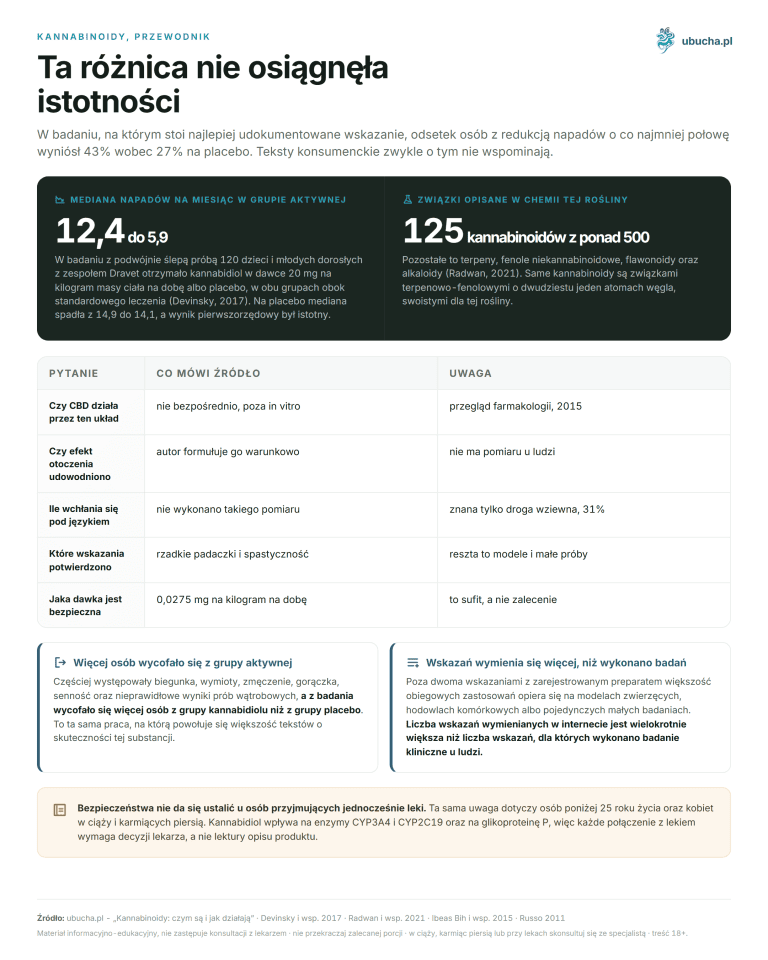
Separating these two categories is more important than the length of the application list. The strongest data concern drug-resistant epilepsies. In a double-blind placebo-controlled trial, 120 children and young adults with Dravet syndrome received cannabidiol at 20 mg per kilogram of body weight per day or placebo, in addition to standard treatment (Devinsky, The New England Journal of Medicine, 2017).
The median monthly number of seizures dropped in the cannabidiol group from 12.4 to 5.9, and in the placebo group from 14.9 to 14.1. A reduction of seizures by at least half was achieved by 43% of those treated with cannabidiol versus 27% receiving placebo, but this difference did not reach significance. Seizure-free rates were 5% versus 0%. The cannabidiol group had more diarrhea, vomiting, fatigue, fever, drowsiness, abnormal liver tests, and more withdrawals.
Two more results from this work complement the picture. Overall participant condition improved by at least one category on a seven-point caregiver rating scale in 62% treated with cannabidiol versus 34% receiving placebo. Total number of all seizure types decreased significantly, but no significant improvement was noted in non-convulsive seizures. Treatment lasted 14 weeks and was compared to a four-week baseline period.
The rest of the list is based on weaker or laboratory evidence. An example is skin: in human sebocyte cultures and human skin organ culture, CBD inhibited lipid production and sebocyte proliferation by activating TRPV4 channels, and its anti-inflammatory action was linked to adenosine A2a receptor and NF-kappaB pathway inhibition (Oláh, The Journal of Clinical Investigation, 2014).
The authors state that CBD has potential as an agent for treating acne vulgaris and stop there. This is a more cautious statement than most descriptions of cannabidiol cosmetics. The study was conducted on cells and skin samples, not patients, so the gap between this result and cream efficacy on the face is real and cannot be bridged by citation alone.
What is the entourage effect and is it proven?
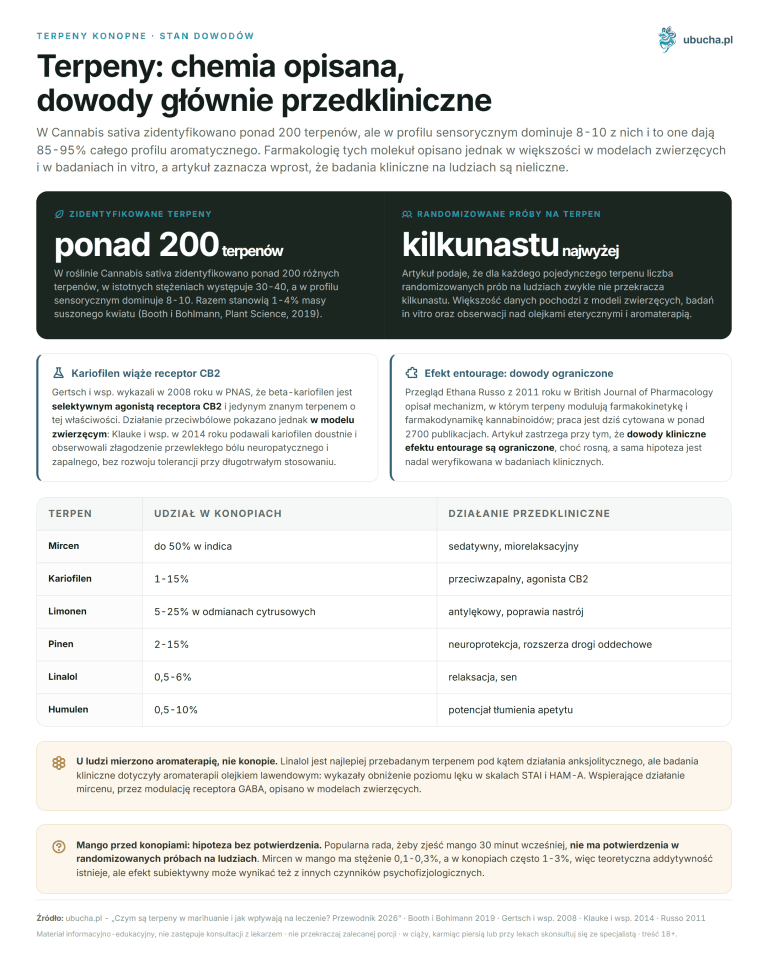
It is a hypothesis, not a finding. The review cited by the entire full-spectrum product market states conditionally in the abstract: synergy between phytocannabinoids and terpenoids, if proven, increases the likelihood that a broad line of new medicinal products can be derived from cannabis (Russo, British Journal of Pharmacology, 2011).
The author is one, though in Polish texts this work is sometimes attributed to two researchers. The review discusses cannabis terpenoids including limonene, myrcene, alpha-pinene, linalool, and beta-caryophyllene, reminds that these are flavor-aroma components present in the daily diet and recognized as safe by the US FDA, and notes that inhaled from ambient air they affect animal and human behavior at single-digit nanogram per milliliter serum concentrations.
The last part of the review proposes methods to study the entourage effect in future experiments. Such a chapter is written when the phenomenon is not yet confirmed. Repeating after this work that a full-spectrum product “works stronger than the sum of its parts” reverses its meaning, as the work only proposes how to verify this.
The review’s argument is more interesting than the slogan extracted from it. Terpenoids share a biosynthetic precursor with phytocannabinoids, so their co-occurrence is not a botanical coincidence. The author considers possible synergy in pain, inflammation, depression, anxiety, addiction, epilepsy, cancer, and fungal and bacterial infections including methicillin-resistant Staphylococcus aureus.
Separately, the review collects evidence that plant components outside the cannabinoid group may act as antidotes to THC’s intoxicating effects and thus raise its therapeutic index. This thread is lost in full-spectrum product descriptions, though it is more interesting than the promise of enhanced effect.
| Extract form | Composition | Implication |
|---|---|---|
| Full spectrum | Cannabinoids and terpenes from the plant, with trace THC | Greatest chance for entourage effect if it exists |
| Broad spectrum | Cannabinoids and terpenes without THC | Intermediate composition, no THC |
| Isolate | Pure cannabidiol | Precise dosing, used in studies |
What dose of CBD is considered safe today?
The latest European position gives a number much lower than the market suggests. The European Food Safety Authority panel conducted benchmark dose modeling based on subchronic studies compliant with good laboratory practice and, applying an uncertainty factor of 400, derived a provisional safe dose of 0.0275 mg per kilogram of body weight per day, about 2 mg per day for a 70 kg person (EFSA Journal, 2026).
This value is conditional on requirements that must not be omitted. It applies only to dietary supplements with cannabidiol purity of at least 98%, without nanoparticles, produced by a process recognized as safe and excluding genotoxicity. The panel also states that CBD safety cannot be established in people under 25 years old, pregnant or breastfeeding women, and those taking medications concurrently.
The long-circulating statement that the World Health Organization recognized CBD as safe up to 1500 mg per day has no current source, and its address returns a 404 error. The gap between this number and EFSA’s position is five hundredfold and concerns the amount the reader measures on a dropper, so we remove it from our texts wherever encountered.
This number is not a recommendation but a ceiling derived from a toxicological model. The uncertainty factor of 400 directly indicates how large a safety margin the panel deemed necessary given the data available. The larger the factor, the less is known about the true harmfulness threshold.
What about CBD safety is still unstudied?
Much, especially in areas critical for approval as food. Assessing cannabidiol as novel food, the EFSA panel in 2022 identified significant data gaps. Concerns involved liver, gastrointestinal tract, and endocrine, nervous, and reproductive systems. Literature searches of animal and human studies up to June 2024 confirmed these gaps remain (EFSA Journal, 2026).
The sharpest statement concerns immunity: not a single study on cannabidiol immunotoxicity exists, though the molecule’s interaction with immune pathways is described and the panel advises caution. This is a clear example of a knowledge gap that cannot be filled by cautious product description wording.
Animal reproductive studies reinforced earlier concerns. Prenatal exposure caused neurodevelopmental effects described as long-lasting and sex-dependent in offspring. Hormonal disturbances were also noted: altered thyroid hormone levels and histopathological changes in adrenal glands.
Why have new studies not closed these gaps? The panel cites methodological reasons: non-standardized protocols, short observation times, and concurrent medication use by participants. This is a useful tip when reading CBD reports in the media, as publication quantity growth is not the same as decisive knowledge growth.
What side effects of CBD have been described in humans?
A review dedicated to cannabidiol adverse effects and toxicity begins by stating that CBD is not risk-free. In human studies on epilepsy and psychiatric disorders, drug interactions, liver abnormalities, diarrhea, fatigue, vomiting, and drowsiness have been described (Huestis, Current Neuropharmacology, 2019).
The list from animal studies is longer and includes developmental toxicity, embryonic-fetal mortality, central nervous system inhibition and neurotoxicity, liver cell damage, spermatogenesis reduction, organ mass changes, and lowered blood pressure. The authors note an important caveat: these were observed at doses higher than those used in human treatment.
EFSA’s position aligns and points to the liver as the most sensitive point. In animal studies, liver toxicity was reproducible, and liver mass and histopathology were the most sensitive indicators. In humans, hepatotoxic potential appeared especially with concurrent use of other drugs. Gastrointestinal complaints were reported at higher doses, and data on neurological and psychiatric safety remain lacking.
The authors’ conclusion is worth quoting fully as it is balanced. Cannabidiol has proven efficacy in serious conditions such as Dravet and Lennox-Gastaut syndromes, and doctors will recommend it beyond registered indications, but before such recommendation they must consider adverse effects and possible drug interactions.
How to check citations in a CBD text?
In three steps, none requiring access to paid databases. Open the given identifier, check if the article title relates to the statement it supports, and finally look in the abstract for the specific number the article assigns. The third step is the worst and filters out most.
We write this from experience with this very article. In its earlier version, one identifier appeared nine times supporting seven different claims, including the number of molecular targets, 5-HT1A receptor modulation, TRPV1 action, bioavailability table, and absorption increase after a fatty meal. That number corresponds to a review on terpenes and entourage effect in mood disorders, which contains none of these data.
Another identifier, cited as a source on cytochrome P450 interactions, led to a study on anterior cruciate ligament genetics. Another, signed with a known pharmacology journal name, pointed to an online brain atlas. Yet another, assigned to a public speaking anxiety study, led to a paper on gastrointestinal interstitial cells.
The practical conclusion for the reader: a link that opens does not prove the author read it. The journal name given in the text is often derived from the URL, not the paper, so it looks credible where no one opened the source. If an article gives a precise percentage but the abstract lacks it, it probably does not exist anywhere.
Frequently Asked Questions
Does CBD act through the endocannabinoid system?
A systematic review of CBD molecular pharmacology states that cannabidiol does not interact with this system directly outside of cell cultures at supraphysiological concentrations, and considers its action in neurological diseases through this system very unlikely (Ibeas Bih, Neurotherapeutics, 2015). The popular mechanism description is therefore a simplification.
Why doesn’t CBD intoxicate like THC?
Because it does not stimulate the CB1 receptor but weakens its response to other molecules. In cell models, CBD behaved as a non-competitive negative allosteric modulator of CB1 and reduced the efficacy and potency of 2-AG and THC (Laprairie, British Journal of Pharmacology, 2015). Intoxication comes from CB1 stimulation.
How much CBD is absorbed after swallowing drops?
This has not been established. A systematic review of CBD pharmacokinetics in humans found absolute bioavailability measured only after smoking, where it was 31%, and no study has done this for any other route of administration (Millar, Frontiers in Pharmacology, 2018). Tables with percentages for drops have no basis.
Does CBD raise anandamide levels?
In a study comparing cannabidiol with amisulpride in people with acute schizophrenia, CBD treatment was accompanied by a significant increase in serum anandamide concentration, associated with clinical improvement (Leweke, Translational Psychiatry, 2012). However, the abstract does not provide either the percentage scale of this increase or the dose.
With which drugs does CBD interact?
A comprehensive 2021 review lists antiepileptic, antidepressant, and opioid analgesic drugs, as well as less expected items like paracetamol and alcohol (Balachandran, Journal of General Internal Medicine, 2021). The authors note that the effect of CBD on concurrently taken drugs requires randomized studies.
What dose of CBD is considered safe?
The EFSA panel derived a provisional safe dose of 0.0275 mg per kilogram of body weight per day, about 2 mg for a 70 kg person, with an uncertainty factor of 400 (EFSA Journal, 2026). This applies only to supplements with at least 98% purity, without nanoparticles.
Is the entourage effect proven?
No. The review cited by the full-spectrum product market formulates synergy conditionally and ends with a proposal for methods to study it in future experiments (Russo, British Journal of Pharmacology, 2011). It is a hypothesis with a described mechanism, not a confirmed result.
What side effects of CBD have been described in humans?
In studies on epilepsy and psychiatric disorders, drug interactions, liver abnormalities, diarrhea, fatigue, vomiting, and drowsiness have been described (Huestis, Current Neuropharmacology, 2019). EFSA points to the liver as the most sensitive point, especially when other drugs are taken simultaneously.
What does this mean for the reader?
The mechanism of CBD action is better described than for most plant substances, yet weaker than sales suggest. Over 65 molecular targets is a literature number, not a list of active pathways. After filtering out reports where effects appeared at unachievable concentrations or lacked causal proof, three targets related to cellular calcium metabolism remain, and none has causal proof yet.
Three things are solidly measured. Cannabidiol suppresses CB1 receptor response instead of stimulating it, explaining the lack of intoxication. In Dravet syndrome, it reduces seizure number more than placebo, at the cost of more side effects. Absolute bioavailability was measured in humans only for one route and is 31% after smoking.
Three other things are weaker today than advertising sounds. The entourage effect remains a hypothesis the review author only proposes to study. The effect on sleep in healthy volunteers was measured by polysomnography and not found. The circulating 1500 mg per day number has no current source, and EFSA’s position states a value five hundred times lower, conditional on product purity.
The practical conclusion remains unchanged since the first paragraph. If you take any medications, are pregnant, breastfeeding, or under 25, decide about CBD with a doctor, as safety cannot be established for these groups today. If you do not belong to any of these, it is simply worth knowing how much of the mechanism description is based on measurement and how much on repetition.
If you want to see in what forms cannabidiol is sold in Poland, visit the oils category.
This article is informational and educational and does not constitute medical advice. Before starting cannabis or CBD for therapeutic purposes, consult a doctor, especially if you take other medications, are pregnant, or breastfeeding.
Author: Michał Waluk · Published: 2026-04-27 · Updated: 2026-08-10