
Cannabinoids and Health - Impact on Body Systems 2026
Cannabinoids system by system: what was really measured in studies on sleep, pain, immunity, and skin, and where EFSA sets the safety ceiling.
Cannabinoids are compounds that act through the endocannabinoid system, one of the more widely distributed regulatory systems in mammals. A pharmacological review links it to mood and anxiety disorders, movement diseases, neuropathic pain, multiple sclerosis, atherosclerosis, hypertension, glaucoma, obesity, and osteoporosis (Pacher et al., Pharmacological Reviews, 2006). This list is often read as a promise but is actually a list of research directions. The difference between the two is that the presence of a receptor in tissue does not yet say anything about the effect of administering a preparation to a human. In this guide, we go system by system and for each claim show exactly what was measured: on whom, how many people, how long, and with what result. We separately note when the result comes from cell culture or animal models, as these are the two most common places where consumer texts jump one level too high. Several popular statements about cannabinoids did not survive such verification and we state directly which ones.
KEY INFORMATION
- The endocannabinoid system regulates sleep, pain, mood, immunity, and metabolism; CB1 receptors predominate in the brain, CB2 in immune cells (Nagarkatti et al., 2009).
- Cannabidiol probably does not directly interact with this system except at supraphysiological in vitro concentrations (Ibeas Bih et al., Neurotherapeutics, 2015).
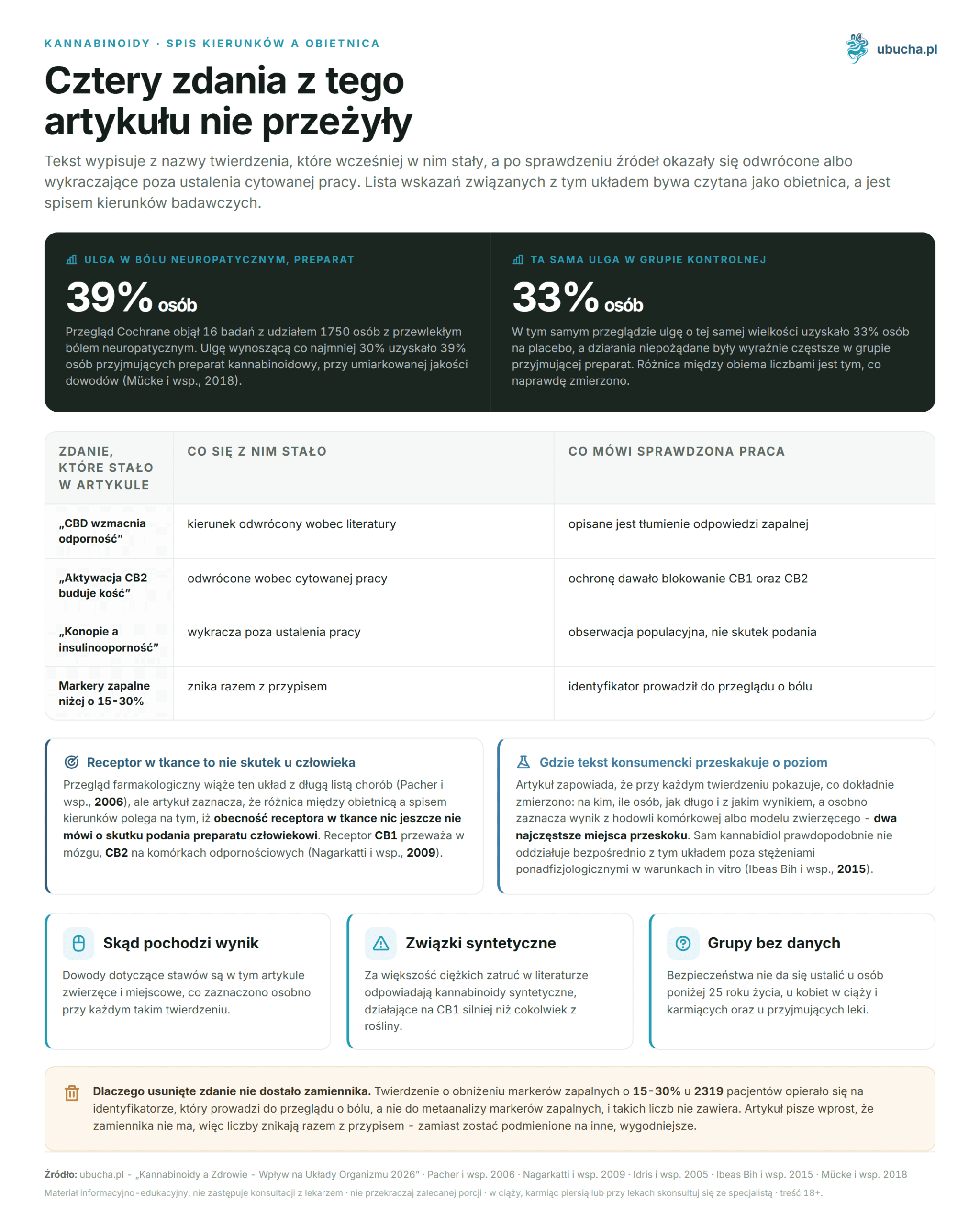
- In a Cochrane review, at least 30% relief in neuropathic pain was achieved by 39% of people versus 33% on placebo, with clearly more frequent adverse effects.
- EFSA provides a temporary safe dose of 0.0275 mg/kg per day, about 2 mg for a 70 kg person; this is a safety ceiling, not a recommendation.
- CBD safety cannot be established for people under 25, pregnant and breastfeeding women, and those taking medications.
What are cannabinoids and how do they act in the body?
Cannabinoids are lipophilic compounds acting through G protein-coupled receptors, designated CB1 and CB2. The CB1 receptor occurs mainly in the brain, the CB2 receptor mainly on immune system cells (Nagarkatti et al., Future Medicinal Chemistry, 2009).
The endocannabinoid system itself consists of three elements at once: receptors, endogenous lipid ligands present in almost all tissues, and enzymes that produce and degrade these ligands. Ligands are not stored in vesicles like classic neurotransmitters but are produced on demand and quickly disappear. Therefore, the system is described as a mechanism correcting deviations rather than a constant signal.
It is worth separating three families of compounds because they have completely different risk profiles. Endocannabinoids are produced by the body. Phytocannabinoids come from the plant. Synthetic cannabinoids are made in the lab and are responsible for most severe poisonings described in the literature because they act on the CB1 receptor much more strongly than anything from the plant.
| Compound | Action on CB1 | Human research status |
|---|---|---|
| CBD | no significant affinity | best studied phytocannabinoid, approved for rare epilepsies |
| THC | strong agonist | clinical trials in pain and spasticity, prescription available |
| CBG, CBN, CBC | poorly understood | mainly in vitro studies and animal models |
| synthetic cannabinoids | very strong agonists | poisoning reports, no consumer uses |
The basics of cannabidiol itself are detailed separately in the guide all about CBD. Here we focus on what research shows for individual body systems.
Does CBD really act through the endocannabinoid system?
Probably not, at least not directly. A systematic review of cannabidiol molecular pharmacology states that the compound does not directly interact with the endocannabinoid system except at supraphysiological concentrations in vitro (Ibeas Bih et al., Neurotherapeutics, 2015).
This statement is worth pausing on because it contradicts the most common shorthand in CBD texts. The authors reviewed the literature and counted over 65 different molecular targets attributed to cannabidiol. After filtering out those active only at unattainable concentrations in the body and those showing only correlation instead of causation, only a handful remained. The surviving targets relate to intracellular calcium regulation.
The review’s conclusion is clear: CBD very likely does not cause effects in neurological diseases through modulation of the endocannabinoid system. The authors add that for none of the other targets is there yet causal proof, so cannabidiol’s mechanism of action remains an open question, not a settled fact.
Why is this important in consumer texts? Because the popular explanation like “CBD supports your endocannabinoid system” sounds mechanistic but is not supported by this review. CBD’s efficacy in rare epilepsies is clinically proven and does not depend on whether we can name the mechanism. Two sentences must be kept separate: one about the result, the other about how it arises.
How do cannabinoids affect the nervous system?
The CB1 receptor is among the most densely distributed receptors in the brain, so cannabinoids affect memory, coordination, mood, and pain perception. A pharmacological review links this system to mood and anxiety disorders, Parkinson’s disease, Huntington’s disease, neuropathic pain, and spinal cord injury (Pacher et al., Pharmacological Reviews, 2006).
The most frequently cited anxiety study is smaller and more detailed than summaries suggest. It involved 57 healthy men randomly assigned to cannabidiol at doses of 150, 300, or 600 mg or placebo before simulated public speaking. Anxiety during speech was reduced only by the 300 mg dose; 150 and 600 mg groups did not differ from placebo (Linares et al., Revista Brasileira de Psiquiatria, 2019). The dose-response curve here is an inverted U shape, so increasing the dose is not a strategy.
The other side of the balance concerns THC in young people. A meta-analysis of eleven longitudinal studies including 23,317 people showed increased risk of depression in young adulthood among those using cannabis during adolescence, with an odds ratio of 1.37. For anxiety, the result was not statistically significant; for suicidal thoughts it was 1.50, and for suicide attempts 3.46 (Gobbi et al., JAMA Psychiatry, 2019). The authors emphasize that individual risk remains moderate to low, but widespread use makes this a public health issue. We write more about the brain in the text on CBD’s impact on the nervous system.
What do studies say about cannabinoids and sleep?
The most often repeated figure in this topic, “66% sleep improvement,” comes from a retrospective case series from a psychiatric clinic, not a randomized study. It included 72 adults: 47 presented for anxiety, 25 for sleep problems (Shannon et al., The Permanente Journal, 2019).
The results of this series are worth stating precisely because distorted versions circulate. Anxiety scores decreased in the first month in 57 people, i.e., 79.2%, and remained lower throughout observation. Sleep scores improved in the first month in 48 people, i.e., 66.7%, but fluctuated in subsequent months. Cannabidiol was well tolerated by all except three patients.
Three things from this study get lost in citations. First, this is not the year 2023 nor the journal Medical Cannabis and Cannabinoids as an earlier version of this article stated; it is Permanente Journal and year 2019. Second, the sleep effect was not stable, so the statement about lack of tolerance has no basis here. Third, a case series without a control group does not distinguish the preparation’s effect from the natural course of the condition and placebo effect, and the authors themselves write that controlled studies are needed.
What remains practically? A signal worth further study, especially on the anxiety side, where the percentage was higher and the effect more durable. Sleep can be a consequence of anxiety in the same people, so separating both threads requires a study designed for this purpose. Such a study does not yet exist.
Do cannabinoids help with chronic pain?
Moderately and at the cost of adverse effects. The Cochrane review included 16 studies with 1750 people with chronic neuropathic pain. Relief of at least 30% was achieved by 39% of those taking cannabinoid preparations versus 33% on placebo, with moderate quality evidence (Mücke et al., Cochrane Database of Systematic Reviews, 2018).
The other half of this review is often omitted but decides the conclusion. Ten percent of participants taking cannabinoids withdrew due to adverse effects versus 5% on placebo. Nervous system events occurred in 61% versus 29%, and psychiatric disorders in 17% versus 5%. The analyzed studies say nothing about long-term risk because none lasted long enough.
The authors formulate the conclusion more cautiously than most consumer texts: potential benefits of cannabinoid preparations in chronic neuropathic pain may be outweighed by potential harms. They also add an important methodological caveat. Studies excluded people with addiction history and serious comorbidities, i.e., exactly the population that most often uses such preparations.
It is worth remembering what these studies concerned. Preparations containing THC or THC combined with CBD predominated, including buccal spray and inhaled cannabis. Applying these results to oil with predominance of cannabidiol is substituting one substance for the result obtained with another (Vučković et al., Frontiers in Pharmacology, 2018).
What do cannabinoids do to the immune system?
They act suppressively, more strongly than the word “support” suggests. CB1 and CB2 receptors were found on immune cells, and THC administration to mice caused pronounced apoptosis of T lymphocytes and dendritic cells, leading to immunosuppression (Nagarkatti et al., Future Medicinal Chemistry, 2009).
Several mechanisms have been described. Cannabinoids reduce cytokine and chemokine production, and in some models increase regulatory lymphocytes, which dampen inflammatory response. Administration of endocannabinoids or blocking enzymes that degrade them also led to immunosuppression and remission of immune-mediated organ damage, e.g., liver.
The authors see therapeutic potential here in inflammatory and autoimmune diseases driven by activated T lymphocytes. However, it should be noted that this mechanism means the opposite direction to “boosting immunity.” A preparation that suppresses immune response is not what someone buying a supplement for infection season is looking for.
It is also worth noting what these findings are based on. Mostly mouse models and cell cultures, not studies in patients with autoimmune disease. The review calls them a basis for developing cannabinoids as a new class of anti-inflammatory drugs, i.e., a research program, not a ready therapy. The distance between lymphocyte apoptosis in mice and a recommendation for a person with psoriasis is standard in this field and rarely signaled in popular texts.
The sentence previously here about reducing inflammatory markers by 15-30% in 2319 patients was removed. The identifier supporting it leads to a pain review, not a meta-analysis of inflammatory markers, and contains no such numbers. There is no replacement, so it disappears along with the citation.
What is the impact of cannabinoids on joints and bones?
The picture is more complex than the popular version of CBD strengthening bones. The study that started bone research showed that mice lacking the CB1 receptor had increased bone mass and were protected from bone loss after ovary removal (Idris et al., Nature Medicine, 2005).
Protection from bone loss in this study was provided by blocking CB1 and CB2 receptors, not stimulating them. Blocking substances inhibited osteoclasts by increasing their apoptosis and limiting survival factor production. The authors saw antagonists as a new class of resorption inhibitors useful in osteoporosis. The statement “CB2 activation builds bone,” which circulated in this article, is reversed in light of this work.
On the joint side, evidence is animal and local. In a rat model of osteoarthritis induced by sodium iodoacetate, local cannabidiol administration reduced firing frequency in joint sensory fibers, raised withdrawal threshold, and improved limb loading. Preventive administration limited acute inflammation and protected the nerve from damage (Philpott et al., Pain, 2017).
This is a good mechanistic study and a weak basis for recommendations. It concerned rats, cannabidiol was administered intra-articularly in micrograms, not orally in drops, and electrophysiology was measured, not patient well-being. Numbers from animal models on fracture healing previously here had no citation and were removed.
How do cannabinoids affect metabolism and weight?
The relationship is opposite to intuition. Analysis of data from a US population study 2005-2010 including 4657 adults showed that current cannabis users had 16% lower fasting insulin and 17% lower HOMA-IR insulin resistance index than non-users (Penner et al., The American Journal of Medicine, 2013).
The authors also noted smaller waist circumference in users. The abstract does not mention BMI, so the earlier sentence about lower BMI was corrected to what was actually measured. Among current users, no dose dependence was found, weakening causal interpretation.
This is a cross-sectional study and must be read as such. It shows co-occurrence, not causation: users may differ from non-users in age, activity, diet, and many other traits that no statistical model fully captures. The statement “cannabis reduces insulin resistance” goes beyond what this work established.
There is also a second difficulty, this time with the phenomenon itself. THC stimulates appetite, an effect described and used clinically in cancer cachexia, yet population-wise cannabis users do not fare worse metabolically. One proposed explanation is adaptive downregulation of CB1 receptors with frequent exposure, but this is a hypothesis, not a finding of this work, so we present it as a hypothesis.
Pharmacology history adds a warning. Rimonabant, a CB1 receptor antagonist developed for obesity, was withdrawn from the European market due to risk of depression and suicidal thoughts. The endocannabinoid system is involved in regulating mood and appetite simultaneously, so manipulating one end of this axis rarely goes without effects on the other.
How do cannabinoids act on the digestive tract?
The digestive tract is densely equipped with endocannabinoid system elements, with clear differences between segments. The review authors list several functions involving this system (Izzo and Sharkey, Pharmacology and Therapeutics, 2010).
- food intake and vomiting reflex
- gastric secretion and mucosal protection
- gastrointestinal motility
- ion transport across epithelium
- visceral sensation
- intestinal inflammation and cell proliferation
Molecular targets in the intestine are not only cannabinoid receptors. The authors mention the vanilloid receptor TRPV1, peroxisome proliferator-activated receptors alpha, and orphan receptors GPR55 and GPR119. Cellularly, this concerns the enteric nervous system and epithelium, as well as mucosal immune cells. This multiplicity explains why a single compound produces unpredictable intestinal effects and why results in functional disorders are inconsistent.
The clinical endocannabinoid deficiency hypothesis concerns migraine, fibromyalgia, and irritable bowel syndrome. Its author points to documented differences in anandamide levels in cerebrospinal fluid in migraine sufferers and imaging evidence of reduced system activity in post-traumatic stress disorder (Russo, Cannabis and Cannabinoid Research, 2016). An earlier version of this article attributed these serum measurements to irritable bowel syndrome patients, which the paper does not state.
The most cited clinical study in Crohn’s disease requires correction. It included 21 people, and the tested preparation was cannabis cigarettes containing 115 mg THC, not cannabidiol oil. Remission was achieved by 5 of 11 people versus 1 of 10 on placebo, but the difference was not statistically significant and the primary endpoint was not met. Clinical response was significant: 10 of 11 versus 4 of 10 (Naftali et al., Clinical Gastroenterology and Hepatology, 2013).
What do cannabinoids do to the skin?
The skin has its own active endocannabinoid system. It participates in regulating proliferation, growth, and differentiation of skin cells, as well as their death, and appendages such as hair follicles and sebaceous glands (Bíró et al., Trends in Pharmacological Sciences, 2009).
The authors phrase this cautiously and that caution matters. The physiological role of the skin endocannabinoid system is maintaining balance between cell proliferation and differentiation and survival, along with regulating epidermal immune response. Disturbance of this balance may, according to the authors, promote development of several skin diseases.
- acne and seborrhea
- allergic dermatitis
- itch and pain
- psoriasis
- hair growth disorders
- systemic sclerosis and skin cancers
“May promote” is not the same as “causes.” The 2009 review remains a collection of hypotheses worth testing, not a list of indications, and we treat it as such here.
The strongest single result concerns sebum. Cannabidiol applied to cultured human sebocytes and skin organ culture inhibited lipogenesis induced by arachidonic acid and a combination of linoleic acid with testosterone, and also limited sebocyte proliferation by activating the TRPV4 channel (Oláh et al., Journal of Clinical Investigation, 2014). The “30-50%” figure previously here does not appear in this paper’s abstract and was removed.
Separately stands the antibacterial thread. Cannabinoids showed activity against methicillin-resistant Staphylococcus aureus, inhibited biofilm formation, eradicated established biofilm, and cannabigerol was effective in a mouse systemic infection model (Farha et al., ACS Infectious Diseases, 2020). The study does not concern bacteria responsible for acne and the earlier sentence on this topic was corrected.
Which medical uses of cannabinoids are confirmed?
The best documented use of cannabidiol is rare childhood epilepsies. In a double-blind study, 120 children and young adults with Dravet syndrome received cannabidiol at 20 mg per kilogram of body weight per day or placebo, both groups alongside standard antiepileptic treatment (Devinsky et al., New England Journal of Medicine, 2017).
The primary outcome was significant: median monthly convulsive seizure count dropped from 12.4 to 5.9 in the cannabidiol group versus 14.9 to 14.1 on placebo. The proportion with at least 50% seizure reduction was 43% versus 27%, but this difference did not reach statistical significance. Seizure freedom was 5% versus zero. Diarrhea, vomiting, fatigue, fever, drowsiness, and abnormal liver tests were more frequent, and more people withdrew from the cannabidiol group.
The cannabidiol preparation is approved in the United States and European Union for drug-resistant epilepsies with specified diagnoses. There is no link to the US agency here because the address previously in this article was incorrect; we describe the registration fact based on the above registration study result.
The second registered preparation is a buccal spray combining THC with CBD, used in spasticity in multiple sclerosis. In Poland, cannabis other than fiber hemp is raw material for magistral drugs and is dispensed only by prescription; we write more about this in the text on what medical marijuana is. Earlier versions of this article gave monthly treatment prices that could not be confirmed in any available source, so they are not included here.
How much cannabidiol is really absorbed into the body?
Less than tables circulating on the internet suggest, and above all: the exact amount is unknown. A systematic review of cannabidiol pharmacokinetics in humans covered 24 studies and found that absolute bioavailability was measured only for inhalation, where it was 31% (Millar et al., Frontiers in Pharmacology, 2018).
No study established absolute bioavailability for oral or buccal routes, although intravenous preparations were available and such measurement was technically possible. The popular table with values 6-12% for capsules and 13-19% for sublingual drops has no source and was removed from this article along with the citation that did not fit.
What does the review actually report? Half-life ranged from 1.4 to 10.9 hours after buccal spray, 2 to 5 days with chronic oral administration, 24 hours after intravenous administration, and 31 hours after smoking. Maximum concentration increased with dose and was higher after a meal and in fat-based preparations. Time to maximum concentration ranged from zero to four hours.
The practical conclusion from this review is modest but true. Meal and carrier type change cannabidiol exposure enough that two people taking the same milligram amount may have different blood concentrations. The authors conclude that data are too limited and available data are contradictory.
What is known about long-term safety of cannabidiol?
The latest European assessment is more cautious than anything circulating in advertising texts. The European Food Safety Authority panel derived a temporary safe dose of 0.0275 mg per kilogram of body weight per day, about 2 mg daily for a 70 kg person, with an uncertainty factor of 400 (EFSA, EFSA Journal, 2026).
This is a safety ceiling, not a recommended or therapeutic dose. The value applies only to supplements with cannabidiol purity of at least 98%, without nanoparticles, with a safe manufacturing process and excluded genotoxicity. The often repeated “1500 mg daily” figure, attributed to the World Health Organization, is 500 times higher and its source address is incorrect. We removed it entirely from this article.
The panel lists specific warning signals. Animal studies show consistent liver toxicity, with liver mass and histopathological changes as the most sensitive endpoints. In humans, hepatotoxic potential especially appears when combined with drugs. Placental transfer and systemic accumulation have been noted, and prenatal exposure causes long-term, sex-dependent neurodevelopmental effects. Hormonal disorders and lack of any immunotoxicity studies are also noted.
One sentence from this assessment should appear in every text touching on dosing. CBD safety cannot be established for people under 25 years old, pregnant and breastfeeding women, and those taking medications simultaneously. This is not a lawyer’s cautionary phrase but a literal panel conclusion, and these groups include most people asking about cannabinoids in a health context.
For this reason, you will not find any dosing protocol in milligrams in this article. All numbers given above describe specific studies: who participated, how many, how long, and what dose was given. None is a recommendation for the reader, and dose selection for any health problem belongs to a doctor.
Which myths about cannabinoids return most often?
Four beliefs return in questions more often than all others combined, and each breaks on a specific study. It is worth going through them one by one because each leads to a different bad decision.
The first myth is “the more, the better.” A simulated public speaking study showed an inverted U curve: only the middle dose reduced anxiety, and the highest dose did not differ from placebo. Increasing the amount not only does not help but enters a range where the risk of adverse effects described by the EFSA panel rises.
The second myth is “CBD cures cancer.” Studies on cell lines and animals describe anticancer effects of some cannabinoids, but there are no human studies allowing this claim. Producers in Poland cannot use medical claims, and an article repeating them directs the reader toward stopping proven effective treatment.
The third myth concerns immunity. The statement “CBD boosts the immune system” is reversed in the literature: the described direction of cannabinoid action on immune cells is suppressing inflammatory response, reducing cytokine production, and in animal models, immunosuppression. For a person with autoimmune disease, this may be a therapeutic goal; for someone seeking support during infection season, it is the opposite direction.
The fourth belief, less dangerous but common, concerns the mechanism. “CBD supports your endocannabinoid system” is a sentence not confirmed by the systematic molecular pharmacology review. Efficacy in rare epilepsies remains a clinical fact regardless of how we explain it.
Frequently Asked Questions
Does CBD act through the endocannabinoid system?
Probably not directly. A systematic review of molecular pharmacology states that cannabidiol does not directly interact with this system except at supraphysiological concentrations in vitro, and among over 65 described molecular targets, only a few related to intracellular calcium regulation remain credible (Ibeas Bih et al., Neurotherapeutics, 2015).
Do cannabinoids help with chronic pain?
Moderately. In a Cochrane review covering 16 studies and 1750 people, 39% of participants achieved at least 30% relief compared to 33% on placebo. At the same time, nervous system adverse events occurred in 61% versus 29%, and the authors state that benefits may be outweighed by harms.
Where does the 66% sleep improvement figure from CBD come from?
From a retrospective case series involving 72 adults. Sleep scores improved in the first month for 66.7% of them, but fluctuated in subsequent months. Anxiety scores decreased in 79.2% and remained lower (Shannon et al., The Permanente Journal, 2019).
How much cannabidiol is absorbed from sublingual drops?
Unknown. A systematic review of human pharmacokinetics established absolute bioavailability only for inhalation, where it was 31%. No such measurement was made for oral or buccal administration in any study (Millar et al., Frontiers in Pharmacology, 2018).
What dose of CBD is considered safe?
The European Food Safety Authority provides a temporary safe dose of 0.0275 mg per kilogram of body weight per day, about 2 mg daily for a 70 kg person. This is a safety ceiling, not a recommendation, and applies only to supplements with at least 98% purity (EFSA, 2026).
Who should not use CBD?
CBD safety cannot be established for people under 25 years old, pregnant and breastfeeding women, and those taking medications simultaneously. In humans, hepatotoxic potential especially appears when combined with drugs, so any such combination requires a doctor’s decision (EFSA, 2026).
Do cannabinoids boost immunity?
The literature describes the opposite direction. Cannabinoids reduce cytokine and chemokine production, and THC administration to mice induced apoptosis of T lymphocytes and dendritic cells leading to immunosuppression (Nagarkatti et al., Future Medicinal Chemistry, 2009). This is potential in inflammatory diseases, not infection prevention.
Summary: what this means for the reader
After going through all the citations in this article, the picture of cannabinoids becomes narrower and more certain at the same time. The endocannabinoid system indeed touches almost every body system and this is well documented. The jump from this anatomical map to the sentence “a cannabinoid will help your ailment” requires a clinical study, and such studies are much fewer than the number of indications listed suggests.
The strongest evidence concerns rare childhood epilepsies and spasticity in multiple sclerosis, i.e., areas where registered prescription drugs act. In chronic pain, the effect is moderate and accompanied by frequent adverse effects. In other areas, from bones through intestines to skin, we have animal models, cell cultures, and single small studies, i.e., material for a hypothesis, not a recommendation.
A separate lesson comes from how easily a result obtained with one substance migrates to a statement about another. The Crohn’s disease study was conducted on cannabis cigarettes with high THC content, the Cochrane review mostly on preparations containing THC, and conclusions from both are often applied to oils with cannabidiol predominance. This substitution happens systematically in consumer texts and always in the same direction.
The practical conclusion is simple. If you take medications, are pregnant or breastfeeding, or are under 25, the European panel states plainly that safety cannot be established in your case. In other situations, it is worth looking at the batch analysis certificate and composition, and discussing any disease-related use with a doctor, not an internet table.
You can find products from this category in the hemp oils section in the u Bucha store.
This article is informational and educational and does not constitute medical advice. Before starting cannabis or CBD for therapeutic purposes, consult a doctor, especially if you take other medications, are pregnant, or breastfeeding.
Author: Michał Waluk · Published: 2026-05-04 · Updated: 2026-08-10