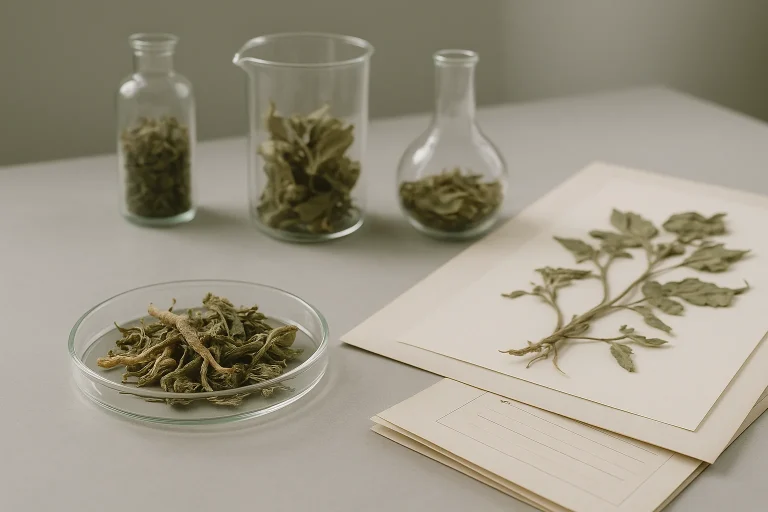

Purps (S-LAB, Synoptis Pharma, Tilray): purple buds and grape aroma
Purps has the same leading terpene, the same unknown lineage, and the same manufacturers as Master Kush. They differ in the descriptions of effects and the number of sources that describe this strain at all.
What is Purps and where does this strain come from?
The lineage of Purps is unknown. The breeder has not disclosed the parents, and databases describing Polish pharmaceutical products only provide the trade name and genetic type. The name itself refers to the purple coloration of the buds, not to a specific breeding line, so nothing about its origin can be inferred from it.
The name is not a genetic indicator. The purple coloration of the buds comes from anthocyanins, plant pigments whose intensity depends on the genotype and the ripening conditions, which is why it appears in completely unrelated lines. Inferring parents from it would yield the same result as deducing relationships from a common part of the name: a false edge in the strain graph that no one would later verify.
The databases themselves are not even consistent regarding the type. The service budcare.pl describes all four Polish products as hybrids with an indica dominance, while medweed.pl simply states indica for the Tilray product. The discrepancy seems minor, but it highlights the basis of these descriptions: on the manufacturer's declaration transcribed by the catalog, not on the genetic designation of the batch.
However, the presence of the strain in the Polish pharmaceutical market is documented: three manufacturers and four products under this name. The THC range is 16.2-24.2%, as the products have two different nominal values, each carrying an allowable deviation both downwards and upwards. The rest, including the breeding history, remains outside the available records.
Which producers supply Purps to Polish pharmacies?
Three manufacturers: Tilray, S-LAB, and Synoptis Pharma. Under this name, they collectively have four pharmaceutical products, two of which belong to S-LAB. The versions differ in nominal content, aroma description, and declared availability, not in genetics, as catalogs describe them as the same strain.
| Producer | Products in catalogs | How does this version differ |
|---|---|---|
| S-LAB | two | the only one with a lower nominal value; its aroma description includes floral and fruity notes alongside earthy |
| Synoptis Pharma | one | spicy-peppery aroma description; availability marked in the catalog as high |
| Tilray | one | the only version described by both sources; sour-fruity aroma description |
Differences are only visible in catalog descriptions, as the pharmacy label looks almost the same for all. All four products have the same form: pharmaceutical dried flower intended for inhalation or for making an infusion, distinct from the assortment of the store department with dried flower. The manufacturer is responsible for the cultivation and processing of the raw material, not for the genetics received with the starting material, so two products of the same strain from two companies can be less similar to each other than two batches from one.
The composition of this offer changes more frequently than it appears from the outside: permits expire, batches run out, and manufacturers withdraw products without notice. Therefore, the table above describes the state of the catalogs, not the state of the pharmacy shelf, and you can check current availability in the the comparison of currently available strains, conducted separately and updated more frequently than this text. Each of these companies has its own discussion in the cluster: Tilray, then Synoptis Pharma, as well as S-LAB.
How does Purps smell and taste?
A sweet grape-berry flavor on the surface, beneath it a distinct spicy-peppery note and a heavy, earthy base. Catalog descriptions vary in detail: the S-LAB and Synoptis Pharma entries emphasize spicy notes, while the Tilray entry highlights sour along with fruity. The common denominator is a spicy character.
Two services provide the profile composition, but they list it differently. Both mention caryophyllene, nerolidol, bisabolol, and limonene. The list from budcare.pl is longer, including humulene, linalool, myrcene, and pinene, which the second source does not note for this strain at all. This difference is not a flaw of one of the databases: each describes a different set of pharmaceutical entries, and medweed.pl has only one under this name.
We do not provide numbers for these names, and this is due to measurement, not caution. The summed shares that Polish catalogs assign to the same pharmaceutical entries appear in three variants: 46, then 73, and in the third listing, 83 percent. The denominator is therefore different in each list and remains hidden from the reader, and the value devoid of reference gives the impression of a laboratory designation in the text about the drug, which it is not. The list of names can be provided honestly, but the weight of individual entries cannot. The scent itself also does not resolve anything, as the same earthy tone can come from different sets of volatile compounds, and the nose cannot distinguish the set from the proportions.
How long does it take for Purps to take effect and how long does the effect last?
The answer depends on the form in which the patient consumes the material. Vapor from a vaporizer provides a noticeable effect during the session, peaking around fifteen minutes and fading within two to four hours. An infusion or another ingested form delays the onset by half an hour or more, and its effects can last up to eight hours.
None of the above values come from measurements made on Purps. Inhalation data comes from studies on vaporized dried flower, while oral data comes from the characteristics of medicinal products containing a synthetic equivalent of THC. No pharmacokinetic study has been published for this label, so transferring ranges to it is an approximation based on the route of administration, not a reading from measurement.
The difference between routes of administration can be greater than the difference between strains. With inhalation, part of the dose enters the bloodstream bypassing first-pass metabolism in the liver, which is why the onset is quick and the peak is narrow. After ingestion, the liver metabolizes the active substance into a form described as longer-lasting, which means that the same amount of material produces a completely different course. Since pharmaceutical dried flower can be prescribed for both uses, the question of duration of action does not have a single answer until it is specified in what form the patient is taking it.
What is known, and what is not known about the effects of Purps?
The action of caryophyllene itself has been demonstrated in animal and in vitro models, but not for this strain. There is no clinical study for Purps, no observational study, and no published chemical analysis of batches. What circulates as a description of the effect comes from manufacturer catalogs and patient reports.
Gertsch and colleagues described in 2008 in PNAS (PMID:18574142) that (E)-caryophyllene selectively binds to the CB2 receptor and reduces carrageenan-induced paw swelling in mice, but only in animals with this receptor. In mice lacking it, the effect disappeared, indicating a CB2-dependent mechanism. The study did not include any anxiety test.
Klauke and colleagues checked in 2014 in European Neuropsychopharmacology (PMID:24210682) how caryophyllene behaves when administered orally. In mice, it suppressed the late, inflammatory phase of pain in the formalin test, without affecting the early phase, and in the neuropathic pain model, it reduced thermal hyperalgesia and mechanical allodynia, without developing tolerance with chronic administration. A broader discussion of this terpene stoi osobno.
In neither of the two studies was caryophyllene tested on humans or in inhaled form from dried flower; both works concern oral or systemic administration in mice in pain and inflammation models, not sleep or mood. Manufacturer materials say otherwise: catalogs describe Purps as relaxing or balanced. However, these are commercial descriptions, not endpoints of research, and should be read as such.
What side effects have been reported after using Purps?
Nothing has been reported separately for Purps. Safety monitoring collects reports under the name of the medicinal product, not by strain name, so there is simply no frequency assigned to this specific label, and there is no way to obtain it. What can be provided pertains to hemp dried flower as a whole group.
At the group level, symptoms associated with the active substance itself recur: dry mouth and throat, dizziness, drowsiness, increased heart rate, and a drop in blood pressure upon standing quickly. The severity depends on the dose, inhalation rate, and previous exposure, which is why percentages from one study do not transfer to a patient following a different dosing regimen.
A separate problem is the strain descriptions circulating online. They assign milder or more severe side effects to specific labels, although there is no comparative measurement behind this. Purps is often described as highly sedating, which in practice means that drowsiness is mentioned more frequently in reports than for entries described as stimulating. This is still a report, not a result, and no one has measured such a difference for this strain. Counting it would require an event registry divided by cultivars, and such a registry does not exist in Polish pharmaceutical trade.
How to vaporize Purps?
There is no single setting for this strain. Caryophyllene, which leads its profile, boils at atmospheric pressure only around 257 degrees Celsius, which is above the temperatures used for vaporizing dried flower. Nevertheless, it transitions to vapor because the boiling point is not a threshold below which the compound does not evaporate.
The other entries from the list boil at much lower temperatures: pinene around 156 degrees, myrcene around 167, limonene around 178, linalool around 195. Sources list nerolidol in the range of 275-277 degrees, and for humulene and bisabolol, there is no measurement in the database made at atmospheric pressure. The gap between the extreme values exceeds one hundred degrees, so no single setting will vaporize the entire list evenly. This is why the practice of conducting sessions in several temperature steps instead of one setting arises.
These numbers describe the boiling of pure compounds, not the device setting. The indication on the vaporizer refers to the temperature of the heating element, not the temperature of the raw material in the chamber, and these two values can differ by several dozen degrees depending on the design. A separate entry on the evaporation of terpenes from the dried flower elaborates on this more broadly, and the difference between the setting and the material temperature is further discussed inny tekst.
Which strains are related to Purps?
None. Purps does not have a single related strain in this comparison, as its lineage is unknown, and without established parents, it is impossible to indicate siblings. This is the answer, not a lack of data: a kinship graph connects strains based on identified parents, not by similarity of names or profiles.
An empty list is not a gap to fill. An edge in such a graph arises only where the parents of both strains are known, so a cultivar without established origins remains a point without connections. Adding siblings by intuition, based on name similarity or similar terpene profiles, would create a connection that no one can confirm, and which the reader would interpret as a fact.
Comparisons side by side are possible, and we do them separately. Purps has three comparisons in this cluster: with Galaxy Walker OG, z Lilac Diesel oraz z Frosted Cherry Cookies. Closest in data, though not lineage, is Master Kush: the same leading terpene, the same unknown lineage, and the same three producers. They only diverge in the description of effects, which is a layer that no one has measured, and in the number of sources that describe these strains.
Frequently asked questions about the Purps strain
Is Purps an indica strain?
Sources are not consistent. The catalog budcare.pl describes all Polish entries as a hybrid with indica dominance, while medweed.pl lists only indica for the Tilray entry. The label type comes from the producer, not from the genetic designation of the batch, so read it as a commercial description.
Who supplies Purps to Polish pharmacies?
Three producers: S-LAB, Synoptis Pharma, and Tilray. Together, they are responsible for four pharmacy entries, two of which belong to S-LAB. However, the assortment changes with the rhythm of deliveries, so check the current state in the list of available strains, not in this text.
What terpene leads in the Purps profile?
Caryophyllene. Both catalogs describing this strain agree on this, as does the weighted order provided by medweed.pl. The rest of the list diverges: budcare.pl additionally lists four entries that the second source does not note for this strain.
Does Purps work stronger than Master Kush?
There is no measurement to resolve this. Catalog descriptions assign deeper sedation to Purps, while Master Kush is described as having a lighter and more alert effect, but both characteristics are commercial descriptions. The leading terpene, lack of established lineage, and list of producers are the same for both strains.
Is the percentage of terpenes provided for Purps?
No, and this is a conscious decision. The catalogs provide shares without a common denominator, causing their sums for the same entries to diverge by several dozen points. A number that cannot be related to the whole appears in the text about the drug as a measurement result, but it is not.
How long does it take for Purps to start working?
With vaporization, within a few minutes; after oral administration, usually after half an hour to two hours. These ranges describe the method of administration, not this specific strain: no pharmacokinetic measurement has been published for Purps, so no number comes from a study on this label.
Dried flower is a pharmaceutical raw material dispensed by prescription in the Rpw category, and its use is determined by the attending physician. The material is informational and does not replace medical advice.
The editorial text was prepared by redakcja ubucha.pl.