
Psychobiotic: how gut bacteria affect mood and stress
A psychobiotic is a probiotic with documented effects on mental health. We check which strains have studies on humans and how significant the measured effect is.
Popular texts about the microbiome usually start like this: most serotonin is produced in the gut, so taking care of bacteria improves mood. The first part is true. The second does not follow from it, because serotonin produced in the gut does not reach the brain; tryptophan, its precursor, crosses the blood-brain barrier. Yet, the impact of the microbiome on mental health is real and documented in randomized studies with specific strains of bacteria. A psychobiotic is precisely such a probiotic, with documented effects on mental health. This text separates evidence from shortcuts in reasoning: it shows the pathways through which the gut truly reaches the brain, which strains have been tested on humans, and how significant the measured effect turned out to be.
KEY INFORMATION
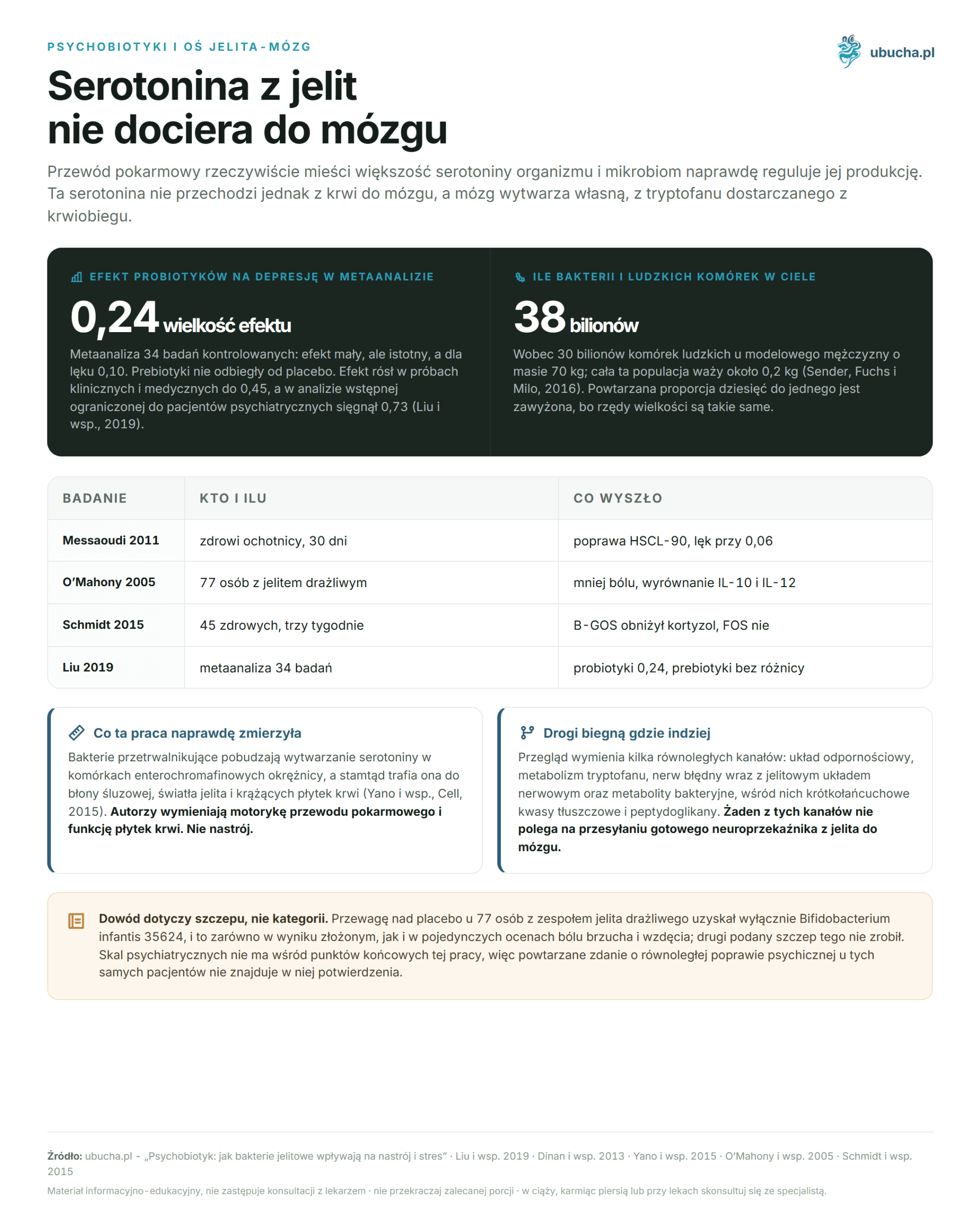
• Liu et al.'s meta-analysis (Neuroscience and Biobehavioral Reviews, 2019) included 34 controlled studies: probiotics had a small but significant effect on depression (d = -0.24), while prebiotics did not differ from placebo.
• The term "psychobiotic" was introduced by Dinan, Stanton, and Cryan (Biological Psychiatry, 2013) as a name for a living organism that provides health benefits to individuals with mental disorders.
• The gastrointestinal tract contains most of the body's serotonin, but this molecule does not reach the brain; the microbiome reaches it through other pathways.
• Najlepiej udokumentowane szczepy to L. helveticus R0052 z B. longum R0175 oraz B. infantis 35624.
What is a psychobiotic and how does it differ from a regular probiotic?
A psychobiotic is a living organism that, when taken in appropriate amounts, provides health benefits to individuals suffering from a mental disorder. This is how it was defined. Dinan, Stanton i Cryan (Biological Psychiatry, 2013). This is not a separate species of bacteria, but a strain with clinical evidence.
The difference from a regular probiotic is therefore formal, not biological. Every psychobiotic is a probiotic; the reverse is not true. The authors of the original definition were more cautious than the market that later used it. They wrote about patients with mental illness, while most subsequent trials were conducted on healthy volunteers or individuals with irritable bowel syndrome.
The mechanism they indicated is specific: these bacteria produce and deliver neuroactive substances, including gamma-aminobutyric acid and serotonin, acting on the gut-brain axis. Preclinical studies on rodents suggested antidepressant or anxiolytic effects, with the vagus nerve, spinal cord, or neuroendocrine system as intermediaries. The irritable bowel syndrome was the most extensively studied at that time.
It is worth reading the last sentence of that paper in full, as it sounds more modest than everything written afterwards: we are still waiting for the results of large placebo-controlled studies. Since 2013, such studies have emerged, and we will return to them later in the text. However, they did not change the rule that evidence always pertains to a single strain, not the category "probiotic."
Is it true that serotonin from the gut regulates mood?
Not in the way that the internet repeats. The gastrointestinal tract indeed contains most of the body's serotonin, and the microbiome does regulate its production. However, this serotonin does not cross from the blood to the brain, and the brain produces its own from tryptophan supplied from the bloodstream.
How do we know that bacteria regulate gut serotonin? Yano et al. (Cell, 2015) They showed that spore-forming bacteria from the microbiota of mice and humans stimulate the production of serotonin in the enterochromaffin cells of the colon, and from there it reaches the mucosa, the intestinal lumen, and circulating platelets. Increasing the concentration of selected bacterial metabolites in the intestinal lumen raised serotonin levels in the colon and in the blood of germ-free mice.
Note what effects this study measured. The authors mention gastrointestinal motility and platelet function. Not mood. Gut serotonin is a molecule of the digestive and coagulation systems, not fuel for the brain.
This distinction has practical consequences. If someone promises mood improvement solely because serotonin is produced in the gut, they are relying on a true premise and a conclusion that does not follow from it. Real pathways of influence exist, but they run elsewhere. A broad review describes them extensively, which we will transition to below, and a broader context of this axis is elaborated in a separate entry about. the gut-brain axis..
Through what pathways does the microbiome reach the brain?
Review Cryana i wsp. (Physiological Reviews, 2019) It lists several parallel channels: the immune system, tryptophan metabolism, the vagus nerve along with the enteric nervous system, and bacterial metabolites, among them short-chain fatty acids, branched-chain amino acids, and peptidoglycans. None of these channels rely on transmitting a ready-made neurotransmitter from the gut to the brain.
The scale of the phenomenon is sometimes exaggerated, so it is worth anchoring it. Sender, Fuchs i Milo (PLoS Biology, 2016) They calculated that in the body of a model man weighing 70 kg, there are about 38 trillion bacterial cells compared to 30 trillion human cells, and this entire population weighs about 0.2 kg. The repeated ratio of ten to one is inflated: the orders of magnitude are the same.
The strongest evidence for the role of the vagus nerve comes from animal studies. Bravo i wsp. (PNAS, 2011) They administered the strain Lactobacillus rhamnosus JB-1 to mice and observed changes in mRNA expression of GABA receptors dependent on the brain region, a decrease in stress-induced corticosterone, and less anxiety and depressive behavior. In mice with severed vagus nerves, there were no neurochemical or behavioral changes.
This is an important result, but it must be read literally. It pertains to mice, and the changes in receptor expression went in both directions, depending on the brain structure. A popular summary stating that this strain works "the same way as benzodiazepines, just without addiction" adds a comparison that is not present in the available summary of this study.
Which strains have the strongest clinical evidence?
In human studies, the burden of proof rests on two positions: the combination of Lactobacillus helveticus R0052 with Bifidobacterium longum R0175 and the strain Bifidobacterium infantis 35624. Besides these, aggregate data matters, as individual trials are small.
Messaoudi i wsp. (British Journal of Nutrition, 2011) They conducted a two-part study: an experiment on rats and a trial with a double-blind, placebo-controlled parallel group of healthy volunteers who took the preparation for 30 days. Improvement was noted on the HSCL-90 scale, in its overall severity index, in the subscales of somatization, depression, and hostility, as well as in the overall score of the HADS scale. The anxiety subscale of HADS stopped at a p-value below 0.06, meaning it did not reach the usual significance threshold. Summaries that simply mention 'anxiety reduction' overlook this boundary.
Obraz zbiorczy daje metaanaliza Liu, Walsha i Sheehan (Neuroscience and Biobehavioral Reviews, 2019) covering 34 controlled studies. Probiotics had a small but significant effect on depression (d = -0.24) and on anxiety (d = -0.10). Prebiotics did not differ from placebo. The effect increased in clinical and medical trials (d = -0.45), and in a preliminary analysis limited to psychiatric patients, it reached d = -0.73.
| Study | Kto i ilu | Time | What was found |
|---|---|---|---|
| Messaoudi 2011, British Journal of Nutrition | healthy volunteers, placebo trial | 30 days | improvement in HSCL-90 and overall HADS score, decrease in free cortisol in urine |
| O’Mahony 2005, Gastroenterology | 77 people with irritable bowel syndrome | 8 weeks | B. infantis 35624 reduced abdominal pain and bloating, normalized the IL-10 to IL-12 ratio |
| Schmidt 2015, Psychopharmacology | 45 healthy volunteers | 3 tygodnie | B-GOS lowered morning cortisol spike; FOS had no effect |
| Liu 2019, Neurosci. Biobehav. Rev. | meta-analysis of 34 controlled studies | - | probiotics d = -0.24 for depression; prebiotics no difference compared to placebo |
How to choose a preparation from this, is described separately in the entry about how to select a probiotic strain.
Does a psychobiotic lower cortisol?
In two independent trials on humans, yes, with two different indicators measured. In Messaoudi's study, daily excretion of free cortisol in urine decreased, which is a measure of 24-hour hormone production. This is a statistically significant result obtained after 30 days of taking the preparation.
The second measurement concerned the morning cortisol spike and yielded a more interesting result, as it separated two components usually lumped together. Schmidt i wsp. (Psychopharmacology, 2015) they administered one of two prebiotics, fructooligosaccharides or galactooligosaccharides B-GOS, or a placebo in the form of maltodextrin to 45 healthy volunteers for three weeks. Salivary cortisol spike upon awakening was significantly lower after B-GOS than after placebo, and participants paid less attention to negative stimuli in the dot-probe test. No such effects were observed after fructooligosaccharides.
The conclusion is uncomfortable for advertising slogans: prebiotics are not one category, just like probiotics. Two substances from the same chemical family, administered in the same scheme and measured by the same method, yielded different results. The statement about 'FOS and GOS prebiotics that reduce reactivity to emotional stimuli' conflates an effective position with one that did not work.
What do psychobiotics offer for irritable bowel syndrome?
This is an area with the longest history of research, as gastrointestinal and psychological symptoms co-occur frequently enough that one intervention can target both. Dinan et al. pointed to irritable bowel syndrome as the place where psychobiotics have been most extensively studied.
O’Mahony i wsp. (Gastroenterology, 2005) They randomly assigned 77 individuals with this diagnosis to three groups: Lactobacillus salivarius UCC4331, Bifidobacterium infantis 35624, or a malt beverage as placebo, for eight weeks. Each strain was administered at a dose of 10 billion live cells. Only B. infantis 35624 showed an advantage over placebo, both in the composite result and in individual assessments of abdominal pain, bloating, and difficulty with bowel movements.
The second result of this work concerns immunity. At the start, patients had an abnormal IL-10 to IL-12 ratio, indicating a predominance of a pro-inflammatory Th-1 profile. Administration of B. infantis 35624 normalized this ratio, which neither the second strain nor the placebo achieved.
It is worth narrowing the conclusion to what this work measured: gastrointestinal symptoms and cytokine ratios. Psychiatric scales are not among the endpoints listed in the summary, so the repeated statement about parallel mental improvement in the same patients is not confirmed in it. Separately, we wrote about irritable bowel syndrome in connection with kannabidiolu i mikrobiomu.
Does the microbiome affect sleep?
Data in humans are correlational and come from small groups, so the answer is: probably yes, but the direction of the relationship remains unresolved. The most frequently cited work measured correlation, not the effect of intervention.
Smith i wsp. (PLoS ONE, 2019) they combined actigraphy with microbiome sampling in 26 participants, exclusively men with an average age of about 22 years. Overall microbiome diversity positively correlated with sleep efficiency and total sleep time, and negatively with wake time after falling asleep. This same diversity also correlated with interleukin 6 levels, a cytokine previously linked to sleep. The group was small and homogenous in gender, so this is a signal for further research, not a rule for the entire population.
Mechanizm zegarowy opisano natomiast na myszach. Thaiss i wsp. (Cell, 2016) they showed that daily oscillations of the microbiota program the transcriptional and epigenetic rhythm of the host, and disrupting this rhythm not only abolishes normal oscillations but also induces new ones in the gut and liver. The work describes the transcriptional and epigenetic rhythm of the host; the quality of sleep is not addressed in its summary. The popular story about germ-free mice that sleep poorly and are fixed by probiotics attributes more to it than can be read from it.
What to eat to support the microbiome?
The strongest dietary evidence in this area pertains to fermented foods, not capsules. Wastyk i wsp. (Cell, 2021) They conducted a seventeen-week randomized study with 18 people per arm, comparing a diet rich in plant fiber with a diet rich in fermented products.
The results were clear. The fermented arm systematically increased microbiota diversity and reduced inflammatory markers. In the high-fiber arm, the primary endpoint, the cytokine response rate, did not change, and participants divided into three distinct immunological trajectories depending on baseline microbiota diversity. The authors concluded that fermented products may counteract the decline in diversity and the increase in inflammation typical of industrialized societies.
This translates simply to your daily menu. Prebiotics are scattered throughout the kitchen, while fermented products are kept on one shelf:
- inulina oraz fruktooligosacharydy: cebula, czosnek, por, karczoch
- beta-glucan: oats, barley
- pectins: apples, citrus fruits
- resistant starch: cooled potatoes, rice cooked the day before
- polifenole: jagody, zielona herbata
- produkty fermentowane: jogurt naturalny, kefir, kimchi, kiszona kapusta, tempeh, miso
Keep in mind the lesson from Schmidt's work: the name of the group does not determine its action. One galacto-oligosaccharide reduced morning cortisol, while a fructo-oligosaccharide in the same study did not. The differences between prebiotics and probiotics are elaborated in a separate entry about prebiotykach i probiotykach.
Frequently Asked Questions
What is a psychobiotic?
It is a living organism that, when taken in the right amount, brings health benefits to individuals with mental disorders. The definition was formulated by Dinan, Stanton, and Cryan in Biological Psychiatry in 2013. It is not a separate species of bacteria, but a specific strain for which such an effect has been demonstrated in research.
Which psychobiotic strains have studies on humans?
The two most well-documented strains are Lactobacillus helveticus R0052 and Bifidobacterium longum R0175, studied by Messaoudi and colleagues for 30 days in healthy volunteers. Bifidobacterium infantis 35624 was studied by O'Mahony's team in 77 individuals with irritable bowel syndrome over eight weeks.
Can a psychobiotic replace an antidepressant?
No. A meta-analysis by Liu et al. from 2019 showed a small but statistically significant effect for probiotics, with a strength of d = -0.24 for depression. This magnitude is incomparable to pharmacotherapy. In cases of diagnosed depressive or anxiety disorders, treatment by a physician is decisive.
How long did the studies on psychobiotics last?
From three weeks to seventeen. Schmidt administered prebiotics for three weeks, Messaoudi a probiotic preparation for 30 days, O'Mahony for eight weeks, and Wastyk conducted a dietary intervention for seventeen weeks. There are practically no shorter observations in this group of studies.
Does serotonin from the gut improve mood?
Not directly. Yano et al. demonstrated in 2015 that gut bacteria stimulate the production of serotonin in enterochromaffin cells, but the effects described in this study pertain to gastrointestinal motility and blood platelets. This serotonin does not cross from the blood to the brain.
Does a prebiotic work the same way as a probiotic?
No. In Liu's 2019 meta-analysis, prebiotics did not differ from placebo either in depression or anxiety, while probiotics showed a significant effect. There are also differences within the prebiotic group itself: galacto-oligosaccharides worked in Schmidt's study, while fructo-oligosaccharides did not.
Probiotic preparations and other supplements in the store ubucha.pl are grouped in the category supplements.
The article is informational and educational in nature and does not replace consultation with a doctor. If you are pregnant, breastfeeding, taking medications, or have chronic conditions, consult the use of supplements or herbs with a specialist.
Author: Michał Waluk · Opublikowano: 2026-05-29 · Aktualizacja: 2026-08-16