
Hops (cones) for sleep and anxiety: effects, dosage, and how to use
Hops for sleep and nervousness in light of research: what a study with non-alcoholic beer showed, what a review says about valerian, and why estrogenic activity matters.
Hops are associated with beer, but Humulus lupulus cones were used in pillows and infusions long before anyone started adding them to brews. Contemporary research on this application is surprisingly sparse and much more cautious than sales descriptions would suggest. One study in humans did show shorter sleep onset, but it was conducted on seventeen individuals using non-alcoholic beer, not capsules. The review cited by everyone when combining hops with valerian ends with a conclusion much more cautious than is often quoted. This article shows what can be defended from this material and what cannot, and explains why we need to talk separately about hormones in hops.
KEY INFORMATION
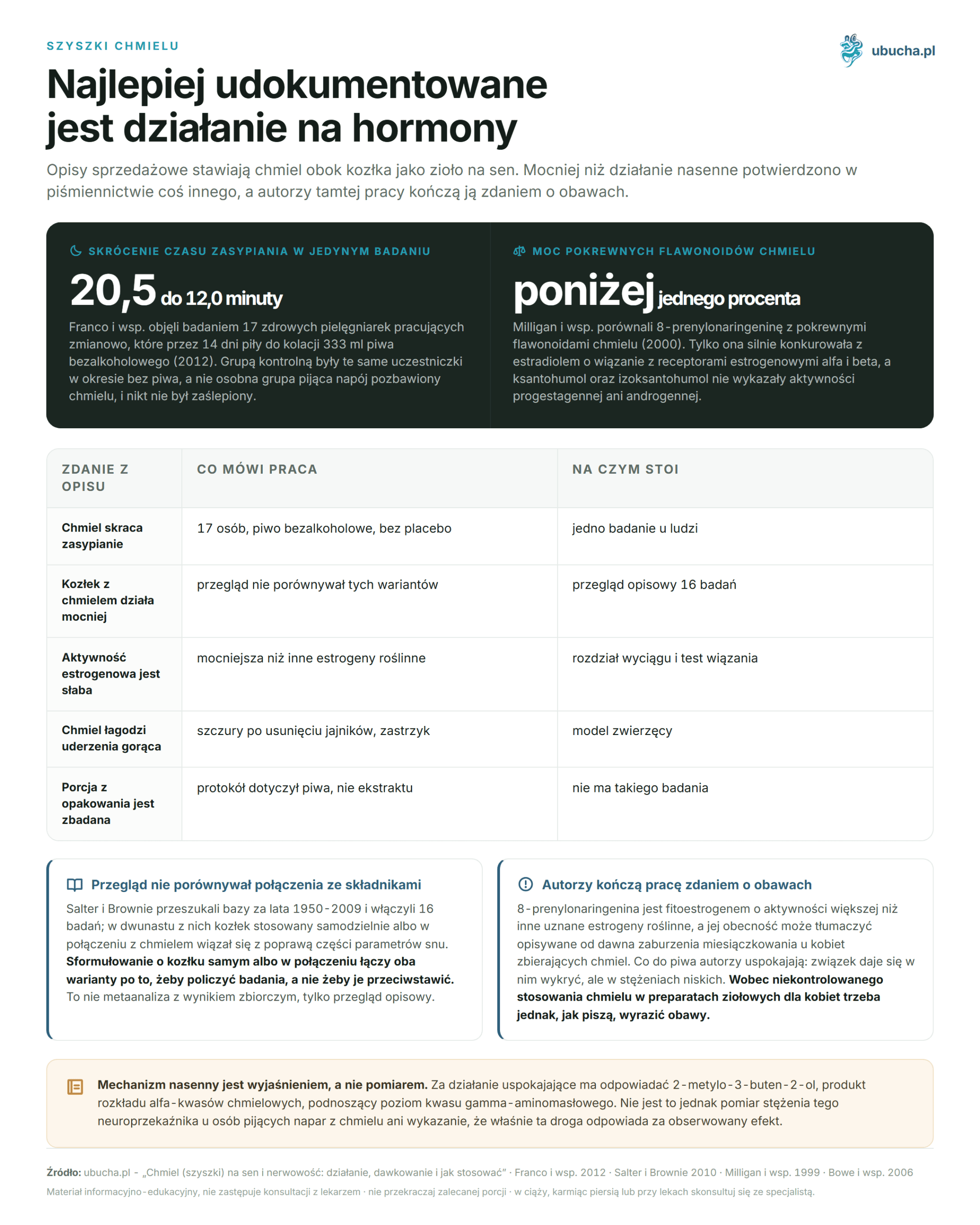
• Franco et al. (PLoS ONE, 2012) studied 17 nurses working shifts. For 14 days, they drank 333 ml of non-alcoholic beer at dinner, and the sleep onset time measured by actigraphy decreased from 20.5 to 12.0 minutes.
• Salter and Brownie (Australian Family Physician, 2010) reviewed 16 studies on valerian and hops. Their conclusion is that further trials are needed before such treatment can be confidently recommended.
• 8-prenylnaringenin from hops is a strong phytoestrogen, more potent than other known plant estrogens (Milligan et al., Journal of Clinical Endocrinology and Metabolism, 1999).
• The authors of the same group directly express concerns about the uncontrolled use of hops in herbal preparations for women. This text does not provide any dosage to measure at home.
What in hops is supposed to work for sleep?
The sedative effect is not due to the hop cone itself, but to the breakdown product of its bitter resins. The compound indicated by researchers is 2-methyl-3-buten-2-ol, which is formed from the degradation of alpha-acids from hops. It raises the level of gamma-aminobutyric acid, or GABA, the main inhibitory neurotransmitter in the central nervous system.
Such a description of the mechanism is provided by the authors of the only study in humans that we discuss below, and it is worth noting what it is not. It is not a measurement of GABA levels in individuals drinking hop infusion nor a demonstration that this pathway is responsible for the observed effect. It is a coherent explanation of why hops might have a calming effect, based on earlier work on the substance itself.
Hops also contain lupulin, a yellow, sticky powder from secretory glands, which accumulates alpha-acids led by humulone and beta-acids with lupulone. This is the raw material for everything else: bitterness in beer, preservative properties, and the mentioned metabolite. A separate group includes prenylated flavonoids, including xanthohumol and isoxanthohumol, as well as 8-prenylnaringenin, which will have a separate section because it is not attributed with sleep effects and has much to do with safety.
What did the study with non-alcoholic beer show?
A reduction in sleep onset time by about eight minutes, decreased nighttime activity, and lowered anxiety, but in a group of seventeen individuals and without a placebo. This is the only study in humans on which all this knowledge about hops stands, so it is worth knowing its details, not just the conclusion.
Franco i wsp. (PLoS ONE, 2012) They included 17 healthy nurses working in shift or night systems. For 14 days, they drank 333 ml of non-alcoholic beer containing hops at dinner, and sleep was recorded using actigraphy worn on the wrist. Sleep onset time decreased from 20.50 minutes during the control period to 12.01 minutes during the beer drinking period. Total nighttime activity decreased from 7259 to 5285 movement impulses. Anxiety levels measured by the STAI questionnaire dropped from 20.69 to 18.09 points.
However, the limitations are as significant as the result. The control group consisted of the same participants during the period without beer, not a separate group drinking a hop-free beverage. No one was blinded, so it is impossible to separate the effect of hops from the influence of the evening ritual and expectations. Seventeen individuals is a sample where chance plays a significant role. Finally, a specific beverage was studied in a specific volume, not an extract in a capsule.
From this last point arises something that needs to be stated clearly. The dosages of extracts provided on supplement packaging do not come from studies that have shown anything in humans. Therefore, you will not find a dosage table or milligram amounts to measure in this article. Whether hops make sense in your situation is determined by your doctor or pharmacist, especially if you are taking sedative medications.
Does hops with valerian work better than either alone?
This has not been demonstrated, and the review that is usually cited to justify this says something different. This is the most frequently misquoted statement in all literature on hops, and it is worth seeing exactly where the leap occurs.
Salter and Brownie (Australian Family Physician, 2010) They searched the AMED and MEDLINE databases for the years 1950-2009 regarding the effectiveness of valerian and hops in primary insomnia. Sixteen studies met the inclusion criteria. In twelve of them, the use of valerian alone or in combination with hops was associated with improvements in some sleep parameters, such as sleep onset time and sleep quality. However, the authors caution that the results require careful interpretation, as the studies differed significantly in methodology. The final conclusion is that further randomized double-blind trials with placebo are needed before such treatment can be confidently recommended.
Note two things. First, the review did not compare the combination with individual components and does not state that the combination is stronger. The phrase "valerian alone or in combination with hops" combines both variants to count the studies, not to oppose them. Second, this is not a meta-analysis with a numerical aggregate result, but a descriptive review that counts studies and assesses their quality.
A fair summary is therefore this: the combination of valerian with hops is studied more often than hops alone, but this does not imply that it works stronger. This review does not allow for any certain statements about hops in monotherapy for primary insomnia. You can find a comparison of herbs used in the evening in the entry about sleep teas with lemon balm, lavender, and hops.
Does hops have hormonal effects?
Yes, and this is the best-documented property of hops in this entire article, more strongly confirmed than its sedative effects. The repeated reassurance that the estrogenic activity of hops is weak and weaker than that of soy is not supported by the studies usually cited.
Milligan i wsp. (Journal of Clinical Endocrinology and Metabolism, 1999) They isolated the extract from hop cones and identified the compound responsible for this activity: 8-prenylnaringenin. They described it as a phytoestrogen with greater activity than other recognized plant estrogens. They also noted that its presence may explain the long-reported menstrual disorders in women harvesting hops. Regarding beer, the authors reassure: the compound can be detected in it, but at low concentrations that do not raise concerns.
A year later ta sama grupa (Journal of Clinical Endocrinology and Metabolism, 2000) compared 8-prenylnaringenin with related flavonoids from hops. Only it strongly competed with estradiol for binding to alpha and beta estrogen receptors. Related compounds had less than one percent of its potency, and xanthohumol and isoxanthohumol did not show progestogenic or androgenic activity. The authors conclude the work with a statement that concerns must be expressed regarding the uncontrolled use of hops in herbal preparations for women.
The conclusion for the reader is different from the usual calming effect. Beer is one thing, and concentrated extract from hops is another, and it is precisely this second one that the authors wrote about with concern.
Does hops alleviate menopausal symptoms?
The same property that warrants caution is also a reason for interest in hops during the perimenopausal period. However, the evidence so far is animal-based and comes from injection studies, not oral ones.
Bowe i wsp. (Journal of Endocrinology, 2006) They worked on a rat model of hot flashes, in which the skin temperature of the tail rises after the removal of the ovaries. Daily subcutaneous administration of 8-prenylnaringenin lowered this elevated temperature after two days, similarly to estradiol. Co-administration with an estrogen receptor antagonist completely abolished the effect, indicating that the action occurs precisely through the estrogen receptor, at least partially peripherally.
This is a well-designed mechanistic study and also a clear boundary of what can be inferred from it. The rat model is not a menopausal woman, subcutaneous injection is not a capsule, and lowering the tail temperature is not the same as experiencing a hot flash. If you are looking for support for menopausal symptoms, talking to a gynecologist is the right place to start, among other reasons, because a preparation with proven estrogenic effects is not neutral in cases of hormone-dependent cancers or during hormonal treatment.
How was hops used before the era of supplements?
A pillow filled with dried hops and an evening infusion are the two oldest ways to use hops outside of brewing. Both have survived to this day, but neither has been studied in comparison to anything.
The infusion is prepared from dried hops soaked in water just below boiling and steeped under cover for several minutes. The taste is distinctly bitter and earthy, as the bitter resins pass into the water, and it pairs well with lemon balm or honey. Covering is practically important because some of the hop components are volatile and escape with the steam without it.
The hop pillow works on a different principle, through inhaling volatile components released from the dried hops throughout the night. It is difficult to talk about dosage here and even harder to measure it, so this method remains in the realm of tradition rather than evidence. The same applies to the alcoholic tincture, which extracts bitter resins more effectively than water, but is not suitable for those avoiding alcohol, with liver diseases, or during pregnancy. We describe similar evening rituals in konopnej herbacie pitej przed snem.
Hops safety: who should be cautious?
Hops cones in the form of an infusion are traditionally well tolerated, but the study by Franco et al. was not designed to detect adverse effects, so it does not answer this question. The greatest concerns relate to concentrated preparations and arise directly from estrogenic activity, not from sedative effects.
Women undergoing hormonal treatment and individuals with a history of hormone-dependent cancer should discuss concentrated hop extract with their healthcare provider. This is not an excessive precaution: the authors of the 2000 paper themselves expressed concern about the uncontrolled use of hops in preparations for women, and they did so in the closing sentence of the publication.
The second group includes individuals taking medications that inhibit the central nervous system. Since hops are believed to enhance GABAergic transmission, which is the same pathway that benzodiazepines and some antihistamines act on, combining them without consultation is not a good idea. There are no studies measuring this interaction in humans, so caution here is based on data.
Separately: pregnancy and breastfeeding is an area without data, and in the case of estrogenic activity, the lack of data means more here than usual. It is also worth remembering that hops and cannabis belong to the same botanical family, Cannabaceae, so if you are allergic to one of these plants, it is better to treat the first contact with the other with caution. We write more about plants from this family in the entry about herbacie z konopi.
Frequently Asked Questions
Does hops really help you fall asleep?
One study in humans suggests so. Franco et al. (2012) measured a reduction in sleep onset time from 20.5 to 12.0 minutes in 17 shift nurses after fourteen days of drinking non-alcoholic beer with dinner. The study had no placebo or blinding, and the reference group consisted of the same individuals during a period without beer.
Does hops with valerian work better than valerian alone?
This has not been demonstrated. Salter and Brownie (2010) reviewed 16 studies and found improvements in some sleep parameters with valerian used alone or with hops, without comparing these variants. They conclude that further trials with a placebo are needed before such treatment can be confidently recommended.
What dosage of hops was used in the studies?
The only protocol involving humans that showed any results was 333 ml of non-alcoholic beer with dinner for fourteen days. The doses of extract provided on supplement packaging do not come from a study with such results. The appropriateness of using hops is determined by a doctor or pharmacist.
Does hops affect hormones?
Yes, and this is better documented than its sedative effects. Milligan et al. demonstrated that 8-prenylnaringenin from hops strongly binds to estrogen receptors and is more potent than other known plant estrogens. The authors express concerns about the uncontrolled use of hops in herbal preparations for women.
Does hops help with hot flashes during menopause?
This has been shown in rats after ovariectomy, with subcutaneous administration of 8-prenylnaringenin, which lowered the elevated tail skin temperature (Bowe et al., 2006). This is an animal model and a different route of administration than a capsule, so the results should not be directly applied to women. Discuss the decision with your gynecologist.
Can hops be combined with sleeping pills?
It's better not to without consultation. Hops are thought to enhance GABAergic transmission, which is the same pathway that benzodiazepines and sedative antihistamines act on. There are no studies measuring this interaction in humans, so caution replaces data here. Ask your doctor or pharmacist.
Susz z szyszek chmielu oraz inne surowce zielarskie znajdziesz w kategorii herbs.
This article is for informational and educational purposes and does not constitute medical advice. Before starting supplementation, consult your doctor, especially if you are taking medications regularly, are pregnant or breastfeeding, or have a chronic illness.
Author: Michał Waluk · Opublikowano: 2026-05-29 · Aktualizacja: 2026-08-15