
Potassium - deficiency, symptoms, and how to safely supplement (FAQ)
Potassium: answers to the most common questions and what studies say. u Bucha.
Potassium is the most important intracellular cation in the body - about 98% of the total potassium pool is found inside cells, and only 2% in the blood. This small extracellular fraction determines the membrane potential of nerve and muscle cells, and deviations in either direction have serious cardiological consequences. EFSA has established the daily potassium requirement for adults at 3,500 mg, however, population studies in Europe show that over 60% of adults do not meet this standard (EFSA Dietary Reference Values, 2016). This article answers the most common questions about potassium - from deficiency symptoms to safe replenishment methods.
KEY INFORMATION
• EFSA recommends 3,500 mg of potassium daily for adults - over 60% of Europeans do not reach this standard (EFSA 2016).
• The first symptoms of deficiency: calf muscle cramps, weakness, palpitations, and constipation.
• Over-the-counter potassium supplements are limited to 99 mg/tablet - both deficiency and excess pose a risk of heart rhythm disturbances.
• The best sources of potassium are a diet rich in vegetables, fruits, and legumes.
• Diuretics, diarrhea, and vomiting are the most common causes of deficiency - they require monitoring of electrolytes.
Where does potassium deficiency come from and who is particularly at risk?
Hypokalemia (K+ concentration in the blood below 3.5 mmol/l) usually has a specific cause - it rarely results solely from an insufficient diet in a healthy person. The kidneys are very efficient at maintaining potassium homeostasis and under normal conditions excrete exactly as much potassium as we provide through food. The problem arises when regulatory mechanisms are disrupted.
The most common causes of potassium deficiency: thiazide and loop diuretics (hydrochlorothiazide, furosemide, torasemide) increase renal excretion of K⁺ - this is the most common cause of hypokalemia in cardiology patients. Diarrhea and vomiting lead to massive loss of electrolytes from the gastrointestinal tract. Abuse of laxatives has the same effect and is often overlooked as a cause of deficiency in individuals with eating disorders. A diet low in fruits and vegetables, high in processed foods - processed foods contain a lot of sodium but little potassium, which further disrupts the balance. Traveler's diarrhea and gastrointestinal infections - even short episodes of intense diarrhea can significantly lower potassium levels. Alcohol increases potassium excretion by the kidneys and leads to nutritional deficiencies.
A little-known mechanism: high intake of simple sugars and insulin resistance may contribute to hypokalemia through insulin-dependent transport of K⁺ into cells. After a high-carbohydrate meal, insulin pushes potassium into cells, temporarily lowering its concentration in the plasma. In individuals with insulin resistance, these fluctuations are more pronounced and may manifest as muscle cramps after high-glycemic meals.
How to recognize potassium deficiency? Symptoms step by step
Symptoms of hypokalemia gradually increase with the decrease in K⁺ concentration in the blood. With mild deficiency (3.0-3.5 mmol/l), symptoms are subtle and easy to overlook. With moderate and severe deficiency (<3.0 mmol/l) can be life-threatening.
Symptoms of mild hypokalemia: Muscle cramps, especially in the calves at night - this is a classic signal. General weakness and muscle fatigue without any other obvious cause. Constipation resulting from weakness of the smooth muscles of the intestines. A feeling of fatigue disproportionate to physical activity.
Symptoms of moderate and severe hypokalemia: Palpitations and irregular heartbeat - a symptom requiring urgent EKG diagnostics. Increased blood pressure - potassium deficiency impairs the vasodilatory effect of potassium on blood vessels. Paresthesia (tingling, numbness of limbs). Muscle paralysis in extreme cases. Changes in EKG: flattening or inversion of the T wave, appearance of the U wave (NIH StatPearls, Hypokalemia, 2024).
Differentiating potassium deficiency symptoms from other causes is difficult without laboratory testing. If you experience regular nighttime muscle cramps or palpitations, measuring electrolytes is a worthwhile test - it is inexpensive, quick, and provides concrete answers.
How to safely replenish potassium - diet vs. supplements
For a healthy person without kidney disease and without diuretics, the best strategy for replenishing potassium is diet, not supplements. Here’s why: over-the-counter potassium supplements are intentionally limited to 99 mg per tablet by the FDA and European regulatory bodies. This is only 2.8% of the daily requirement of 3,500 mg. The limitation is not accidental - higher dose tablets pose a risk of local hyperkalemia in the intestines and dosing errors that can trigger arrhythmias.
Meanwhile, one serving of white beans (100 g) provides ~1,200 mg of potassium, and one baked potato with skin (~200 g) - about 1,000 mg. Three such products throughout the day can cover the full requirement without any supplements. The Mediterranean diet and the DASH diet, both rich in vegetables, legumes, and fruits, naturally provide 4,000-5,000 mg of potassium daily. It is no coincidence that these dietary patterns are most strongly associated with cardiovascular protection.
Potassium supplementation is justified in specific clinical situations: when a blood test confirms hypokalemia, when a doctor prescribes diuretics and recommends K⁺ supplementation, during intense sports with significant sweating in the heat. In these cases, supplements should be used under the control of K⁺ levels in plasma, not "just in case".
Questions about potassium often come from people who have suddenly started exercising intensely or switched to a minimally processed diet and are experiencing nighttime calf cramps. In both cases, the remedy is usually not a supplement, but one simple question: how many fruits and vegetables do you eat daily? The often given answer "not too many" explains everything.
Potassium and blood pressure - a relationship that changes clinical practice
One of the best-documented properties of potassium is its effect on blood pressure. Potassium acts as a natural antagonist to sodium in regulating body fluid volume - it stimulates sodium excretion by the kidneys and relaxes the arterial walls through hyperpolarization of smooth muscle cells. A meta-analysis of 33 randomized controlled trials showed that potassium supplementation lowered systolic blood pressure by an average of 3.5 mmHg in individuals with hypertension - an effect comparable to a mild antihypertensive medication (Poorolajal et al., Nutrients, 2017).
The DASH diet (Dietary Approaches to Stop Hypertension) recommended by the American Heart Association bases its hypotensive action, among other things, on high potassium intake from vegetables, fruits, and dairy products - targeting 4,700 mg daily. This is more than the European EFSA standard (3,500 mg), but reflects the amount at which clinical studies show clear cardioprotective effects (NIH NHLBI, DASH Eating Plan, 2024).
The sodium to potassium ratio in the diet is more important than the absolute amount of either of these minerals. A typical Polish diet rich in processed products provides 3,000-4,000 mg of sodium daily with only 2,000-2,500 mg of potassium - a Na:K ratio opposite to optimal. Replacing even half of processed snacks with fruits and vegetables can shift this ratio to one favorable for the cardiovascular system without the need for supplements.
Frequently Asked Questions
What are the first symptoms of potassium deficiency?
The first symptoms of hypokalemia are nighttime muscle cramps in the calves, general weakness and muscle fatigue, constipation, and palpitations. At K⁺ levels below 3.0 mmol/l, heart rhythm disturbances and changes in ECG may occur, requiring urgent medical assistance. Measuring electrolytes from blood is a basic test when potassium deficiency is suspected (NIH StatPearls, 2024).
Can I supplement potassium without blood tests?
This is not recommended. Over-the-counter potassium supplements are limited to 99 mg/tablet for safety reasons - both potassium deficiency and excess can cause dangerous arrhythmias. Before supplementation, have your electrolytes tested and consult the results with a doctor who will assess whether and in what form supplementation is necessary.
Which foods are richest in potassium?
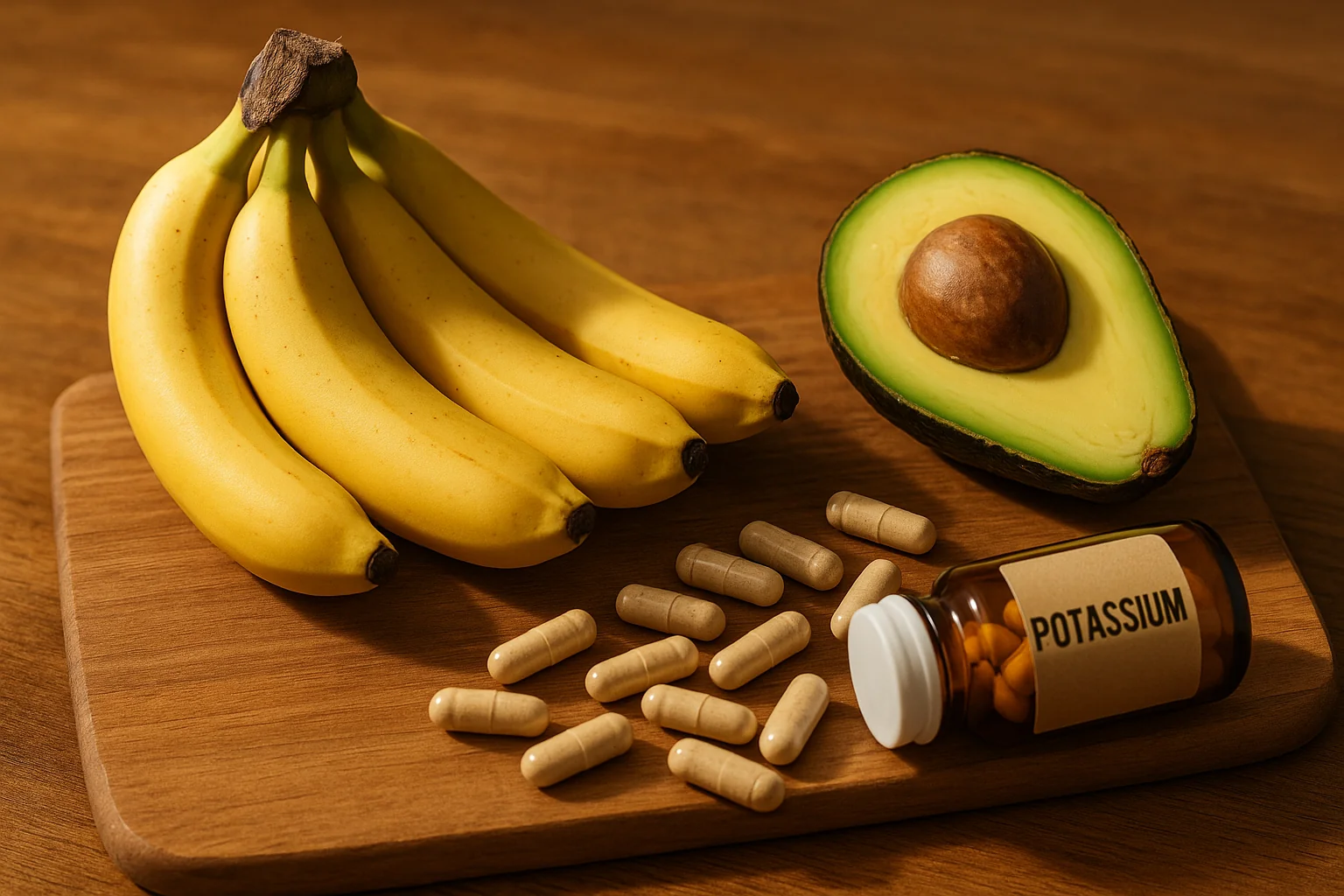
The best sources: white beans (~1,200 mg/100 g), baked potato with skin (~1,000 mg/200 g), avocado (~700 mg/avocado), cooked spinach (~540 mg/100 g), salmon (~628 mg/100 g), banana (~360 mg/each). A varied diet with a portion of vegetables and fruits at every meal covers the daily requirement of 3,500 mg without supplements.
Why do diuretics cause potassium deficiency?
Thiazide and loop diuretics increase potassium excretion by the kidneys through the Na⁺/K⁺ exchange mechanism in the distal tubule. Patients taking these medications can lose more than 1,000 mg of potassium daily through urine beyond the norm. Therefore, diuretic therapy requires regular monitoring of electrolytes and often potassium supplementation prescribed by a doctor.
Is potassium from supplements absorbed the same as from food?
Potassium absorption from supplements (potassium chloride or citrate) is over 90% and is similar to absorption from food. Potassium citrate has the additional advantage of alkalizing urine, which reduces the risk of oxalate stone formation. Potassium chloride is cheaper and equally effective in correcting hypokalemia without accompanying metabolic acidosis.
Does a ketogenic and low-carbohydrate diet increase the risk of potassium deficiency?
Yes - and for several reasons at once. First, the ketogenic diet limits the intake of fruits, legumes, and potatoes, which are the main sources of potassium. Second, low insulin levels on a keto diet reduce renal retention of sodium and potassium - the kidneys excrete more electrolytes in urine. Third, ketosis causes increased diuresis in the first weeks, which intensifies electrolyte loss. People on a ketogenic diet often experience muscle cramps, fatigue, and palpitations precisely due to potassium (and magnesium) deficiency. The solution is to increase the intake of low-carbohydrate potassium-rich vegetables (avocado, spinach, kale, broccoli) or - if necessary - careful supplementation under electrolyte control.
Czy nadmiar potasu jest niebezpieczny - co to jest hiperkaliemia?
Hyperkalemia (K⁺ concentration in the blood above 5.5 mmol/l) is a dangerous condition requiring urgent medical attention, as high potassium levels disrupt the electrical conduction of the heart and can lead to cardiac arrest. In healthy individuals with properly functioning kidneys, dietary hyperkalemia is practically impossible - the kidneys efficiently excrete the excess. The risk arises with: chronic kidney disease (impaired excretion), use of potassium-sparing medications (spironolactone, ACE inhibitors, sartans), excessive potassium supplementation without laboratory control. Therefore, potassium supplementation above 99 mg daily requires medical supervision and regular monitoring of electrolytes (NIH StatPearls, Hyperkalemia, 2024).
This article is for informational and educational purposes and does not replace consultation with a doctor. If you are pregnant, breastfeeding, taking medications, or have chronic conditions, consult the use of supplements or herbs with a specialist.
Author: Michał Waluk · Published: 2026-05-04 · Updated: 2026-05-04