
Lemon Skunk (Cannabis sativa L. Red No 2): a strain with an undisclosed pedigree
Lineage undetermined, one manufacturer, terpene composition known from one source. We gather what can be verified about this strain and directly name what has not been measured.
Where does Lemon Skunk come from and what is its lineage?
It is unknown. The parents of this strain are not provided by any of the sources on which this cluster is based, so the pedigree section remains empty and will stay that way until someone documents it. However, the registration record of the raw material is known, along with its genetics according to one description and the declared THC content.
The empty section is neither an oversight nor a flaw in the compilation. The breeder either never announced the lineage from which this line was derived, or did so in a location that can no longer be found today, and strain databases then copy each other’s guesses until it starts to look like a fact. In this cluster, the pedigree has been established for sixty out of eighty-five strains; the remaining twenty-five have the same empty section as Lemon Skunk.
The name suggests an answer and that is precisely why it is a trap. Names are given by the breeder, not the registry; they may describe the aroma or pay homage to a line that was selling well at the time, and a common word in the trade name proves nothing in either direction. A pedigree entered by intuition creates false connections between strains and remains online for years, as subsequent services copy it without questioning the source.
In the registry, the raw material is listed as Cannabis sativa L., Red No 2, and the genetics are described as sativa. The full registered name also carries a numerical component from the manufacturer’s declaration, which we do not quote here: the same number applies with a tolerance of ten percent of the value, so recorded individually it pretends to be a measurement, which it is not. We provide the THC content as a range of 17.1-20.9%.
Which manufacturer supplied this strain to Polish pharmacies?
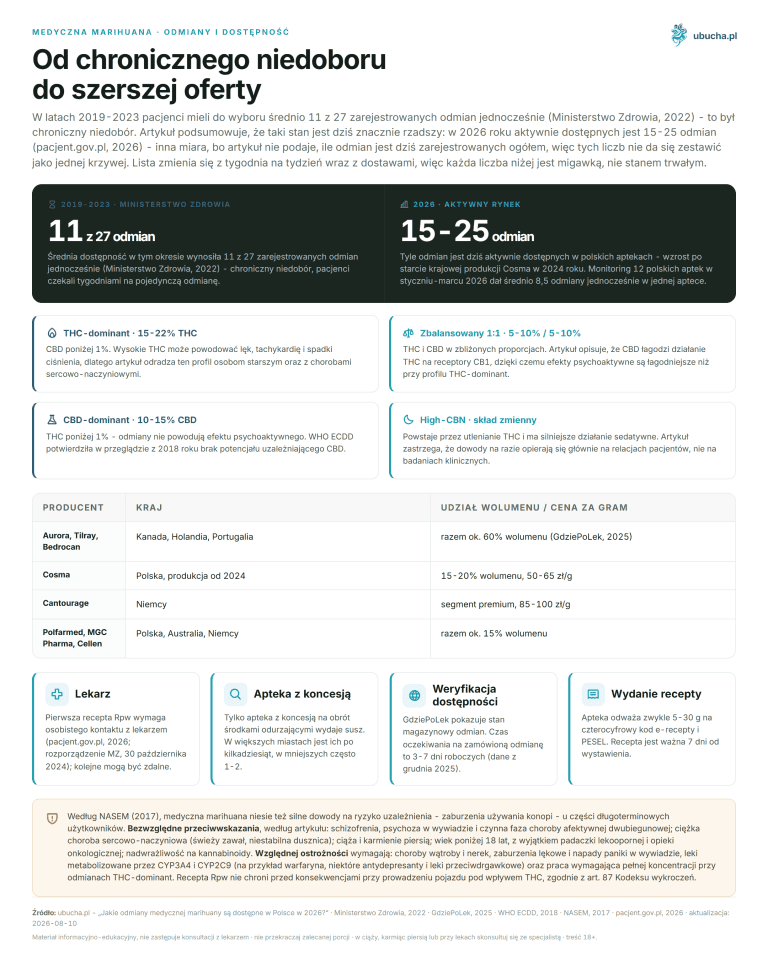
One, Canopy Growth, selling in Poland under the medical brand Spectrum Therapeutics, and in one catalog entry. The same manufacturer accounts for thirteen strains in the Polish compilation, so Lemon Skunk was not a separate or unique entry for them. There are no other pharmacy versions of this strain from other companies in the compilation, which means it can only be compared with other strains.
| Producer | Registered name, without the numerical component | Genetics according to the source | THC content as a range | Position in the comparison |
|---|---|---|---|---|
| Canopy Growth, Spectrum Therapeutics brand | Cannabis sativa L., Red No 2 | sativa | 17,1-20,9% | one |
It is not possible to check how the pharmacy versions of this strain differ from each other, because there is only one version. Where the same name is supplied by several companies, differences are visible in the registration record, in the declared content, and in the description of genetics; with one supplier, the entire supply hangs on one permit and one supply chain, and a break with them means the strain is unavailable throughout the country.
The availability of a single entry changes faster than any text about it ages. The database from which the description of this strain's composition comes now marks it as withdrawn, while our pharmacy compilation recorded it as an existing entry. Both things can be true within a few weeks, as the presence of the raw material in the warehouse depends on permits and delivery schedules. We keep the current status in the list of strains available in Polish pharmacies.
About the manufacturer and the other seven strains it supplies, piszemy osobno. It is worth remembering that dried flower from the retail category is not the same product as the pharmacy raw material: they differ in the method of dispensing, documentation, and purpose.
What does Lemon Skunk smell and taste like?
Contrary to its name, it is not citrusy. The only description that exists for this strain in available databases mentions a spicy, minty, and fruity note, without mentioning citrus at all. The aroma was evaluated by nose, not by chromatograph, so this is a catalog label, not a measurement result.
The terpene composition recorded for this position includes humulene, caryophyllene, ocimene, and terpinolene, with terpinolene indicated as the most prevalent. Separate entries are dedicated to each of these compounds: humulenowi, kariofilenowi, ocymenowi i terpinolenowi. Their aromatic characteristics are described independently of this strain: terpinolene is often described as having a fresh, resinous tone with a bitter finish, ocimene as sweet and herbal, caryophyllene brings pepperiness, and humulene contributes bitterness known from hops.
In the recorded composition, there is no limonene, which is the compound one would expect to find first for a citrus tone. The citrus label exists in the dictionary of this database and has been assigned to several dozen other entries; however, it was not assigned to Lemon Skunk, even though the name practically begs for it. The perception of aroma also depends on how the dried flower has been stored: volatile compounds dissipate from an open package faster than cannabinoids, so a batch that has been stored longer smells weaker, even though the content declared on the packaging remains the same. Therefore, the description of aroma is the least durable information in this entire compilation.
How long does it take for the strain to take effect and how long does the effect last?
For the strain itself, this has not been established at all. The course was measured for the route of administration, not for the trade name, so the following ranges describe what happens with the hemp material introduced into the body through the lungs or the digestive tract, regardless of which product was dispensed at the pharmacy.
The route of administration determines the course more than the variety itself. After vaporization, the substance passes from the lungs to the blood almost immediately, so the first sensations appear after a few minutes, the intensity increases for another ten to thirty minutes, and the whole effect lasts for two to four hours. After ingestion, the raw material first passes through the intestine and liver, so the first sensations are awaited from half an hour to two hours, and the episode can last six, sometimes eight hours. Hence the most common mistake with oral administration: anyone who thinks nothing is happening after thirty minutes and takes another dose will receive both doses at once. The above ranges describe the route of administration, not this variety; pharmacokinetic studies for a single cultivar have not been published.
For Lemon Skunk, there is nothing to clarify: neither the manufacturer nor the database describing this entry publishes any measurements of concentrations in the blood after its use. Tables with specific minutes assigned to particular trade names circulating on forums are based on someone else's feelings, not laboratory designations.
What has been shown about the effects of this strain, and what remains a declaration?
Very little has been shown, and not about the strain, but about one of its terpenes. Two studies concern terpinolene: one on mice, the other in a test tube. The terpene composition of this entry is known from one source. Everything else is either a catalog declaration or a patient report, and we separate it here as well.
Ito and Ito described in 2013 in the Journal of Natural Medicines (PMID:23339024) an experiment in which inhaled terpinolene exhibited sedative effects in mice; the effect was also maintained in mice with impaired sense of smell, indicating that the action occurred after the compound was absorbed into the body through the nose, not solely through the perception of aroma.
The second study, Okumura and colleagues in Oncology Letters from 2012 (PMID:22740904), is even further from the patient, as it does not concern the body at all: terpinolene reduced the level of AKT1 protein and inhibited the proliferation of human leukemia cells of the K562 line in culture; the study did not address pain, sleep, or anxiety. The boundary of these findings must be stated clearly, as no one else writes it. No effect of terpinolene on pain, anxiety, or sleep has been demonstrated in humans or in any animal pain model; available data only includes sedative effects after inhalation in mice and its impact on leukemia cell lines in vitro.
The catalog from which the description of this entry comes assigns it stimulating effects. This is a sales label, not a result of measurement; this entire dictionary actually has three entries, as the strain can be relaxing, balanced, or stimulating, and nothing beyond that. Moreover, it contradicts the only available animal experience in which the leading terpene of this strain sedated mice instead of stimulating them. We do not resolve contradictions, as there is no way to do so: none of these sources measured humans consuming this dried flower.
What side effects have been reported for this strain?
No side effects have been reported by name for this strain, as the reporting system does not use strain names. Reports are associated with the packaging of a specific medicinal product and its batch, and Lemon Skunk appeared in Polish circulation as one entry from one manufacturer, which narrows this material down to zero.
Reports of adverse effects are collected for medicinal products with a batch number, not for the strain name, so the following pertains to hemp dried flower as a group of raw materials. The most frequently reported symptoms are dry mouth, red eyes, and increased heart rate. Dizziness upon rapid standing, daytime drowsiness, and temporary worsening of short-term memory are less frequently described, as well as anxiety that increases with dosage. A separate issue is medications taken concurrently, especially sedatives and those affecting coagulation: their assessment requires knowledge of the entire list of preparations, not just the description of the plant. We do not provide the frequency of these symptoms numerically, as public compilations for hemp dried flower in Poland do not separate them by individual products.
Zero reports under the strain name does not mean that nothing happened with this entry. It only means that if something did happen, the record would have gone under the batch number of the packaging and blended into the statistics common to the entire group of dried flowers, without the possibility of extracting that specific name.
At what temperature do the terpenes from this profile evaporate?
At very different temperatures, and that is the whole answer. Terpinolene, the leading aromatic compound of this entry, boils at atmospheric pressure at 183-185 °C, ocimene at 177 °C, and caryophyllene only at 256-259 °C, which is above the values usually set on the device for plant material.
For humulene from the same set, there is no comparable number. The only recorded measurement comes from reduced pressure conditions, 99-100 °C at 3 mmHg, and the boiling temperature measured under such reduced pressure cannot be compared with atmospheric values. Placed next to the others, it would suggest that humulene evaporates from the dried flower first, which would be untrue and arise solely from mixing two measurement scales.
These numbers describe the pure compound in the chamber, not the device setting. The material in the chamber can be cooler than the display reading, tables circulating online provide values for the same terpenes that can differ by several dozen degrees, and manufacturers measure temperature at different points. Therefore, we treat these thresholds as the order in which compounds leave the dried flower, not as a recipe for the setup. We explain separately in at what temperature do terpenes evaporate from the dried flower, why temperature tables contradict each other. oraz dlaczego ustawienie waporyzatora is not the temperature of the dried flower itself.
Which strains are related to it?
None, if you ask about siblings. Siblings designate a common, named parent, and since the parents of Lemon Skunk have not been revealed, there is nothing to compare. An empty field here is not a gap to be filled with assumptions, but rather a result of a pedigree chart based solely on documented connections.
On the other side of the same graph, however, Lemon Skunk appears. In the lineage of the strain Frosted Lemon Angel it is listed as one of two parents, alongside Kosher Kush, and this is recorded by three independent descriptions of that strain. This is a descendant relationship, not a lateral one: it indicates from whom Frosted Lemon Angel originates, not with whom Lemon Skunk shares parents. Siblings cannot be derived from this as long as the other side of the pedigree remains empty.
The skunk component in the name is also not sufficient. In the same pharmacy listing stands Island Sweet Skunk, whose pedigree has also not been revealed, so the common term speaks of the relationship between the two strains just as a shared surname does for two unrelated people. Listing them as siblings would be guessing based solely on commercial labeling.
Instead of kinship, there are two verifiable points of reference: the producer who supplies the remaining seven items from their list, and the terpene indicated in the description as the leading one, after which one can search for strains with a similar scent profile. We maintain a complete list of strains available in Polish pharmacies in a separate review.
Frequently Asked Questions about Lemon Skunk
Does Lemon Skunk have a known pedigree?
No. None of the available sources indicate the parents of this strain, and we do not fill in the pedigree with assumptions based on the name.
How many producers supplied this strain to Polish pharmacies?
One, Canopy Growth, selling under the medical brand Spectrum Therapeutics, in one catalog item. The same producer is responsible in the Polish listing for thirteen strains.
What THC content does the source provide for this strain?
The declared THC content for this item is in the range of 17.1-20.9%. We record the range because the producer's declaration is subject to a tolerance of ten percent of the value.
Does terpinolene have a calming effect?
In mice, it has been shown to do so, and only to that extent. In humans, this has not been studied at all, so transferring this result to a person consuming dried flower has no basis.
Why are there no percentage shares for terpenes?
Because the denominator is unknown. The shares provided by Polish databases for the same items sum up to forty-six percent at one time and eighty-three percent at another, so the number next to the terpene name would appear to be a measurement, which it is not.
Is Frosted Lemon Angel related to Lemon Skunk?
Yes, but in the descendant line: Lemon Skunk appears in the pedigree of Frosted Lemon Angel as one of the parents, alongside Kosher Kush. This does not make them siblings.
Can Lemon Skunk be purchased without a prescription?
No. Dried flower used in medicine is issued in Poland exclusively by prescription in the Rpw category, and the choice of raw material is determined by the attending physician.
Dried flower is a pharmaceutical raw material issued by a doctor's prescription in the Rpw category. The material is for informational purposes and does not replace medical advice or information included with the packaging. The editorial text was prepared by redakcja ubucha.pl.