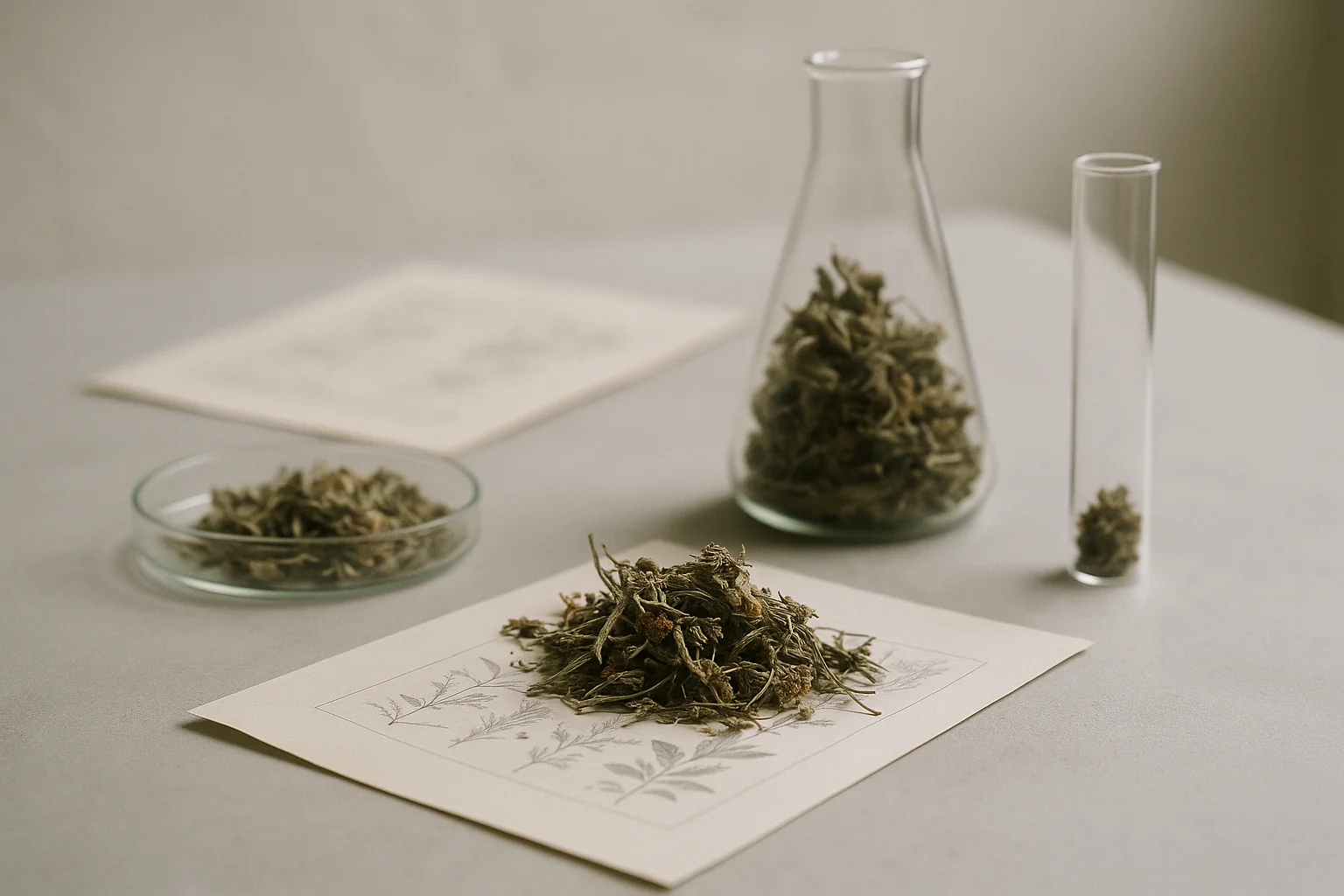

King Sherb (Cannabis flos S-LAB): lineage of OG Kush Breath and caryophyllene at the forefront
King Sherb is an S-LAB hybrid with a lineage of OG Kush Breath and Blue Sherbet, described in Polish databases by a single source. We gather here the profile composition, the state of evidence for caryophyllene, and what has not been verified for this cultivar.
What is this strain and where does it come from?
King Sherb is a hybrid with an indica dominance, created by crossing OG Kush Breath with Blue Sherbet. This lineage is provided by the seed database attributing the strain to the breeder In House Genetics, and it is confirmed by the Polish description of the S-LAB raw material premiere. In pharmacies, the strain is available as dried flower dispensed by prescription.
Lineage is a value in itself here, because in this comparison of strains, twenty-five cultivars out of eighty-five have no established parents. King Sherb belongs to the better-documented part. We found the origin record in two independent places: in the database organizing the genealogies of seed strains and in a Polish announcement about the introduction of S-LAB dried flower to the market. Both indicate the same parental pair, so this is not a reading from a single entry copied further.
The Sherb component in the trade name corresponds to the second parent, but the mere coincidence of words does not resolve anything. In the same comparison, ten strains contain the word kush in their name, and half of them have no documented origin, so the common term can be just a marketing gimmick. The genetics of King Sherb is described by the database as a hybrid with an indica dominance, and this description comes from a single source, not an averaged result of several independent designations.
Which manufacturers supply this strain to Polish pharmacies?
One. King Sherb is supplied to Polish pharmacies exclusively by S-LAB, and in the list of raw materials, it corresponds to a single trade position. Therefore, there are no competing versions to choose from, and the differences that a patient sees arise from the production series, not from the choice of the producer.
| Producer | Registered name without a numerical component | Declared THC content | Genetics description in the source |
|---|---|---|---|
| S-LAB | Cannabis flos S-LAB | 19,8-24,2% | hybrid with an indica dominance |
The registered name in pharmacy circulation includes the declared potency number. We provide it without this component because the value on the label has a tolerance from the producer of up to ten percent in either direction, and when entered into the text as a single number, it pretends to be an accuracy that does not exist. The same declaration, written accurately, gives a range of 19.8-24.2%.
Differences that are not visible in such a table must be sought in the series documentation. Each batch of dried flower has its own certificate of analysis and its own measurement result, so two packages of the same name can lie at opposite ends of the allowed range. With plant raw material, this is a normal state of affairs, not a producer's defect.
The presence of the strain in pharmacies changes at a pace that the pharmacy cannot influence. The raw material undergoes successive series releases, the importer may depend on a single delivery, and the permit for admission has its expiration date. The database from which the King Sherb profile description comes currently marks this position as unavailable. We keep the current state of pharmacy stocks exclusively in the comparison of strains available in Polish pharmacies, and the remaining entries from the same producer are collected in a study about the portfolio S-LAB. Outside of pharmacy circulation, however, there is a retail category of hemp dried flower available without a prescription, which is a separate type of product and not a substitute for the raw material from the pharmacy.
How does this strain smell and taste?
Citrusy and peppery. The Polish database describing this raw material lists four scent impressions: citrus, peppery, spicy, and earthy. This set fits the profile composition, where alongside caryophyllene, there are limonene, myrcene, and nerolidol, although the aroma description remains a sensory impression, not a result of laboratory measurement.
We provide the profile composition as a composition, without shares. The reason is straightforward: databases do not specify what these shares refer to, and when attempting to sum them, the numbers do not add up to a whole. For some entries, the sum stops below half, while for others, it reaches four-fifths, so the denominator is different each time. The order in such a comparison thus carries one piece of information: caryophyllene has emerged at the forefront.
The description of the scent and the description of the composition are two different records. The citrus impression can easily be linked to limonene, and the peppery note to caryophyllene, but the nose does not measure concentrations, and the same note can come from a compound that is not in the comparison at all. Therefore, flavor notes remain a commercial description, not analytical data. Separate studies gather what has been shown for limonene, dla mircenu oraz dla nerolidolu.
The medicinal dried flower reaches the patient in a sealed package, and grinding usually releases a more pronounced aroma than whole flower clusters. The intensity can also depend on the age of the batch, as volatile components diminish during storage, even at the correct temperature.
How long does it take for the strain to take effect and how long does the effect last?
It depends on the method of administration, not the strain name. For King Sherb, no one has measured the effects separately, so the only honest information available is the ranges described for inhaled and orally consumed dried flower. The following paragraph summarizes them in a format we use throughout this compilation.
The route of administration determines the course more than the variety itself. After vaporization, the substance passes from the lungs to the blood almost immediately, so the first sensations appear after a few minutes, the intensity increases for another ten to thirty minutes, and the whole effect lasts for two to four hours. After ingestion, the raw material first passes through the intestine and liver, so the first sensations are awaited from half an hour to two hours, and the episode can last six, sometimes eight hours. Hence the most common mistake with oral administration: anyone who thinks nothing is happening after thirty minutes and takes another dose will receive both doses at once. The above ranges describe the route of administration, not this variety; pharmacokinetic studies for a single cultivar have not been published.
For King Sherb itself, this does not change anything in either direction. The profile led by caryophyllene does not have its own time course assigned, as such measurement requires blood markers, not a description of the strain. The difference that a patient notices between two brand names usually comes from the measured portion of material and the equipment settings, not from genetics.
What is known, and what is not known about the effects of this strain?
Nothing is known about the strain itself. No study has tested King Sherb as a product or compared it to other dried flowers. Available evidence pertains to a single component of the profile, caryophyllene, and comes from animal studies and receptor binding measurements in vitro.
The first of the two studies we refer to here was published in 2008 in the Proceedings of the National Academy of Sciences (PMID:18574142), using a mouse model and an in vitro setup with human cells. (E)-caryophyllene selectively bound to the CB2 receptor (Ki = 155 nM) and inhibited carrageenan-induced paw swelling in wild-type mice, but not in CB2 receptor-deficient mice (Cnr2-/-), indicating a CB2-dependent mechanism; the study did not include any anxiety tests.
The second study was published in 2014 in European Neuropsychopharmacology (PMID:24210682) and examined the same compound in rodents. Oral caryophyllene reduced the late inflammatory phase of pain in the formalin test in a CB2 receptor-dependent manner, with no effect on the early phase; in a neuropathic pain model, it alleviated thermal hyperalgesia and mechanical allodynia without developing tolerance with chronic administration.
The limitations of these results are as important as the results themselves. In neither of the two studies was caryophyllene tested on humans or in inhaled form from dried flower; both studies pertain to oral or systemic administration in mice in pain and inflammation models, not sleep or mood.
The producer's material and patient reports create a separate record. The database describing this raw material assigns it relaxing and balanced effects, but this is an expectation record, not a measurement result. The entirety of evidence for caryophyllene itself, apart from trade names, is gathered osobne opracowanie.
What side effects have been reported for this strain?
None, if the question pertains solely to this name. There is no public compilation of symptoms attributed to King Sherb, as Polish drug safety supervision does not maintain statistics divided by cultivars. What can be reliably described pertains to dried flower as a whole group of raw materials dispensed from pharmacies.
Reports of adverse effects are collected for medicinal products with a batch number, not for the strain name, so the following pertains to hemp dried flower as a group of raw materials. The most frequently reported symptoms are dry mouth, red eyes, and increased heart rate. Dizziness upon rapid standing, daytime drowsiness, and temporary worsening of short-term memory are less frequently described, as well as anxiety that increases with dosage. A separate issue is medications taken concurrently, especially sedatives and those affecting coagulation: their assessment requires knowledge of the entire list of preparations, not just the description of the plant. We do not provide the frequency of these symptoms numerically, as public compilations for hemp dried flower in Poland do not separate them by individual products.
If such statistics were to be created for King Sherb, they would have to start from the batch numbers introduced by S-LAB and from reports associated with specific packaging. With a single commercial item and variable availability in circulation, the collected material would be so sparse that it could not yield frequency counts. This is a limitation of the data collection method, not an indication of anything regarding the safety of the strain itself.
How to vaporize this strain?
Just like any other medicinal dried flower, because the vaporizer settings are chosen based on the profile composition, not the brand name. Caryophyllene, which stands out in this profile, has a boiling point significantly higher than lighter components, so no single setting will extract everything at once.
| Profile component | Boiling temperature at atmospheric pressure |
|---|---|
| myrcene | about 167 °C |
| limonene | about 178 °C |
| caryophyllene | about 257 °C |
| nerolidol | 275-277 °C |
The numbers from the table come from chemical cards of pure compounds, not from measurements in the vaporizer chamber, and that is their limit. The temperature on the display describes the heater or airflow, not the interior of the material, which can be several dozen degrees cooler. A separate study explains why published comparisons of temperatures can contradict each other.
In practice, this means that lower settings primarily release the most volatile components, while heavier ones remain in the material for higher settings. With a profile led by caryophyllene, the difference between the first and last draws can therefore be quite pronounced in taste. Vaporizer manufacturers provide their own recommendations for their devices, and it is these, not the boiling tables of pure compounds, that describe specific equipment.
The range visible in the table also explains why one setting describes this profile worse than two. Between the lightest and heaviest of the listed components lies over a hundred degrees, so the material given at a low setting retains some content for a higher setting. This is due to the boiling temperatures themselves, not to the properties assigned to King Sherb, and it applies equally to any dried flower with a similarly stretched composition.
Which strains are related to it?
One, and that from one parent. In this comparison of strains, Original Gangster Deluxe is related to King Sherb because both lines carry OG Kush Breath in their lineage. The second parent is different in both cases, so we are talking about half-siblings, not identical twins.
Original Gangster Deluxe reaches Polish pharmacies from a different producer than King Sherb and has a differently arranged profile: it features terpinolene, not caryophyllene. This clearly shows that a common parent does not directly translate to a common scent or a common composition. The description of that strain prowadzimy osobno.
The list of relationships in this comparison is created solely from documented pedigrees and deliberately omits parents that are broad families of style. If we were to consider every strain that has an OG Kush line or Afghan somewhere in the tree as siblings, we would create a graph where almost everything connects with everything, and thus it says nothing.
A separate note concerns the second parent. Blue Sherbet does not have its own position in Polish pharmacies, so this branch of the pedigree does not generate any additional relationships here. A complete list of cultivars currently available in pharmacy trade is collected overview of available medical marijuana strains.
Frequently Asked Questions
Is King Sherb available without a prescription?
No. Dried flower is a pharmaceutical raw material dispensed by a doctor's prescription in the Rpw category, so the pharmacy dispenses it only on a prescription issued by an authorized physician.
What is the THC content in this strain?
The source provides a declared value with a manufacturer's tolerance of up to ten percent, which gives a range of 19.8-24.2%. We do not provide a single number because the label applies with a deviation in both directions.
Who produces King Sherb for Polish pharmacies?
S-LAB. In the list of raw materials, there is one entry for this strain from this producer, so there are no alternative versions or choices between producers.
Which component leads in the profile of this strain?
Caryophyllene. The composition description comes from one source and mentions alongside it limonene, myrcene, and nerolidol, without providing shares in the profile.
Does King Sherb help with sleep?
It is unknown. No clinical study has been published for this cultivar, and studies on caryophyllene have been conducted on mice and in pain models, not sleep.
Is the strain consistently available in pharmacies?
No. Availability depends on the release of subsequent batches and the decision of the importer, and the database describing this raw material marks it as unavailable at the time of writing.
The material is for informational purposes only and does not replace medical advice or recommendations from a pharmacist. Editorial text: redakcja ubucha.pl.