
How much CBD can you take daily? Safe dosing and maximum doses
In 2026, EFSA set a temporary safe level for CBD: 0.0275 mg/kg, which is about 2 mg daily for a 70 kg person. Check what the studies say.
In February 2026, the European regulator provided a specific number for the first time: 0.0275 mg of CBD per kilogram of body weight per day, which is about 2 mg daily for a person weighing 70 kg. This is less than what is contained in a single drop of a typical 5% oil. At the same time, stores describe portions of 25 mg and 50 mg as standard, and guides repeat the number 1500 mg from the WHO report. These three numbers come from three different worlds: risk assessment, sales, and clinical studies conducted under laboratory control. Below, I separate them and show what exactly was measured and at what doses real problems arose, mainly from the liver and interactions with medications.
KEY INFORMATION
• EFSA set a temporary safe level of 0.0275 mg per kilogram of body weight per day, which is about 2 mg for a 70 kg person (EFSA Journal 2026, e9862).
• The number 1500 mg comes from studies with laboratory supervision, not from home supplementation.
• At 1500 mg per day, 5 out of 16 healthy volunteers had ALT exceed five times the normal level (Watkins et al., 2021).
• CBD hamuje CYP3A4 oraz CYP2C19, a najlepiej udokumentowana interakcja dotyczy klobazamu.
• The supplemental dosage for healthy adults has not been established in studies.
How much CBD can be taken daily according to European regulators?
The European Food Safety Authority provided a temporary safe consumption level on February 9, 2026: 0.0275 mg of CBD per kilogram of body weight per day. For a person weighing 70 kg, this amounts to about 2 mg daily. This level applies only to CBD supplements with a purity of at least 98% and only to healthy adults over the age of 25.
Liczba jest niska, bo panel EFSA (EFSA Journal 2026, e9862) It was derived from modeling a reference dose based on sub-chronic studies compliant with good laboratory practice principles, and then applied an uncertainty factor of 400. Such a large margin reflects data gaps and unmeasured toxicity at 2 mg. The authority itself calls this level temporary and promises a revision when chronic studies in humans become available.
For comparison, it is worth contrasting this with an independent toxicological assessment. The team Hendersona (Regulatory Toxicology and Pharmacology, 2023) derived an acceptable daily intake of 0.43 mg per kilogram of body weight, which is about 30 mg per day for a 70 kg person, and an upper limit of 70 mg per day for supplements intended for healthy adults. The range between 2 mg and 70 mg illustrates how much the result depends on the assumptions made and whether the assessment includes children and women planning pregnancy. None of these figures constitute a therapeutic recommendation.
Where did the figure of 1500 mg per day come from?
From a single sentence in the review by Bergamaschi and colleagues (Current Drug Safety, 2011): chronic use and high doses up to 1500 mg per day are well tolerated in humans. Raport WHO z 2018 roku repeated this assessment. Both documents describe research conditions, not the recommended supplement dose.
Part of this picture holds up. In a phase I study Taylor and colleagues (CNS Drugs, 2018) administered single doses to healthy volunteers ranging from 1500 to 6000 mg, as well as 750 mg and 1500 mg twice daily. No serious adverse events occurred, and no one discontinued participation. The most common complaints were diarrhea, headache, and drowsiness.
The problem arises with prolonged administration. Watkins and colleagues (Clinical Pharmacology and Therapeutics, 2021) administered 1500 mg per day for about 3.5 weeks to sixteen healthy adults. In seven individuals, or 44%, ALT exceeded the upper limit of normal, and in five, or 31%, it exceeded five times the limit, meeting international criteria for drug-induced liver injury. Six individuals discontinued participation, some with symptoms resembling hepatitis. The authors found no factor that could predict who would be affected: neither baseline characteristics, nor CYP2C19 genotype, nor CBD plasma concentration. Therefore, the 1500 mg dose belongs to a study with monthly liver function tests, not to a home shelf.
At what doses does CBD elevate liver enzymes?
In the registration study of Epidiolex at 10 mg and 20 mg per kilogram of body weight per day, elevated aminotransferases were recorded in fourteen patients, or 9% of those treated with CBD (Devinsky i in., New England Journal of Medicine, 2018). For a person weighing 70 kg, this corresponds to approximately 700 to 1400 mg per day.
The biggest risk enhancer turned out to be concomitant valproate. In an open safety study involving 81 patients, where the CBD dose was increased from 5 to 50 mg per kilogram, abnormal liver tests occurred specifically in those taking valproate (Gaston i in., Epilepsia, 2017). A meta-analysis of twelve randomized studies involving 803 participants calculated the same phenomenon numerically: the odds ratio for severe adverse events related to abnormal liver tests was 11.19 with a confidence interval from 2.09 to 60.02 (Chesney i in., Neuropsychopharmacology, 2020).
This same meta-analysis provides an important caveat. The liver signal came exclusively from studies on childhood epilepsy, where CBD was combined with clobazam or valproate. Excluding these studies, the only adverse effect significantly more frequent than in the placebo group was diarrhea. However, this does not mean that the liver is out of the picture in monotherapy, as Watkins' study involved healthy volunteers without any antiepileptic medications.
| Dose | Kontekst | Co zaobserwowano |
|---|---|---|
| do 6000 mg jednorazowo | zdrowi ochotnicy, faza I | no serious events, mainly diarrhea and headache |
| 1500 mg per day, 3.5 weeks | zdrowi ochotnicy, faza I | ALT above five times the normal limit in 5 out of 16 individuals |
| 10 do 20 mg na kilogram | registration study, Lennox-Gastaut syndrome | elevated aminotransferases in 9% of treated patients |
| 5 do 50 mg na kilogram | otwarte badanie z lekami przeciwpadaczkowymi | abnormal liver tests with valproate |
Z jakimi lekami CBD wchodzi w interakcje?
CBD inhibits cytochrome P450 isoenzymes, primarily CYP3A4 and CYP2C19, thus increasing the concentration of drugs metabolized through the same pathway. The best-documented case is clobazam: its level increased by an average of 60%, and the active metabolite norclobazam by 500% (Geffrey i in., Epilepsia, 2015).
In that study, thirteen children were taking clobazam along with CBD. Adverse effects were reported in ten of them and subsided after reducing the dose of clobazam, not after discontinuing CBD. This is a good illustration of the mechanism: the issue was not CBD itself, but the drug whose concentration increased due to it.
A broader overview of interactions was provided by Gaston's study, which measured the concentrations of nineteen antiepileptic drugs. The levels of clobazam, topiramate, and rufinamide changed significantly. In adults, zonisamide and eslicarbazepine were also added. A separate case was described of a patient taking warfarin, whose INR increased after starting CBD, necessitating a reduction in the anticoagulant dose (Grayson i in., Epilepsy and Behavior Case Reports, 2018). This is a single case report, so it says nothing about the frequency of the phenomenon, but it is enough reason to discuss it with a doctor. It is no coincidence that EFSA excluded individuals taking medications from its safety assessment.
What doses of CBD were used in studies involving adults?
Very diverse and without a common denominator. A review of 35 studies in thirteen medical contexts did not indicate a single effective dose (Millar i in., British Journal of Clinical Pharmacology, 2019), and a review of 25 studies involving 927 adults found that the regimens and routes of administration varied too much to derive a recommendation from them (Larsen i Shahinas, 2020).
The most frequently cited work on sleep and anxiety is a retrospective review of patient charts by Shannon and colleagues (Permanente Journal, 2019). It included 72 adults from a psychiatric clinic, taking CBD usually around 25 mg per day as an adjunct to treatment. Anxiety severity decreased in 57 individuals, or 79.2%, and sleep quality improved in 48 individuals, or 66.7%, with sleep results varying in subsequent months. This is a case series without a control group, so no dosage can be derived from it.
The situation is similar in chronic pain. A review by Arguety and colleagues (Frontiers in Pharmacology, 2020) summarizes that CBD provides relief in some pain conditions, but not all, and over-the-counter products carry the risk of contamination. An honest conclusion is this: for a healthy adult using CBD for well-being, the dose has not been established in studies. Numbers like 10 mg or 50 mg come from sales practice, not clinical protocols.
Does a higher dose of CBD work better?
Not always. In a simulated public speaking test involving 57 men, anxiety was reduced only by a dose of 300 mg, while 150 mg and 600 mg did not differ from placebo (Linares i in., Revista Brasileira de Psiquiatria, 2019). The dose-response curve had an inverted U shape.
The result was replicated in real conditions. Sixty individuals were assigned to placebo, clonazepam, and CBD at doses of 100, 300, and 900 mg before a real presentation in front of a group. The anxiolytic effect appeared only at 300 mg (Zuardi i in., Frontiers in Pharmacology, 2017). Thus, increasing the dose is not a strategy in itself.
The composition of the extract is also interesting. A meta-analysis of observational data from 670 patients with drug-resistant epilepsy showed improvement in 71% of those treated with CBD-rich extracts compared to 46% with pure CBD, with an average daily dose of 6.0 versus 25.3 mg per kilogram (Pamplona i in., Frontiers in Neurology, 2018). The data comes from observations, not randomization, so treat it as a premise, not proof. The practical conclusion remains the same: if the effect weakens after increasing the dose, return to the previous level instead of going higher.
Ile CBD z etykiety trafia do krwiobiegu?
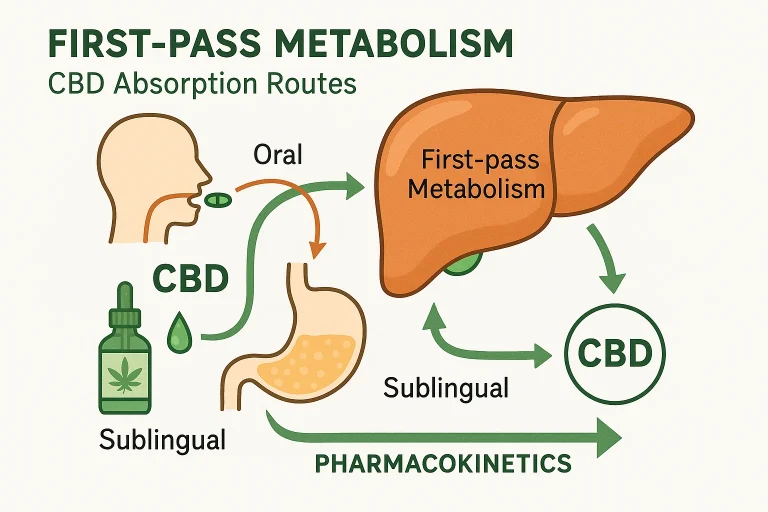
It is not precisely known, and this is not an excuse. A systematic review of the pharmacokinetics of CBD in humans showed that no one has yet measured the absolute bioavailability after oral or sublingual administration. The only measured value is 31% after inhalation (Millar i in., Frontiers in Pharmacology, 2018).
The same review states what is known. The half-life ranges from 1.4 to 10.9 hours after aerosol administration to the mucosa and from 2 to 5 days with chronic oral administration. The maximum concentration appears within 0 to 4 hours and increases after a meal and in fat-based formulations. Percentages circulating in guides, such as 13 to 19% for sublingual oil and 4 to 8% for capsules, have no basis in measurements in humans, so doses cannot be converted between forms based on them.
Additionally, there is the quality of labels. In a study of 84 products from 31 companies, 30.95% of products had a content consistent with the declaration, 42.85% were underreported, and 26.19% were overreported; THC was detected in 21.43% of samples (Bonn-Miller i in., JAMA, 2017). We have noticed in conversations with customers that the question about the certificate of analysis was asked much less frequently than the question about the price per milligram, even though it is the certificate that determines whether dose conversion makes sense. Without batch testing by an independent laboratory, the number on the bottle is a declaration, not a measurement.
Who should not use CBD without consulting a doctor?
EFSA excluded four groups from its assessment. For none of them was a safe level established, even temporarily. This is not a ban, just information that data is lacking.
- Individuals under the age of 25.
- Pregnant women.
- Breastfeeding women.
- Individuals taking any medications.
In the case of seniors, a prospective observation of 2736 patients over 65 years old is often cited, in which after six months the median pain intensity decreased from 8 to 4 points, and the most common side effects were dizziness in 9.7% and dry mouth in 7.1% (Abuhasira i in., European Journal of Internal Medicine, 2018). Note: the study concerned medical marijuana containing THC, not CBD itself, so it does not translate to supplement dosing. Slowed liver metabolism and polytherapy are still sufficient reasons to start with the smallest dose in this group.
In children, the only documented use is a prescription medication for severe drug-resistant epilepsy, administered under the supervision of a neurologist and with monitoring of liver function tests. During pregnancy, Argueta's review indicates prenatal exposure as a real developmental risk. Aside from these situations, there is no data to suggest any dosage.
Frequently Asked Questions
How many mg of CBD can you take daily?
The only number set by the European regulator is 0.0275 mg per kilogram of body weight per day, which is about 2 mg daily for a person weighing 70 kg (EFSA Journal 2026, e9862). It is temporary and applies to healthy adults over 25 years old. Doses like 25 mg have no backing in risk assessment.
Czy 1500 mg CBD dziennie jest bezpieczne?
Not in home conditions. With 1500 mg per day for about 3.5 weeks, seven out of sixteen healthy volunteers had ALT levels above normal, and five exceeded five times the normal level, which meets the criteria for drug-induced liver injury (Watkins i in., 2021). Six individuals discontinued participation in the study.
Does CBD damage the liver?
At therapeutic doses of 10 mg and 20 mg per kilogram, elevated aminotransferases were noted in 9% of patients treated with CBD (Devinsky i in., 2018). The risk increased with concurrent valproate use. There are no such observations at supplemental doses, but no one has systematically studied them.
Can CBD be combined with medications?
Not without consultation. CBD inhibits CYP3A4 and CYP2C19. The concentration of clobazam increased by an average of 60%, and its active metabolite norclobazam by 500% (Geffrey i in., 2015). EFSA excluded individuals taking medications from its assessment due to a lack of data for them.
How much CBD to take for sleep?
An effective dose has not been established. The most frequently cited work is a review of records from 72 adults, where at about 25 mg per day, sleep quality improved in 66.7% of individuals, but results varied in subsequent months (Shannon et al., 2019). This is a case series, not a controlled study.
Can CBD be taken daily for a long time?
There is no data on long-term use. EFSA called its level temporary precisely because chronic studies in humans are incomplete, and applied an uncertainty factor of 400. The WHO report from 2018 found no potential for addiction, but that answers a different question than the safety of chronic consumption.
If after this reading you want to start with the smallest doses, check out hemp oils and see if the manufacturer provides a batch analysis certificate. Detailed calculations of drops are described in the text Dosing CBD: how many drops to take, and the selection of concentration in the article Which CBD concentration to choose.
This article is for informational and educational purposes and does not constitute medical advice. Before starting to use cannabis or CBD for therapeutic purposes, consult a doctor, especially if you are taking other medications, are pregnant, or breastfeeding.
Author: Michał Waluk · Opublikowano: 2026-06-22 · Aktualizacja: 2026-08-07