
CBD chewing gum - does it work and for whom (FAQ)
CBD chewing gum: answers to frequently asked questions and what studies say. u Bucha.
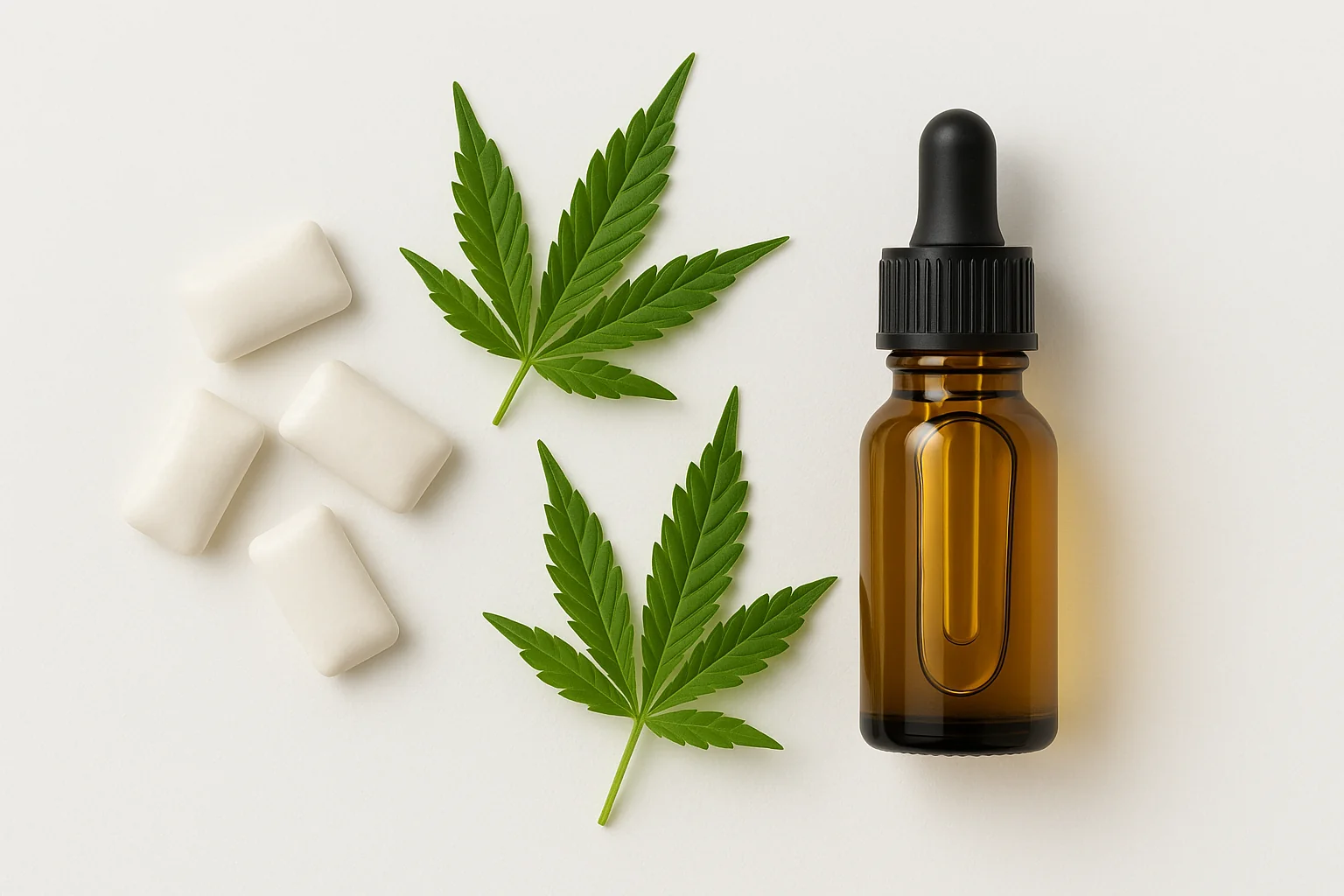
CBD chewing gum is one of the most discreet and convenient ways to supplement with cannabidiol. Instead of unscrewing a bottle of oil at your desk or swallowing a capsule, you simply chew - just like regular gum. But does it really work? The absorption route through the oral mucosa is the actual pathway through which CBD goes directly into the bloodstream - bypassing the liver and the first-pass effect that reduces the bioavailability of capsules. Millar and colleagues confirm that the bioavailability of oral CBD taken without fat is only 6-19% (Millar et al., Pharmaceuticals, 2019). This article answers the most common questions about CBD gum: how it works, who it's for, how long to chew, and what to watch out for.
KEY INFORMATION
• CBD from gum is absorbed through the oral mucosa (buccal route), bypassing the first-pass effect through the liver - similar to sublingual oil (Millar et al., Pharmaceuticals, 2019).
• A typical CBD gum contains 5-25 mg of CBD per piece - less than a typical dose from oil, but higher bioavailability compensates for the difference.
• WHO (2018) confirms a good safety profile for CBD in humans.
• The potential problem with drug tests concerns only full-spectrum gum - CBD isolate is safer.
How is CBD absorbed from chewing gum?
The mechanism of action of CBD gum is based on buccal absorption - absorption through the mucous membrane lining the cheeks, gums, and palate. While chewing, CBD is released from the gum base structure into the saliva, from where it penetrates through a thin layer of epithelium into the dense network of blood vessels directly beneath the mucous membrane. From there, it enters the bloodstream without passing through the liver - which means that the CYP3A4 enzyme responsible for CBD metabolism in hepatocytes does not have time to partially break it down before it reaches its target.
Important note: some CBD with saliva is swallowed and reaches the stomach, where it is absorbed through the classical digestive route, more slowly and with lower bioavailability. The ratio of buccally absorbed CBD to swallowed CBD depends on the product, chewing time, and individual oral anatomy. Manufacturers of good CBD gums optimize the composition for the fastest possible release of CBD into the saliva to maximize buccal absorption before it is swallowed.
CBD gum vs other forms - comparison
CBD gum occupies a specific place between sublingual oil and capsules. Faster than a capsule, more convenient to use in public places than oil, but with slightly less control over the exact dose than both of these products. The table below compares key parameters.
| Feature | CBD Gum | Sublingual Oil | CBD Capsule |
|---|---|---|---|
| Absorption Route | Buccal + part digestive | Sublingual (main) + digestive | Digestive |
| Time to effect | 15-45 minutes | 15-45 minutes | 60-90 minut |
| Bioavailability | Umiarkowana-wysoka | Umiarkowana-wysoka | Low-moderate |
| Discretion of Use | Bardzo wysoka | Low-moderate | High |
| Dose precision | Dependent on the manufacturer | High (drops) | High (capsule) |
| Taste/comfort | Depends on the aroma | Herbal, intense | No taste |
How many CBD gummies should you chew daily?
Dosing CBD gums is not standardized - it depends on the concentration of CBD in the specific product and individual needs. With gum containing 10 mg of CBD, chewing 1-2 pieces daily provides a dose of 10-20 mg, which falls within the range used for daily wellness supplementation. Individuals with more specific goals - e.g., reducing tension in stressful moments or supporting sleep - may chew gum at specific times of the day rather than daily.
The 2018 report from the WHO Expert Committee on Addictions states that CBD does not exhibit addictive potential and has a good safety profile in humans (WHO, 2018). This is an important confirmation for everyday use products like CBD gum - the lack of addiction risk makes regular use safe from this perspective.
What should you pay attention to when buying CBD gummies?
When choosing CBD gum, it is worth checking a few things. The first is the CoA certificate from an independent laboratory - it should confirm the declared amount of CBD and THC level. The second is the type of CBD: full-spectrum gum contains trace amounts of THC, broad-spectrum and CBD isolate should have THC at zero or trace levels below the detection threshold. The third is the composition of the gum base - a natural plant base or synthetic base without controversial ingredients like polyethylene. The fourth is sweeteners: sorbitol is a common choice, but with high consumption, it can have an osmotic effect and cause diarrhea.
We have noticed that products labeled as "CBD gum" are appearing on the market with very low actual CBD concentrations, sometimes below 1 mg per piece - marketed as "CBD" only due to the presence of trace amounts. Always compare the CBD content in mg per piece, not just the product name.
Does CBD gum help with relaxation and stress?
One of the most common reasons for reaching for CBD gum is daily stress and tension - situations where a discreet form of supplement intake at work, during meetings, or on public transport has a real advantage over oil. CBD has shown anxiolytic properties in studies on healthy volunteers by activating the serotonin receptor 5-HT1A - the same receptor activated by some anxiolytic medications, although through a different mechanism. The review by Blessing et al. from 2015 in Neurotherapeutics indicates promising preclinical and early clinical data for CBD in anxiety, with a good safety profile (Blessing et al., Neurotherapeutics, 2015).
CBD gum has a practical advantage over capsules: the time to effect is shorter due to buccal absorption, and the act of chewing itself may have a stress-reducing effect by activating the vagus nerve and the sensory mechanism of chewing. This is, of course, an effect unrelated to CBD - chewing regular gum also lowers cortisol. The combination of the mechanical effect of chewing with the pharmacological action of CBD through the mucous membrane makes CBD gum particularly useful in moments of acute tension, not just as a preparation for daily preventive supplementation.
Frequently Asked Questions
How does CBD chewing gum work?
CBD gum releases cannabidiol in the mouth during chewing. CBD is absorbed through the mucous membranes of the cheeks and gums directly into the bloodstream - similar to oil held under the tongue. This route bypasses the first-pass effect through the liver and may provide higher bioavailability than oral capsules (Millar et al., Pharmaceuticals, 2019).
Does CBD gum work faster than CBD oil?
Both forms rely on absorption through the mucous membranes of the mouth and act in a similar timeframe - 15-45 minutes. Sublingual oil, held under the tongue for 60-90 seconds, may have slightly better-controlled absorption than gum, where the ratio of buccal CBD to swallowed CBD is variable. In practice, both forms act faster than swallowed capsules.
How much CBD does a typical chewing gum contain?
Typical CBD gums contain between 5 mg to 25 mg of CBD per piece, with most products in the 10-15 mg range. This is less than the typical dose from CBD oil (25-50 mg), but the higher bioavailability of the buccal route may compensate for the effect at a lower nominal dose. Always check the declared CBD content in mg per piece - not just on the bulk packaging.
Who is CBD chewing gum the best choice for?
CBD gum is particularly effective for those who dislike the taste of oils, need a discreet form in public places, want to incorporate CBD into an existing habit of chewing gum, or seek a quick effect without visible use of a supplement. It's also a good choice for those who have difficulty swallowing capsules.
How long should you chew CBD gum?
Most of the CBD is released within the first 10-15 minutes of chewing. After this time, the gum is largely depleted of cannabidiol - further chewing does not significantly increase the dose. Holding saliva in the mouth for a moment before swallowing allows more time for buccal absorption.
Does CBD gum contain THC?
Full-spectrum CBD gums contain trace amounts of THC (up to 0.3%). With regular use of several pieces daily, there may be a buildup of THC detectable in tests. Gums made from CBD isolate or broad-spectrum CBD should have a zero THC level confirmed by a CoA certificate - this is the right choice for individuals subject to drug testing.
Does CBD chewing gum have side effects?
CBD in doses of 5-25 mg used in gums is well tolerated - a WHO report from 2018 confirms a good safety profile (WHO, 2018). Potential issues relate to other ingredients in the gum: sorbitol as a sweetener can cause an osmotic effect with high consumption, and gum base or flavors may cause reactions in sensitive individuals.
This article is informational and educational in nature. It contains internal links to products available in the u Bucha store. Prices and specifications may change - please check the current data on the product page before purchasing.
Author: Michał Waluk · Published: 2026-05-04 · Updated: 2026-05-04