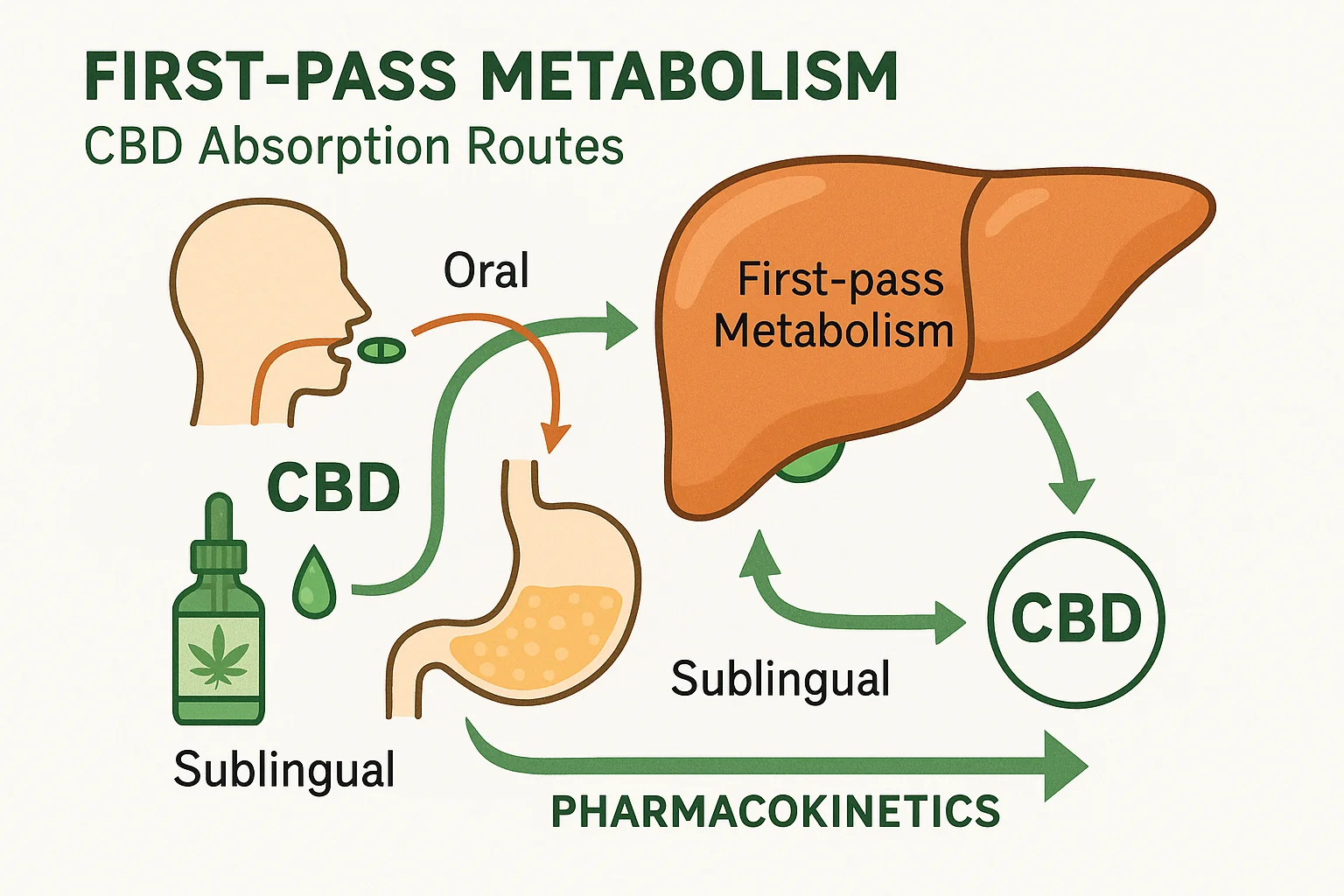

First-pass effect - why swallowing CBD oil wastes most of the dose
First-pass effect - the mechanism of action explained simply, based on research. u Bucha.
If you swallow CBD oil instead of holding it under your tongue, you lose the vast majority of the dose before CBD reaches the blood. The oral bioavailability of CBD is only 6-19% - the rest is broken down by the liver in a process called the first-pass effect (Millar et al., Frontiers in Pharmacology, 2019). This is a key pharmacokinetic fact that explains why the method of administration matters more than the dose itself. In this article, we explain how the liver metabolizes CBD, which routes bypass this effect, and how to practically improve the bioavailability of CBD oil.
KEY INFORMATION
• The oral bioavailability of CBD is 6-19% - this means that 81-94% of the swallowed dose is metabolized by the liver before it reaches the blood (Millar et al., Frontiers in Pharmacology, 2019).
• Sublingual administration bypasses the first-pass effect: CBD is absorbed through the mucous membrane of the mouth directly into the circulation.
• Eating a fatty meal before oral CBD increases bioavailability 2-5 times.
• The CYP3A4 and CYP2C19 enzymes in the liver are responsible for CBD metabolism - their activity varies genetically among individuals.
What is the first-pass effect and why does it affect CBD?
The first-pass effect (first-pass metabolism) is a pharmacokinetic phenomenon in which a substance absorbed by the small intestine first travels through the portal vein to the liver - before reaching the systemic circulation. The liver is a metabolic organ: it contains a dense network of enzymes from the cytochrome P450 (CYP450) family, which convert chemical substances into more polar, excretable forms. For many drugs and supplements, the liver 'captures' a significant portion of the dose before it reaches the target tissues.
CBD is particularly susceptible to the first-pass effect because it is highly lipophilic (fat-soluble), which facilitates its absorption from the intestines but also predisposes it to efficient extraction by hepatocytes. The main enzymes metabolizing CBD in the liver are CYP3A4 and CYP2C19. CYP3A4 converts CBD into 7-hydroxyCBD and further into 7-carboxyCBD - metabolites with significantly weaker biological activity. The CYP3A4 enzyme is responsible for the metabolism of about 50% of all drugs.
What does this look like numerically? After swallowing 100 mg of CBD, only 6-19 mg of CBD may reach the bloodstream. The rest - 81-94 mg - is broken down by the liver before leaving the portal system. This is a dramatic contrast to other routes of administration.
Which routes of administration bypass the first-pass effect?
The first-pass effect only applies to substances absorbed through the intestines and transported via the portal vein. Any route of administration that bypasses this pathway provides higher bioavailability. The table below compares the main routes of CBD administration with their bioavailability and onset speed.
| Route of administration | Bioavailability | Time to effect | First-pass effect |
|---|---|---|---|
| Oral (swallowing) | 6-19% | 1-2 hours | Tak - silny |
| Sublingual (under the tongue) | 13-35% | 15-45 minutes | Partially - weaker |
| Inhalation (vaporization) | 11-45% | 2-10 minutes | No - complete bypass |
| Transdermal (patch/cream) | Low, variable | Hours | No - local action |
| Oral with fat | 13-60% (szacunkowo) | 1-2 hours | Partially - lymphatic transport |
Why is sublingual administration more effective than swallowing?
The oral cavity has an extensive network of capillaries, especially under the tongue - hence the term 'sublingual'. The mucous membrane in this area is thin and richly vascularized. CBD dissolved in a carrier oil (MCT, olive oil) comes into contact with this membrane, diffusing directly into small venous vessels that drain blood directly into the jugular vein - bypassing the portal-hepatic system. The effect: CBD enters the systemic circulation without passing through the liver.
We have noticed that many CBD oil users hold it under their tongue for only 15-20 seconds, after which they quickly swallow. This is too short for the mucous membrane to absorb a significant amount of CBD. Pharmacokinetic studies suggest that optimal sublingual absorption requires at least 60 seconds of contact - ideally 90-120 seconds. The difference between 15 seconds and 90 seconds can translate to two- or threefold higher concentrations of CBD in the blood.
Millar and colleagues, in a systematic review of CBD bioavailability, summarized data from 24 pharmacokinetic studies and demonstrated that the average sublingual bioavailability (13-35%) is significantly higher than oral (6-19%), although still lower than inhalation (Millar et al., Frontiers in Pharmacology, 2019). An important observation: the variance in bioavailability among individuals is enormous - from 2% to over 40% at the same dose and route of administration. This is influenced by polymorphisms in CYP3A4 and CYP2C19, body mass, fat tissue content, and food.
How does fat improve the absorption of oral CBD?
Birnbaum and colleagues investigated how a high-fat meal affects the pharmacokinetics of CBD in individuals with epilepsy treated with Epidiolex. Consuming 100 g of fat before the CBD dose increased the maximum concentration of CBD in the blood (Cmax) by 5.5 times and increased the area under the curve (AUC) by 4 times compared to taking it on an empty stomach (Birnbaum et al., Epilepsia, 2019). This is one of the largest dietary influences on the bioavailability of any xenobiotic recorded in the literature.
The mechanism involves the formation of micelles and chylomicrons in the intestines after fat digestion. Lipophilic CBD integrates into these fat structures, which are transported to the lymphatic system via intestinal lymphatic vessels (lymphatic route). Chylomicrons enter the blood through the thoracic duct, bypassing the portal vein and liver - at least on the first pass. This is a partial bypass of the first-pass effect.
Our observations indicate that the practical advice 'take CBD with fat' is common but rarely explained mechanistically. The difference between taking CBD oil on an empty stomach and taking it after a spoonful of peanut butter or a piece of avocado can be practically equivalent to a 2-3 fold change in dosage. This is important information, especially for those using CBD for health reasons and monitoring their dosage.
Individual variability in CBD metabolism - why effects differ among individuals
The activity of the CYP3A4 enzyme varies genetically and environmentally among individuals. People with the 'fast metabolizer' CYP3A4 genotype break down CBD faster - their oral bioavailability will be lower than 6%. Individuals with the 'slow metabolizer' may achieve bioavailability close to the upper range (19% or more). Gender, age, diet, and concurrent use of other drugs that inhibit or induce CYP3A4 further modify CBD metabolism.
Inhibitory CYP3A4 (e.g., grapefruit, grapefruit juice, certain medications) increase the bioavailability of CBD by reducing its hepatic clearance. This is a well-known interaction: grapefruit juice inhibits CYP3A4 in the intestines (not just in the liver), which allows significantly more CBD to survive the transport through the intestinal wall. The same applies to many medications - CYP3A4 inhibitors can dramatically raise exposure to CBD.
CBD Nanoformulations - do nanoemulsions really bypass the first-pass effect?
A new marketing argument has emerged in the CBD market: "CBD nanoemulsion" with higher bioavailability. What does this term mean? Nanoemulsions are systems in which CBD is encapsulated in oil droplets with a diameter of less than 200 nm, surrounded by a surfactant. Such small particles are absorbed by the intestines faster than regular oil - they do not wait for slow emulsification by bile acids. They may also more frequently enter the lymphatic system (bypassing the portal vein).
In vitro and rodent studies indeed show higher bioavailability for CBD nanoemulsions compared to conventional oil - an estimated increase of 2-4 times. However, clinical data in humans is scarce. Most studies come from nanoemulsion manufacturers, which raises an obvious conflict of interest. An independent comparative study by Huestis and colleagues showed that the differences in bioavailability between CBD formulations are less dramatic in vivo than suggested by in vitro data - the human digestive system is more complex than cell models.
An important perspective: even if the nanoemulsion doubles the bioavailability of CBD to ~20-30%, it is still significantly less than sublingual administration (13-35%) or inhalation (up to 45%). Nanoemulsion speeds up and partially increases absorption, but does not eliminate the first-pass effect - it reduces its impact by facilitating faster chylomicron formation and lymphatic transport.
The future of CBD formulations: what can truly improve bioavailability?
Beyond nanoemulsions, researchers are exploring several other approaches to improve the bioavailability of oral CBD. Cyclodextrins - "cage" molecules that incorporate CBD into their structure - may enhance its water solubility and absorption. Liposomes (fatty vesicles mimicking cell membranes) can protect CBD from degradation in the stomach and facilitate absorption through enterocytes.
Another approach is modifying the chemical structure: prodrugs of CBD that are enzymatically converted to the active form in the intestines after absorption - bypassing hepatic degradation. These strategies are still in preclinical research, but they show that the first-pass effect is an actively researched pharmaceutical issue, not just a limitation to be accepted.
Practical takeaway: when choosing a CBD supplement, it's worth checking if the manufacturer provides bioavailability studies for the specific formulation. The absence of such data for "nano" or "liposomal" products suggests that marketing is outpacing science. Holding oil under the tongue for 90 seconds remains the simplest and best-documented method to improve bioavailability available to everyone (Millar et al., Frontiers in Pharmacology, 2019).
Frequently Asked Questions
What is the first-pass effect?
The first-pass effect is the process by which a substance absorbed by the intestines travels through the portal vein to the liver before reaching the systemic circulation. The liver metabolizes part of the substance through CYP450 enzymes before it can reach the tissues. For CBD, oral bioavailability is only 6-19% - meaning a loss of 81-94% of the dose in the liver (Millar et al., Frontiers in Pharmacology, 2019).
How to avoid the first-pass effect when using CBD?
The main alternatives are sublingual, inhalation, and transdermal administration. Sublingual administration bypasses the portal vein - CBD is absorbed directly through the mucous membrane of the oral cavity into the sublingual venous network. Sublingual bioavailability is 13-35% - clearly higher than oral (Millar et al., Frontiers in Pharmacology, 2019).
Why is swallowing CBD oil less effective than holding it under the tongue?
When you swallow oil, CBD goes to the liver via the portal vein, where CYP3A4 and CYP2C19 enzymes break it down into inactive metabolites. By holding the oil under the tongue for 90 seconds, CBD is absorbed through the rich network of sublingual vessels directly into the bloodstream, bypassing the liver. The effect occurs faster and more effectively.
Does eating fat together with CBD improve absorption?
Yes. Consuming 100 g of fat before a dose of CBD increased the maximum concentration of CBD in the blood by 5.5 times compared to taking it on an empty stomach. Fat forms micelles and chylomicrons in the intestines, which transport CBD through the lymphatic system with partial bypass of the liver (Birnbaum et al., Epilepsia, 2019).
How long should CBD oil be held under the tongue?
A minimum of 60 seconds, with an optimum of 90-120 seconds. During this time, the sublingual mucosa absorbs CBD directly into the sublingual veins. Contact for less than 30 seconds significantly reduces sublingual absorption - CBD is swallowed too quickly and loses the absorption pathway that bypasses the liver.
This article is for informational and educational purposes and does not replace consultation with a doctor. If you are pregnant, breastfeeding, taking medications, or have chronic conditions, consult the use of supplements or herbs with a specialist.
Author: Michał Waluk · Published: 2026-05-04 · Updated: 2026-05-04