
Alzheimer's and microglia - how CBD supports the cleaning of amyloid plaques through TRPV2
Alzheimer i mikroglej — mechanizm wyjasniony prosto, w oparciu o badania. u Bucha.
Alzheimer's disease affects approximately 55 million people worldwide and accounts for 60-70% of all dementia cases, according to WHO (2023). Despite decades of research, there is no drug that halts its progression. New directions include not only neurons but also brain glial cells - specifically microglia: built-in "cleaning cells" that fail to remove toxic amyloid plaques in individuals with Alzheimer's. In this article, we explain what we know about the role of the TRPV2 receptor in this process, how CBD affects amyloid phagocytosis by microglia, and where we stand on the clinical research map.
KEY INFORMATION
• Alzheimer's disease affects approximately 55 million people globally and is the leading cause of dementia - there is no drug that halts its progression (WHO, 2023).
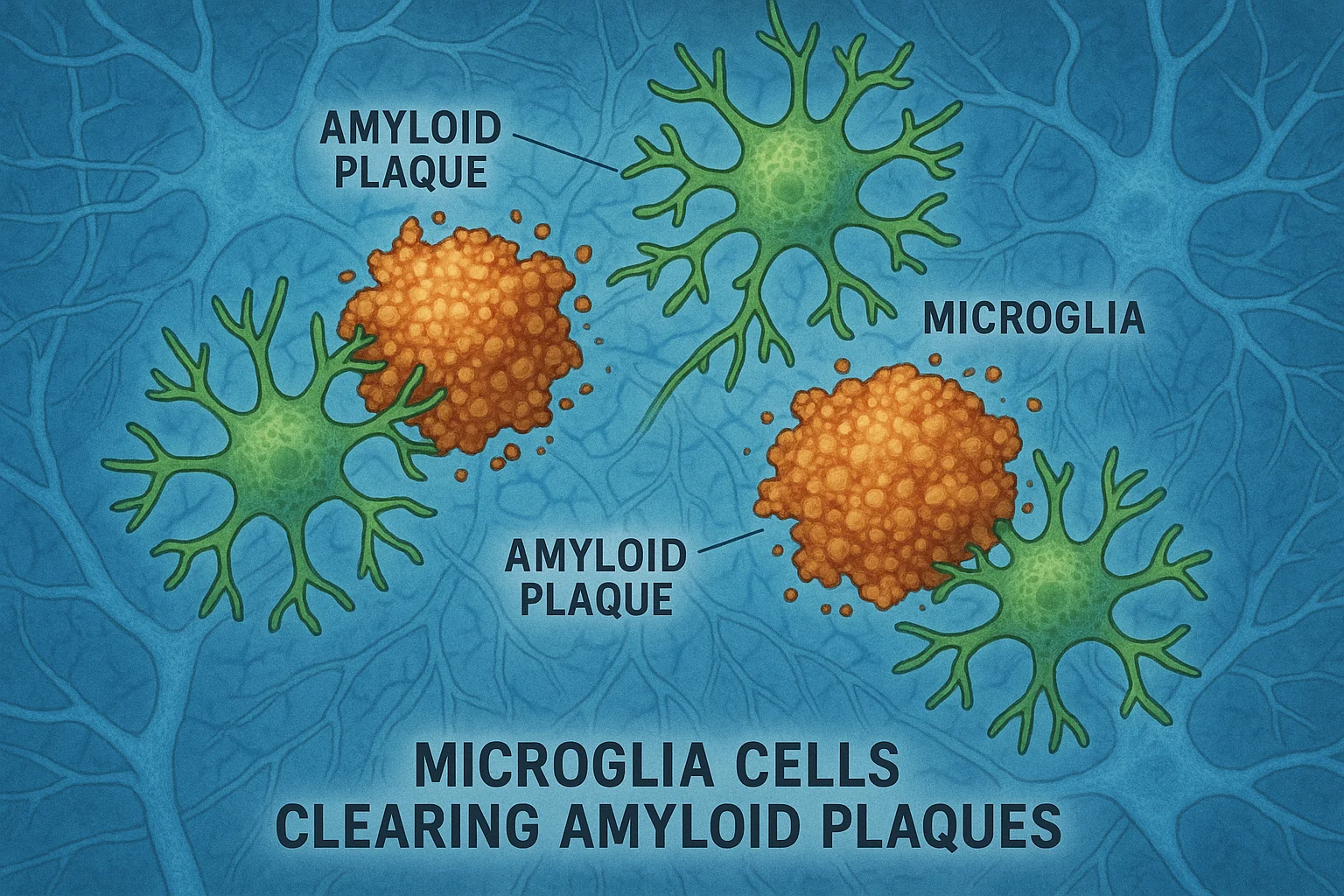
• Microglia are immune cells of the brain responsible for phagocytosing amyloid plaques - in Alzheimer's, this function is impaired.
• CBD activates the TRPV2 receptor on microglia, which in a cell model increased beta-amyloid phagocytosis by about 2-fold (Carrier et al., JAD, 2022).
• CBD also acts through the CB2 receptor (anti-inflammatory) and PPARγ (neuroprotective) - the effects are multifaceted.
• Results are at the preclinical stage and early phase 1/2 trials - CBD is not a cure for Alzheimer's.
What are amyloid plaques and why do they destroy neurons?
Beta-amyloid (Aβ) is a fragment of the precursor protein APP, which, when improperly cleaved by beta- and gamma-secretases, forms Aβ42 peptides particularly prone to aggregation. Monomers combine into oligomers, oligomers form fibrils, and fibrils arrange into plaques (amyloid plaques). Plaques accumulate in the space between neurons, disrupting synaptic transmission and triggering a local inflammatory response from microglia. Activated microglia release cytokines IL-1β and TNF-α, which damage neurons - a paradox: cells meant for defense become a source of additional injury (Heneka et al., Nature Reviews Neuroscience, 2015).
A parallel process is the phosphorylation of tau protein, forming so-called neurofibrillary tangles inside neurons. Amyloid plaques and tau tangles coexist, and their mutual interaction accelerates neurodegeneration. Contemporary research treats both processes as elements of the same pathological cascade - not as independent phenomena.
What is microglia and why does it fail in Alzheimer's?
Microglia constitute about 10-15% of all brain cells and are the only population of resident immune cells in the central nervous system. At rest, they continuously "scan" the brain space, extending and retracting processes several micrometers long. When they encounter foreign particles, synaptic debris, or protein aggregates, they phagocytose them - engulfing and degrading them. This function is crucial for "cleaning" the brain of metabolic products and pathological aggregates.
In Alzheimer's disease, microglia transition to an inflammatory phenotype (M1), where the release of pro-inflammatory cytokines predominates, and their phagocytic ability is impaired. Genomic studies show that mutations in the TREM2 gene (expressed on microglia) - a receptor crucial for phagocytosis - significantly increase the risk of Alzheimer's, directly proving that "damaged" cleaning ability is a cause, not just a consequence of the disease (Guerreiro et al., NEJM, 2013).
| Microglial state | M2 phenotype (healthy) | Fenotyp M1 (zapalny - Alzheimer) |
|---|---|---|
| Main function | Phagocytosis, repair | Release of pro-inflammatory cytokines |
| Cytokines | IL-10, TGF-β (anti-inflammatory) | IL-1β, TNF-α, IL-6 (pro-inflammatory) |
| Amyloid phagocytosis | Effective | Impaired |
| CBD effect (CB2, TRPV2) | Supports this phenotype | Shifts towards M2 |
TRPV2 - the receptor through which CBD supports amyloid phagocytosis
The TRPV2 (Transient Receptor Potential Vanilloid 2) receptor belongs to a family of ion channels activated by mechanical, thermal, and chemical stimuli. It is expressed, among others, in macrophages and microglia, where it regulates cell migration and phagocytosis. A key study by Carrier et al. published in Journal of Alzheimer’s Disease in 2022 showed that CBD activates TRPV2 in microglial cells, which increased the efficiency of beta-amyloid aggregate uptake in cell cultures by about twofold (Carrier et al., JAD, 2022).
The mechanism is as follows: activation of TRPV2 by CBD causes an influx of calcium ions into the cell, mobilizing the endocytic mechanisms of microglia. In other words, microglia become a "more efficient vacuum cleaner" for toxic aggregates. Importantly, this effect was independent of cannabinoid receptors CB1 and CB2 - TRPV2 is a separate pathway through which CBD acts neuroprotectively without engaging the endocannabinoid system in the strict sense.
It is worth emphasizing that TRPV2 is not the only "non-CB" pathway for CBD. This cannabinoid also interacts with TRPV1 (capsaicin receptor), adenosine A2A receptor, and serotonin 5-HT1A receptor. This multifaceted pharmacology explains why CBD exhibits effects in such diverse disease contexts - it is not a placebo effect, but a multi-target interaction with nervous tissue.
CBD a zapalenie neuronalne - mechanizm przez receptor CB2
Alongside its action through TRPV2, CBD exerts a strong anti-inflammatory effect through the CB2 receptor, which is densely distributed on microglia and immune system cells (to a lesser extent in neurons). Activation of CB2 inhibits the release of IL-1β and TNF-α, reduces the migration of pro-inflammatory monocytes, and promotes the M2 phenotype of microglia. A study by Ja et al. in a mouse model of Alzheimer's showed that activation of CB2 reduced amyloid burden and improved cognitive test outcomes (Ja et al., Frontiers in Pharmacology, 2018).
The third mechanism is the PPARγ (peroxisome proliferator-activated receptor gamma) receptor, which CBD activates directly. PPARγ regulates the expression of genes related to lipid metabolism and inflammation, and its activation reduces beta-amyloid neurotoxicity in neuronal cultures. Watt and Karl in a review published in Frontiers in Pharmacology (2017) described this as one of the key neuroprotective mechanisms of CBD independent of the endocannabinoid system (Watt & Karl, Frontiers in Pharmacology, 2017).
Where are we on the map of clinical research?
The vast majority of data on CBD and Alzheimer's comes from in vitro studies (cell cultures) and animal models. When translating these results to humans, caution is necessary: mice with Alzheimer's genotype (e.g., APP/PS1) do not perfectly replicate human pathology, as tau tangles do not naturally form in mice. This is an important methodological caveat.
Clinical studies with CBD in neurodegeneration are in early stages. In the ClinicalTrials.gov registry, several phase 1/2 trials are investigating CBD in mild cognitive impairment and early Alzheimer's. One of the more promising - the Australian randomized study CannCog - is examining the combination of CBD and THC in patients with early dementia, but full results have not yet been published (as of mid-2026). The lack of approved indications means that CBD supplementation by individuals at risk of Alzheimer's is a decision based on mechanistic data, not clinical confirmation.
What can CBD do, and what can it not do in the context of Alzheimer's?
Mechanistic data indicate several real directions of CBD action: enhancement of amyloid phagocytosis through TRPV2, reduction of inflammation through CB2, neuroprotection through PPARγ. These are not hypotheses - they are described biochemical pathways with repeatable results in cell models. The clinical question - whether the effects are sufficient and achieved at safe doses in humans - remains unanswered.
It is worth adding a preventive perspective. Epidemiological data suggest that brain inflammation is one of the early (even 20-year clinical lead) processes in Alzheimer's. If CBD exhibits anti-inflammatory effects in microglia even at low, supplemental doses, potentially the most valuable approach would not be treating advanced disease, but prevention in the early phase of amyloid accumulation. This is a hypothesis without confirmation in RCTs, but biologically justified - and one of the reasons researchers consider CBD in populations with genetic risk for Alzheimer's (carriers of the APOE4 gene). Naturally, any decision regarding long-term supplementation in this group requires consultation with a neurologist.
From our experience, caregivers of seniors with early Alzheimer's ask about CBD more often than anything else in the cannabis category. The honest answer is: preclinical data are promising, but there is no clinical study confirming the slowing of disease progression in humans. The decision to supplement should always be consulted with the attending neurologist.
Frequently Asked Questions
What are amyloid plaques and why are they dangerous?
Amyloid plaques are aggregates of beta-amyloid protein that accumulate between neurons in Alzheimer's disease. They block synapses, trigger chronic inflammation, and lead to neuronal death. The WHO estimates that Alzheimer's accounts for 60-70% of dementia cases, affecting approximately 55 million people globally (WHO, 2023).
What is microglia and what role does it play in the brain?
Microglia are resident immune cells of the brain - the equivalent of macrophages in nervous tissue. Healthy microglia phagocytose (engulf) protein aggregates, synaptic debris, and pathogens. In Alzheimer's, this ability is impaired: cells enter a state of chronic inflammation instead of effectively removing amyloid (Heneka et al., NRN, 2015).
How does CBD affect microglia and amyloid?
CBD activates the TRPV2 receptor on microglia, which increases calcium ion influx and mobilizes endocytic mechanisms. In a cell model, Carrier et al. demonstrated about a twofold increase in beta-amyloid phagocytosis under the influence of CBD administered through the TRPV2 receptor (JAD, 2022).
Is CBD approved as a drug for Alzheimer’s?
No. No drug has been approved by the EMA or FDA as a means to halt the progression of Alzheimer’s. CBD has promising mechanisms of action in preclinical models, but it has not yet undergone a large Phase 3 clinical trial for this disease. It should not be used as a substitute for neurological treatment.
What other mechanisms does CBD have against neurodegeneration?
Besides TRPV2, CBD acts through the CB2 receptor (inhibiting IL-1β and TNF-α in microglia) and through the PPARγ receptor (reducing amyloid neurotoxicity). The review by Watt and Karl described these pathways as independent of the classical endocannabinoid system, making CBD particularly a multifaceted neuroprotectant (Frontiers in Pharmacology, 2017).
This article is for informational and educational purposes and does not replace consultation with a doctor. If you are pregnant, breastfeeding, taking medications, or have chronic conditions, consult the use of supplements or herbs with a specialist.
Author: Michał Waluk · Published: 2026-05-04 · Updated: 2026-05-04