
Jakie stężenie CBD wybrać? 5%, 10%, 15%, 20% - kompletny przewodnik
Stężenie olejku CBD to arytmetyka, nie siła. Sprawdź, ile mg daje kropla przy 5, 10, 15 i 20 procentach, ile kosztuje 100 mg i co zmienia wchłanianie.
Procent na etykiecie olejku mówi mniej, niż się wydaje. Stężenie nie opisuje siły produktu, tylko jego gęstość: ile miligramów CBD mieści się w mililitrze. Olejek 20% wzięty w trzech kroplach i olejek 10% wzięty w sześciu dostarczają dokładnie tyle samo. Mimo to opisy sklepowe przypisują 5% początkującym, a 20% zaawansowanym, jakby sam procent coś rozstrzygał. W przeglądzie 35 badań klinicznych nad CBD nie ma ani jednej próby porównującej procentowe stężenia; porównywano tam dawki w miligramach na kilogram masy ciała, kilkadziesiąt razy wyższe od konsumenckich. Ten tekst rozkłada wybór stężenia na to, co da się sprawdzić: arytmetykę butelki, zawartość kropli, cenę za 100 mg oraz dwie rzeczy, które naprawdę zmieniają ekspozycję na CBD.
KLUCZOWE INFORMACJE
• 5% to 50 mg CBD w mililitrze, czyli 500 mg w butelce 10 ml. Reszta wynika z mnożenia.
• Zawartość kropli zależy od pipety: 200-300 kropli na 10 ml to 1,67-2,5 mg przy 5%.
• Dawki dla zdrowego konsumenta nie ustaliło żadne z 35 badań klinicznych przeglądu Millara (British Journal of Clinical Pharmacology, 2019); podawano w nich od poniżej 1 do 50 mg/kg na dobę.
• Tłusty posiłek podniósł ekspozycję na CBD 4,2 razy (Taylor i in., CNS Drugs, 2018).
• Prowizoryczna dawka bezpieczna według EFSA to 0,0275 mg/kg na dobę, czyli około 2 mg dla osoby 70 kg (EFSA Journal, 2026).
Co oznacza stężenie procentowe na etykiecie olejku CBD?
Stężenie procentowe mówi, jaką część zawartości butelki stanowi CBD, i przekłada się wprost na miligramy. 5% to 50 mg CBD w każdym mililitrze, 10% to 100 mg, 15% to 150 mg, a 20% to 200 mg. Butelka 10 ml zawiera więc odpowiednio 500, 1000, 1500 i 2000 mg.
| Stężenie | CBD w 1 ml | Butelka 10 ml | Butelka 30 ml |
|---|---|---|---|
| 5% | 50 mg | 500 mg | 1500 mg |
| 10% | 100 mg | 1000 mg | 3000 mg |
| 15% | 150 mg | 1500 mg | 4500 mg |
| 20% | 200 mg | 2000 mg | 6000 mg |
Ta tabela jest zarazem najprostszym testem uczciwości etykiety. Na opakowaniu stoją trzy liczby: procent, pojemność butelki oraz deklarowana masa CBD. Muszą się zgadzać ze sobą. Zapis „10%, 1000 mg, 10 ml” jest spójny. Zapis „10%, 1000 mg, 30 ml” już nie, bo 30 ml dziesięcioprocentowego olejku to 3000 mg. Rozjazd oznacza albo błąd na etykiecie, albo produkt opisany tak, żeby wyglądał mocniej.
Warto tu zaznaczyć granicę tego, co procent w ogóle opisuje. Mówi o zawartości butelki, nie o tym, ile CBD trafi do krwiobiegu, i nie o tym, ile powinieneś wziąć. To pierwsza z trzech osobnych spraw, które opisy produktów zwykle zlepiają w jedną.
Ile CBD zawiera jedna kropla?
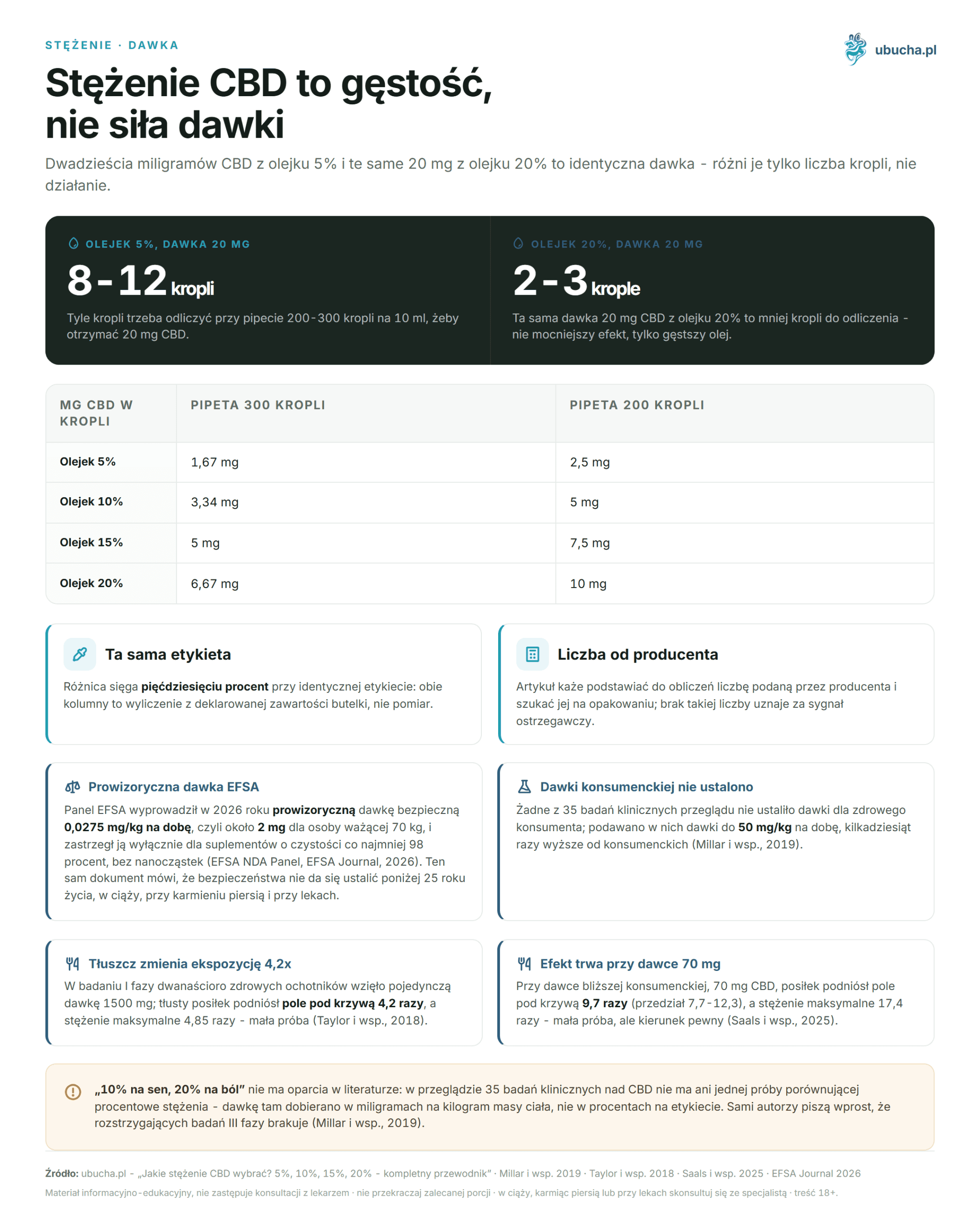
To zależy od pipety, nie od stężenia. Butelka 10 ml daje zwykle od 200 do 300 kropli, więc kropla olejku 5% zawiera od 1,67 do 2,5 mg CBD. Różnica sięga pięćdziesięciu procent przy identycznej etykiecie, dlatego do obliczeń podstawiaj liczbę podaną przez producenta.
| Stężenie | Pipeta 300 kropli | Pipeta 200 kropli | Krople na 20 mg |
|---|---|---|---|
| 5% | 1,67 mg | 2,5 mg | 8-12 |
| 10% | 3,34 mg | 5 mg | 4-6 |
| 15% | 5 mg | 7,5 mg | 3-4 |
| 20% | 6,67 mg | 10 mg | 2-3 |
Olejki CANNOVA dostępne u Bucha deklarują 1,67 mg CBD w kropli przy 5% i 3,34 mg przy 10%, co odpowiada trzystu kroplom z butelki 10 ml. Kto policzy dawkę według popularnego założenia o dwustu kroplach, weźmie o połowę mniej, niż zaplanował. Dlatego pierwsza rzecz, którą sprawdzasz po otwarciu opakowania, to nie procent, tylko liczba miligramów w kropli.
Czy wyższe stężenie CBD działa mocniej?
Nie. O ekspozycji decyduje liczba miligramów, która trafia do organizmu, a nie procent na etykiecie. Dwadzieścia miligramów CBD z olejku 5% i te same 20 mg z olejku 20% to identyczna dawka. Różni je objętość oleju nośnikowego i liczba kropli, którą musisz odliczyć.
Co realnie kupujesz razem z wyższym stężeniem? Mniej kropli przy tej samej dawce, dłużej starczającą butelkę i niższą cenę za 100 mg. To trzy powody praktyczne, nie farmakologiczne.
Za tę wygodę płacisz gruboziarnistością. Przy 20% i pipecie trzystukroplowej jedna kropla to 6,67 mg, więc dawki 5 mg nie odmierzysz w ogóle, a 15 mg trafisz tylko z grubsza. Przy 5% ta sama pipeta daje krok 1,67 mg, czyli cztery razy drobniejszy. Jeśli dopiero sprawdzasz, jak reagujesz na CBD, drobny krok jest wart więcej niż oszczędność kilkunastu złotych miesięcznie.
Stąd bierze się jedyna sensowna reguła przejścia między stężeniami: zmieniasz je wtedy, gdy liczenie kropli robi się nieporęczne, a nie wtedy, gdy chcesz mocniejszego efektu. Mocniejszy efekt to inna dawka w miligramach, którą możesz ustawić na każdym stężeniu. Więcej o samym odmierzaniu znajdziesz w tekście Dawkowanie CBD.
Jaką dawkę CBD ustaliły badania kliniczne?
Żadne nie ustaliło dawki dla zdrowego konsumenta. Przegląd systematyczny 35 badań klinicznych z trzynastu obszarów medycznych (Millar i in., British Journal of Clinical Pharmacology, 2019) objął prace, w których 23 zgłosiły istotną poprawę w punkcie pierwszorzędowym, przy dawkach od poniżej 1 do 50 mg na kilogram masy ciała na dobę. Stężeń CBD w osoczu nie podała żadna.
Skala tych liczb tłumaczy, dlaczego nie da się ich przenieść na butelkę olejku. W randomizowanych badaniach padaczki średnia dawka wynosiła 15 mg/kg na dobę, czyli około 1050 mg dziennie u osoby ważącej 70 kg. Cała butelka 10 ml olejku 20% zawiera 2000 mg, więc starczyłaby na niecałe dwa dni, a odmierzenie takiej porcji pipetą trzystukroplową wymagałoby ponad 150 kropli. W badaniu I fazy podawano 750 lub 1500 mg dwa razy dziennie (Taylor i in., CNS Drugs, 2018). Tam, gdzie sygnału nie było wcale, czyli w małych próbach nad cukrzycą, chorobą Crohna, nadciśnieniem ocznym, stłuszczeniem wątroby i bólem przewlekłym, średnia wynosiła 2,4 mg/kg.
Wynika z tego rzecz, którą opisy produktów przemilczają: przypisania w rodzaju „10% na sen, 20% na ból” nie mają oparcia w tej literaturze. W przeglądzie nie ma ani jednej próby porównującej ze sobą procentowe stężenia olejków konsumenckich, bo badania dobierają dawkę w miligramach na kilogram masy ciała, nie w procentach na etykiecie. Autorzy piszą wprost, że rozstrzygających badań III fazy brakuje.
Od strony bezpieczeństwa jedyna liczba pochodząca od organu regulacyjnego idzie w przeciwną stronę niż marketing stężeń. Panel EFSA wyprowadził w 2026 roku prowizoryczną dawkę bezpieczną 0,0275 mg na kilogram masy ciała na dobę, czyli około 2 mg dziennie dla osoby ważącej 70 kg, i zastrzegł ją wyłącznie dla suplementów o czystości CBD co najmniej 98 procent, bez nanocząstek (EFSA NDA Panel, EFSA Journal, 2026). Ten sam dokument stwierdza, że bezpieczeństwa CBD nie da się ustalić u osób poniżej 25 roku życia, u kobiet w ciąży i karmiących piersią oraz u przyjmujących leki.
Ile kosztuje 100 mg CBD przy różnych stężeniach?
Im wyższe stężenie, tym niższa cena za miligram, choć sama butelka kosztuje więcej. W kategorii olejków u Bucha stoi dziś sześć pozycji, wszystkie w butelkach 10 ml, z czego trzy zawierają kannabidiol. Po przeliczeniu na 100 mg deklarowanego CBD ich ceny mieszczą się w przedziale od 9,50 do 13 zł (stan na 15 sierpnia 2026), a najtaniej wypada wariant najmocniejszy.
Ten rozrzut wygląda skromnie, dopóki nie pomnożysz go przez miesiąc. Przyjmijmy dla rachunku 20 mg dziennie, czyli 600 mg miesięcznie: przy górnym przeliczniku wychodzi około 78 zł, przy dolnym około 57 zł. Różnica rzędu 20 zł miesięcznie daje w skali roku ponad 250 zł. Przy porcji dwa razy mniejszej ta sama proporcja daje dwa razy mniejszą kwotę, więc oszczędność zaczyna cokolwiek znaczyć dopiero przy regularnym, wyższym dawkowaniu.
Jednej pozycji w tym zestawieniu brakuje. Wśród olejków u Bucha nie ma dziś wersji 15% z kannabidiolem: piętnaście procent występuje wyłącznie w olejku CBG, a to inny fitokannabinoid, więc porównywanie go z CBD po cenie za miligram niczego nie mówi. Asortyment rotuje szybciej niż artykuł, dlatego przed zakupem sprawdź aktualne dane w kategorii olejki.
Cena i tak nie jest w tym wyborze argumentem najmocniejszym, co widać w powyższym rachunku. Dwadzieścia złotych miesięcznie przegrywa z jednym pytaniem, na które odpowiada następna sekcja: czy w ogóle wchłaniasz to, co odmierzasz.
Czy posiłek zmienia to, ile CBD wchłoniesz?
Bardziej niż jeden krok w górę na skali stężeń. W badaniu I fazy tłusty posiłek podniósł maksymalne stężenie CBD w osoczu 4,85 razy, a pole pod krzywą 4,2 razy (Taylor i in., CNS Drugs, 2018). Ta sama dawka, zupełnie inna ekspozycja.
Do tej liczby należy dopisać zastrzeżenie, którego zwykle się nie podaje. Ramię badające wpływ posiłku obejmowało dwanaścioro zdrowych ochotników i pojedynczą dawkę 1500 mg, czyli poziom odległy od zawartości butelki liczonej w kroplach.
Nowsza praca dotyczy dawki bliższej konsumenckiej. Jedenaścioro zdrowych ochotników, pięciu mężczyzn i sześć kobiet, dostało w układzie krzyżowym pojedynczą dawkę ekstraktu odpowiadającą 70 mg CBD, raz na czczo, raz po standaryzowanym tłustym posiłku (Saals i in., Scientific Reports, 2025). Stosunek średnich geometrycznych wyniósł 17,4 dla stężenia maksymalnego, przy 90-procentowym przedziale ufności 12,4-24,2, oraz 9,7 dla pola pod krzywą, przedział 7,7-12,3. Grupa jest mała, ale oba przedziały leżą w całości powyżej jedynki: kierunek jest pewny, sama wielkość efektu już nie.
Czego natomiast nie wiadomo, mimo że internet twierdzi inaczej. Przegląd 24 prac farmakokinetycznych u ludzi podaje jedną jedyną biodostępność bezwzględną, 31 procent po paleniu, i zaznacza, że dla pozostałych dróg podania nie próbowało jej wyznaczyć żadne z uwzględnionych badań (Millar i in., Frontiers in Pharmacology, 2018). Krążące „13-19% doustnie” w tej pracy owszem stoi, ale we wstępie, jako tło z wcześniejszych prac obejmujących badania na zwierzętach, a nie jako pomiar u człowieka. Praktyczny wniosek jest prostszy niż spór o procenty: bierz olejek razem z posiłkiem zawierającym tłuszcz i o stałej porze, zanim zaczniesz szukać mocniejszej butelki.
Czy pełne spektrum pozwala wybrać niższe stężenie?
Nie ma dowodu, który dałoby się przenieść na olejek konsumencki. Praca cytowana w tym miejscu najczęściej to metaanaliza danych obserwacyjnych o padaczce lekoopornej (Pamplona i in., Frontiers in Neurology, 2018), a jej wynik jest bardziej złożony, niż sugeruje popularny skrót o efekcie entourage.
Autorzy zebrali dane 670 pacjentów z jedenastu badań obserwacyjnych. Poprawę częstości napadów zgłaszano częściej przy ekstraktach bogatych w CBD (71%) niż przy oczyszczonym CBD (46%), przy p poniżej 0,0001. Po zastosowaniu standardowego progu klinicznego, czyli spadku liczby napadów o co najmniej połowę, różnica znikała: 37% wobec 42%, p = 0,52. Średnia dawka dobowa wynosiła 6,0 mg/kg dla ekstraktów i 25,3 mg/kg dla oczyszczonego CBD, a działania niepożądane, zarówno łagodne, jak i ciężkie, zgłaszano częściej przy preparacie oczyszczonym. To dane nierandomizowane, zbierane w różnych ośrodkach, i sami autorzy piszą, że synergię składników trzeba dopiero potwierdzić w badaniach kontrolowanych.
Co z tego wynika dla wyboru butelki? Tyle, że planowanie niższego stężenia na podstawie napisu „full spectrum” nie ma podstaw. Wynika natomiast coś innego: pełne spektrum niesie śladowy THC, a to zmienia obraz przy testach. Osiemnaścioro zdrowych dorosłych waporyzowało susz bogaty w kannabidiol, dostarczający 100 mg CBD oraz 3,7 mg THC. Troje z nich oddało łącznie sześć próbek moczu, w których stężenie metabolitu THC przekroczyło 15 ng/ml; wszystkie sześć wypadło dodatnio przy progu przesiewowym 20 ng/ml, a dwie także przy 50 ng/ml. Po czystym CBD, podanym doustnie i wziewnie, autorzy nie stwierdzili przemiany do THC w żadnej z badanych postaci (Sholler i in., Journal of Analytical Toxicology, 2022).
Zastrzeżenie do tego pomiaru jest przy wyborze butelki istotne: badanie dotyczyło waporyzowanego suszu, nie olejku, więc nie mówi nic o tym, ile THC odłoży się po miesiącu brania preparatu pełnospektralnego. Mówi tyle, że jednorazowa ekspozycja na kilka miligramów THC wystarczyła, żeby przekroczyć progi testu. Jeśli podlegasz kontrolom, wybieraj izolat albo szerokie spektrum, niezależnie od stężenia.
Jak przeliczyć dawkę przy zmianie stężenia?
Podziel dotychczasową dawkę w miligramach przez zawartość CBD w kropli nowego olejku. Brałeś 5 kropli olejku 10% po 3,34 mg, czyli 16,7 mg. Po przejściu na 20%, gdzie kropla ma 6,67 mg, te same 16,7 mg to 2,5 kropli. Dawka bez zmian, butelka starcza dwa razy dłużej.
Najczęstszy błąd polega na zachowaniu liczby kropli. Pięć kropli olejku 10% zamienione na pięć kropli olejku 20% podwaja dawkę, choć rutyna wygląda identycznie. Dlatego przy każdej zmianie butelki przelicz dawkę na miligramy, zanim odmierzysz pierwszą porcję.
Zauważyliśmy przy porządkowaniu opisów produktów, że dwa olejki o tym samym procencie potrafią różnić się zawartością kropli o połowę, bo mają inne pipety. Etykieta z samym procentem nie wystarczy do przeliczenia. Szukaj na opakowaniu liczby miligramów w kropli albo liczby kropli w butelce, a jeśli producent nie podaje żadnej z nich, potraktuj to jako sygnał ostrzegawczy.
Przed zmianą stężenia zapisz przez dwa tygodnie, ile miligramów bierzesz dziennie i o jakiej porze. Bez tej liczby zmiana butelki jest zgadywaniem, a przy okazji tracisz jedyny punkt odniesienia, który masz. Skąd brać sam produkt i na co patrzeć przy zakupie, opisaliśmy w tekście Gdzie kupić CBD w Polsce.
Najczęściej zadawane pytania
Które stężenie olejku CBD wybrać na początek?
Najniższe dostępne, czyli zwykle 5%, bo daje najdrobniejszy krok dawkowania: od 1,67 do 2,5 mg CBD w kropli zależnie od pipety. Nie dlatego, że jest słabsze, tylko dlatego, że łatwiej nim odmierzyć małą porcję i zapisać, ile faktycznie bierzesz.
Czy wyższe stężenie CBD działa mocniej?
Nie. Liczy się liczba miligramów, która trafia do organizmu, a nie procent na etykiecie. Dwadzieścia miligramów z olejku 5% to ta sama dawka co 20 mg z olejku 20%. Wyższe stężenie zmniejsza liczbę kropli i cenę za 100 mg, ale nie zmienia samego CBD.
Ile kropli olejku 10% to 20 mg CBD?
Zależy od pipety. Przy 300 kroplach w butelce 10 ml kropla ma 3,34 mg, więc 20 mg to 6 kropli. Przy pipecie dającej 200 kropli kropla ma 5 mg i wystarczą 4 krople. Liczbę miligramów w kropli podaje producent na opakowaniu.
Czy olejek CBD 15% jest lepszy od 10%?
Nie jest lepszy, jest gęstszy. Ta sama dawka w miligramach wymaga przy 15% mniej więcej dwóch trzecich liczby kropli co przy 10%. W przeglądzie 35 badań klinicznych nie ma próby porównującej procentowe stężenia olejków, bo dawkę dobiera się tam w miligramach na kilogram masy ciała.
Czy olejek CBD trzeba trzymać pod językiem?
Nie ma pomiaru, który by to rozstrzygnął. Przegląd 24 prac o farmakokinetyce CBD u ludzi (Millar i in., 2018) podaje jedną biodostępność bezwzględną, 31 procent po paleniu, i zaznacza, że dla pozostałych dróg podania nie wyznaczyło jej żadne z uwzględnionych badań. Krążące procenty nie pochodzą więc z pomiaru u człowieka.
Czy olejek CBD może dać dodatni wynik testu na THC?
Czyste CBD nie dawało takiego wyniku, ale produkty ze śladowym THC mogą. W badaniu Sholler i in. (2022) po waporyzacji suszu bogatego w CBD, dostarczającego 100 mg CBD i 3,7 mg THC, troje z osiemnastu uczestników oddało łącznie sześć próbek moczu przekraczających próg przesiewowy 20 ng/ml.
Czy istnieje górny limit dzienny dla CBD?
Panel EFSA wyprowadził w 2026 roku prowizoryczną dawkę bezpieczną 0,0275 mg na kilogram masy ciała na dobę, czyli około 2 mg dla osoby ważącej 70 kg, i tylko dla suplementów o czystości co najmniej 98 procent. Dla osób poniżej 25 roku życia, kobiet w ciąży i przyjmujących leki bezpieczeństwa nie ustalono.
Pełną ofertę olejków konopnych wraz z aktualnymi cenami i deklarowaną zawartością kropli zebraliśmy w kategorii olejki.
Artykuł ma charakter informacyjno-edukacyjny i nie stanowi porady medycznej. Przed rozpoczęciem stosowania konopi lub CBD w celach terapeutycznych skonsultuj się z lekarzem, zwłaszcza jeśli przyjmujesz inne leki, jesteś w ciąży lub karmisz piersią.
Autor: Michał Waluk · Opublikowano: 2026-06-15 · Aktualizacja: 2026-08-15