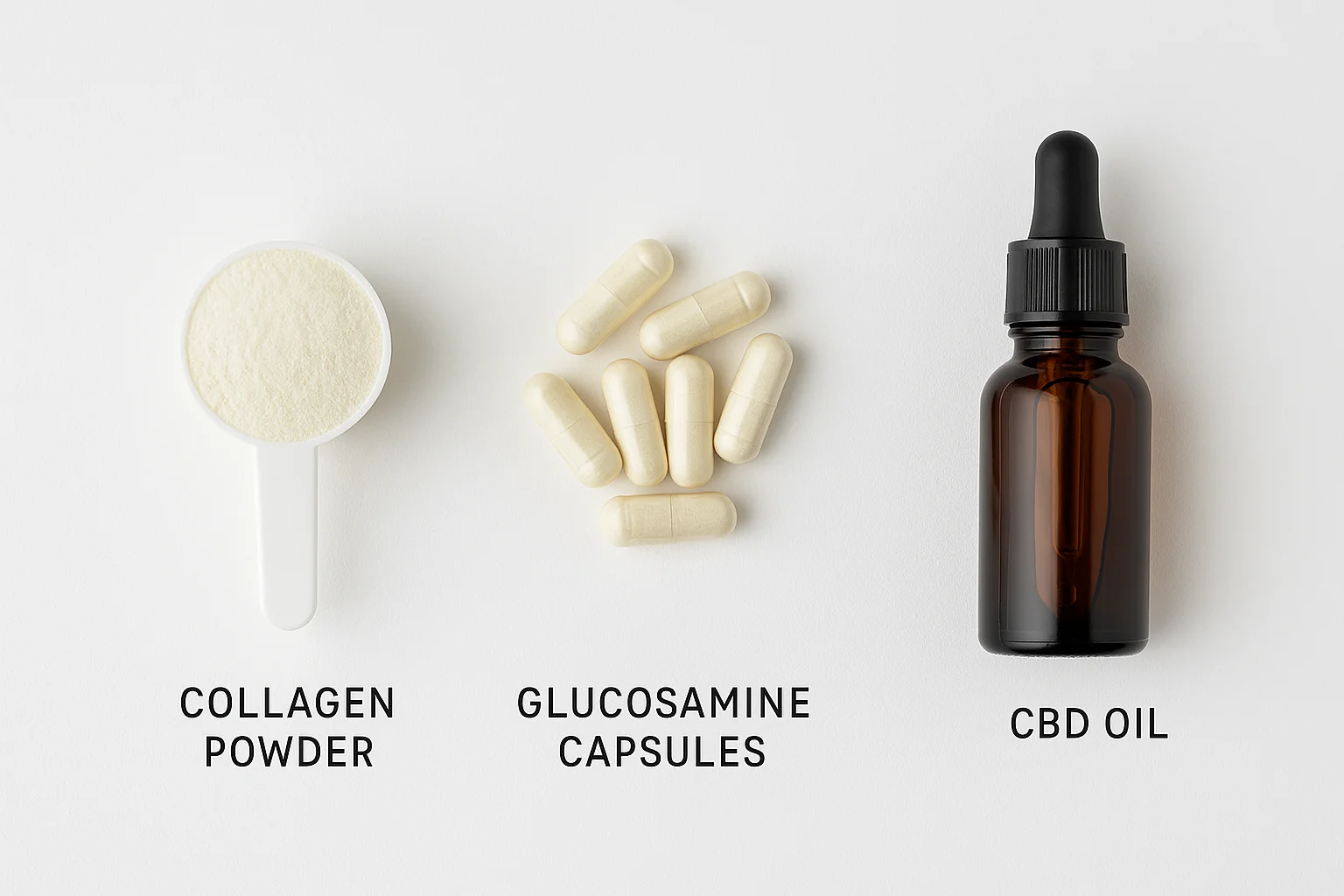

Supplements for Joints: Collagen, Glucosamine, and CBD - What to Choose and How to Combine
What studies really show about glucosamine, collagen, and CBD for joints. Results from large RCTs, meta-analyses, and guidelines, without marketing promises.
The three most popular joint supplements have very different quality of evidence, and the order does not correspond to their position in advertisements. Glucosamine has been studied the most extensively, and that is why the most negative information is known about it: in large, independent studies, it does not differ from placebo, and rheumatological guidelines advise against its use. Collagen has weaker data than suggested by packaging, though not zero. CBD has not had a single positive clinical study in humans with osteoarthritis, despite promising results in animals. This text separates what is known from human studies from what comes from laboratories and manufacturer materials, and shows how to plan your own test before spending hundreds of zlotys.
KEY INFORMATION
• Glucosamine reduced pain by 0.4 cm on a 10 cm scale, with a threshold of perception at 0.9 cm (Wandel et al., BMJ, 2010).
• ACR guidelines from 2019 strongly discourage glucosamine.
• CBD 20-30 mg per day did not differ from placebo in a 12-week RCT (Vela et al., Pain, 2022).
• Collagen UC-II 40 mg improved WOMAC, but the study was funded by the manufacturer.
Which joint supplement has the strongest evidence?
The strongest signal from this group comes from curcumin, the weakest from CBD. Glucosamine is the best-studied and performs the worst, as large independent studies did not distinguish it from placebo. Collagen is in the middle: a positive result, but from small studies, most often funded by the product's manufacturers.
The table below organizes what realistically results from human studies. It deliberately omits biochemical mechanisms. A nice mechanism in a test tube does not automatically translate to less knee pain, and it is precisely on mechanisms that most joint supplement advertisements are based.
| Supplement | Najlepsze dane u ludzi | Application |
|---|---|---|
| Glucosamine | RCT on 1,583 individuals, meta-analysis of 3,803 patients, individual data analysis of 1,625 patients | Effect below the threshold of perception, discouraged by ACR |
| Chondroityna | The same large studies | Discouraged for knee and hip, conditionally allowed for hand |
| Kolagen UC-II 40 mg | RCT na 191 osobach, 180 dni | Poprawa WOMAC, badanie sponsorowane przez producenta |
| Hydrolyzed collagen | Meta-analysis of 11 RCTs, 870 participants | Positive signal, but huge variability of results between studies |
| CBD doustnie | RCT na 136 osobach, 12 tygodni | Negative result, no difference compared to placebo |
| MSM | Pilot study on 50 people | Not enough data to draw any conclusions |
| Curcumin | Metaanaliza 8 RCT | The strongest signal in this group, trials still small |
Do glucosamine and chondroitin really work for joint pain?
Not to a degree that patients would notice. In the GAIT study involving 1,583 people with painful knee osteoarthritis, neither glucosamine, nor chondroitin, nor their combination outperformed placebo in the primary endpoint (Clegg i wsp., NEJM, 2006).
The percentage of responses to placebo was 60.1%, to glucosamine 64.0%, and the difference did not reach statistical significance. Celecoxib, used as an active control, performed better than placebo by 10 percentage points and showed that the study had the power to detect a true effect.
A network meta-analysis of 10 large studies involving 3,803 patients provided the same numerical picture (Wandel i wsp., BMJ, 2010). The authors predetermined that a difference of less than 0.9 cm on a ten-centimeter pain scale is not noticeable to patients. Glucosamine yielded 0.4 cm, chondroitin 0.3 cm, and both together 0.5 cm. No confidence interval reached the threshold. The width of the joint space also did not change.
The strongest conclusion comes from the analysis of individual data from 1,625 patients across five industry-independent studies (Runhaar i wsp., Annals of the Rheumatic Diseases, 2017). Glucosamine did not outperform placebo after 3 months, 24 months, or in any subgroup: neither in individuals with more severe pain, nor with higher BMI, nor with inflammatory features.
Why do glucosamine study results vary so much?
Because some positive results come from studies funded by the manufacturer of a specific product. Wandel and colleagues demonstrated this directly: commercially sponsored trials yielded greater effects than independent ones, and the difference between these two groups of studies was statistically significant.
The most frequently cited positive study is a three-year trial on 212 patients, in which glucosamine sulfate 1500 mg per day halted the narrowing of the joint space and slightly improved the WOMAC score (Reginster i wsp., Lancet, 2001). The study was funded by the producer of crystalline glucosamine sulfate, and its results could not be replicated in independent trials.
Hence the discrepancy between guidelines. The American College of Rheumatology in its 2019 guidelines strongly advises against glucosamine for knee, hip, and hand osteoarthritis and chondroitin for knee and hip, conditionally allowing it only for hand joints (Kolasinski i wsp., Arthritis Care and Research, 2020). The European panel ESCEO, which includes authors of sponsored studies, still recommends prescription crystalline glucosamine sulfate. The OARSI guidelines from 2019 do not include glucosamine among first-line therapies (Bannuru i wsp., Osteoarthritis and Cartilage, 2019).
While reviewing labels, we noticed a recurring problem: many over-the-counter products do not specify whether glucosamine sulfate or glucosamine hydrochloride was used, and the dosage may be split into three capsules per day. Even if one were to accept the optimistic version of the evidence, a product without the specified form and without a dosage of 1500 mg per day does not replicate the conditions of any study.
What do studies show about collagen for joints?
Collagen has better data than glucosamine, but still weak. The most frequently cited trial is a study on 191 individuals with knee osteoarthritis, in which undenatured type II collagen at a dose of 40 mg per day for 180 days improved the WOMAC score more than placebo and more than the combination of glucosamine and chondroitin (Lugo i wsp., Nutrition Journal, 2016).
The caveat is the same as with glucosamine. The study was funded by the producer of the UC-II raw material, and the authors were associated with it. The same group previously published a smaller trial on 55 healthy volunteers with knee pain after exercise, in which 40 mg per day for 120 days improved knee extension range (Lugo i wsp., Journal of the International Society of Sports Nutrition, 2013).
The cumulative picture is provided by a meta-analysis of 11 randomized studies involving 870 participants (Simental-Mendía i wsp., Clinical and Experimental Rheumatology, 2025). It yielded positive results: an improvement in function by 6.46 points and pain by 13.63 points compared to placebo. However, heterogeneity reached 75% for function and 88% for pain, meaning that individual studies reported very different results. Hydrolyzed collagen at doses around 10 g per day and UC-II at a dose of 40 mg were lumped together, two products differing in dosage by three orders of magnitude. This is not a result on which a solid recommendation can be based.
Does CBD relieve joint pain in humans?
There is no evidence for that. The only published randomized double-blind study in patients with joint degeneration yielded a negative result: synthetic CBD at a dose of 20-30 mg per day for 12 weeks did not differ from placebo (Vela i wsp., Pain, 2022).
It's important to know the numbers, as they are very clear. The trial involved 136 patients with joint degeneration or psoriatic arthritis, whose pain persisted despite treatment. The difference in pain intensity between groups after 12 weeks was 0.23 mm on a hundred-millimeter scale with p equal to 0.96. An improvement of over 30 mm was reported by 22% of those on CBD and 21% on placebo. There was also no difference in sleep quality, anxiety, mood, or pain catastrophizing.
Optimistic reports come from animal models and should be read as such. Topical application of CBD reduced sensory fiber activity in the joint and pain behaviors in rats with chemically induced knee degeneration (Philpott i wsp., Pain, 2017). CBD gel applied to the skin of rats with joint inflammation reduced swelling and inflammatory infiltrates (Hammell i wsp., European Journal of Pain, 2016). These rodents, a different method of administration and doses calculated per kilogram of body weight. Translating these results to a capsule or drops for humans remains a hypothesis.
How to plan your own joint supplement test?
If you want to try it despite weak evidence, plan it as an experiment with a deadline. Test one substance at a time, at the dose from the studies, for 12 weeks, with a recorded baseline. Otherwise, you won't be able to distinguish the effect of the product from natural fluctuations in pain.
The doses that were actually studied are as follows.
| Substance | Dose from studies | Trial duration |
|---|---|---|
| Kolagen UC-II | 40 mg per day | 180 dni |
| Hydrolyzed collagen | about 10 g per day | 12-24 tygodni |
| Glucosamine sulfate | 1500 mg per day | 12 weeks or longer |
| MSM | 6 g per day in two doses | 12 weeks |
| Curcumin | about 1000 mg per day | 8-12 weeks |
From our experience from conversations in the store, the most common mistake is the lack of a baseline. Before you buy your first package, record your pain intensity on a scale from 0 to 10, the number of days per week with pain, and one specific activity that is difficult: stairs, squats, opening a jar. After 12 weeks, compare these three numbers. If there is no improvement, stop the product instead of adding another.
What about MSM and curcumin?
Both substances have comparably modest data, although curcumin performs the best in this group. A meta-analysis of 8 randomized studies showed that turmeric extract at a dose of about 1000 mg of curcumin per day reduced pain by 2.04 points on the visual analog scale and the WOMAC score by 15.36 points (Daily i wsp., Journal of Medicinal Food, 2016).
The authors themselves noted that the total number of participants was small, and the risk of error in individual trials was assessed as low to moderate. Additionally, there is a technical problem: curcumin itself is poorly absorbed, so the results pertain to products with piperine or in lipid formulations, not powdered spice from the kitchen.
MSM was tested in one pilot study on 50 people with knee pain. A dose of 3 g twice daily for 12 weeks reduced pain and improved physical function on the WOMAC scale, but did not affect stiffness or the total score (Kim i wsp., Osteoarthritis and Cartilage, 2006). The authors stated outright that the pilot study does not allow for confirming either the benefits or the safety of long-term use. Since then, no large confirming study has been conducted. Note the dose: 6 g per day is significantly more than most combined ready-made products declare.
What can no joint supplement replace?
Movement and weight reduction. These are the only conservative interventions that the American College of Rheumatology guidelines from 2019 recommend in the strongest category for knee and hip degeneration. No supplement made it into this group, and glucosamine was placed in the negative recommendations.
In the same guidelines, strong recommendations also include self-management programs for the disease, tai chi, using a cane for knee degeneration, and topical non-steroidal anti-inflammatory drugs. The OARSI guidelines from 2019 indicate education and a structured land-based exercise program, optionally with weight control, as the primary therapy for knee degeneration.
Weight reduction works mechanically and faster than anything you swallow. When walking, the knee joint bears a load many times greater than body weight, so every kilogram lost relieves the cartilage of several kilograms of force with each step. Strengthening exercises for the muscles around the joint improve stabilization and relieve the joint surfaces.
A supplement makes sense as an addition to this, not as a replacement. If your budget is limited, spend it first on a physiotherapy consultation and an exercise plan, then possibly on a product. This order comes directly from the hierarchy of evidence, not from caution.
Frequently Asked Questions
Does glucosamine work for joint pain?
According to the best available data, not to a degree you will feel. A meta-analysis of 10 studies on 3,803 patients showed a pain reduction of 0.4 cm on a 10 cm scale, with the threshold of perception set at 0.9 cm (Wandel i wsp., BMJ, 2010). The ACR guidelines from 2019 strongly discourage it.
How much collagen to take for joints and for how long?
The studies used two forms in very different doses: undenatured UC-II at 40 mg per day for 180 days and hydrolyzed collagen at around 10 g per day. A meta-analysis of 11 studies showed improvement in pain and function, but with heterogeneity reaching 88% (Simental-Mendía i wsp., 2025).
Does CBD help with joint pain?
This has not been demonstrated in humans. In a randomized study of 136 patients, synthetic CBD at 20-30 mg per day for 12 weeks resulted in a difference of 0.23 mm on a hundred-millimeter scale compared to placebo, with a p-value of 0.96 (Vela i wsp., Pain, 2022). Positive results come from studies on rats.
Can collagen, glucosamine, and CBD be combined?
No interactions between these substances have been described, so technically yes. The sense is different: three products with weak evidence do not add up to a strong effect. CBD inhibits CYP450 enzymes, which is significant with anticoagulant and anticonvulsant medications, so if you are on regular pharmacotherapy, consult your doctor or pharmacist.
How long should you wait to assess whether a joint supplement is effective?
Set a timeline before starting, not during. A reasonable trial period is 12 weeks for one substance, as that was the duration of most studies on collagen, MSM, and CBD. Record your pain intensity on a scale of 0-10 and one activity that is difficult for you. No change after 12 weeks means discontinuation.
What works better for joints than supplements?
Movement and weight reduction. The ACR guidelines from 2019 in the strongest category mention exercises, weight reduction for overweight individuals, self-management programs for the disease, and topical anti-inflammatory medications for the knee (Kolasinski i wsp., 2020). No supplement has a recommendation of this strength.
You can find more about CBD in relation to training loads in the post CBD for athletes, and about interactions with medications in the text CBD oil for seniors. Aktualny asortyment znajdziesz w kategoriach supplements i hemp oils.
This article is for informational and educational purposes and does not constitute medical advice. Before starting to use cannabis or CBD for therapeutic purposes, consult a doctor, especially if you are taking other medications, are pregnant, or breastfeeding.
Author: Michał Waluk · Opublikowano: 2026-06-22 · Aktualizacja: 2026-08-07