
Colostrum: what is it, properties and is it worth supplementing beyond infancy?
Bovine colostrum under the microscope of research: how much IgG really survives digestion, what trials showed in athletes, whether it raises IGF-1 and who should not use it.
Colostrum, in Polish siara, is the first secretion of the mammary gland after childbirth. For a calf, it is the only source of antibodies, as immunoglobulins do not pass through the placenta in cows. Hence the simple marketing shortcut: since colostrum builds the immunity of a newborn, it should also build yours. This shortcut does not withstand the collision with data. Supplements contain only bovine colostrum, and the adult intestine does not absorb antibodies from it like the intestine of a newborn. Below you will find what has really been measured in adults: how many immunoglobulins survive the journey through the stomach, how trials went in athletes, what measurements of gut barrier and IGF-1 levels showed, and who should not use colostrum. Each number has a reference to the source work.
KEY INFORMATION
• Bovine colostrum: 34 to 87 g IgG1 and 1.5 to 5 g lactoferrin per liter (Playford and Weiser, 2021).
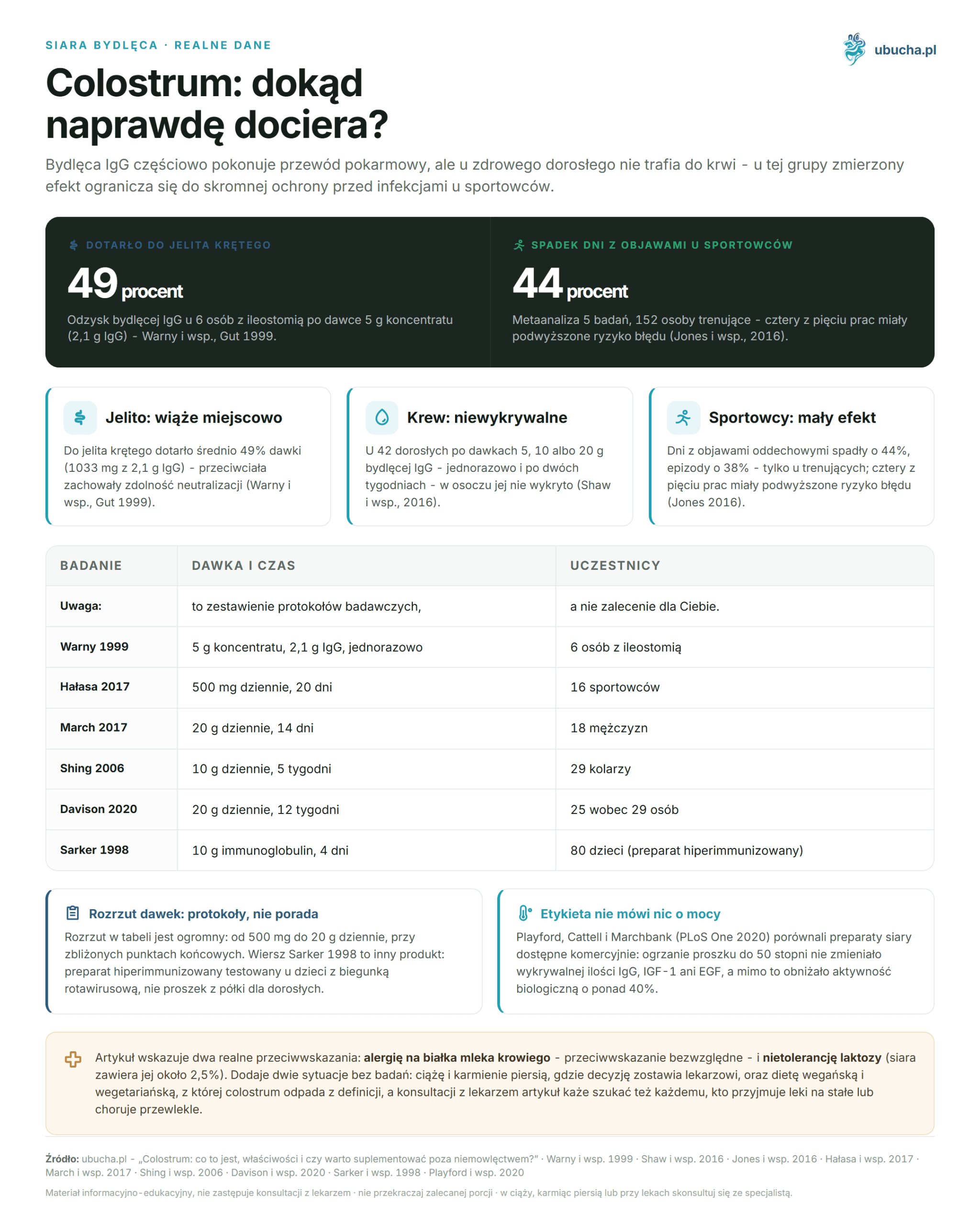
• In 6 individuals with ileostomy, 49% of the administered bovine IgG reached the end of the small intestine (Warny et al., 1999).
• Meta-analysis of 5 studies, 152 training individuals: fewer days with respiratory symptoms (Jones et al., 2016).
• 20 g daily for 12 weeks did not raise IGF-1 in plasma (Davison et al., 2020).
• Contraindications: allergy to cow’s milk proteins and lactose intolerance.
What is colostrum and is human colostrum found in supplements?
Colostrum is the secretion of the mammary gland from the first hours after childbirth. In supplements, there is only bovine colostrum, obtained after calving. No one sells human colostrum in capsules, so observations from feeding newborns with breast milk do not transfer to a preparation for adults.
The difference between the two fluids works both ways. Bovine colostrum has significantly more immunoglobulins than human, as a calf is born without any antibodies from its mother. However, it has about ten times less lactoferrin, as noted by Playford and Weiser in their 2021 review. Citing studies on human colostrum as an argument for cow colostrum capsules is therefore a substitution of subjects.
The composition changes dramatically within the first day. The table compares the concentrations provided by Playford and Weiser for bovine colostrum and for mature cow’s milk.
| Component | Bovine colostrum | Mature milk |
|---|---|---|
| IgG1 (g/l) | 34.0 to 87.0 | 0.31 to 0.40 |
| IgG2 (g/l) | 1.6 to 6.0 | 0.03 to 0.08 |
| IgA (g/l) | 3.2 to 6.2 | 0.04 to 0.06 |
| IgM (g/l) | 3.7 to 6.1 | 0.03 to 0.06 |
| Lactoferrin (g/l) | 1.5 to 5 | 0.02 to 0.75 |
| Lactoperoxidase (mg/l) | 11 to 45 | 13 to 30 |
| Lysozyme (mg/l) | 0.14 to 0.7 | 0.07 to 0.6 |
| Lactose | about 2.5% | 4.7 to 5.0% |
What else does colostrum contain besides immunoglobulins?
Casein, oligosaccharides, antibacterial enzymes, and growth factors, some of which play roles that product descriptions remain silent about. The most interesting is the contribution of components that do not act themselves but protect others.
Casein is a good example here. The review of colostrum composition describes it not only as a source of energy but also as a protein with immunoregulatory and antibacterial properties, while partially protecting epidermal growth factor from digestion and improving the stability and absorption of insulin-like growth factor (Playford and Weiser, Nutrients, 2021). The natural packaging of these molecules is therefore significant, and isolating a single fraction may not yield the same effect.
Oligosaccharides are present in colostrum at about 1 g/L, roughly twice as much as in mature milk. Most of them are not digested in the upper gastrointestinal tract, thus acting prebiotically. Lactose also provides galactose and glucose used in glycogen synthesis.
Enzymes create a separate system of chemical defense. Lysozyme breaks down the cell wall of bacteria, and lactoferrin enhances its action against E. coli. The same work notes that using a formula for infants devoid of lysozyme, instead of one containing this enzyme, was associated with three times more frequent diarrhea.
Do antibodies from colostrum enter the blood and enhance immunity?
No, they do not. Bovine IgG acts in the intestinal lumen, where it binds pathogens and their toxins, but in adults, it does not penetrate the bloodstream. The statement “antibodies from colostrum enhance your immunity” confuses two different phenomena: local neutralization in the gastrointestinal tract and systemic immunity.
How much of it survives the stomach? Warny et al. (Gut 1999) administered 5 g of a concentrate containing 2.1 g of bovine IgG to six volunteers with ileostomy and collected intestinal contents. On average, 1033 mg was recovered, or 49% of the dose, and the antibodies retained their ability to neutralize toxins. Recovery depended on passage time: 68% with a passage shorter than two hours versus 36% with a slower one. Administration with an antacid or omeprazole did not improve anything.
The second part of the answer concerns the blood. Shaw et al. (2016) administered a single dose of 5, 10, or 20 g of bovine immunoglobulin preparation to 42 healthy adults, and then divided doses for two weeks. Bovine IgG was detected in stool. It was not found in plasma in measurable amounts either after a single dose or after two weeks. Thus, half of the dose reaches further than the duodenum but remains in the digestive tube.
What remains of colostrum after passing through the stomach?
More than intuition about protein digestion would suggest, but not enough for anything to reach the blood. A review dedicated to the action of bovine immunoglobulins in humans states that in stool, from very small amounts to 50% of ingested IgG was recovered, with the percentage being higher in infants than in adults due to differences in stomach pH and intestinal conditions (Ulfman, Frontiers in Nutrition, 2018).
The authors draw a conclusion significant for the entire topic: bovine IgG may be active along the entire length of the gastrointestinal tract. It binds many human pathogens and allergens, neutralizes cell infections in experimental conditions, limits inflammation in the intestine, and binds to human Fc receptors, which enhances phagocytosis and antigen presentation. This action is local, not systemic.
Some proteins do not just survive but change into something active. Lactoferricin is formed from lactoferrin as a result of digestion by pepsin in an acidic environment, i.e., in a reaction that occurs naturally in the stomach, and retains the antibacterial activity of the original protein, often stronger (Gifford, Cellular and Molecular Life Sciences, 2005).
The boundary is set by the mature gut barrier. In adults, intestinal permeability limits the passage of these molecules into circulation, which is confirmed by the observation that consuming large amounts of colostrum did not raise IGF-1 levels in plasma in healthy adults (Playford and Weiser, 2021). Everything that colostrum does in an adult occurs in the intestinal lumen.
Does colostrum reduce respiratory infections in athletes?
This is an area where data actually exist, although modest. The meta-analysis by Jones et al. (BMC Sports Science, Medicine and Rehabilitation 2016) included 5 randomized studies and 152 participants, all regularly training, with an observation period of 8 to 12 weeks.
Results: the number of days with upper respiratory symptoms decreased by 44% (rate ratio 0.56, confidence interval 0.43 to 0.72), and the number of episodes by 38% (0.62, interval 0.40 to 0.99). The authors add a caveat that does not appear in advertisements: due to incomplete reporting of methods, four out of five studies were rated as having moderate or high risk of bias.
A frequently cited study by Crooks et al. (International Journal of Sport Nutrition and Exercise Metabolism 2006) measured something else. It involved 35 long-distance runners aged 35 to 58 years, supplementation lasted 12 weeks, and the endpoint was secretory IgA in saliva. It increased by 79%. The authors themselves warn against translating this into health, as the sample was small and the variability of results was large.
We noted when compiling the literature that this work is sometimes cited as evidence of fewer infections. It is not, as infections were not counted in it. The endpoint was the concentration of antibody in saliva, which is a surrogate marker, and the authors themselves advise against translating it into health.
What do studies say about intestinal permeability during exercise?
Let’s start with the terminology. “Leaky gut” is not a clinical diagnosis and has no diagnostic criteria. Studies on colostrum measured surrogate markers: the ratio of lactulose to rhamnose or mannitol, zonulin in stool, and I-FABP protein, released upon damage to enterocytes.
In the work of Marchbank et al. (2011), twelve volunteers took colostrum or placebo for 14 days before standardized exercise that raised internal temperature by an average of 1.4 degrees. In the placebo arm, permeability increased 2.5 times, while with colostrum, the increase was 80% less. March et al. (2017) repeated the observation in 18 men with 20 g daily for 14 days: after exercise, the lactulose to rhamnose ratio and I-FABP concentration were lower than in placebo.
A Polish study by Hałasa et al. (Nutrients 2017) involved 16 athletes and a dose of 500 mg daily for 20 days. After the intervention, results were within normal limits, and the difference from placebo also concerned zonulin in stool. The second model involves anti-inflammatory drugs: Playford et al. (Clinical Science 2001) administered indomethacin to 7 volunteers for 5 days, and in the control arm, permeability increased threefold, while with simultaneous administration of colostrum, it did not increase significantly.
The numbers of participants speak for themselves: 7, 12, 16, and 18 individuals. These are laboratory indicators in very small samples, not treatment of disease.
Does colostrum improve sports performance and body composition?
The effects are modest and mainly appear during periods of high training load. Shing et al. (British Journal of Sports Medicine 2006) divided 29 trained road cyclists into a group taking 10 g of colostrum protein concentrate daily and a whey group.
After five weeks of normal training, the effect on the time for a 40 km ride was deemed unclear. Only after five days of high-intensity training did the colostrum group achieve a 1.9% improvement from baseline and maintained starting heart rate. That is the entire measured effect.
Body composition was studied by Antonio et al. (Nutrition 2001): 20 g daily for 8 weeks in individuals training at least three times a week. The colostrum group increased lean mass without bone by an average of 1.49 kg, while the whey group gained 2.11 kg of body mass. Strength and time to exhaustion did not change in either group. A newer trial by Durkalec-Michalski et al. (European Journal of Sport Science 2025) after 12 weeks in men training for endurance showed support for aerobic capacity but no impact on body composition.
The popular online figure of “plus 1.5 kg of lean mass in cyclists” combines two different studies. The gain comes from Antonio et al., while the cyclists are from Shing et al.
Does colostrum raise IGF-1 and is it a problem for athletes?
In studies, it does not raise. The question is valid, as the World Anti-Doping Agency advises athletes against colostrum precisely due to concerns about increased IGF-1, and there is also a question about long-term safety.
This was checked by Davison, Jones, Marchbank, and Playford (European Journal of Nutrition 2020) in three protocols. The first: 40 g of colostrum once in 16 healthy men with moderate exercise for 4.5 hours. The second: 20 g daily for 4 weeks, with 10 people per arm. The third: 20 g daily for 12 weeks, with 25 on colostrum and 29 on placebo. The baseline IGF-1 concentration was 130 ng/ml and did not differ between groups after intervention in any protocol.
Earlier Finnish studies reported an increase in IGF-1 in serum after colostrum, but the same group provided an explanation. In the second part of the study Mero et al. (Journal of Applied Physiology 2002) orally administered isotopically labeled recombinant human IGF-1 and after an hour found mainly fragments weighing 0.6 kDa, accounting for 96% of radioactivity. The authors’ conclusion was clear: the data do not support the absorption of IGF-1 from bovine colostrum. The hormonal panic surrounding this component has no basis in measurements.
How does lactoferrin differ from colostrum in studies?
These are two different interventions, and the results of one should not be attributed to the other. Lactoferrin is a single iron-binding protein, studied in isolated form in doses of hundreds of milligrams. Colostrum is a matrix in which lactoferrin is only one of the components.
The scale is important here. In bovine colostrum, there is 1.5 to 5 g per liter, which is about one-tenth the concentration of human colostrum (Playford and Weiser, 2021). Powder manufacturers rarely declare its content, so you cannot read from the label whether the portion approaches the doses studied separately.
How does lactoferrin itself perform? In a randomized study Oda et al. (Nutrients 2023) assigned 157 healthy adults to bovine lactoferrin at a dose of 200 mg daily or to placebo for 12 weeks, and 145 individuals were analyzed. Overall results of respiratory and systemic symptoms were lower in the lactoferrin group, and the researchers also noted higher expression of activation markers on plasmacytoid dendritic cells. This is an interesting signal for the isolated protein. It is not evidence that colostrum powder does the same, and labels combining both components should be read accordingly.
What is known about colostrum in infectious diarrhea?
The strongest data in this area come from hyperimmunized preparations, i.e., from cows deliberately vaccinated against a specific pathogen. This is not the same product as the powder from the shelf, although both are called colostrum.
In a study by Sarker et al. (Pediatric Infectious Disease Journal 1998), eighty children with rotavirus diarrhea received 10 g of immunoglobulins isolated from colostrum of cows immunized against four serotypes of rotavirus for 4 days, including 3.6 g of specific antibodies. The volume and frequency of stools were lower, the need for rehydration fluids was lower, and the virus disappeared from stool on average in 1.5 days compared to 2.9 days on placebo. A similar scheme was used by Mitra et al. (Acta Paediatrica 1995), also in rotavirus diarrhea in children.
The third group includes patients with severe immune deficiency. Rump et al. (Clinical Investigator 1992) used immunoglobulins from bovine colostrum in HIV-infected patients with chronic diarrhea. All these works concern the treatment of ongoing infections in individuals at increased risk, conducted with a preparation of known antibody titer. Transferring them to prevention in healthy adults is an abuse.
Who should not use colostrum?
Two contraindications are real and common. The first is allergy to cow’s milk proteins: colostrum contains casein and beta-lactoglobulin, indicated in the literature as the main immunogen for individuals allergic to cow’s milk. A colostrum preparation is not safer than milk in this regard.
The second is lactose intolerance. Colostrum contains about 2.5% lactose, which is less than mature milk, but with portions of several grams, as used in sports studies, the lactose load ceases to be symbolic. Some manufacturers remove lactose during processing, and such information should be on the packaging.
There are situations without data. Pregnancy and breastfeeding have not been the subject of studies on colostrum supplementation, so the decision should be left to the doctor. For vegans and vegetarians avoiding animal products, colostrum is out of the question by definition.
A separate group includes individuals whose intestinal permeability is increased due to disease. The authors of the composition review caution that in such conditions, systemic absorption of growth factors from colostrum could be significant, although no one has studied this (Playford and Weiser, 2021). In the case of active inflammatory bowel disease, it is wiser to establish a course of action with a gastroenterologist than to transfer results obtained in healthy runners to oneself.
Why do two packages of colostrum work differently?
Because they differ in biological activity, not just declaration on the label. This is the most practical finding in the entire topic and at the same time one that no label reveals.
Twenty commercial colostrum preparations intended for humans were tested, assessing their ability to stimulate division and migration of intestinal epithelial cells. Differences between products reached six times and are so large that they hinder comparing results of clinical studies conducted on different preparations. The comparison of the most and least active preparation translated into results in an animal model: gastric damage decreased by 86% with the most active sample versus 48% with the weakest (Playford, PLoS One, 2020).
The authors of this work pointed out two probable causes of discrepancies. The first is heat treatment, routine in production: the standard process includes pasteurization, usually about 15 seconds at 72 degrees Celsius, and then drying to powder (Playford and Weiser, 2021). How much activity is lost during the heating of the powder is shown in the section on preparation and storage. The second cause is the contribution of the first milkings: activity was high in the first and second milkings on the day of calving, and by the third day, it dropped by 77%.
This leads to a conclusion that undermines the most commonly used purchasing criterion. The declared percentage of immunoglobulins does not indicate the activity of the preparation, as the protein may be present and detectable by immunological testing while being devoid of action. The authors themselves propose assessing biological activity as a better method of quality control than measuring concentrations of growth factors.
Powder or capsules?
Powder, if you care about amounts comparable to those in studies. The calculation is simple, and it decides, not the convenience of form.
A capsule holds a fraction of a gram of powder, as that is how much fits into a typical shell. With a capacity of about half a gram, a research protocol of 20 g daily would mean forty capsules a day, and with one gram, twenty. No one will regularly take that, and lozenges and liquid forms hold even less. Powder allows you to measure any amount, at the cost of the characteristic taste of colostrum. Check the weight on the packaging before converting anything into days of use.
This does not mean that capsules are useless. At doses of around a gram daily, aimed at local action in the intestine, the form does not matter much, and convenience increases the chance that supplementation will last longer than a week. The only important thing is not to confuse it with the research protocol and not to expect the same results from it. You can find such preparations in the supplements category.
When choosing, pay attention to three pieces of information: the country of origin of the raw material, the drying method, and whether the manufacturer even states the thermal processing conditions. The last point is the least often fulfilled, and it means the most for the activity of the powder.
How to prepare and store colostrum?
In lukewarm water, never in hot, and in a closed package away from moisture. The recommendation to avoid boiling water has circulated in product descriptions for years, but only measuring biological activity shows how low the threshold is.
Heating the powder to 50 degrees Celsius for an hour reduced biological activity by over 40%, even though immunological measurements did not show a loss of the proteins themselves (Playford, PLoS One, 2020). Pouring a portion into hot tea or coffee means a temperature clearly higher than in this experiment. Room temperature water, cold plant milk, yogurt, or a smoothie after cooling are safe variants.
The powder itself is hygroscopic, so close the package after each use and keep it in a dry place, without exposure to sunlight. Do not transfer the supply to a transparent jar standing on the counter next to the stove. Keep the scoop dry, as a wet one clumps the rest of the contents.
The time of day has no confirmed significance. The popular advice to take it on an empty stomach thirty minutes before a meal has no support in studies with humans, and in the cited protocols, participants took the preparation in various schemes. Regularity is more important here than the hour.
What doses and times were used in studies?
The table below collects what was actually administered to participants in the works cited in this article. This is a summary of research protocols, not a recommendation for you. The range is huge: from 500 mg to 20 g daily, with similar endpoints.
| Study | Dose | Time | Participants |
|---|---|---|---|
| Warny 1999 | 5 g concentrate, 2.1 g IgG | once | 6 individuals with ileostomy |
| Hałasa 2017 | 500 mg daily | 20 days | 16 athletes |
| March 2017 | 20 g daily | 14 days | 18 men |
| Shing 2006 | 10 g daily | 5 weeks | 29 cyclists |
| Antonio 2001 | 20 g daily | 8 weeks | active adults |
| Davison 2020 | 20 g daily | 12 weeks | 25 vs 29 individuals |
| Sarker 1998 | 10 g immunoglobulins daily | 4 days | 80 children |
| Oda 2023 (lactoferrin) | 200 mg daily | 12 weeks | 145 adults |
From our observations of this market, it appears that labels are silent on two things precisely described in studies: the content of IgG in dry mass and the time from calving when the raw material was collected. Without these numbers, comparing the price per gram says nothing. When rebuilding the intestines after antibiotic therapy, a comparison with the entry on supplements after antibiotics is useful, and when training loads are concerned, a comparison with L-glutamine is beneficial.
Frequently Asked Questions
Do you have to take colostrum on an empty stomach?
None of the discussed studies compared the timing of intake. An indirect hint is given by the work of Warny et al. (Gut 1999): recovery of bovine IgG was higher in individuals with a shorter passage to the ileum, 68% vs 36%. Antacid or omeprazole did not improve recovery.
Is colostrum safe with lactose intolerance?
Bovine colostrum contains lactose, about 2.5% according to the review by Playford and Weiser (2021), which is less than mature milk. Small portions may be tolerated, but several grams of powder daily can cause bloating and loose stools. Allergy to cow’s milk proteins is an absolute contraindication.
Does colostrum heal leaky gut?
No, because leaky gut is not a clinical diagnosis. Studies measured surrogate markers: the ratio of lactulose to rhamnose, zonulin in stool, and I-FABP protein. Trials ranged from 7 to 18 participants and concerned barriers burdened by exercise or anti-inflammatory drugs.
Does colostrum raise IGF-1 in the blood?
In the study by Davison et al. (European Journal of Nutrition 2020) it did not raise. 40 g was checked once in 16 men, 20 g daily for 4 weeks, and 20 g daily for 12 weeks. In no protocol did the plasma concentration differ from placebo.
How does colostrum differ from lactoferrin in capsules?
Lactoferrin is a single protein, colostrum is a whole matrix. In bovine colostrum, there is 1.5 to 5 g per liter, about one-tenth the concentration of human colostrum. Results of studies on isolated lactoferrin are not evidence of the action of colostrum powder.
Will colostrum help someone who does not train?
It is unknown, as no one has properly checked this. The meta-analysis by Jones et al. (2016) included 5 studies and 152 participants, all regularly training. Studies on gut barrier were also conducted in athletes. There is a lack of data for a less active person.
Bovine colostrum and other immune support can be found in the supplements category.
This article is for informational and educational purposes and does not constitute medical advice. Before starting supplementation, consult your doctor, especially if you are taking medications regularly, are pregnant or breastfeeding, or have a chronic illness.
Author: Michał Waluk · Published: 2026-06-15 · Updated: 2026-09-22